
If you run a health plan, a CMS business partner, or any organization that connects to CMS systems or handles CMS-controlled data, at some point you will be asked to prove your security controls actually work. The Information Security Assessment Program (ISAP) is CMS's mechanism for that proof, and version 2.0 tightened both the scope of what gets tested and the quality of evidence a third-party evaluator has to produce. I have run more than 200 security assessments across 14 countries since 2013, many of them against exactly this kind of government-driven, NIST-based control set, and the pattern is always the same: organizations that treat the assessment as a document-collection exercise struggle, and organizations that treat it as a real test of their defenses pass cleanly.
This guide walks through what a CMS ISAP v2.0 assessment involves, how to prepare for it, how to choose a third-party evaluator who will actually help you rather than just hand you a PDF, and the specific mistakes that turn a routine assessment into a scramble. I am going to be direct about what matters and skip the marketing.
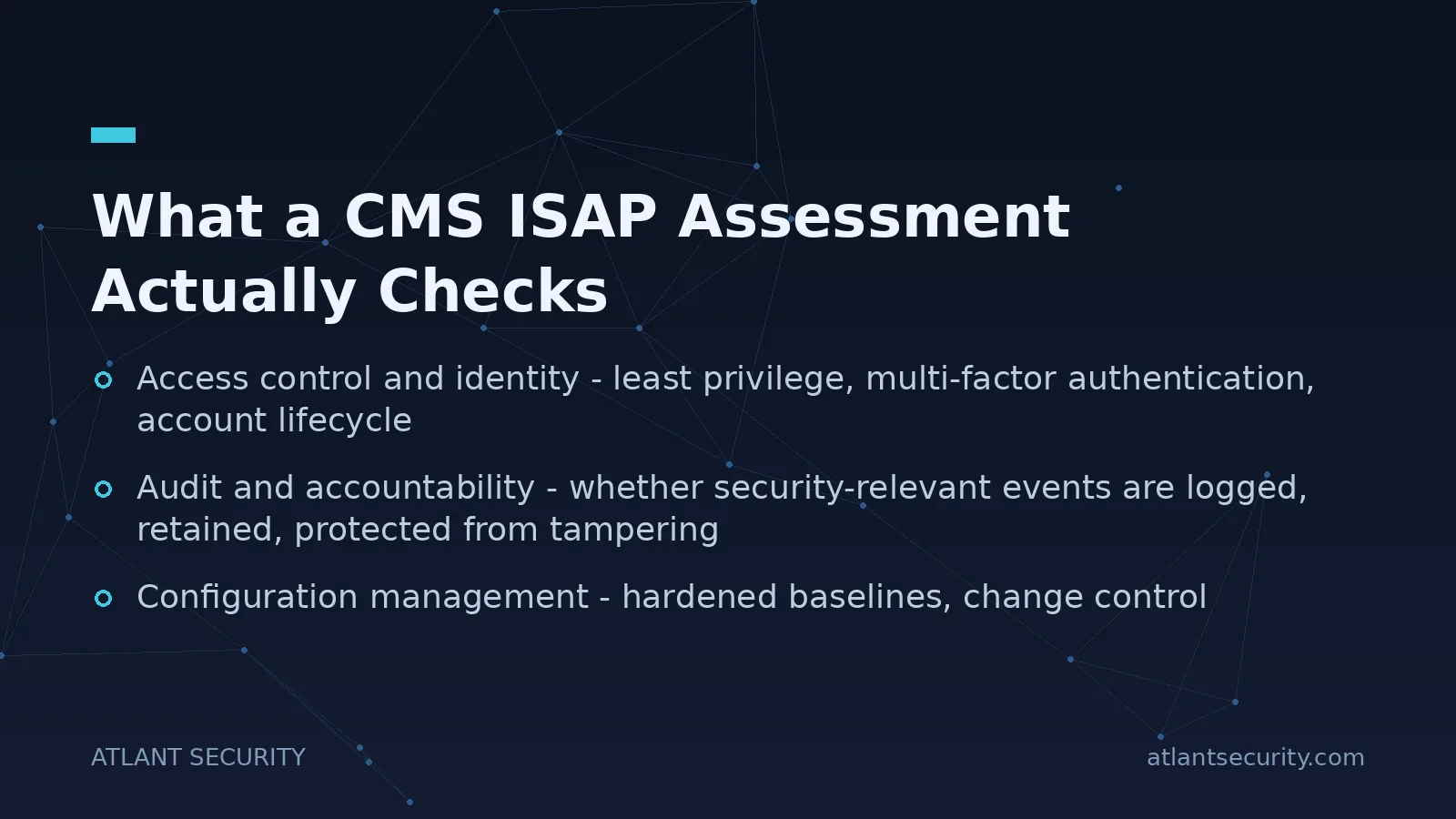
What a CMS ISAP Assessment Actually Checks
CMS security expectations are built on the Acceptable Risk Safeguards (ARS), which are themselves a tailoring of the NIST SP 800-53 control catalog for the healthcare and federal data context. An ISAP engagement exists to independently verify that the controls you claim to have implemented are present, configured correctly, and effective under realistic conditions. In practice that means an evaluator will look across several control families:
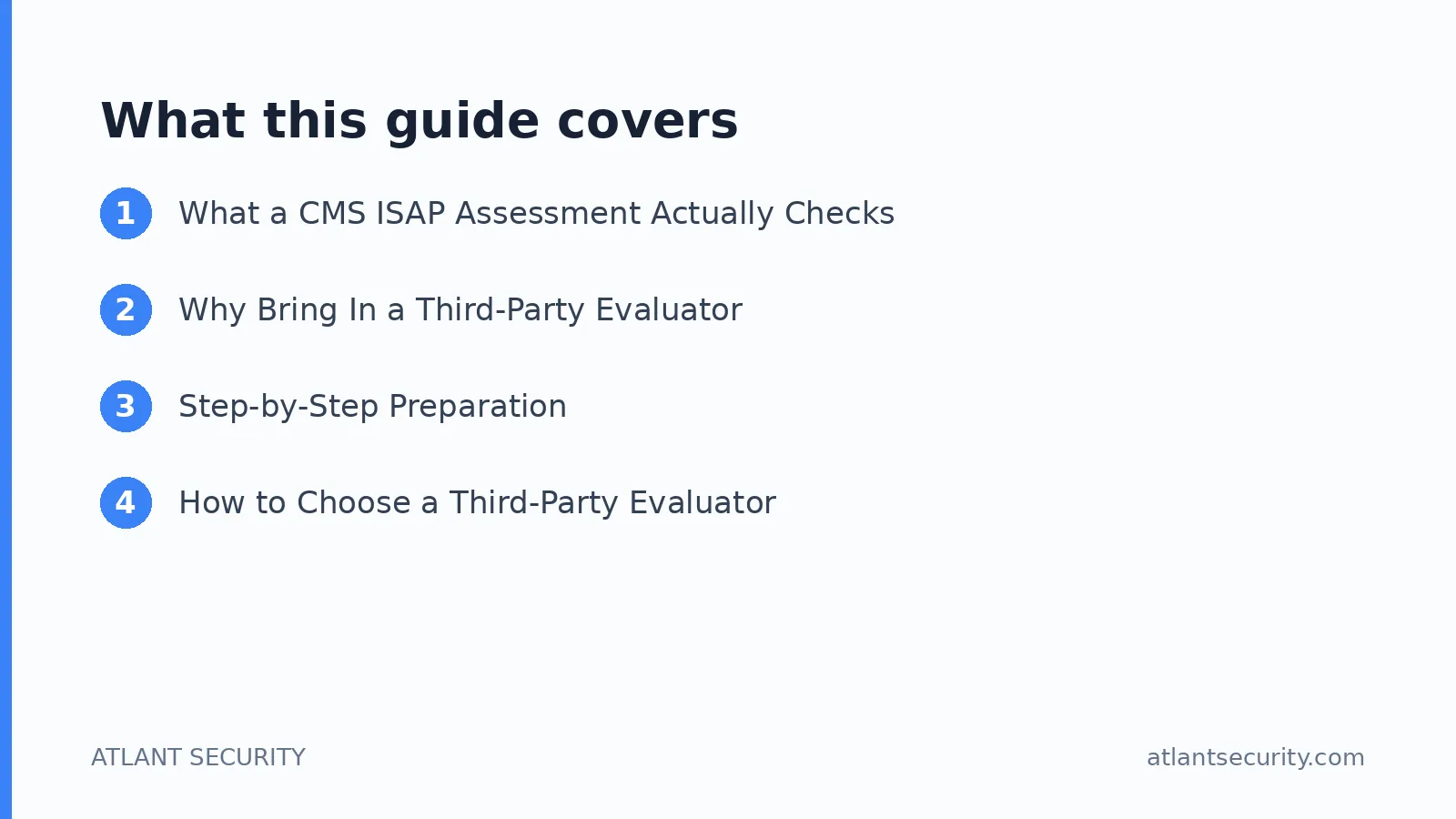
- Access control and identity - least privilege, multi-factor authentication, account lifecycle, privileged access management, and separation of duties.
- Audit and accountability - whether security-relevant events are logged, retained, protected from tampering, and actually reviewed.
- Configuration management - hardened baselines, change control, and drift detection on the systems that touch protected data.
- Contingency and incident response - documented plans that have been tested, not plans that live only in a policy binder.
- System and communications protection - encryption in transit and at rest, network segmentation, and boundary defenses.
- Risk assessment and continuous monitoring - evidence that you find and fix weaknesses on an ongoing basis rather than once a year.
The v2.0 refresh puts more weight on evidence quality and on testing effectiveness rather than mere existence. A policy that says you require MFA is not evidence. A configuration export showing MFA enforced on every privileged account, plus a test that confirms a login without a second factor is rejected, is evidence. This shift is the single most important thing to internalize before you start.
Why Bring In a Third-Party Evaluator
You can and should run internal self-assessments, but CMS-facing programs generally expect an independent assessment because independence is what gives the result credibility. A qualified external evaluator adds value in ways an internal team usually cannot:
- They test, they do not just interview. A good evaluator will attempt to bypass your controls the way an attacker would, then document what worked and what did not.
- They map cleanly. Findings should trace from the ISAP/ARS control, to the NIST 800-53 control it derives from, to the HIPAA Security Rule requirement it supports, so a single body of evidence serves multiple compliance obligations. If you are also carrying HIPAA obligations, our HIPAA compliance work is built to reuse the same evidence.
- They give you defensible artifacts. The output should survive review by a CMS assessor and by your own auditors, with raw test logs behind every executive-level statement.
- They see your blind spots. Teams that built a system rarely attack it well, because they unconsciously avoid the paths they know are fragile.
The value is not the badge at the end. The value is a prioritized, tested understanding of where you are actually exposed.
Step-by-Step Preparation
Here is the sequence I use with clients preparing for a NIST-based government assessment. Follow it in order and the assessment itself becomes anticlimactic, which is exactly what you want.
1. Fix your scope before anyone else defines it for you
Catalog every system that stores, processes, or transmits CMS-controlled or protected health data. Draw the real data flow: where it enters, where it rests, which APIs move it, which vendors touch it. An unclear boundary is the most common cause of a painful assessment, because everything downstream inherits that ambiguity.
2. Assemble your documentation set
Pull together your System Security Plan or equivalent, your access control policy, incident response plan, configuration standards, vulnerability management procedure, and vendor inventory. If a control has no documented owner and procedure, treat that as a finding you can close now rather than one an evaluator raises later.
3. Run an honest internal gap analysis
Score each in-scope control as implemented, partially implemented, or not implemented, and be ruthless about it. Partially implemented is not implemented. This is where a structured IT security audit pays for itself, because it surfaces the gaps while you still have time to remediate quietly.
4. Remediate the high-risk gaps first
Prioritize by real risk, not by ease. Missing MFA on privileged accounts, flat networks with no segmentation around sensitive data, and unmonitored logging are the findings that draw the most scrutiny and cause the most damage in a real breach. Close those before the evaluator arrives.
5. Select your evaluator carefully
Issue a specific request for proposal. Ask for redacted sample deliverables, the resumes of the people who will actually do the testing (not the sales team), and a description of their testing methodology. I cover selection criteria in detail below.
6. Support the assessment properly
Provide just-in-time access, keep a dedicated point of contact available, and respond to information requests quickly. Assessments stall when the evaluator waits days for a credential or a config export. A tight feedback loop shortens the whole engagement.
7. Validate remediation before you submit
Every high-risk finding you fix should be re-tested and the closure evidence documented. Unverified remediation is how organizations end up failing on a control they thought they had closed.
How to Choose a Third-Party Evaluator
Ignore star ratings and vendor leaderboards, including anyone who ranks themselves at the top of one. Judge an evaluator on things you can verify:
| What to check | What good looks like | Warning sign |
|---|---|---|
| Relevant experience | Prior NIST 800-53 / ARS assessments in healthcare or government data contexts | Generic "we do all frameworks" with no specifics |
| Who does the work | Named, certified testers (CISSP, OSCP, CISA) on the engagement | Senior names in the pitch, juniors on the job |
| Methodology | Written test plans that describe how each control is exercised | Questionnaire-only "assessments" |
| Deliverables | Executive summary plus raw evidence and reproduction steps | A rating sheet with no supporting logs |
| Independence | No conflict with the tools or vendors they recommend | Assessment bundled with product sales |
Always ask for anonymized sample reports and at least a couple of reference calls. A logo wall proves a marketing budget, not competence. And be skeptical of anyone who promises a guaranteed pass before they have seen your environment, because a real assessment can only tell you the truth about what you have built.
The Mistakes That Cost People
Across the government-adjacent assessments I have run, the same avoidable failures recur:

- Treating the assessment as paperwork. Controls must function under attack conditions. A control that exists on paper but fails when tested is worse than no control, because it creates false confidence.
- Scoping too broadly or too vaguely. Insist on healthcare- and CMS-specific scoping so the effort lands where the risk is.
- Ignoring the human layer. Phishing and social engineering remain the most reliable initial access vectors. If your assessment does not include them, it is incomplete. This is where realistic penetration testing earns its keep.
- Relying only on automated scans. Scanners are necessary but blind to business logic, process gaps, and physical exposure. Pair them with manual testing and a proper vulnerability assessment.
- Skipping validation. Fixes that are never re-tested are assumptions, not remediation.
After You Pass: Staying Ready
An ISAP result is a snapshot. Controls drift, staff turn over, and new systems get connected. The organizations that never scramble at audit time are the ones that treat readiness as continuous:
- Continuous monitoring. Use SIEM and alerting to catch configuration drift and anomalous access as it happens.
- Periodic control review. Refresh policies and re-test key controls on a schedule aligned with CMS guidance changes, not just before the next assessment.
- Ongoing awareness training. Run phishing simulations and incident response drills regularly, because the human layer degrades fastest.
- Vendor assurance. Cascade your control requirements to the suppliers who touch CMS data, and verify rather than trust.
- Metrics that matter. Track mean time to remediate and control maturity so you can show trend, not just a point-in-time pass.
For organizations that do not have a full-time security leader to own this, an outsourced or virtual CISO can carry the continuous-readiness workload between formal assessments.
Frequently Asked Questions
What is CMS ISAP v2.0?
ISAP is CMS's Information Security Assessment Program, the process by which organizations that handle CMS-controlled data have their security controls independently verified. The controls are based on the CMS Acceptable Risk Safeguards, which tailor the NIST SP 800-53 catalog. The v2.0 revision places more emphasis on the quality of evidence and on demonstrated effectiveness of controls rather than their mere documented existence.
Do I have to use an external assessor?
Independent assessment is the norm for CMS-facing programs because independence is what makes the result credible to CMS and to your own auditors. You should still run internal self-assessments continuously, but the formal result generally needs to come from a qualified third party with no stake in hiding problems.
How long does an ISAP assessment take?
It depends entirely on scope, the number of in-scope systems, and how prepared you are. A tightly scoped environment with clean documentation and remediated high-risk gaps moves quickly. A broad, poorly documented environment with unaddressed findings can take much longer because most of the time gets spent chasing evidence rather than testing controls. Preparation is the biggest single lever on duration.
How does ISAP relate to HIPAA?
They overlap heavily. Because both trace back to recognized security control principles, a single well-built body of evidence can satisfy ISAP/ARS controls and the corresponding HIPAA Security Rule requirements at the same time. A good evaluator maps findings across both so you are not paying to prove the same control twice.
What is the most common reason organizations struggle with the assessment?
Confusing documentation with evidence. A policy stating a control exists is not proof the control works. The organizations that pass cleanly are the ones that can show a control configured, enforced, logged, and tested, with artifacts to back each claim.
What should I do first if an assessment is coming?
Lock down your scope and run an honest internal gap analysis before you engage anyone externally. Knowing exactly what is in scope and where your real weaknesses are lets you remediate the high-risk items quietly and turns the formal assessment into a confirmation rather than a discovery exercise.
Preparing for a CMS ISAP assessment? I help organizations scope, remediate, and pass NIST-based assessments without the last-minute scramble, drawing on 200+ assessments across 14 countries. Book a free strategy call and get a fixed-price proposal within 24 hours.
