
SOC 2 is the credential most SaaS buyers ask for before they will trust you with their data, and it is also where companies waste the most money. The waste almost always comes from one decision made badly: who you bring in to help. Hire the wrong kind of expert and you pay for a template dump, a rushed audit, and controls that look good on paper but fall apart the first time a customer asks a hard question. Hire the right one and SOC 2 becomes a repeatable programme that shortens sales cycles for years. Having guided many companies through this, here is how to hire for SOC 2 implementation without getting burned.
Understand what SOC 2 actually requires before you hire
You cannot evaluate an expert if you do not understand the work. SOC 2 is an attestation performed by a licensed CPA firm against the AICPA Trust Services Criteria. There are two report types and five criteria, and the choices you make here determine who you need.
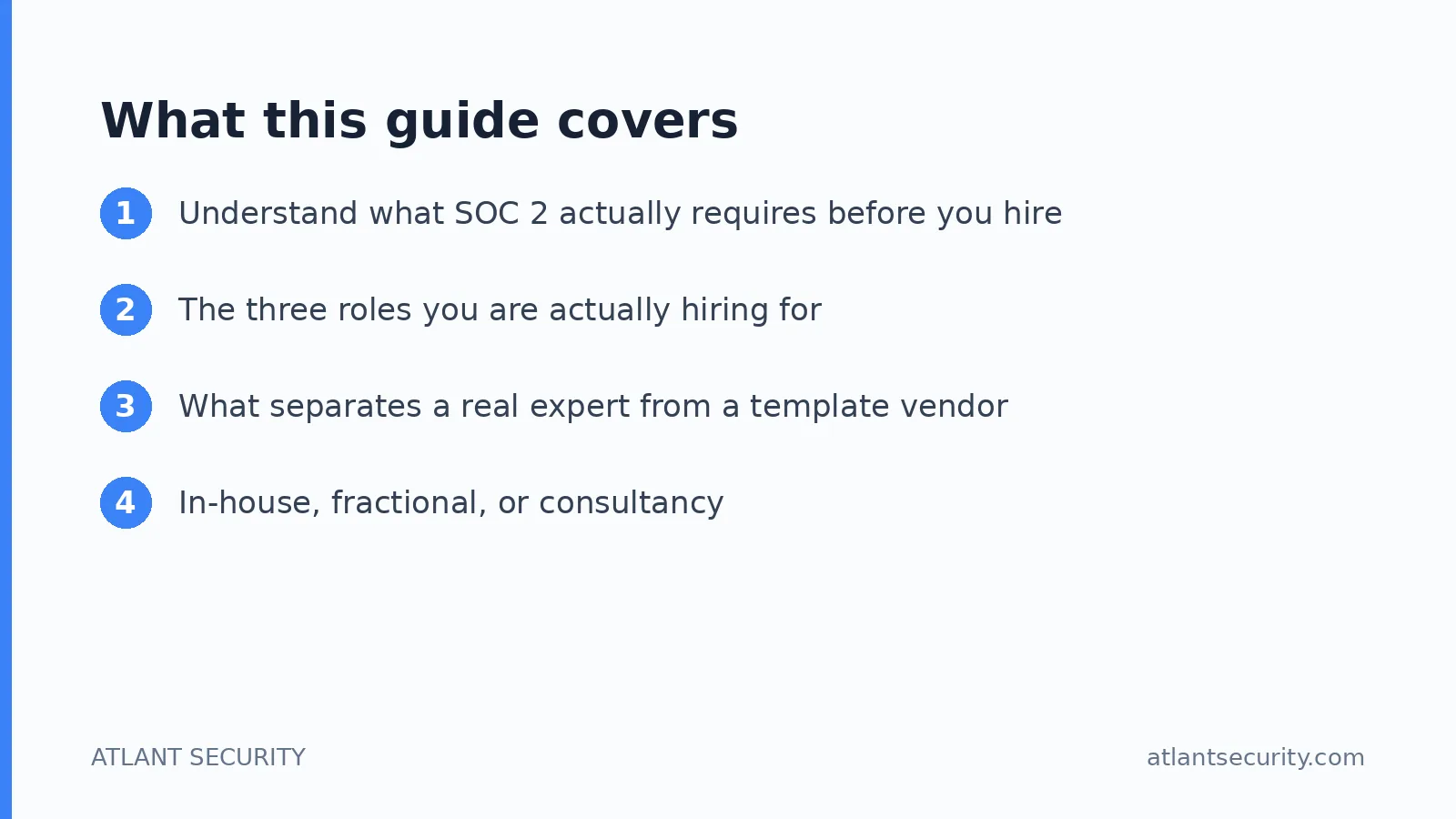
- Type I assesses whether your controls are designed appropriately at a single point in time. It is faster and useful as a first milestone.
- Type II assesses whether those controls operated effectively over a period, typically three to twelve months. This is what serious enterprise buyers want.
The five Trust Services Criteria are Security (always required), Availability, Processing Integrity, Confidentiality, and Privacy. You choose which apply based on what you promise customers. A crucial point people miss: the CPA firm that issues your report cannot also implement your controls for you. That independence requirement is exactly why you hire a separate readiness partner to do the implementation. Understanding this split is the foundation of hiring well.
The three roles you are actually hiring for
"SOC 2 expert" is a vague term that hides three genuinely different jobs. Confusing them is the root cause of most bad engagements.
| Role | What they do | What they cannot do |
|---|---|---|
| Readiness / implementation consultant | Assess gaps, design and help implement controls, prepare evidence and documentation | Issue the audit report |
| CPA audit firm | Independently examine controls and issue the SOC 2 report | Implement your controls (independence rule) |
| Compliance automation platform | Automate evidence collection and monitoring via integrations | Make judgement calls, design controls for your context, or replace expertise |
You will likely use all three, but they are not interchangeable. The platform automates collection; it does not tell you which controls fit your architecture or how to fix a failing one. The auditor judges; they do not build. The readiness consultant is the one who owns getting you audit-ready, and this is the hire that most determines whether the project succeeds. Our SOC 2 readiness work is precisely this role.
What separates a real expert from a template vendor
The market is full of people who will sell you a folder of policy templates and call it SOC 2. Templates are not controls. Here is what genuine expertise looks like, and the questions that expose the difference.
They start with your architecture, not a checklist
A real expert asks how your platform is built, where data flows, which cloud services you use, and how your team ships code, before they mention a single control. If someone hands you a control list before understanding your environment, they are selling a template. Ask: "How will you tailor the control set to how we actually run?"
They scope Trust Services Criteria to your reality
Adding Privacy or Processing Integrity when your customers do not require them inflates cost and audit scope for no benefit. A strong consultant pushes back on over-scoping. Ask: "Which criteria should we include and why, given what we promise customers?"
They build controls your team can sustain
A control that requires heroics to maintain will fail during the Type II observation window, and a failed control in your report is worse than not having it. Experts design controls that fit your operating rhythm. Ask: "How do you make sure these controls still work in month six?"
They know the auditors and the evidence bar
Someone who has been through many audits knows what evidence auditors accept and where they push back. That knowledge prevents the expensive back-and-forth that stretches a three-month project into nine. Ask: "What evidence do auditors most often reject, and how do you prevent that?"
They are honest about timelines
Anyone promising a Type II report in a few weeks is either misunderstanding the scheme or misleading you. Type II requires an observation period. Honesty about this is a strong signal of competence.
In-house, fractional, or consultancy
There are three ways to get the expertise, and the right one depends on your stage and how often you will face compliance work.
| Model | Best for | Trade-off |
|---|---|---|
| Full-time in-house hire | Larger companies with ongoing, multi-framework compliance needs | Expensive and slow to recruit; overkill for a first SOC 2 |
| Fractional / virtual CISO | Growing SaaS that needs senior ownership without a full-time cost | Requires a partner who genuinely integrates with your team |
| Project consultancy | One-off readiness push toward a specific audit deadline | Knowledge can walk out the door if not documented and transferred |
For most SaaS companies doing their first SOC 2, a fractional model gives the best balance: senior expertise that owns the programme, integrates with engineering, and stays to handle the audit and the customer security reviews that follow. Our virtual CISO services and part-time CISO engagements are built for exactly this, and for financial services specifically we offer a fintech virtual CISO with sector context.
A hiring process that surfaces real expertise
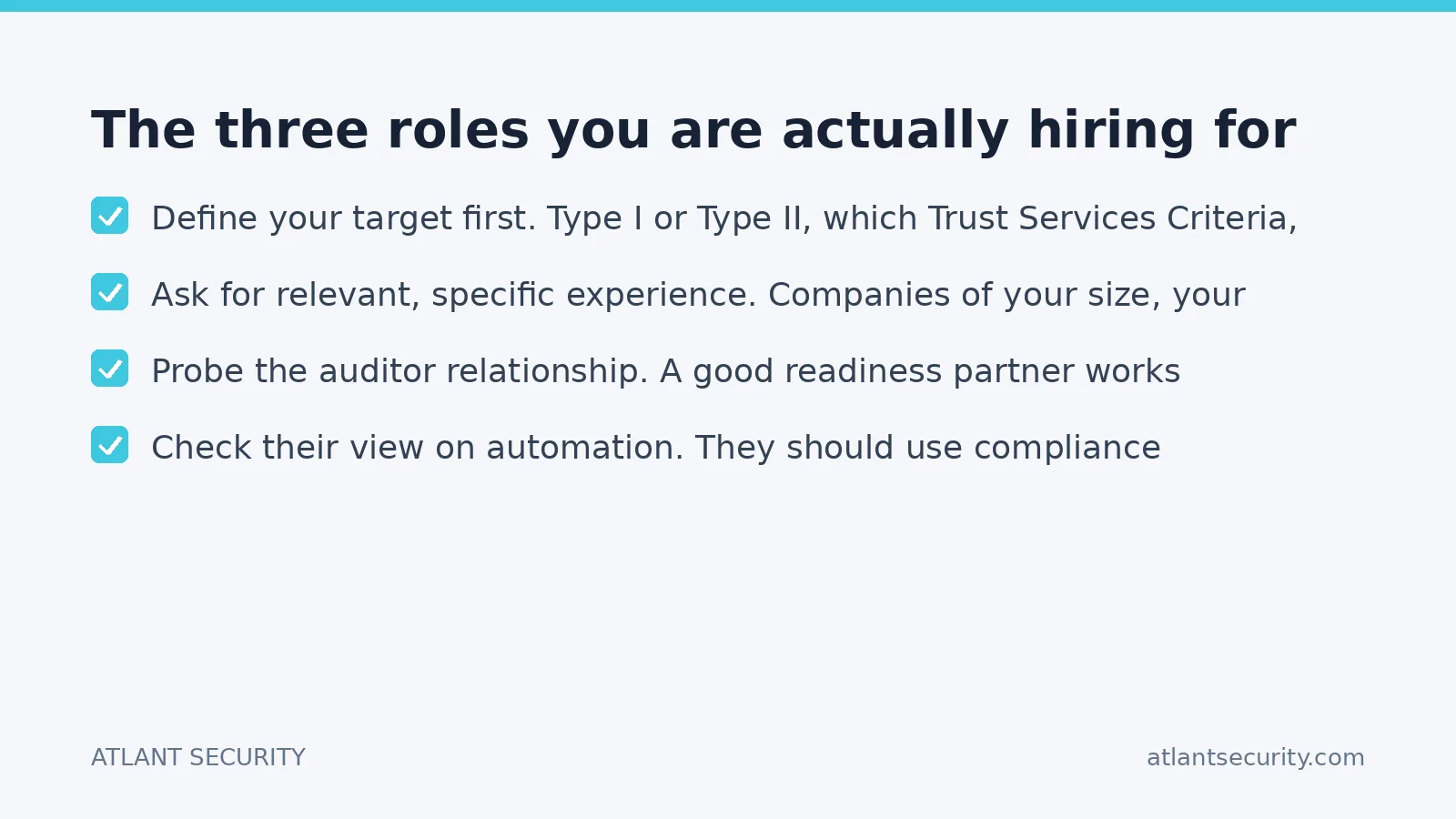
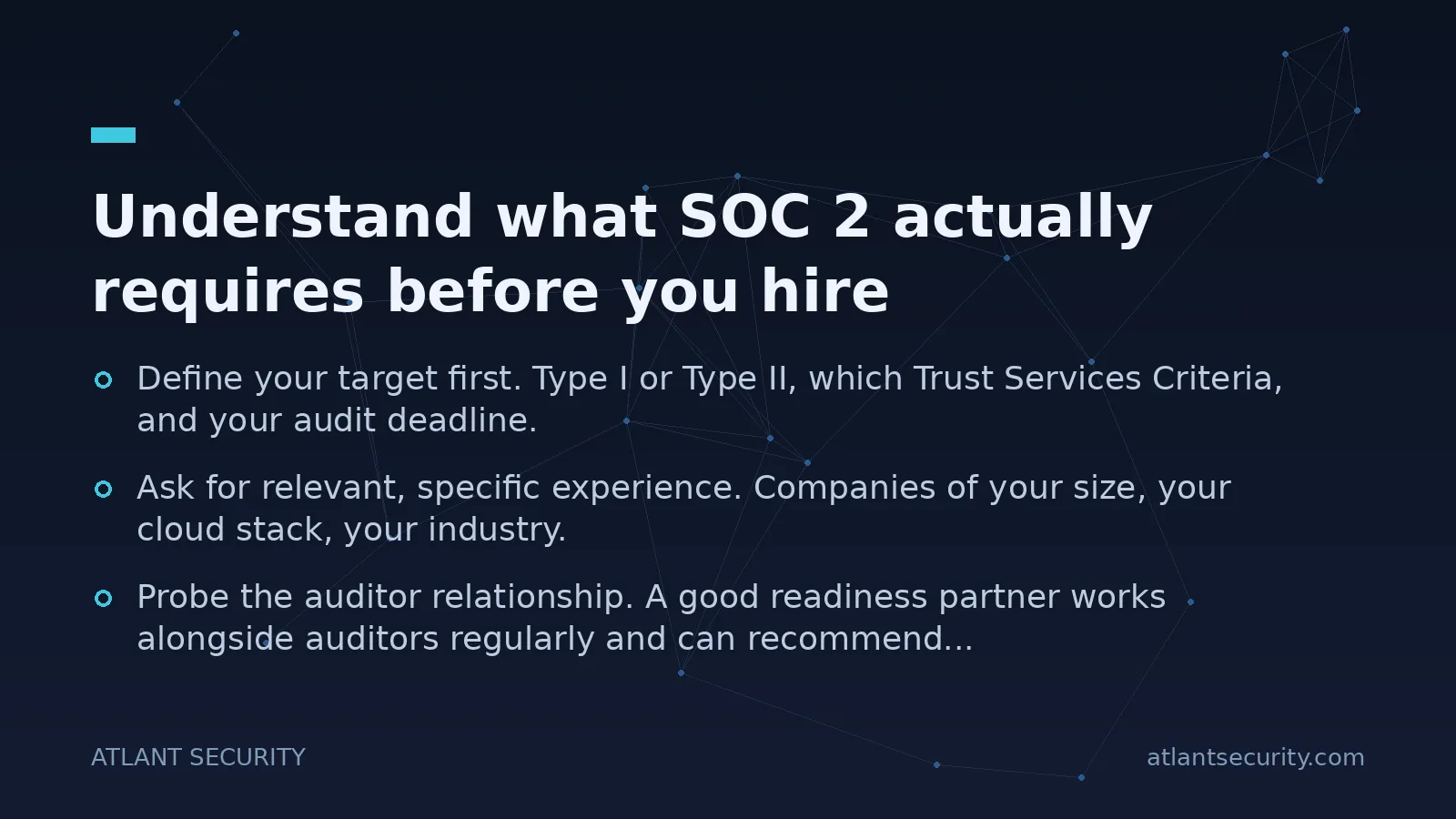
- Define your target first. Type I or Type II, which Trust Services Criteria, and your audit deadline. This lets you evaluate candidates against a concrete goal.
- Ask for relevant, specific experience. Companies of your size, your cloud stack, your industry. Generic "we have done SOC 2" is not enough.
- Give them a real scenario. Describe your architecture and ask how they would approach scoping and the first three controls they would prioritise. Their answer reveals whether they think or template.
- Probe the auditor relationship. A good readiness partner works alongside auditors regularly and can recommend firms without compromising independence.
- Confirm knowledge transfer. Ask how they document controls and hand over so you can maintain and recertify without them. If the answer is vague, you will be dependent on them forever.
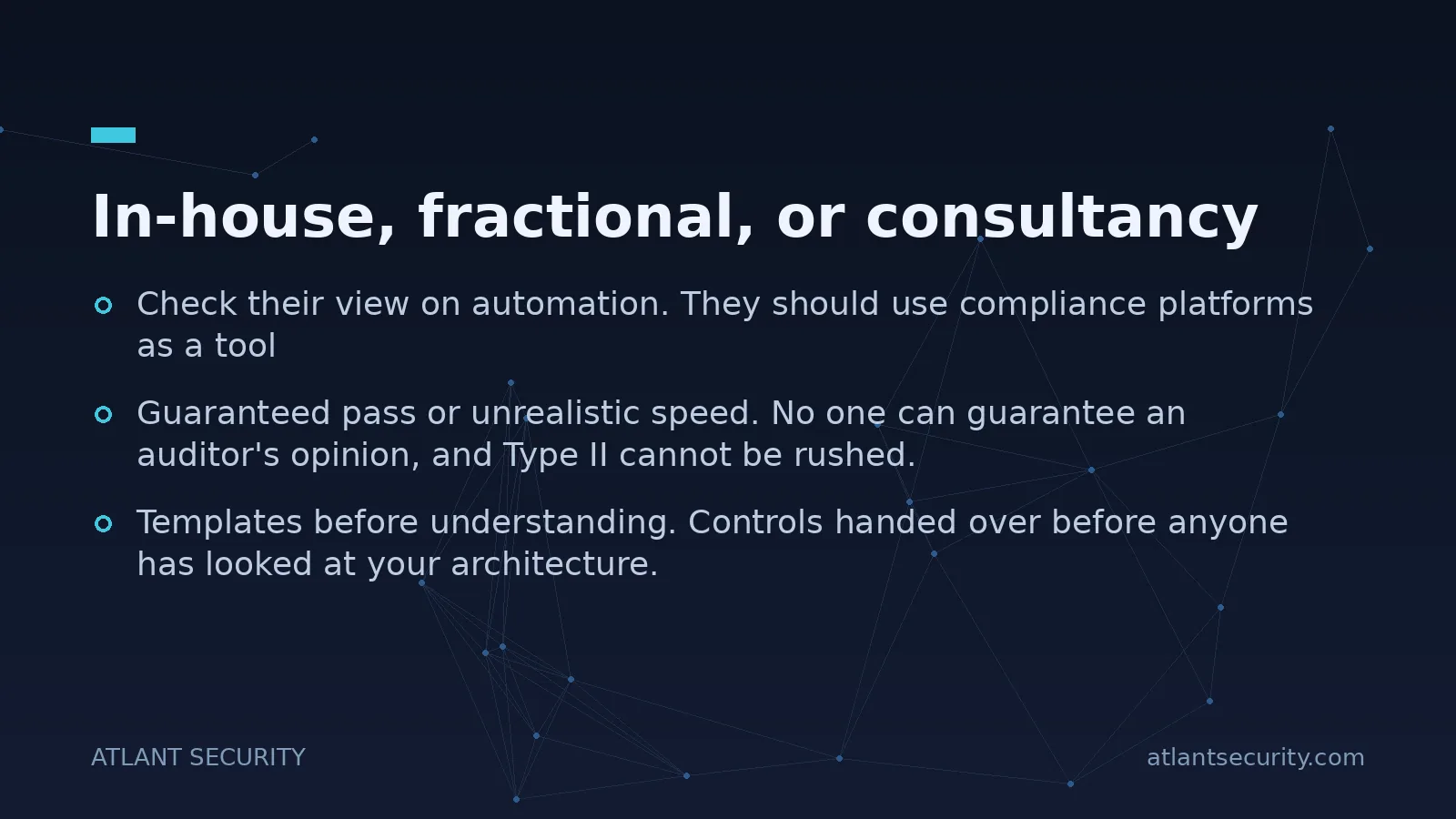
- Check their view on automation. They should use compliance platforms as a tool, not sell them as a substitute for judgement.
Before you even hire, an independent IT security audit or gap assessment gives you a clear picture of the work ahead, which in turn makes it far easier to judge whether a candidate's proposal is realistic or inflated.
Red flags to walk away from
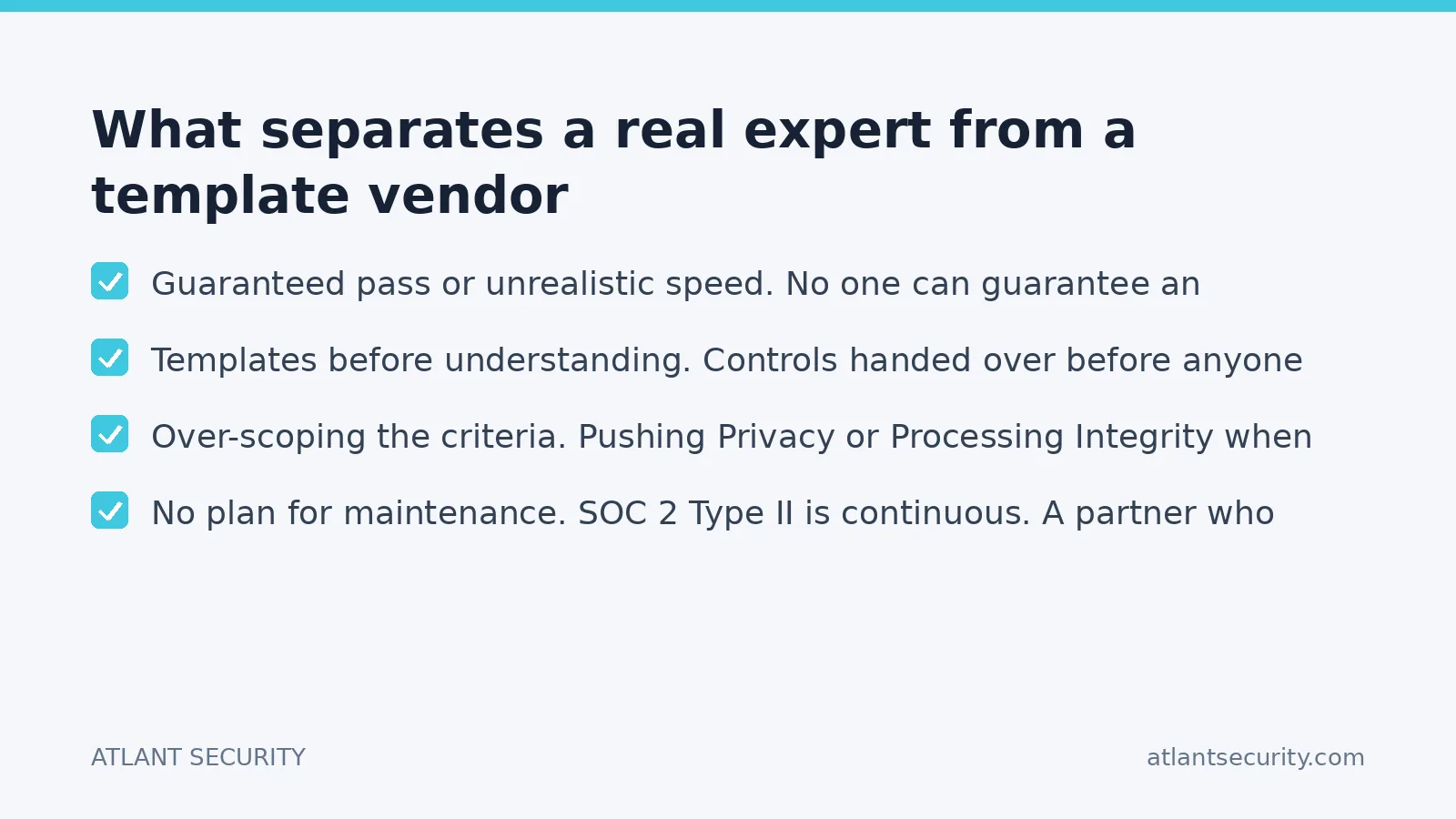
- Guaranteed pass or unrealistic speed. No one can guarantee an auditor's opinion, and Type II cannot be rushed.
- Selling the audit and the implementation together. This violates auditor independence. The firm issuing your report must be separate from the one building your controls.
- Templates before understanding. Controls handed over before anyone has looked at your architecture.
- Over-scoping the criteria. Pushing Privacy or Processing Integrity when your customers do not need them, inflating cost.
- No plan for maintenance. SOC 2 Type II is continuous. A partner who disappears after the report leaves you exposed at your next audit window.
How SOC 2 connects to your broader security
SOC 2 controls overlap heavily with other frameworks and with practical security. The access control, monitoring, and change management you build map onto ISO 27001, HIPAA, and PCI requirements. And a SOC 2 report says your controls are designed and operating; it does not prove they stop a real attacker. That is why mature companies pair SOC 2 with a penetration test that validates the controls under realistic conditions. Hiring an expert who understands this bigger picture means your SOC 2 investment reinforces everything else instead of standing alone.
How Atlant Security helps
We run SOC 2 readiness end to end: gap assessment against the Trust Services Criteria you actually need, control design that fits how your engineers work, evidence and documentation preparation, and coordination with an independent audit firm. We integrate as a fractional security leader so the controls still work at month six and the knowledge stays with your team. If SOC 2 is on your roadmap and you want it done right the first time, contact us to scope a readiness engagement.
Frequently Asked Questions
Can the same firm implement our controls and perform the audit?
No. SOC 2 requires the CPA firm issuing your report to be independent of the controls it examines. That is precisely why you hire a separate readiness or implementation partner to do the build, and a licensed CPA firm to perform the attestation. A vendor offering both is a red flag.
Do compliance automation platforms replace the need for an expert?
No. Platforms automate evidence collection and continuous monitoring, which is genuinely useful, but they do not design controls for your architecture, make judgement calls, or fix a failing control. They are a tool that an expert uses, not a substitute for the expertise itself.
Should we start with Type I or Type II?
If a customer needs proof quickly, a Type I gives a faster milestone by assessing control design at a point in time. Most enterprise buyers ultimately want Type II, which tests operating effectiveness over a period. A common path is Type I first, then Type II over the following observation window.
How long does SOC 2 implementation take?
Readiness and control implementation typically take two to four months depending on your starting maturity. Type II then requires an observation period of three to twelve months during which controls must operate effectively. Anyone promising a Type II report in weeks does not understand the scheme.
How much of the work can our own engineers do?
A good deal, once controls are designed. Engineers implement technical controls, and a strong readiness partner transfers knowledge so your team can maintain and recertify. The expertise you are paying for is scoping, control design, evidence standards, and auditor coordination, not doing every task for you.
