SOC 2 is the compliance milestone that unlocks enterprise deals for SaaS and cloud companies, and the single biggest determinant of whether it goes smoothly is who you put in charge of it. I have run more than 200 security assessments across 14 countries since 2013, and I have watched otherwise capable teams burn six months and a five-figure budget because they hired the wrong help, or hired the right help for the wrong scope. This is a practical guide to hiring SOC 2 experts: the distinct roles involved, what each one actually does, how to tell competence from marketing, and the questions that separate a real practitioner from someone reselling a checklist.
First, understand what SOC 2 actually requires
SOC 2 is an attestation performed by a licensed CPA firm against the AICPA Trust Services Criteria. There is no pass or fail badge and no certificate in the ISO sense. Instead, an auditor issues a report describing your controls and their opinion on whether those controls are suitably designed (Type 1) and, over a monitoring period of typically three to twelve months, operating effectively (Type 2).
Two things follow from this that shape every hiring decision:
- The auditor and the people who help you prepare are separate roles. A CPA firm that issues your report cannot also build your controls for you without impairing independence. So you are almost always hiring at least two kinds of help.
- SOC 2 is scoped around the criteria you select. Security (the Common Criteria) is mandatory. Availability, Confidentiality, Processing Integrity, and Privacy are optional and chosen based on what you promise customers. Hiring someone who scopes in all five when you only need Security is a common and expensive mistake.
The roles you are actually hiring for
People say hire a SOC 2 expert as if it were one person. In practice the work splits across a few distinct functions. On a small team one person may cover several of them, and that is fine, but you should know which hats need wearing.
1. The readiness advisor or Virtual CISO
This is the person who owns the program: scoping, gap assessment, control design, policy authorship, evidence strategy, and getting you audit-ready. For most companies without a full-time security leader, this is best filled by a fractional or Virtual CISO rather than a rushed full-time hire. It gives you senior judgment without a permanent six-figure salary before you can justify one. Our Virtual CISO services and SOC 2 readiness engagements exist precisely for this stage.
2. The internal owner
Even with outside help, you need someone inside the company who is accountable day to day: chasing evidence, coordinating engineering, and answering the auditor. This is usually an existing engineering lead, head of ops, or compliance manager. Do not outsource this entirely. An external advisor who has no internal counterpart ends up nagging people with no authority, and momentum dies.
3. The engineering implementer
Many SOC 2 controls are technical: access management, logging and monitoring, change management, encryption, vulnerability management, and infrastructure hardening. Your existing DevOps or platform engineers usually do this work with guidance, rather than a specialist hire. What you are buying from an advisor here is the mapping between a criterion and the concrete configuration that satisfies it.
4. The auditor (the CPA firm)
The firm that issues the report. They must be independent from the people who built your controls. You are hiring them for the attestation itself, not for consulting.
5. Specialist testers
A penetration test is not strictly required by SOC 2, but most auditors expect evidence of a vulnerability management program, and enterprise buyers reviewing your report almost always ask for a recent pen test. Budget for one and treat it as part of the same effort. A broader vulnerability assessment supports the ongoing monitoring controls auditors look for.
In-house, consultant, or automation platform?
There are three broad ways to resource SOC 2 preparation, and most companies use a blend.
| Approach | Best for | Watch out for |
|---|---|---|
| Full-time hire | Companies with ongoing, broad security needs beyond one report | Slow to recruit; a single generalist rarely covers advisory, engineering, and audit liaison well |
| Fractional or Virtual CISO / consultant | Most first-time SaaS companies needing senior judgment fast | Choose someone who has done audits end to end, not a policy-template reseller |
| Compliance automation platform | Evidence collection and continuous monitoring across cloud accounts | A tool automates evidence, it does not make decisions or design controls; it is not a substitute for expertise |
The most common failure I see is a team that buys an automation platform, assumes the software is the expert, and discovers three months in that nobody scoped the engagement, wrote defensible policies, or decided which criteria to include. Tools are genuinely useful for evidence and monitoring. They do not replace someone who understands what good looks like.
How to evaluate a SOC 2 consultant
When you interview an advisor or firm, you are trying to distinguish someone who has lived through audits from someone who has read about them. These questions do that.
Questions that reveal real experience
- How do you decide which Trust Services Criteria to include? A strong answer ties scope to customer commitments and contractual promises, and pushes back on including criteria you do not need. A weak answer is include everything to be safe.
- Walk me through the difference between Type 1 and Type 2 and which we should start with. They should explain that Type 1 is a point-in-time design opinion, Type 2 covers an observation window, and that many companies start with Type 1 to enter the market and then run a Type 2 window. If they promise a Type 2 in a couple of weeks, that is a red flag, because Type 2 by definition requires an observation period.
- How do you handle evidence for a control we do not yet have? The honest answer involves implementing the control and letting it operate, not fabricating evidence or backdating anything.
- Which controls do first-time companies most often get wrong? Expect specifics: access reviews, offboarding, change management approvals, vendor risk. Vague answers signal shallow experience.
- How do you work with the auditor? A good advisor has relationships with several CPA firms and can explain how they prepare a clean audit package, without being the auditor themselves.
Red flags
- Guaranteeing you will pass. No legitimate advisor guarantees an auditor's opinion.
- Selling a certificate or badge. SOC 2 produces a report, not a certificate.
- The same firm offering to both prepare and audit you. That is an independence problem.
- Fixed timelines that ignore the Type 2 observation window.
- Pricing quoted before anyone has discussed your scope, architecture, or existing controls.
What SOC 2 help realistically costs and how long it takes
I will not quote you a precise figure, because anyone who does before understanding your environment is guessing. But the shape of it is predictable. Readiness advisory, the audit fee, and a pen test are three separate line items. The audit fee goes to the CPA firm and scales with scope and criteria. Readiness advisory scales with how much of the work you can do internally versus how much you need built for you. A pen test is priced by scope of the application and infrastructure in test.
On timeline, a realistic path for a first-time company is several weeks to reach Type 1 readiness if your engineering foundation is reasonable, followed by a Type 2 observation window of three to twelve months. Companies that try to compress this below the observation window are misunderstanding what Type 2 is.
A sensible sequence for a first SOC 2
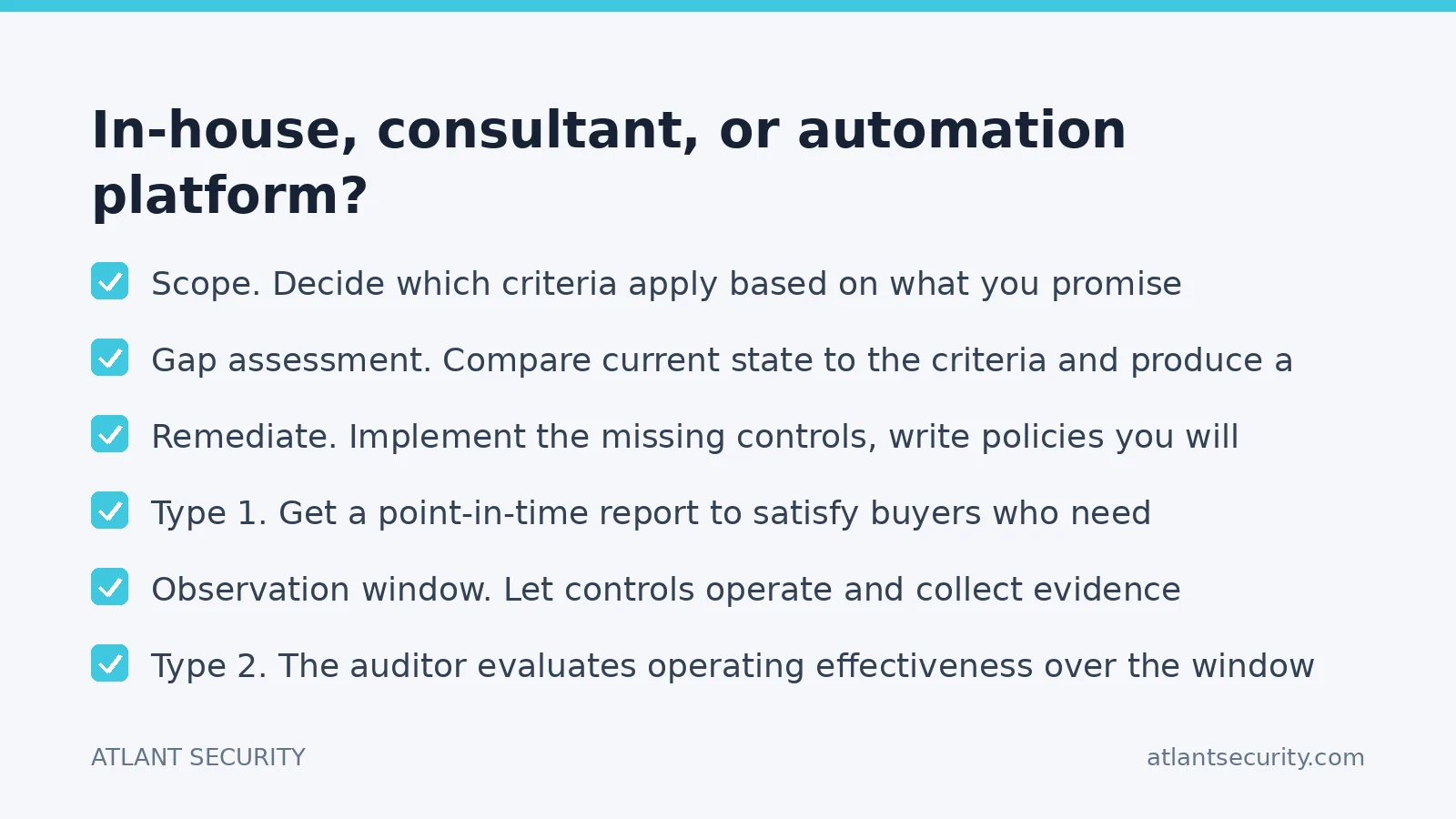
- Scope. Decide which criteria apply based on what you promise customers. Start with Security; add others only when justified.
- Gap assessment. Compare current state to the criteria and produce a prioritized remediation list. This is where a readiness engagement earns its keep.
- Remediate. Implement the missing controls, write policies you will actually follow, and stand up evidence collection.
- Type 1. Get a point-in-time report to satisfy buyers who need something now.
- Observation window. Let controls operate and collect evidence continuously.
- Type 2. The auditor evaluates operating effectiveness over the window and issues the report enterprise buyers really want.
- Maintain. SOC 2 renews annually. Build the muscle to keep controls running, not to re-cram every year.
If you also have a broader security posture to shore up, pairing SOC 2 with a full IT security audit gives you a defensible baseline rather than a report that papers over real gaps.
How SOC 2 fits with your other obligations
SOC 2 rarely lives alone. Companies selling into regulated buyers often need it alongside other frameworks, and the work overlaps heavily. If your customers ask for ISO 27001, much of the control base is shared. Healthcare buyers may push you toward HIPAA readiness, and payment flows bring PCI DSS into scope. A good advisor maps these once so you build controls that satisfy several frameworks at once rather than running three disconnected projects.
Frequently asked questions
Do I need to hire anyone at all, or can we do SOC 2 ourselves?
A technically strong team with prior audit experience can self-prepare, especially with an automation platform for evidence. Most first-time companies benefit from senior advisory to scope correctly and avoid rework, because the cost of a mis-scoped or failed first attempt usually exceeds the cost of getting help.
Can the same firm prepare us and perform the audit?
No. The CPA firm issuing your SOC 2 report must be independent from the people who designed and implemented your controls. You hire preparation help and an auditor separately. Any firm offering both for the same engagement is creating an independence conflict.
Should we start with Type 1 or Type 2?
If you have a deal blocked on compliance right now, a Type 1 gives you a point-in-time report quickly to keep the sale moving. Type 2 is what most enterprise buyers ultimately want because it covers operating effectiveness over time. A common path is Type 1 first, then a Type 2 window immediately after.
Is a penetration test required for SOC 2?
Not strictly by the criteria, but auditors expect evidence of vulnerability management, and enterprise buyers reviewing your report almost always ask for a recent pen test. Budget for one as part of the same effort.
The honest limitation of any point-in-time test is that it ages the moment you deploy. AI-driven pentesting exists for that gap: AI-run testing you can repeat on every release, with free retesting after you remediate.
How do I know a consultant is any good before signing?
Ask them to walk through a real engagement: how they scoped it, which controls the client got wrong, how they worked with the auditor, and what they would do differently. Specific, self-critical answers signal real experience. Guarantees of passing and pressure to include every criterion signal the opposite.
Where to start
If you are hiring for SOC 2, the highest-leverage first move is a scoping and readiness conversation with someone who has taken companies through audits before, not a rush to buy a tool or post a job. That conversation tells you which criteria you actually need, what your gaps are, and how much of the work you can do internally. From there the hiring decisions become obvious. If you want that conversation, get in touch and we will map your path to a clean SOC 2 report, through our SOC 2 and Virtual CISO practices.