
Choosing a third-party assessor to evaluate your NIST 800-53 controls is one of the higher-stakes vendor decisions a healthcare organization makes. Get it right and you gain an accurate picture of your risk, a defensible compliance posture, and a partner who makes your next audit smoother. Get it wrong and you pay for a glossy report that says everything is fine, right up until a breach or an Office for Civil Rights inquiry proves it was not.
I have led more than 200 security assessments across 14 countries since 2013, including work for organizations handling protected health information. This guide is written to help you evaluate assessors the way an experienced buyer would: by looking past marketing claims at the substance of the work. I will not name or rank specific firms, because star ratings and vendor leaderboards are marketing, not evidence. What follows is how to judge capability for yourself.
Why NIST 800-53 matters for healthcare
NIST Special Publication 800-53 is a catalog of security and privacy controls. It is mandatory for US federal systems, but healthcare organizations adopt it voluntarily because it is comprehensive, well-maintained, and maps cleanly to the obligations you already carry. The HIPAA Security Rule is deliberately high level, and NIST's own SP 800-66 explicitly shows how 800-53 controls can be used to satisfy those requirements. In practice, an 800-53 aligned program gives you:
- A structured way to demonstrate HIPAA and HITECH due diligence to regulators and business partners.
- Control mappings that also translate to HITRUST, SOC 2, and payer security requirements, so one program feeds many demands.
- A common language your clinical, IT, and compliance teams can share when talking about risk.
The point of a third-party assessment is not to collect a certificate. It is to find out, honestly, whether your controls actually work in the environment where patient data lives: your EHR, imaging systems, billing platforms, telehealth tools, and increasingly your connected medical devices. A good assessor translates the control catalog into a program that fits your organization. A weak one hands you a filled-in spreadsheet.
When to start looking for an assessor
The best time to engage an assessor is before you are forced to. Common triggers I see:
- A regulatory inquiry or audit notice. An OCR investigation, often following a breach or a complaint, puts you on a short clock to demonstrate that your controls exist and function.
- A near-miss. A phishing email that got further than it should have, or a misconfiguration caught late, is a signal that your internal view of your controls is too optimistic.
- A contractual requirement. Payers, partners, and larger health systems increasingly require documented security attestation before they will do business with you.
- A merger or acquisition. Whether you are buying or being bought, the security posture of the target is now part of the deal's value and risk.
- A major technology change. Rolling out connected medical devices, a new EHR, or telehealth at scale changes your attack surface and should be validated before go-live.
Do not wait for a crisis. Capable assessors book weeks or months ahead, and a rushed assessment under regulatory pressure is always more expensive and less useful than a planned one.
What separates a strong assessor from a weak one
Instead of comparing brand names, compare the qualities that actually predict a good outcome. Here is what I look for, and what the warning signs are.
| Criterion | What good looks like | Warning sign |
|---|---|---|
| Healthcare context | Understands PHI flows, clinical workflows, and how a control affects patient care | Generic IT auditors with no healthcare experience |
| NIST 800-53 depth | Works fluently with the current revision and tailors baselines to your risk | Treats the catalog as a fixed checklist to tick off |
| Evidence-based testing | Validates that controls function, not just that a policy document exists | Relies on interviews and self-attestation alone |
| Framework mapping | Maps 800-53 to HIPAA, HITECH, and HITRUST so one effort serves many needs | Assesses in isolation with no crosswalk |
| Clear deliverables | Executive summary plus technical detail and prioritized remediation | A raw scorecard with no path to fix anything |
| Independence | Assesses honestly, even when the news is bad | Sells you the products they then recommend you buy |
Notice that none of these are about price or brand. The single most valuable thing an assessor gives you is an honest finding you did not want to hear. An assessor whose incentive is to keep you comfortable is worth less than nothing, because a false sense of security is more dangerous than a known gap.
Credentials worth verifying
Certifications are not a guarantee of quality, but the absence of any is a red flag. For a healthcare NIST 800-53 assessment, look for a team that carries a credible mix of the following: For healthcare organisations we run a healthcare pentest as its own discipline: patient-facing portals, health data APIs, provider network access and the data flows between them.
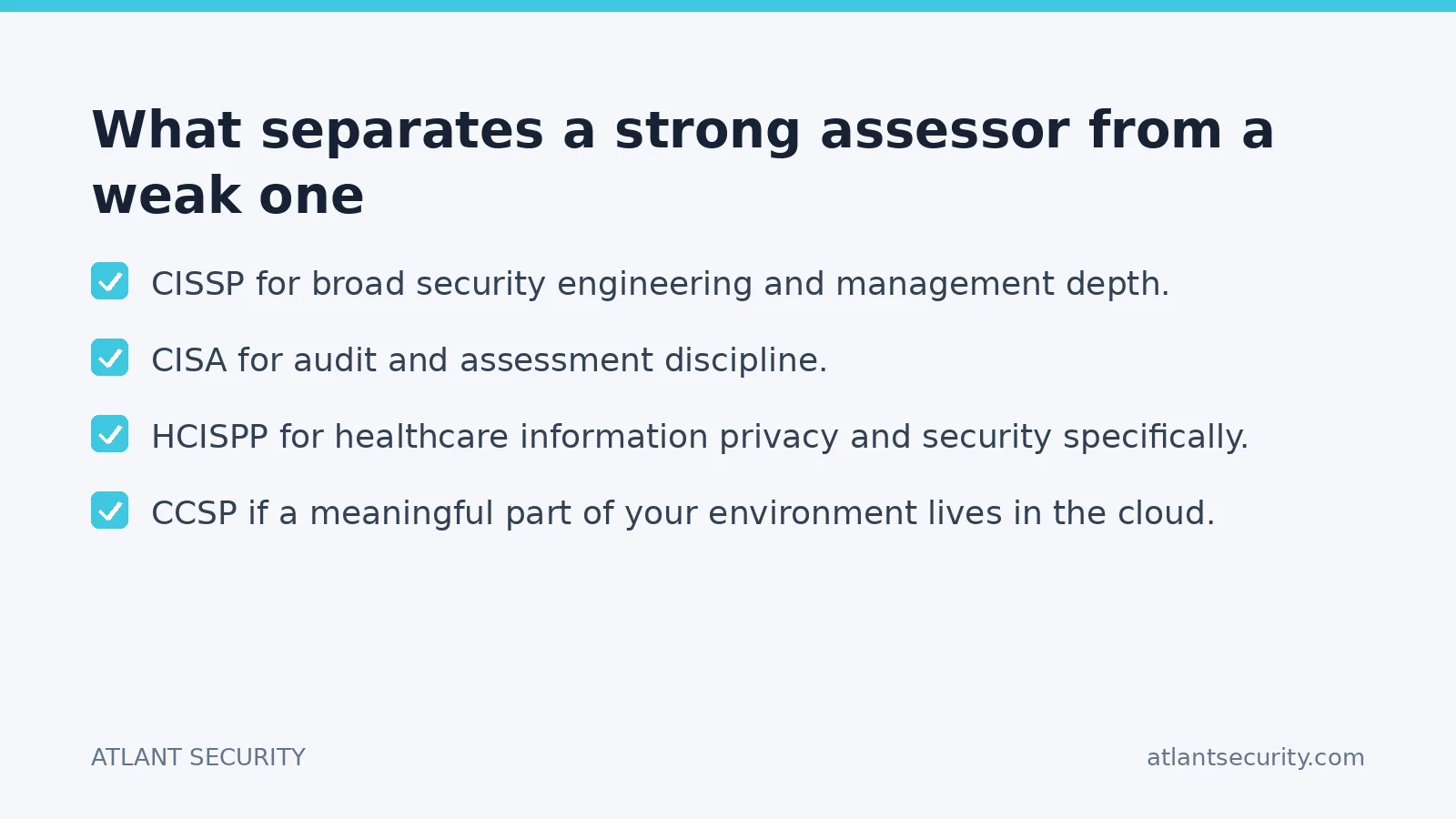
- CISSP for broad security engineering and management depth.
- CISA for audit and assessment discipline.
- HCISPP for healthcare information privacy and security specifically.
- CCSP if a meaningful part of your environment lives in the cloud.
Just as important as individual certifications is verifiable, relevant experience. Ask for anonymized, redacted sample reports and real letters of engagement. Ask who specifically will do the work, not who is on the sales call. The résumé that matters is the one belonging to the person who will actually be in your systems.
A practical selection process
Here is a sequence that consistently produces a good match without wasting months:
- Define scope first. Map where PHI actually flows: EHR, billing, imaging, telehealth, connected devices, backups, and any third parties that touch it. Scope drives everything else, and a fuzzy scope produces a fuzzy assessment.
- Write a focused RFP. Ask for specific evidence of recent healthcare assessments, a sample executive summary, and a sample technical report. Vague requests get vague proposals.
- Validate credentials and references. Confirm the certifications above and speak to references in organizations similar to yours.
- Run a small pilot. A bounded mini-assessment of one system or department tells you more about responsiveness, clarity, and rigor than any proposal. Consider it the interview.
- Interview the actual assessors. Include your IT, compliance, and clinical leads. You want people who can explain a control's purpose in terms your clinicians understand.
- Agree on deliverables and timelines in writing. Define report format, turnaround, and how remediation support and follow-up questions are handled before you sign.
If your internal team is small, a structured IT security audit from an experienced provider can serve as both the assessment and the education your team needs to sustain the program afterward.
Where assessments go wrong
Most disappointing engagements fail in one of a few predictable ways. Avoid them:
- Recycled scopes. An assessor who applies the same generic template to a rural clinic and a multi-hospital system is not really looking at your risk.
- Check-the-box mentality. A control that exists on paper but has never been tested is not a control. Insist on evidence that controls function end to end.
- No clinical context. A purely technical team may flag a control as "implemented" without understanding that a clinical workflow quietly bypasses it every shift.
- A report with no path forward. Findings without prioritized, realistic remediation leave you exactly where you started, only poorer.
- Conflicts of interest. Be cautious of assessors who both find the problems and sell the products that supposedly solve them.
Two habits protect you here. First, have your own team verify a sample of the assessor's findings independently, so you know their work holds up. Second, ask for both an executive-level summary and the underlying evidence, so a board member and an engineer can each get what they need from the same engagement.
Turning an assessment into ongoing security
An assessment is a snapshot. Patient data faces a moving threat, so treat compliance as a program, not a one-time event:
- Monitor continuously. Watch control status through your logging and monitoring stack rather than rediscovering drift once a year.
- Review policies on a set cycle. Refresh them as NIST revisions and your own environment change.
- Test the human layer. Ongoing phishing simulation and role-based training keep the controls that depend on people effective.
- Validate new technology before production. Every new device, telehealth tool, or AI system should be checked against your controls before it touches PHI.
- Cascade requirements to vendors. Your business associates and sub-vendors are part of your risk. Hold them to comparable standards and reassess them periodically.
Between full assessments, targeted testing keeps you honest. A regular vulnerability assessment catches configuration drift, and periodic penetration testing shows how a real attacker would move through your environment. If you need someone to own this program continuously without hiring a full-time executive, a virtual CISO can carry that accountability.
Frequently Asked Questions
Is NIST 800-53 required for healthcare organizations?
NIST 800-53 is mandatory for US federal information systems, not for private healthcare providers directly. Healthcare organizations adopt it voluntarily because it is a comprehensive control catalog that maps cleanly to the HIPAA Security Rule. NIST's own SP 800-66 shows how 800-53 controls satisfy HIPAA requirements, which is why many providers use it as their control baseline. Clinical networks, EHR dependencies, supplier access and recovery systems are what a hospital actually runs on, and hospitalpentest.com is scoped to those rather than to the public website.
How is a NIST 800-53 assessment different from a HIPAA audit?
A HIPAA audit checks whether you meet the requirements of the HIPAA Security, Privacy, and Breach Notification Rules. A NIST 800-53 assessment evaluates a detailed catalog of technical, operational, and management controls. Because 800-53 is more granular, it is often used as the implementation layer that demonstrates HIPAA compliance in practice. Many organizations pursue both together through a single mapped program.
What certifications should a healthcare assessor hold?
Look for a mix such as CISSP for security depth, CISA for audit discipline, and HCISPP for healthcare-specific privacy and security. CCSP matters if your environment is cloud-heavy. More important than any single certification is verifiable, recent experience assessing organizations like yours, which you should confirm through sample reports and references.
How long does a NIST 800-53 assessment take?
It depends entirely on scope. A single system or department can be assessed in a couple of weeks, while a full enterprise assessment across EHR, billing, imaging, and connected devices takes longer and involves more evidence gathering. Beware of anyone promising a fixed, very fast turnaround before they understand your environment, and beware of open-ended timelines with no milestones.
Should we run the assessment internally instead of hiring a third party?
Internal self-assessment is useful for readiness, but it lacks independence, and independence is precisely what regulators, partners, and payers want to see. An internal team also tends to share the same blind spots that created the gaps. The strongest approach is to use internal reviews to prepare, then bring in an independent assessor for the findings that carry weight externally.
Choosing a NIST 800-53 assessor for your healthcare organization? Atlant Security delivers honest, evidence-based assessments mapped to HIPAA and HITECH, led personally by a former Microsoft security consultant with 200+ assessments across 14 countries. Start with a focused HIPAA and healthcare security engagement or book a free strategy call and get a fixed-price proposal within 24 hours.
