
We have probably seen your problem before. Our smallest client had eight employees. Our largest secures the nuclear power plant of the United Arab Emirates. Whatever shape yours is, tell us about it and we will tell you how we would fix it.
"CPS 234 vs NIST 800-53" is a slightly misleading way to frame the question, and understanding why is the first step to using both well. One is a mandatory outcome-based obligation from your prudential regulator. The other is a voluntary, exhaustive catalogue of security controls from a US standards body. They are not competitors. In the APRA-regulated entities I have worked with since 2013, the smart teams stop asking which one to pick and start using NIST 800-53 as the toolbox that makes CPS 234 compliance concrete.
This article explains what each framework actually is, where they genuinely differ, and - the part most comparisons skip - how to map one onto the other so you get audit-ready CPS 234 evidence without reinventing a control set from scratch.
The Short Answer
CPS 234 tells you what security outcomes APRA requires. NIST 800-53 gives you a detailed menu of how to achieve them. CPS 234 is roughly a seven-page principle-based standard; NIST 800-53 is a catalogue running to hundreds of pages. If you are an Australian bank, insurer, or superannuation trustee, CPS 234 is compulsory and NIST 800-53 is one of several optional control catalogues you can use to operationalise it. You do not choose between them - you comply with the first using something like the second. For a bank the useful test is one that follows the money through the payment workflow and the privileged-access paths; that is what bankpentest.com is built to do.
What CPS 234 Is
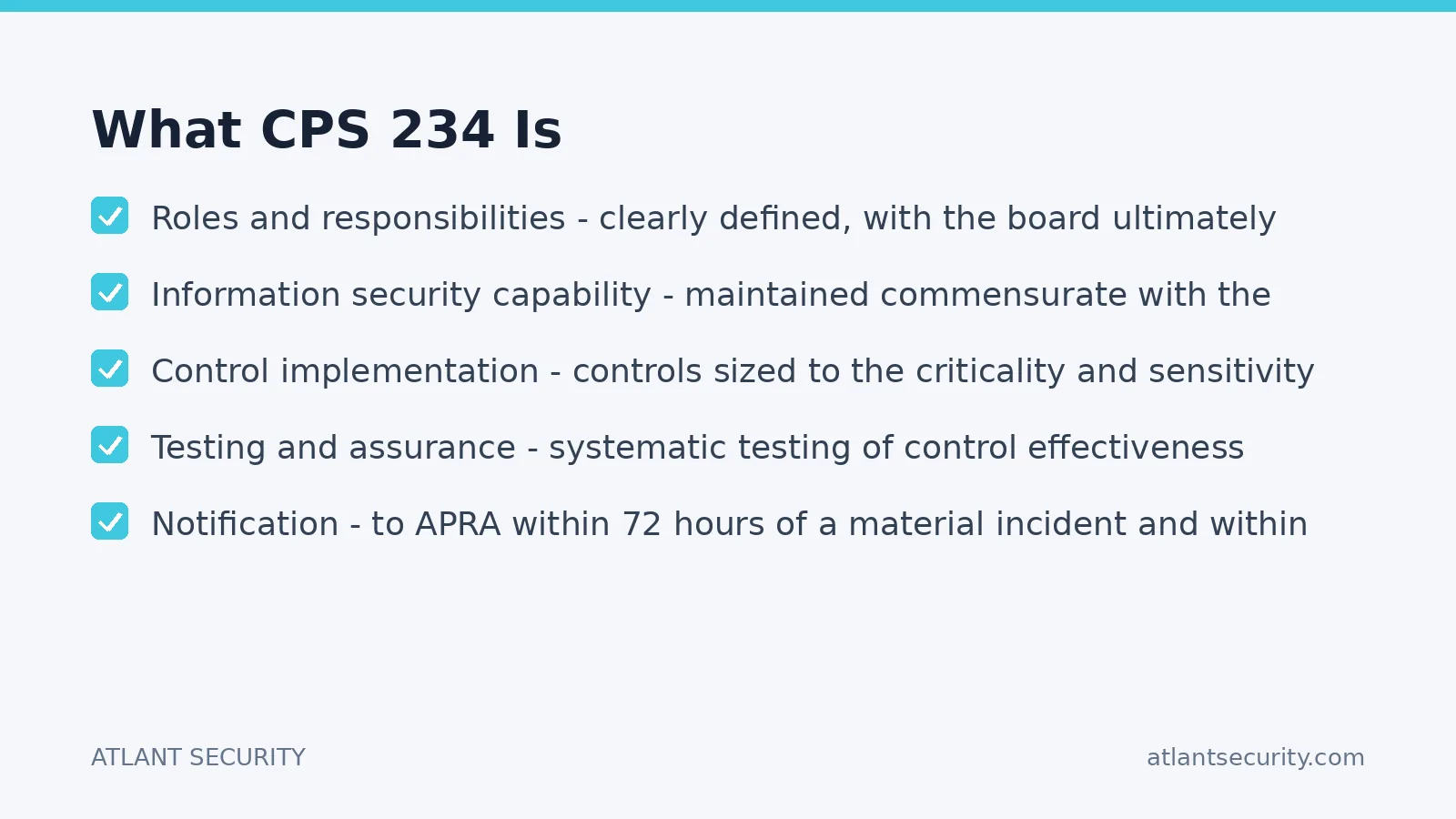
CPS 234 is APRA's prudential standard for information security, in force since 1 July 2019 and binding on all APRA-regulated entities. It is deliberately principle-based rather than a control checklist, and it centres on a handful of outcomes:
Roles and responsibilities - clearly defined, with the board ultimately accountable for information security.
Information security capability - maintained commensurate with the size and extent of threats to the entity's assets.
Control implementation - controls sized to the criticality and sensitivity of the information assets they protect, including assets managed by third parties.
Testing and assurance - systematic testing of control effectiveness and internal audit review of control design and operation.
Notification - to APRA within 72 hours of a material incident and within 10 business days of a material control weakness.
Notice what CPS 234 does not do: it does not tell you which encryption algorithm to use, how often to scan for vulnerabilities, or what your password policy should be. That is intentional. The regulator sets the outcome and holds the board accountable; the entity chooses the controls. That flexibility is a strength, but it is also why so many teams struggle - they are handed a set of outcomes and no catalogue to build against.
What NIST 800-53 Is
NIST Special Publication 800-53 is the US National Institute of Standards and Technology's catalogue of security and privacy controls. The current revision organises controls into 20 families - among them Access Control, Audit and Accountability, Configuration Management, Contingency Planning, Identification and Authentication, Incident Response, Risk Assessment, System and Communications Protection, System and Information Integrity, and, added in the latest revision, Supply Chain Risk Management. In total it defines well over a thousand individual controls and enhancements.
Crucially, NIST 800-53 is prescriptive where CPS 234 is not. It tells you, at the level of a specific control, what to do - manage accounts a certain way, enforce least privilege, monitor systems, protect data in transit. It also ships with baselines (low, moderate, and high impact) so you can select a coherent starting set rather than picking controls at random. It originated for US federal systems under FISMA, and it is voluntary for a private Australian entity, but its granularity is exactly what CPS 234's flexibility lacks.
The Core Differences
Aspect 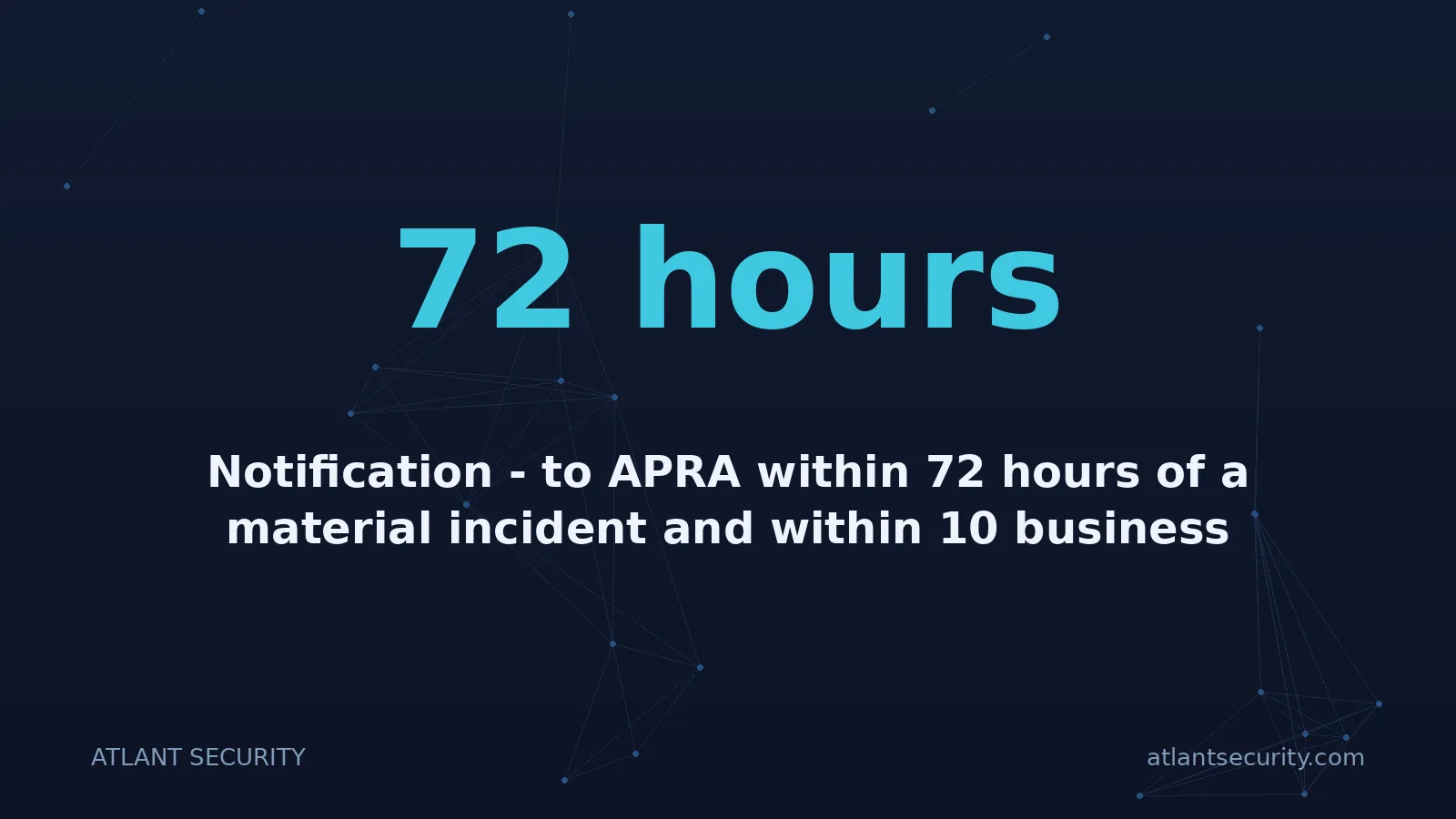 | CPS 234 | NIST 800-53 |
|---|---|---|
Type | Mandatory prudential standard | Voluntary control catalogue |
Issuer | APRA (Australia) | NIST (United States) |
Applies to | APRA-regulated banks, insurers, super funds | Any organisation that chooses to adopt it |
Style | Principle-based, outcome-focused | Prescriptive, control-by-control |
Size | Roughly seven pages | 20 families, 1,000+ controls |
Answers | What outcome is required | How to implement it |
Enforcement | Regulatory obligation, board accountable | No enforcement on its own |
The row that matters most is the last content row. CPS 234 answers "what", NIST 800-53 answers "how". Once you internalise that, the comparison stops being a competition and becomes a design pattern.
How to Use NIST 800-53 to Operationalise CPS 234
Here is the approach I use when a regulated client wants CPS 234 compliance they can actually evidence. Take each CPS 234 outcome and map it to the NIST 800-53 control families that deliver it. The standard tells you the destination; the catalogue gives you a tested route.
CPS 234 outcome | Relevant NIST 800-53 families | What it gives you |
|---|---|---|
Roles, responsibilities, governance | Program Management (PM), Planning (PL) | Documented security program leadership and accountability |
Risk-based capability | Risk Assessment (RA) | A repeatable risk assessment and vulnerability monitoring process |
Access and identity controls | Access Control (AC), Identification and Authentication (IA) | Least privilege, account management, MFA parameters |
Logging and record-keeping | Audit and Accountability (AU) | Defined log content and review to support incident notification |
Maintaining security capability | Configuration Management (CM), System and Information Integrity (SI) | Baselines, change control, monitoring for tampering |
Incident notification and response | Incident Response (IR) | Structured handling and monitoring behind the 72-hour obligation |
Third-party information assets | Supply Chain Risk Management (SR), System and Services Acquisition (SA) | Supplier controls and notification requirements |
Protecting data in transit and networks | System and Communications Protection (SC) | Boundary protection and transmission confidentiality |
Worked through this way, NIST 800-53 turns CPS 234's outcomes into a concrete list of controls you can implement, test, and evidence. When your internal auditor asks how you satisfy the "control implementation" outcome, you point to specific, named controls with configuration and testing records behind them, rather than gesturing at a principle. That is the difference between a compliance program that reads well and one that survives an independent audit.
NIST 800-53 Is Not Your Only Option
NIST 800-53 is thorough, but it is not the only catalogue you can hang CPS 234 on, and for some Australian entities it is not the most natural fit. Three alternatives are worth knowing:

ISO/IEC 27001 - internationally recognised, certifiable, and often already familiar to Australian boards and auditors. If you are pursuing certification anyway, mapping CPS 234 onto your ISO 27001 controls avoids maintaining two control sets. Our ISO 27001 readiness work frequently doubles as CPS 234 evidence.
The Australian Government Information Security Manual (ISM) - the local control catalogue, which pairs naturally with the ACSC Essential Eight and keeps you within an Australian frame of reference.
NIST Cybersecurity Framework (CSF) - a lighter, higher-level structure that many entities use for board-level reporting on top of a detailed catalogue underneath.
The choice usually comes down to what you already have. If your organisation is ISO 27001 certified, lean on that. If you are deeply invested in the Essential Eight and the ISM, stay there. NIST 800-53 shines when you want maximum granularity and detailed implementation guidance, particularly for technical control families. What matters is choosing one backbone and mapping consistently, rather than borrowing a control here and there with no coherent structure.
Common Mistakes When Blending the Two
Treating it as a choice. You do not comply with NIST 800-53 instead of CPS 234. CPS 234 is the obligation; the catalogue is a means to it.
Adopting the whole catalogue. Over a thousand controls is not a target - it is a menu. Select against a baseline and your risk profile, not everything on the page.
Mapping on paper only. A control cross-reference spreadsheet is not evidence. CPS 234 requires you to test control effectiveness, so the mapped controls have to actually operate and be reviewed.
Ignoring the board dimension. No control family in any catalogue substitutes for the board accountability CPS 234 demands. That has to be structured explicitly, not assumed to fall out of the technical controls.
If you do not have the internal seniority to run this mapping and keep it honest, a virtual CISO can own the framework, the evidence, and the board reporting. For fast-moving regulated startups, a fintech-focused virtual CISO is often the most efficient way to get CPS 234-ready without hiring a full security team.
Frequently Asked Questions
Do I have to comply with both CPS 234 and NIST 800-53?
No. If you are an APRA-regulated entity, CPS 234 is mandatory. NIST 800-53 is a voluntary control catalogue you can use to implement CPS 234, but you are never obligated to adopt it. You could use ISO 27001, the Australian ISM, or another catalogue instead.
Is NIST 800-53 or ISO 27001 better for CPS 234?
Neither is inherently better - it depends on what you already run. ISO 27001 is certifiable and often more familiar to Australian boards and auditors, so if you are pursuing certification anyway it avoids maintaining two control sets. NIST 800-53 offers more granular, prescriptive detail, which helps for technical control families. Pick the one that fits your existing environment and map consistently.
Why is CPS 234 so much shorter than NIST 800-53?
Because they do different jobs. CPS 234 is a principle-based regulatory standard that sets required outcomes and leaves control selection to the entity, which keeps it short. NIST 800-53 is an exhaustive catalogue of specific controls and enhancements, so it necessarily runs to hundreds of pages.
Does using NIST 800-53 guarantee CPS 234 compliance?
No. Implementing NIST controls gives you a strong technical foundation, but CPS 234 also requires board accountability, testing of control effectiveness, internal audit review, and timely notification to APRA. Those governance and assurance outcomes must be addressed explicitly - they do not come automatically from a control catalogue.
How does third-party risk fit into a CPS 234 and NIST 800-53 mapping?
CPS 234 explicitly covers information assets managed by related parties and third parties. In NIST 800-53 you address this through the Supply Chain Risk Management and System and Services Acquisition families, ensuring supplier contracts include appropriate controls and notification requirements fast enough to meet your own APRA obligations.
Where should a regulated entity start?
Start from CPS 234's outcomes, not from a control catalogue. List what the standard requires, choose one backbone catalogue that suits your environment, map the outcomes to control families, then implement, test, and retain evidence. Reading our guide on what CPS 234 requires first will make the mapping much faster.
Where to Start
Stop treating CPS 234 and NIST 800-53 as rivals. CPS 234 is the obligation you must meet; NIST 800-53 is one of the best-detailed toolkits for meeting it. Map the standard's outcomes to a control backbone, implement and test the controls, and keep the evidence current - that is what turns a principle-based standard into a defensible compliance program.
If you want help building that mapping or validating one you already have, get in touch. Our guide on preparing for a CPS 234 audit is a practical next step once your control set is in place.
Want to know where you actually stand?
A fixed-price IT security audit answers that in 14 days: 20 NIST 800-53 domains checked against your live environment, findings ranked by what an attacker can reach, and a remediation plan with named owners. You read the report before you pay.
See what the 14-day audit covers