The risk assessment is where most SOC 2 projects quietly go wrong. Not the controls, not the audit itself, but the messy, judgment-heavy exercise of deciding what could hurt your customers' data and how much you care. Auditors know this, which is why the CC3 risk assessment criteria are among the first things a good examiner tests. In more than 200 security assessments since 2013, I have seen far more companies stumble on the risk assessment than on any technical control.
This article walks through the challenges I see most often in SOC 2 risk assessments and how to handle each one so the work holds up under audit and actually makes your company safer. If you are still deciding whether you need Type 1 or Type 2 first, start with our SOC 2 readiness overview, then come back here.
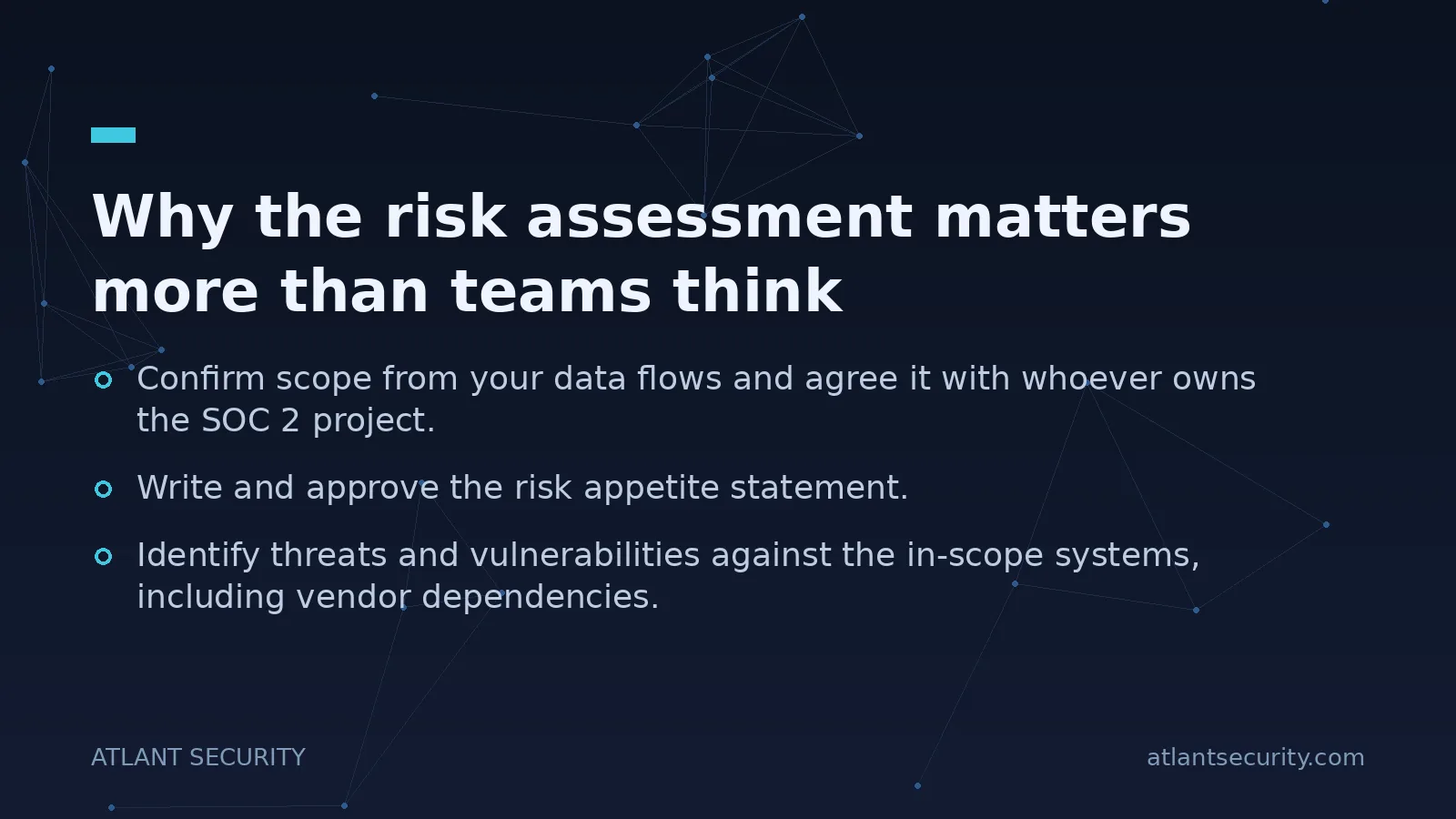
Why the risk assessment matters more than teams think
SOC 2 is built on the Trust Services Criteria, and the common criteria (the CC series) include a dedicated block for risk assessment. In plain terms, the auditor wants evidence that you have identified the risks to the systems in scope, analyzed their likelihood and impact, and tied your controls back to those risks. A control with no risk behind it looks arbitrary. A risk with no control behind it is an open finding.
Done properly, the risk assessment is the spine of the whole report. It explains why you chose the controls you chose. Done as a last-minute spreadsheet the week before fieldwork, it becomes the thing that unravels everything else. The challenges below are the reasons that spreadsheet falls apart.
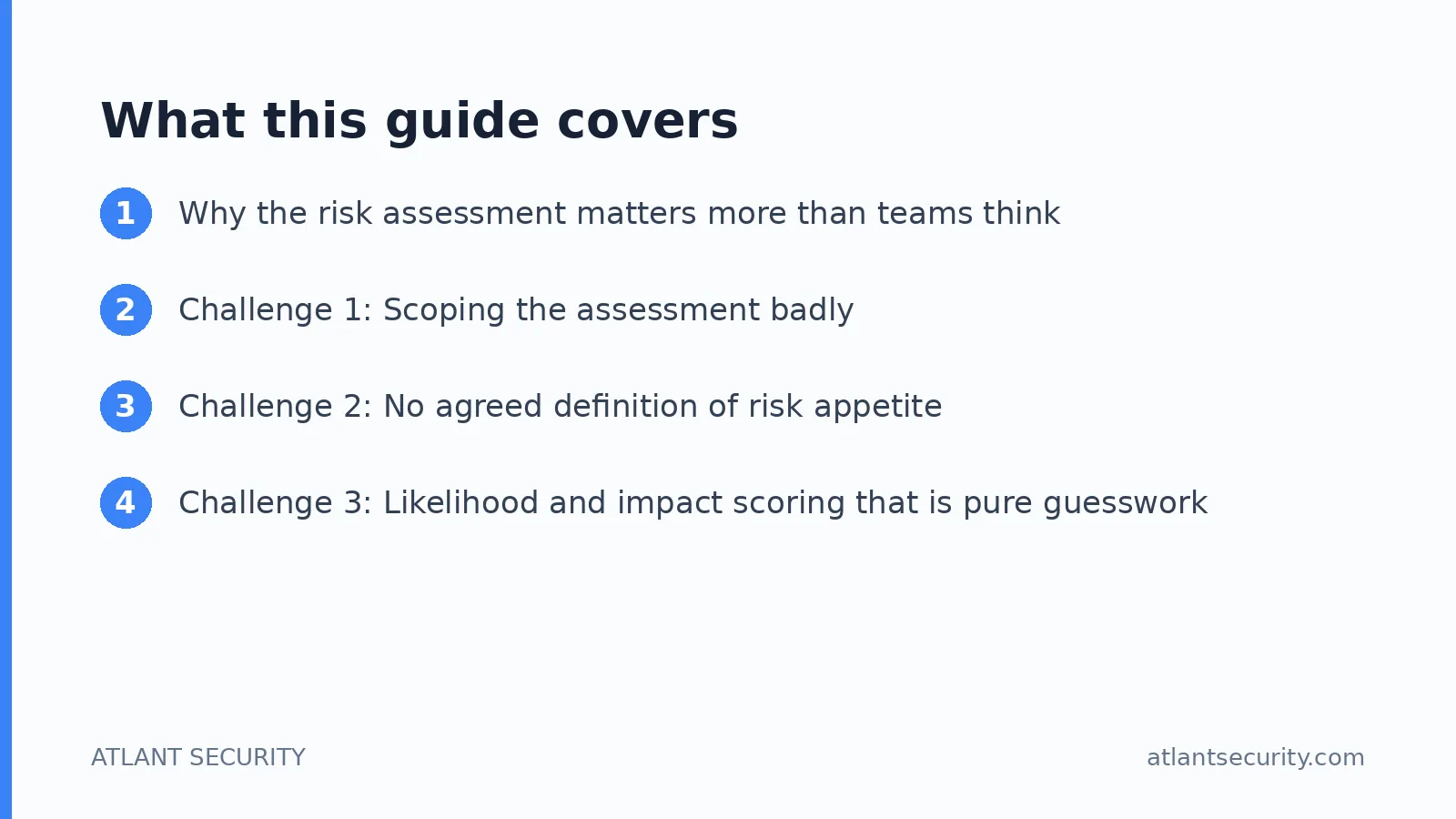
Challenge 1: Scoping the assessment badly
The single most common mistake is scoping either far too wide or far too narrow. Teams that scope everything (every laptop, every internal tool, every dev sandbox) produce a risk register so large that nobody maintains it. Teams that scope too narrow leave out the systems that actually process customer data and get caught when the auditor asks how a given data flow is protected.
The scope of your risk assessment should match the scope of your SOC 2 report: the systems, people, and processes involved in delivering the service your customers rely on. Practical guidance:
- Start from the data. Map where customer data enters, is stored, is processed, and leaves. Those systems are in scope.
- Include the supporting infrastructure that could compromise those systems: identity provider, CI/CD pipeline, cloud management plane, and privileged access paths.
- Exclude environments that genuinely never touch production data, but document why you excluded them. Auditors accept exclusions with a rationale, not silent gaps.
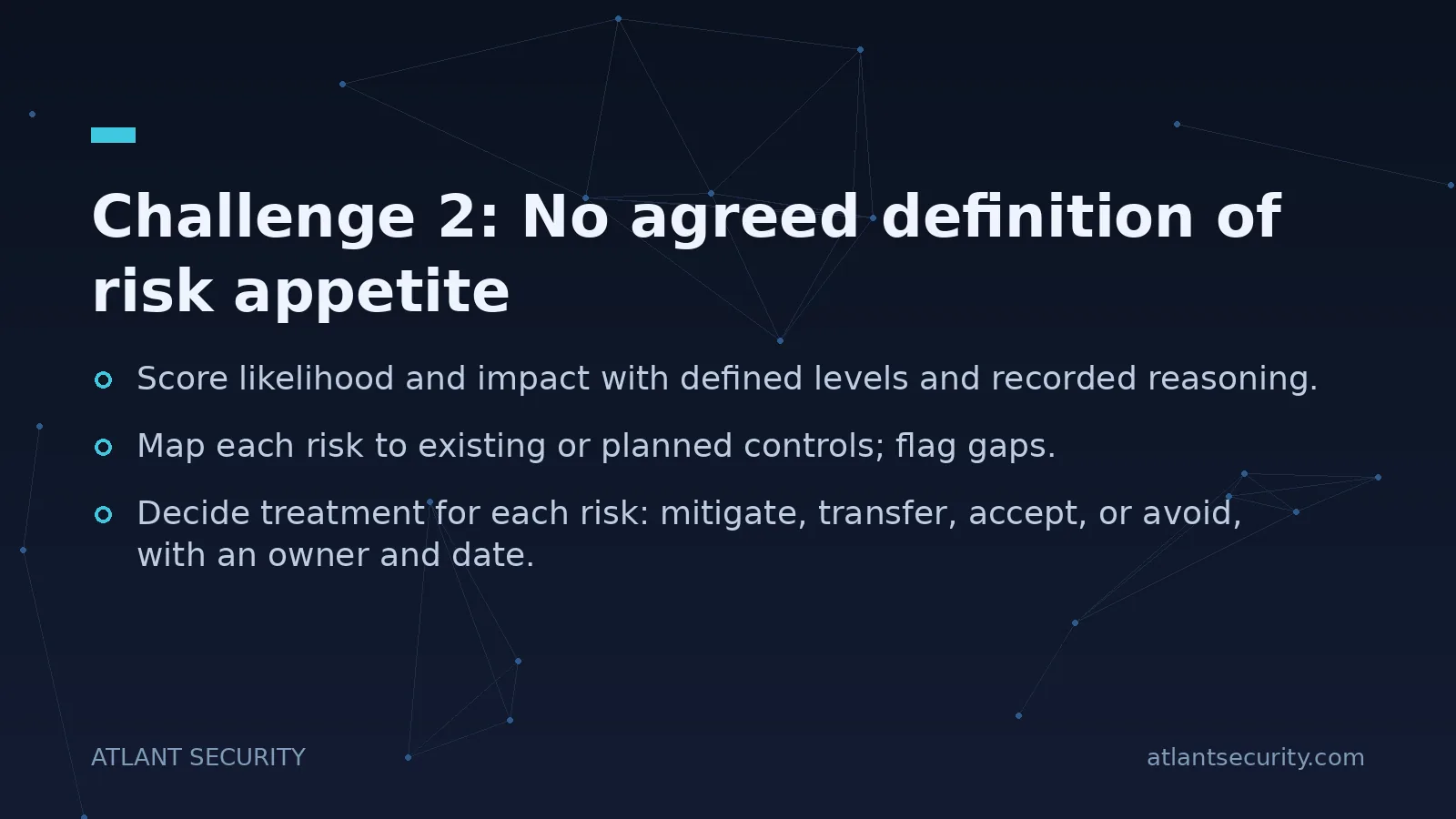
Challenge 2: No agreed definition of risk appetite
You cannot rank risks until leadership agrees on what an acceptable risk looks like. Without that, every scoring session turns into an argument, and the results drift depending on who ran the meeting. I have watched two engineers score the same risk as "low" and "critical" in the same workshop because nobody had defined the terms.
Fix this before you score anything. Write a short, plain-language risk appetite statement approved by an executive owner. It should say, in one page, what kinds of impact the company treats as unacceptable (for example, any exposure of customer data, or downtime beyond a stated threshold) and what it is willing to tolerate. This single document removes most of the subjectivity from the rest of the process.
Challenge 3: Likelihood and impact scoring that is pure guesswork
Most risk registers use a five-by-five likelihood-by-impact grid, and most of the numbers in them are invented. That is not automatically a problem: qualitative scoring is fine for SOC 2 as long as it is consistent and defensible. The problem is when the same reviewer scores similar risks differently, or when nobody can explain why a risk is "likelihood 4."
To make scoring defensible:
- Define each level. "Likelihood 4" should mean something concrete, such as "we have seen attempts of this kind in our logs" or "this occurs across the industry several times a year."
- Score with at least two people in the room, ideally one technical and one who understands the business impact.
- Record a one-line justification for every score. Auditors rarely challenge the number itself; they challenge the absence of reasoning.
Challenge 4: Third-party and vendor risk gets ignored
Your SOC 2 report covers your service, but your service almost certainly depends on subservice organizations: your cloud provider, your payment processor, your email and analytics vendors. Auditors expect you to have assessed the risk those vendors introduce and to show how you monitor them. Teams routinely forget this until fieldwork, then scramble to collect vendor SOC 2 reports they never reviewed.
Build vendor risk into the assessment from the start:
- Maintain a current inventory of vendors that touch customer data or underpin the service.
- For each, record what data they handle, their criticality, and what assurance you rely on (their own SOC 2 report, ISO 27001 certificate, or a completed security questionnaire).
- Note the complementary user entity controls from your critical vendors' reports. These are the things the vendor expects you to do, and auditors will check that you actually do them.
If vendor risk is a weak spot, a focused vulnerability assessment and a structured vendor review will surface the gaps faster than another spreadsheet.
Challenge 5: Risks that never map to controls
A risk assessment that lives in its own document, disconnected from your control set, is worthless to an auditor. The whole point is traceability: this risk is addressed by these controls, and here is the evidence those controls operate. When the mapping is missing, you get the two worst audit outcomes at once - risks with no mitigation, and controls that exist for no stated reason.
Every risk in your register should point to one or more specific controls, and every control should trace back to at least one risk. When you add a control, ask which risk it reduces. When you accept a risk, document who accepted it and why. This mapping is also what makes the annual update fast instead of painful.
Challenge 6: Treating it as a one-time exercise
SOC 2, especially Type 2, assumes your risk assessment is a living process, not an artifact you produced once. New features, new integrations, new data types, and new vendors all change your risk picture. Auditors look for evidence that you revisit risk on a defined cadence and after significant changes. A register dated eleven months ago with no updates is a red flag.
Set a formal cadence (at minimum annual, better quarterly for fast-moving teams) and trigger an update whenever you ship something that changes how customer data is handled. Keep the evidence: meeting notes, updated scores, and sign-off. This is exactly the kind of continuous ownership a virtual CISO is built to carry when you do not have a full-time security leader.
Challenge 7: No clear owner
When the risk assessment belongs to everyone, it belongs to no one. Engineering assumes compliance owns it, compliance assumes the CTO owns it, and it rots between them. Name a single accountable owner with the authority to convene the workshop, make scoring calls, and escalate accepted risks to leadership. That owner does not have to do all the work, but they have to make sure it happens.
Common challenges and how to handle them
| Challenge | What goes wrong | How to fix it |
|---|---|---|
| Scope | Too wide to maintain, or too narrow to pass | Match scope to customer data flows; document exclusions |
| Risk appetite | No agreed threshold, endless arguments | One-page appetite statement, executive-approved |
| Scoring | Inconsistent, unjustified numbers | Define each level, score in pairs, record reasoning |
| Vendor risk | Ignored until fieldwork | Live vendor inventory with assurance evidence |
| Control mapping | Risks and controls disconnected | Trace every risk to a control and back |
| Staleness | Register updated once and forgotten | Fixed cadence plus change-triggered reviews |
| Ownership | No accountable person | Name one owner with authority to decide |
A workable order of operations
If you are starting from scratch, run the assessment in this sequence rather than jumping straight to scoring:
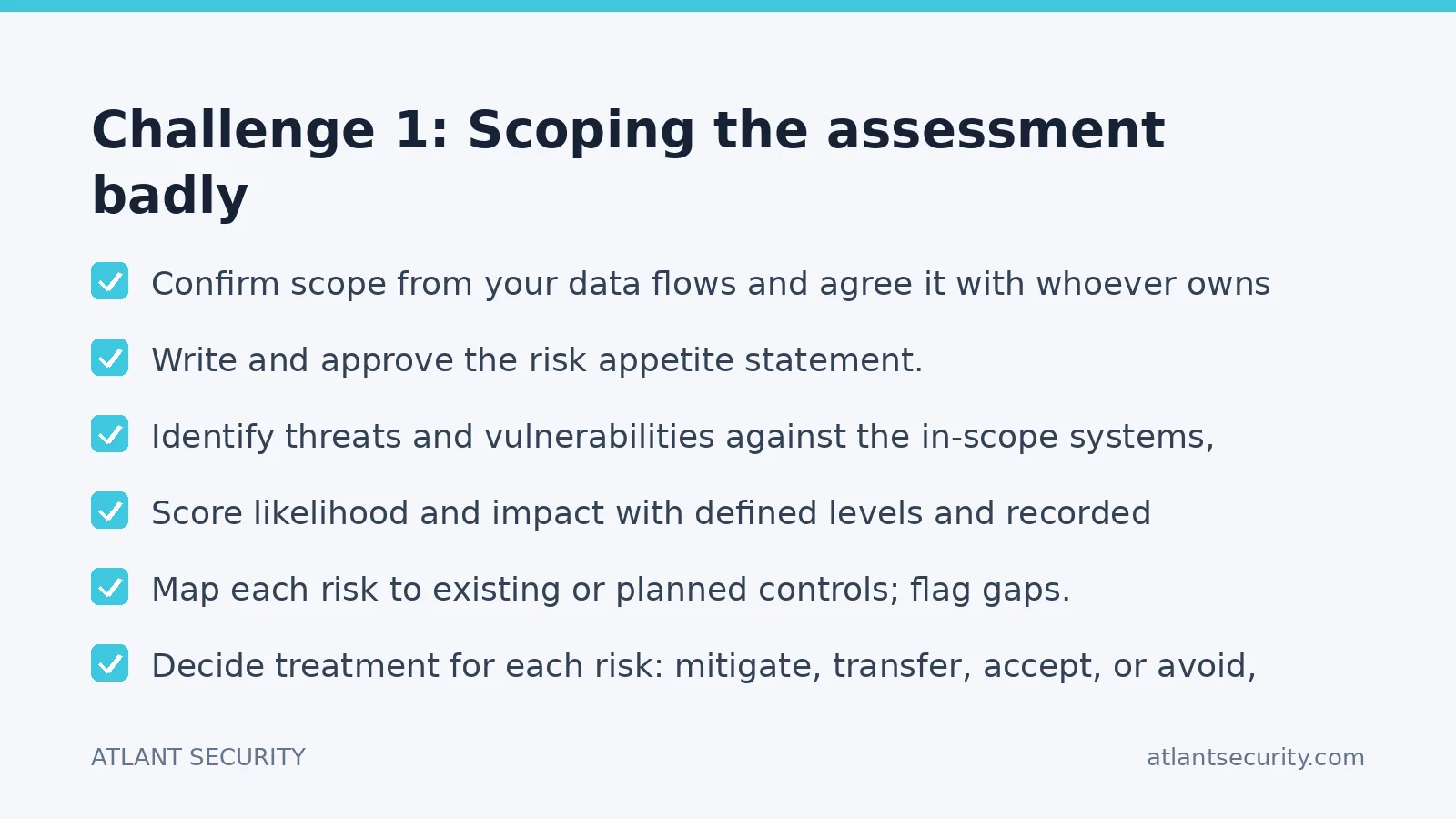
- Confirm scope from your data flows and agree it with whoever owns the SOC 2 project.
- Write and approve the risk appetite statement.
- Identify threats and vulnerabilities against the in-scope systems, including vendor dependencies.
- Score likelihood and impact with defined levels and recorded reasoning.
- Map each risk to existing or planned controls; flag gaps.
- Decide treatment for each risk: mitigate, transfer, accept, or avoid, with an owner and date.
- Get executive sign-off and schedule the next review.
This is the same backbone whether you are pursuing SOC 2 for the first time or maintaining it. If you want the report itself explained end to end, our SOC 2 service page covers how the pieces fit together, and a broader IT security audit can validate that your controls actually work before an examiner tests them.
Frequently Asked Questions
Is a risk assessment actually required for SOC 2?
Yes. The common criteria include a dedicated risk assessment component, and auditors test it directly. You cannot pass a SOC 2 examination without demonstrating that you identify, analyze, and respond to risks to the systems in scope.
Can we use a qualitative risk assessment, or does it need to be quantitative?
Qualitative scoring, such as a likelihood-by-impact matrix, is perfectly acceptable for SOC 2. What matters is that your method is consistent, that each level is defined, and that you can explain the reasoning behind each score. Quantitative models are optional and rarely worth the extra effort at this stage.
How often should we update the risk assessment?
At least once a year, and again whenever a significant change alters how customer data is handled: a new product line, a major integration, a new critical vendor, or an incident. For Type 2, auditors want to see the assessment treated as an ongoing process across the entire audit period, not a single snapshot.
Who should own the risk assessment?
One named person with the authority to convene the workshop, resolve scoring disputes, and escalate accepted risks to leadership. In smaller companies this is often a founder, a head of engineering, or an outsourced virtual CISO. The key is a single accountable owner rather than shared responsibility.
How do vendors fit into our risk assessment?
Vendors that handle customer data or underpin your service are part of your risk picture. Maintain an inventory, record what assurance you rely on for each, and review the complementary user entity controls in their SOC 2 reports so you actually perform the tasks they assume you do.
Get the risk assessment right before fieldwork
The risk assessment is not paperwork you produce to satisfy an auditor. It is the reasoning that justifies every control in your report, and when it is done well the rest of the audit gets dramatically easier. If you want a second set of expert eyes on your scope, scoring, and control mapping before an examiner sees it, get in touch and we will help you build a risk assessment that holds up.