
Quick answer
Governance, risk and compliance (GRC) software replaces the sprawl of spreadsheets and disconnected tools with one system that manages your risks, your vendors, and every compliance framework together. Venvera is exactly that platform: a risk management SaaS, a third-party risk management (TPRM) SaaS, and a multi-framework compliance engine in one, with AI doing the busywork.
Most organisations discover their GRC problem the same way. A customer asks for your SOC 2 report. A regulator points at DORA or NIS2. An auditor wants evidence, and you realise it lives in fourteen spreadsheets, three shared drives, and one person's memory. Every framework gets its own silo, the same control gets documented five times, and risk management is a document someone updates the week before the board meeting.
That model does not scale, and it does not survive contact with a serious auditor. Governance, risk and compliance is not fourteen separate problems. It is one connected discipline, and it deserves one connected platform. That is the thesis behind Venvera.
What GRC software actually needs to do
Good GRC software has to do three things at once. It has to give you a single, honest view of your risk. It has to keep you compliant across every framework that applies to you, without duplicating work. And it has to manage the third parties who now carry a large share of your risk surface. Venvera is built around exactly those three pillars, so let us take them in turn.
Risk management SaaS: a living register, not a stale document
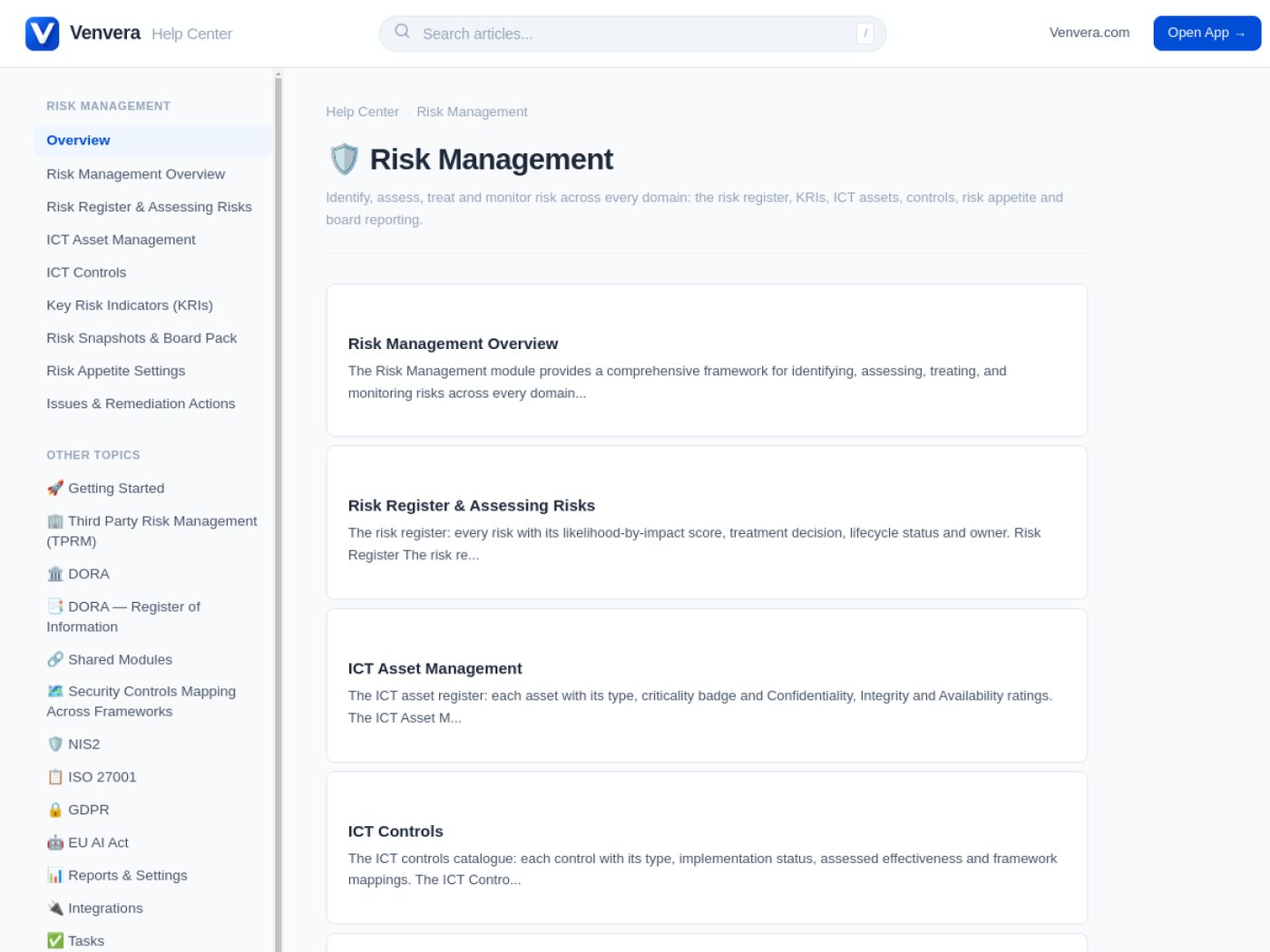
At the core of Venvera is a proper risk management SaaS. The centralised risk register holds every risk with its likelihood-by-impact score, treatment decision, lifecycle status, and owner, so nothing lives in someone's inbox. Risks connect to your ICT assets, each catalogued with its type, criticality badge, and Confidentiality, Integrity and Availability ratings, so you can trace exactly which exposure threatens which system.
What makes it a management tool rather than a list is the machinery around the register:
- Key Risk Indicators (KRIs) track each metric with its direction, green and amber thresholds, and current RAG status, so risk is monitored continuously rather than reviewed once a quarter.
- Risk appetite is configured explicitly with three tolerance levels and acceptance and escalation sliders on a 1 to 25 scale, so "how much risk is acceptable" becomes a defined number, not a vibe.
- Controls are tracked with their type, implementation status, assessed effectiveness, and framework mappings, tying risk treatment directly to compliance evidence.
- Risk snapshots capture point-in-time views of the register and KRI landscape that you can compare over time and export straight into board reporting.
- Issues and remediation log control weaknesses and findings with their rating, status, owner, and remediation actions.
The result is that when your board or your auditor asks "what are your top risks and what are you doing about them," the answer is one screen, current to today, with an owner against every line.
TPRM SaaS: govern the vendors who carry your risk
Your risk no longer stops at your own perimeter. It runs through every cloud provider, processor, and ICT supplier you depend on, and regulators like DORA now expect you to prove you are managing that. Venvera includes a dedicated third-party risk management (TPRM) SaaS built for exactly this.
The heart of it is the ICT Providers register, documenting each vendor with its service type, country, criticality rating, active contracts, and Legal Entity Identifier (LEI). From there you run questionnaire campaigns against your vendors, with a dashboard that tracks every campaign through pending, in-progress, and completed states so nothing slips.
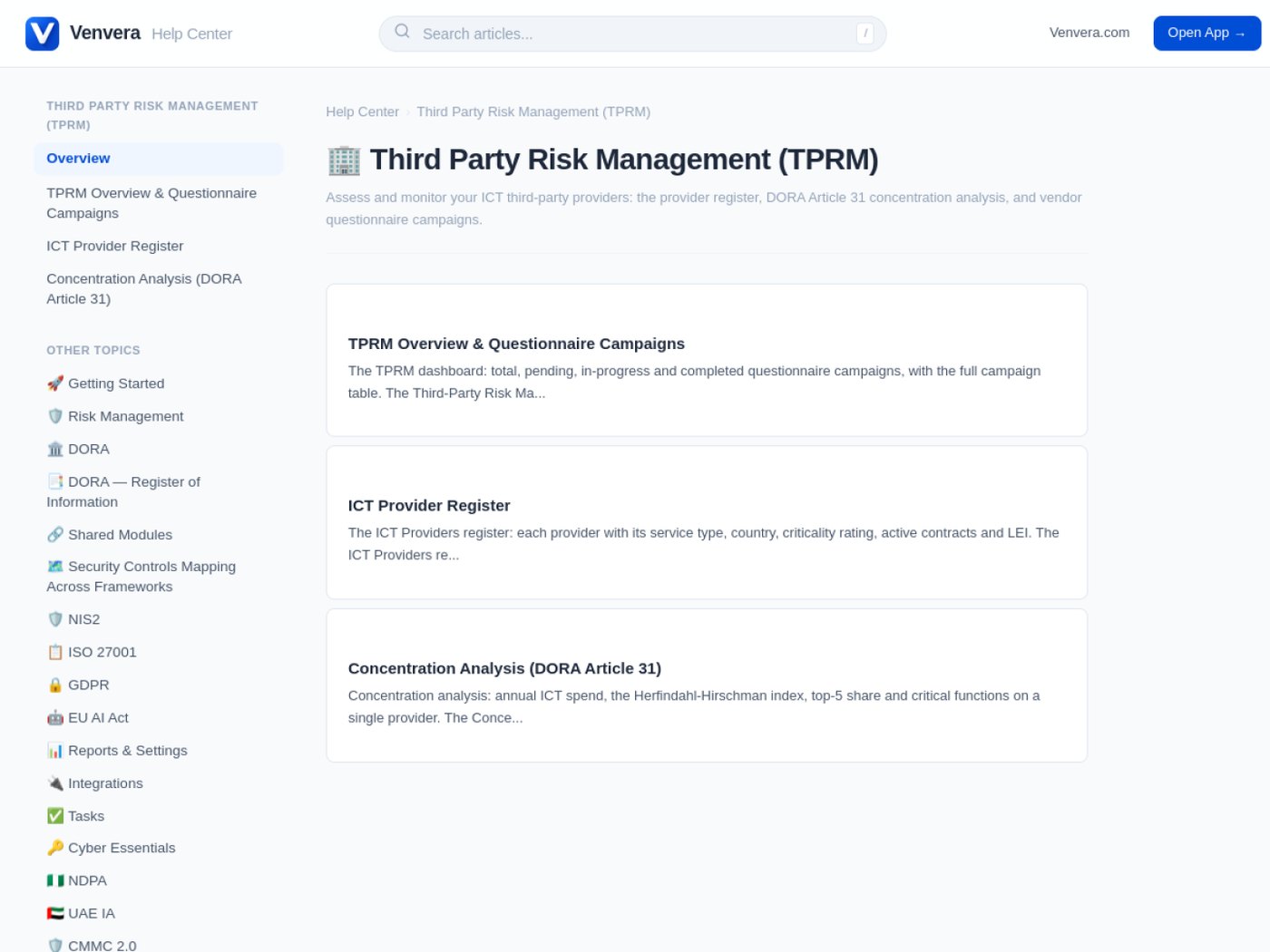
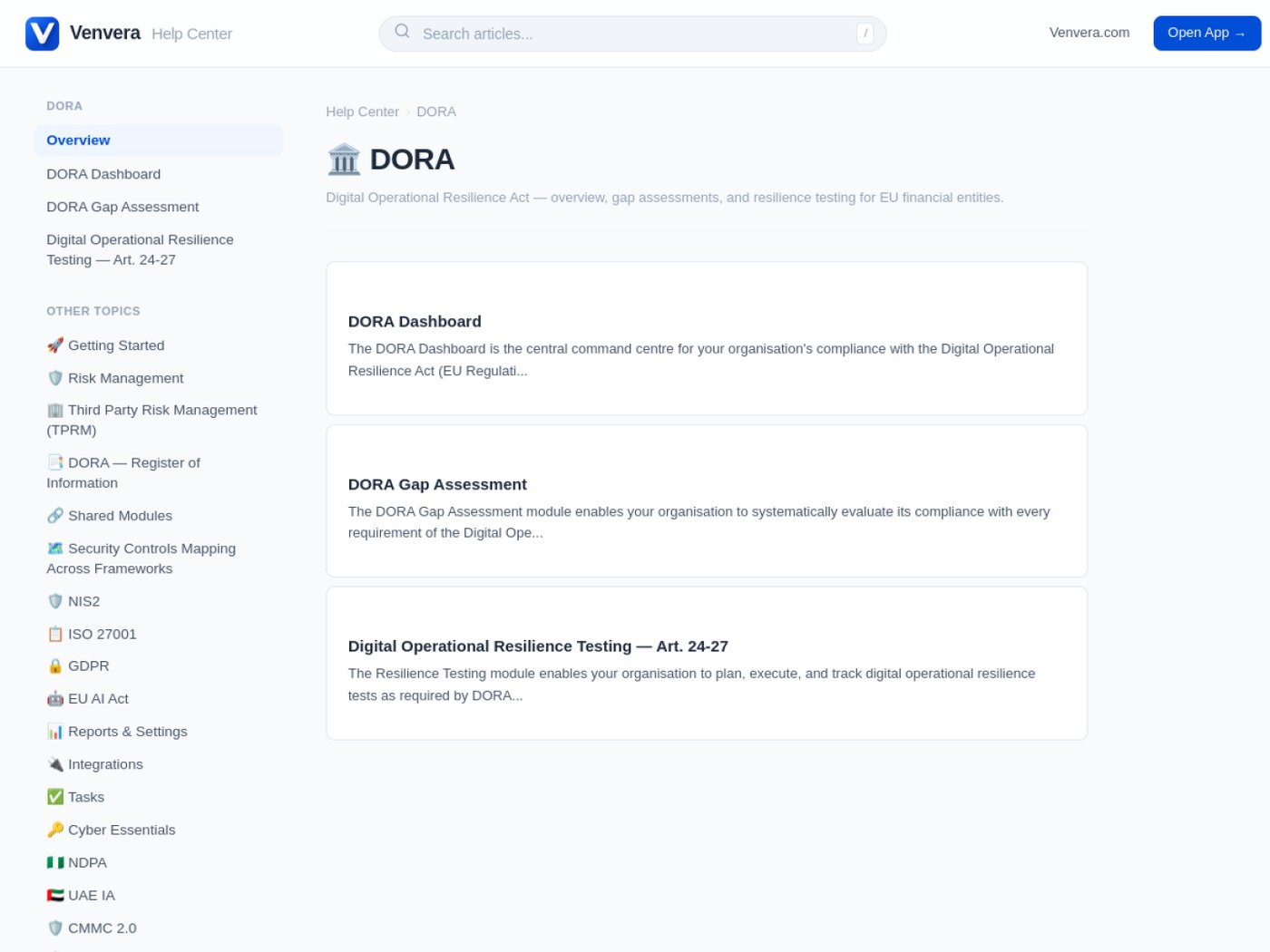
The part that most tools miss is concentration risk. Under DORA Article 31, you are expected to understand how dependent you are on any single provider. Venvera calculates it for you: annual ICT spend, the Herfindahl-Hirschman Index, your top-5 vendor share, and a clear flag on any critical function that rests on a single provider. That is the difference between claiming you manage vendor risk and being able to prove it to a regulator. For designated financial entities we run this as a dedicated engagement through TLPT for DORA: scope your authority validates, targeted threat intelligence, and the evidence pack the supervisor signs off.
Compliance across every framework, without doing the work twice
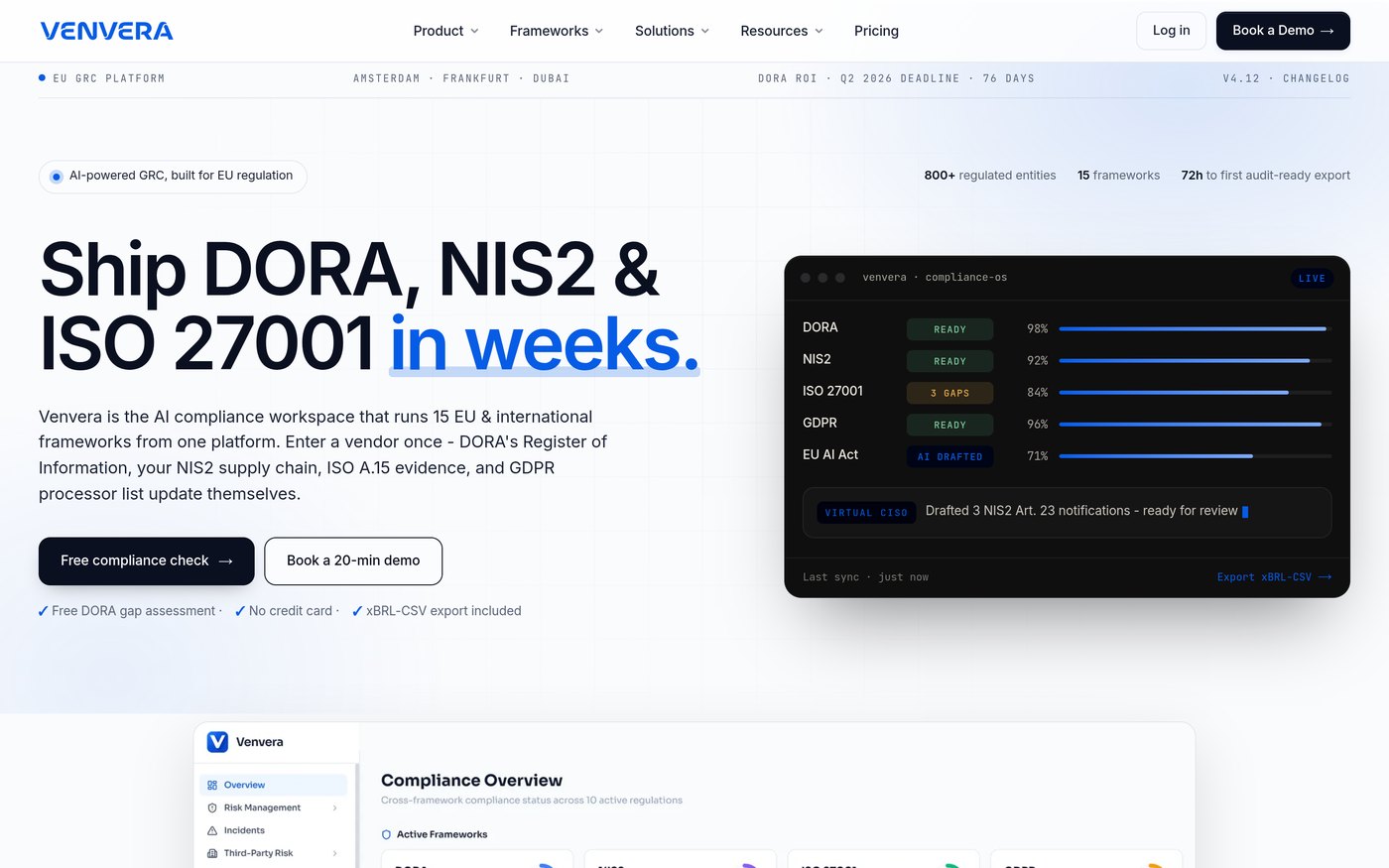
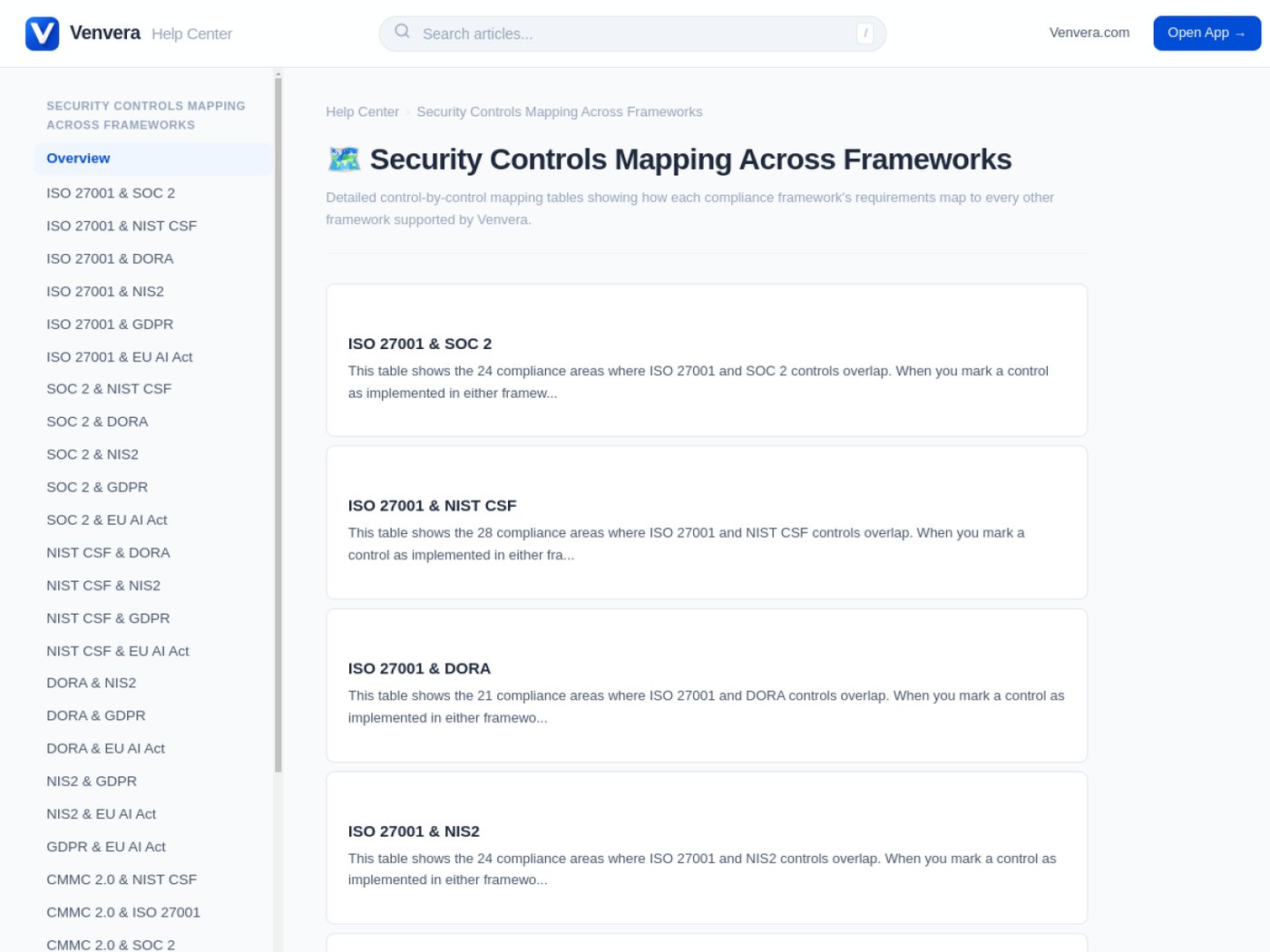
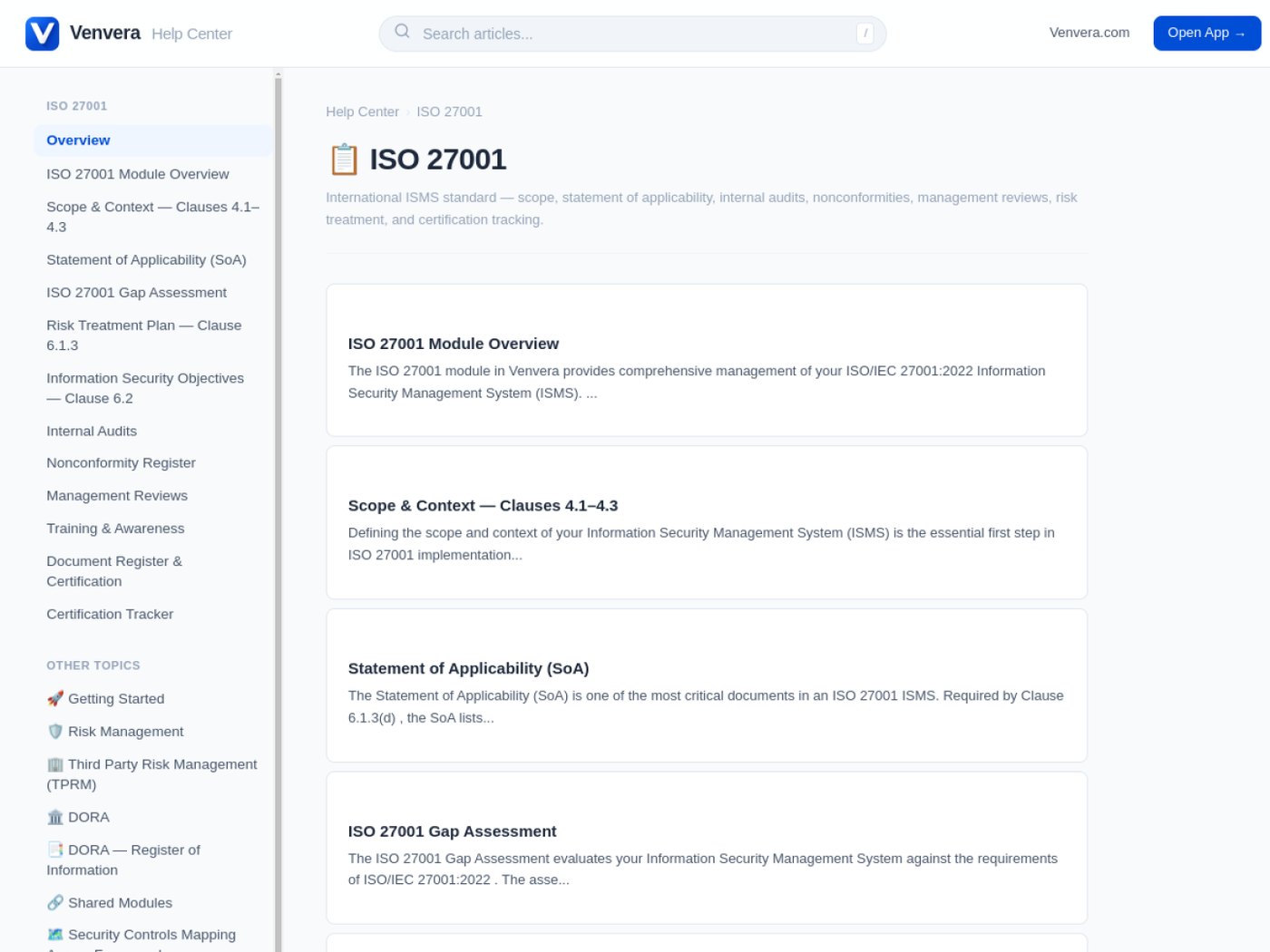
Venvera supports a genuinely broad set of frameworks: DORA, NIS2, GDPR, the EU AI Act, ISO 27001, Cyber Essentials, CMMC 2.0, PCI-DSS, HIPAA, Solvency II, SAMA CSF, Saudi NCA ECC, and more. The point is not the length of the list. It is that they share a single control layer underneath.
Through control propagation and security controls mapping across frameworks, a control you implement once satisfies its equivalents everywhere it applies. Add ISO 27001 and SOC 2 and DORA, and Venvera recognises the overlap instead of asking you to evidence the same control three times. Cross-framework task management then auto-generates the compliance work items each framework needs and routes them to owners, so "get compliant" becomes a tracked queue of tasks rather than an overwhelming wall.
AI that does the compliance busywork
Compliance has always been drowning in manual effort: gathering evidence, checking policies against controls, answering the same questions for the hundredth time. Venvera puts AI to work on precisely that drudgery.
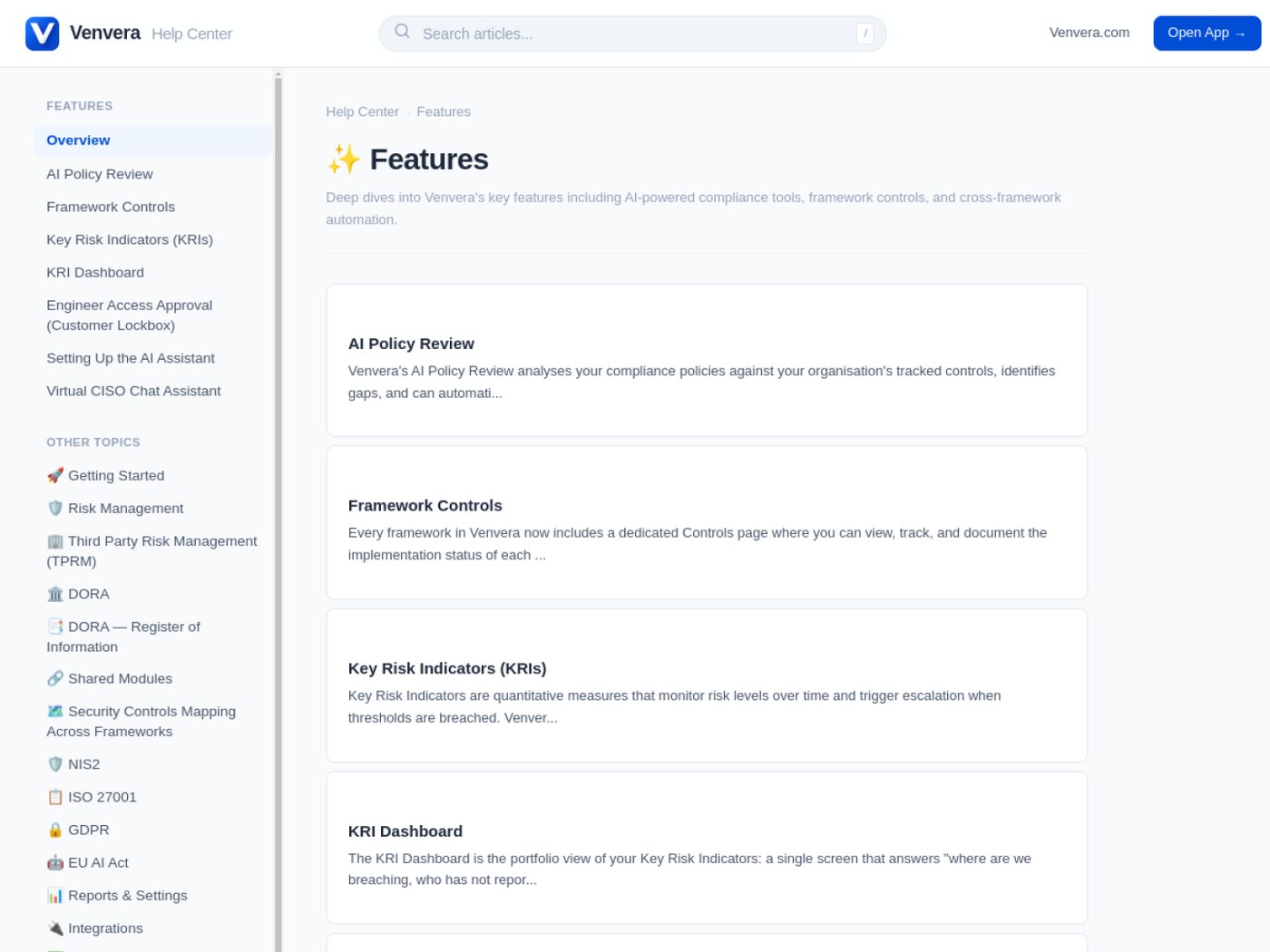
- AI policy review analyses your policies against your tracked controls, identifies the gaps, and can help close them.
- An AI evidence assistant helps collect and organise the evidence auditors demand, backed by a reusable evidence library with freshness and renewal tracking so nothing goes stale.
- A virtual CISO chat assistant is always available to answer compliance questions in plain language.
Evidence, integrations, and board-ready reporting
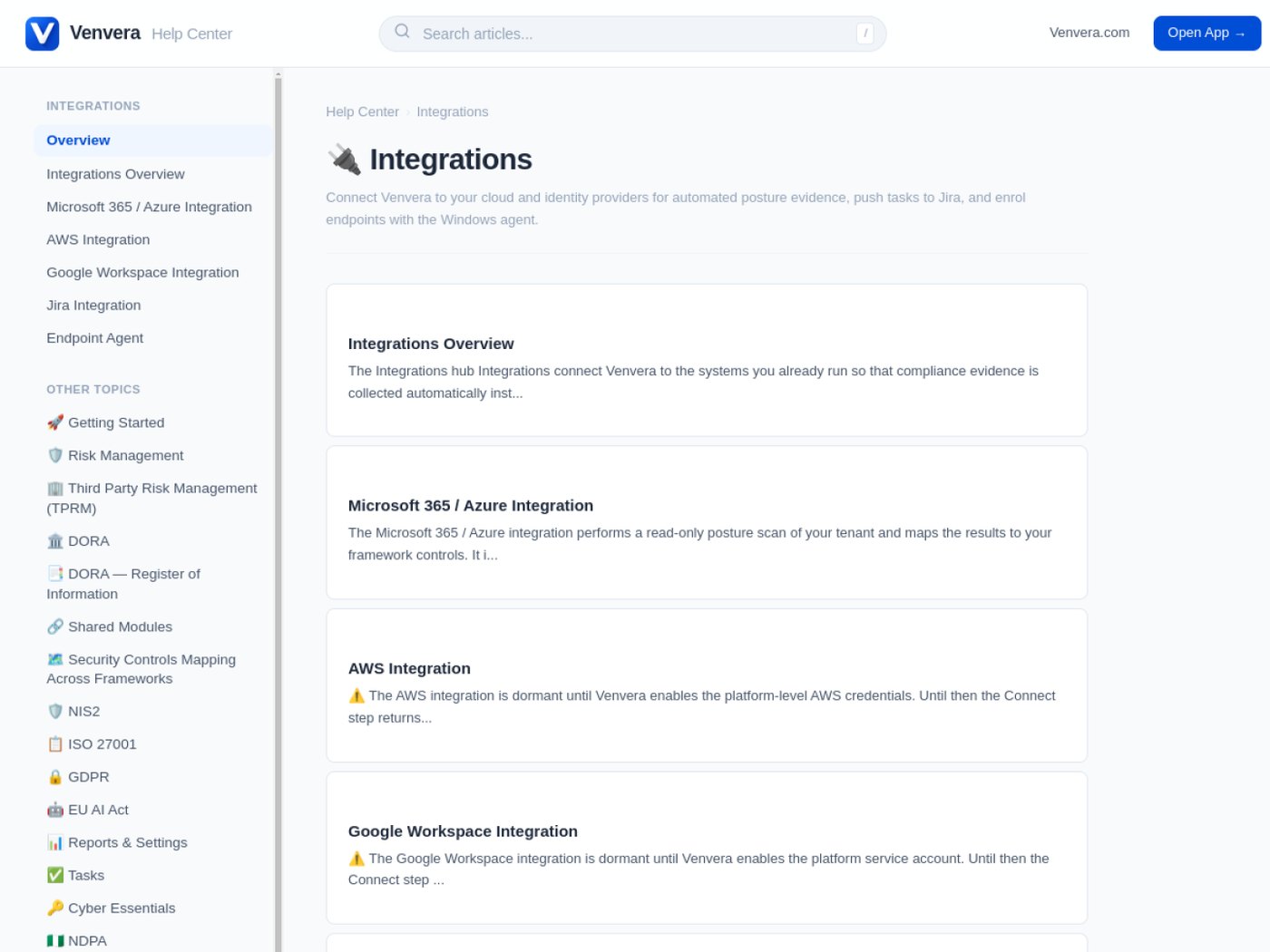
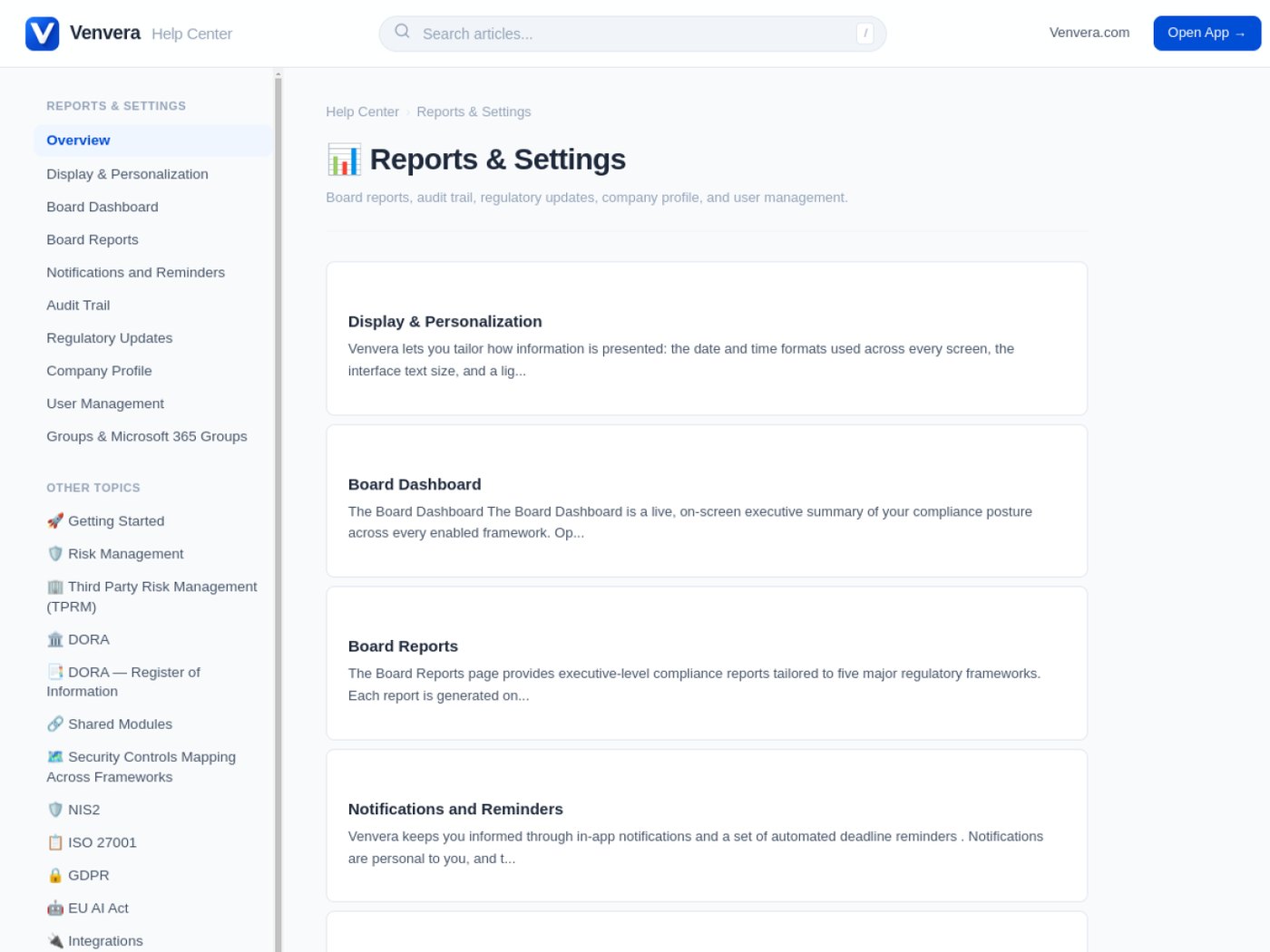
Venvera connects to your cloud and identity providers to pull automated posture evidence, pushes tasks straight to Jira, and enrols endpoints with a Windows agent, so a large share of your evidence collects itself. On the output side, board reports, audit trails, regulatory updates, and certification tracking mean the story of your programme is always ready to tell, whether the audience is your board, an auditor, or a regulator.
For groups and consultancies, Company Groups enable multi-tenant policy sharing across entities, and a Customer Lockbox model means no Venvera engineer can ever view your data without your explicit, time-bound approval. Governance applied to the platform itself.
Who Venvera is for
Venvera fits any organisation where compliance has outgrown spreadsheets: financial firms facing DORA and Solvency II, companies in scope for NIS2, SaaS businesses juggling SOC 2 and ISO 27001, healthcare handling HIPAA, and enterprises that must manage a long tail of ICT vendors under real regulatory scrutiny. If you are running more than one framework, or if a regulator expects to see your risk and vendor governance on demand, a connected GRC platform stops being a nice-to-have and becomes the only sane way to operate.
Frequently asked questions
What is GRC software?
GRC software brings governance, risk management and compliance into one system. Instead of separate spreadsheets per framework, it manages your risk register, your vendors, and every compliance framework together, with shared controls and evidence so you do the work once.
Is Venvera a risk management SaaS?
Yes. Venvera includes a full risk management module: a centralised risk register with likelihood-by-impact scoring, treatment decisions and owners, Key Risk Indicators with RAG thresholds, explicit risk appetite settings, control effectiveness tracking, and exportable risk snapshots for board reporting.
Does Venvera handle third-party risk management (TPRM)?
Yes. Venvera's TPRM module maintains an ICT Providers register (with service type, country, criticality, contracts and LEI), runs vendor questionnaire campaigns, and calculates DORA Article 31 concentration risk including the Herfindahl-Hirschman Index and top-5 vendor share.
Which compliance frameworks does Venvera support?
DORA, NIS2, GDPR, the EU AI Act, ISO 27001, Cyber Essentials, CMMC 2.0, PCI-DSS, HIPAA, Solvency II, SAMA CSF, Saudi NCA ECC and more. Controls map across frameworks, so implementing a control once satisfies its equivalents everywhere it applies.
How does Venvera reduce compliance workload?
Control propagation means you evidence a shared control once, not per framework. Cross-framework task management auto-generates and assigns work items. AI policy review finds gaps, an AI evidence assistant helps collect evidence, and integrations pull automated posture evidence from your cloud and identity providers.
How does Venvera keep our data secure?
Venvera uses a Customer Lockbox model: no Venvera engineer can view your organisation's data without your explicit, time-bound approval. Combined with audit trails and role-based access, governance is applied to the platform itself, not just the frameworks it manages.
Retire the compliance spreadsheets
Run your risk register, your vendors, and every framework from one connected platform, with AI handling the busywork and evidence that is always audit-ready.
Explore Venvera GRC platform