Strengthening Healthcare IT Security through Comprehensive Security Audits
Alexander Sverdlov
Security Analyst

Healthcare is the industry where a security failure is not measured only in dollars. When a hospital's systems go down, ambulances get diverted, surgeries get postponed, and clinicians fall back to paper in the middle of caring for patients. That is what makes healthcare such a persistent target: attackers know the pressure to restore operations is enormous, and the data is among the most valuable on the criminal market. A stolen credit card gets cancelled in a day. A medical record, with its history, identifiers, and insurance details, does not expire.
I am Alexander Sverdlov, founder of Atlant Security and a former Microsoft security consultant. Over more than 200 assessments across 14 countries, healthcare environments consistently stand out for one reason: they combine extremely sensitive data with unusually complex, hard-to-patch technology. This article explains the real security challenges healthcare organizations face, why a proper IT security audit is the right starting point, and what practical steps meaningfully reduce risk.
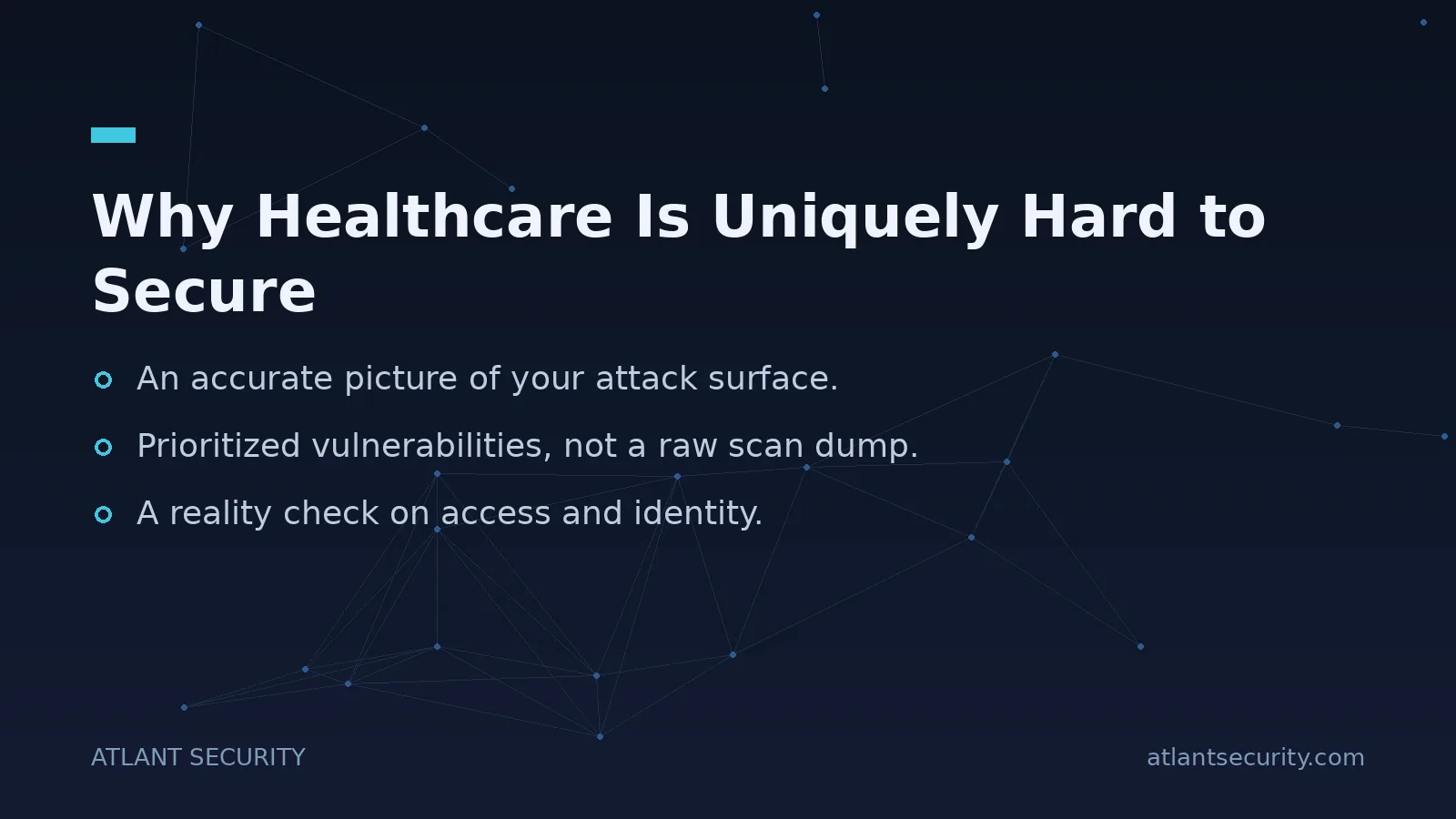
Why Healthcare Is Uniquely Hard to Secure
Most industries deal with servers, laptops, and cloud applications. Healthcare deals with all of that plus a layer that almost nobody else has: connected medical devices that keep patients alive and cannot simply be rebooted or patched on a Tuesday afternoon. Understanding the specific challenges is the first step to addressing them.
Electronic Health Records Concentrate Risk
Electronic health records made care faster and more coordinated, but they also concentrated enormous amounts of sensitive data into systems accessed by hundreds or thousands of users. Every clinician, nurse, billing clerk, and contractor who touches the record is a potential access path. The security question is rarely whether the EHR vendor's software is sound. It is whether access to it is controlled, monitored, and limited to what each role actually needs.
Connected Medical Devices Are the Weak Link
Infusion pumps, imaging systems, patient monitors, and lab equipment increasingly run on networks, and many run outdated, unpatchable operating systems that the manufacturer certified years ago. You cannot treat these like a normal laptop. You often cannot install security agents on them, and taking them offline for updates may not be an option. These devices are frequently the softest target in a hospital network, and once compromised they become a foothold into everything else.
Compliance Is a Floor, Not a Ceiling
Healthcare organizations must meet requirements such as HIPAA in the United States and the GDPR for patient data in Europe. Compliance matters, but I want to be direct about something I see constantly: organizations that treat the regulation as the finish line remain very breachable. HIPAA tells you to conduct a risk analysis and protect data. It does not hand you a secure configuration. Passing an audit and being genuinely secure are related but not the same thing. Our HIPAA compliance work is built around closing that gap, not just checking boxes.
The Threat Landscape Targets Availability
Ransomware operators specifically target healthcare because downtime is intolerable. When patient care depends on systems being available, the incentive to pay is higher, and attackers know it. This makes availability, not just confidentiality, a core security objective in healthcare. Backups that are tested and truly isolated are as much a patient-safety control as they are an IT control.
Why an IT Security Audit Comes First
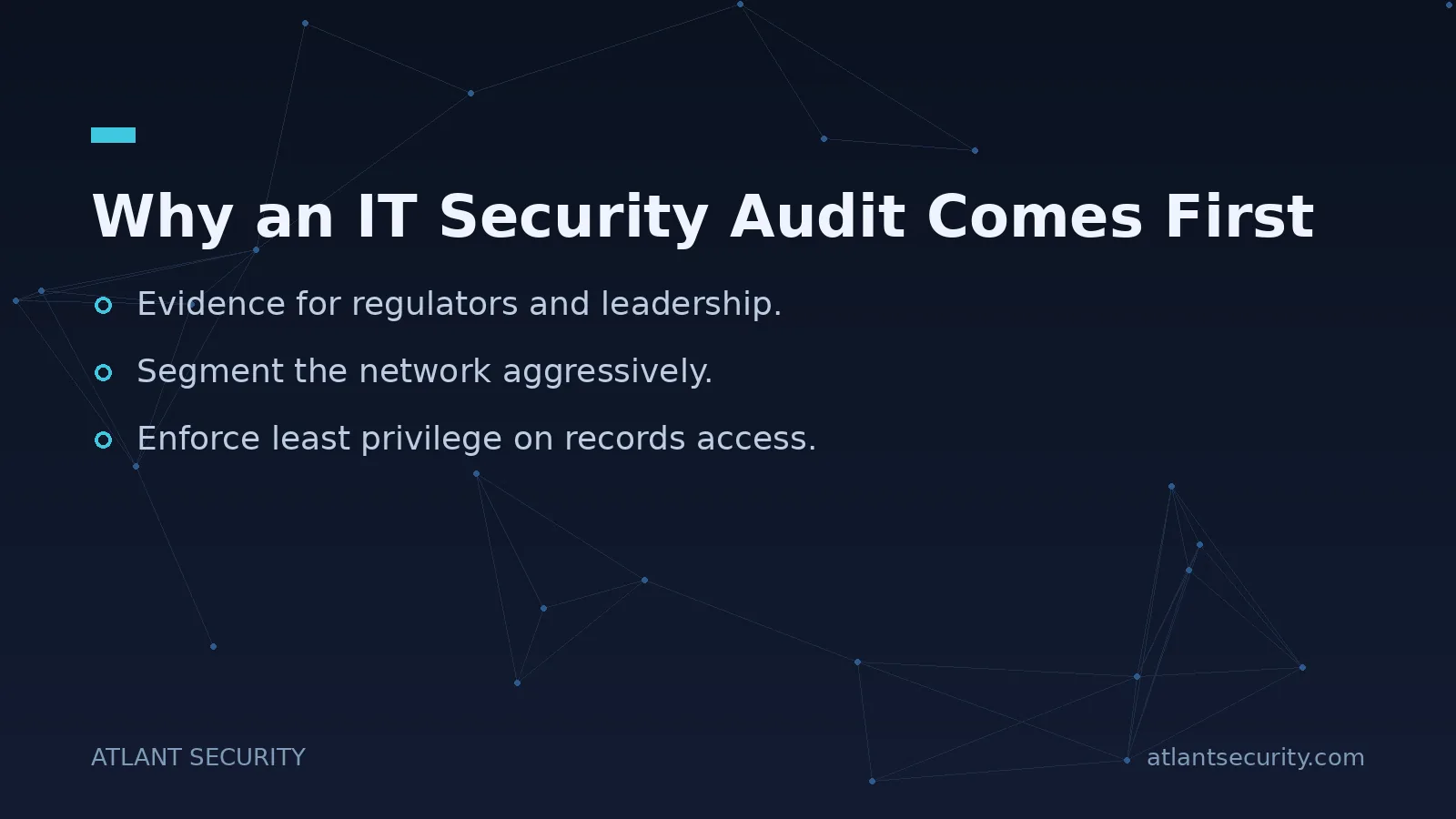
You cannot protect what you have not honestly assessed. In healthcare I frequently find organizations buying security products before they understand their own environment, which is like prescribing before diagnosing. A structured IT security audit gives you the diagnosis. Done properly, it delivers several things a product purchase never will.
- An accurate picture of your attack surface. Most healthcare organizations do not have a complete, current inventory of what is connected to their network, especially medical devices. You cannot secure devices you do not know exist.
- Prioritized vulnerabilities, not a raw scan dump. A good audit tells you which of thousands of findings actually matter for your environment and your threat model, so limited staff time goes to the highest-impact fixes first.
- A reality check on access and identity. Audits routinely surface former employees with active accounts, shared logins on clinical workstations, and administrators with far more access than they need.
- Evidence for regulators and leadership. A documented assessment supports your compliance obligations and gives the board a clear, honest view of where the risk sits.
The point of an audit is not to generate a thick report that sits on a shelf. It is to produce a short, ranked list of things to fix and the confidence that you are fixing the right things.
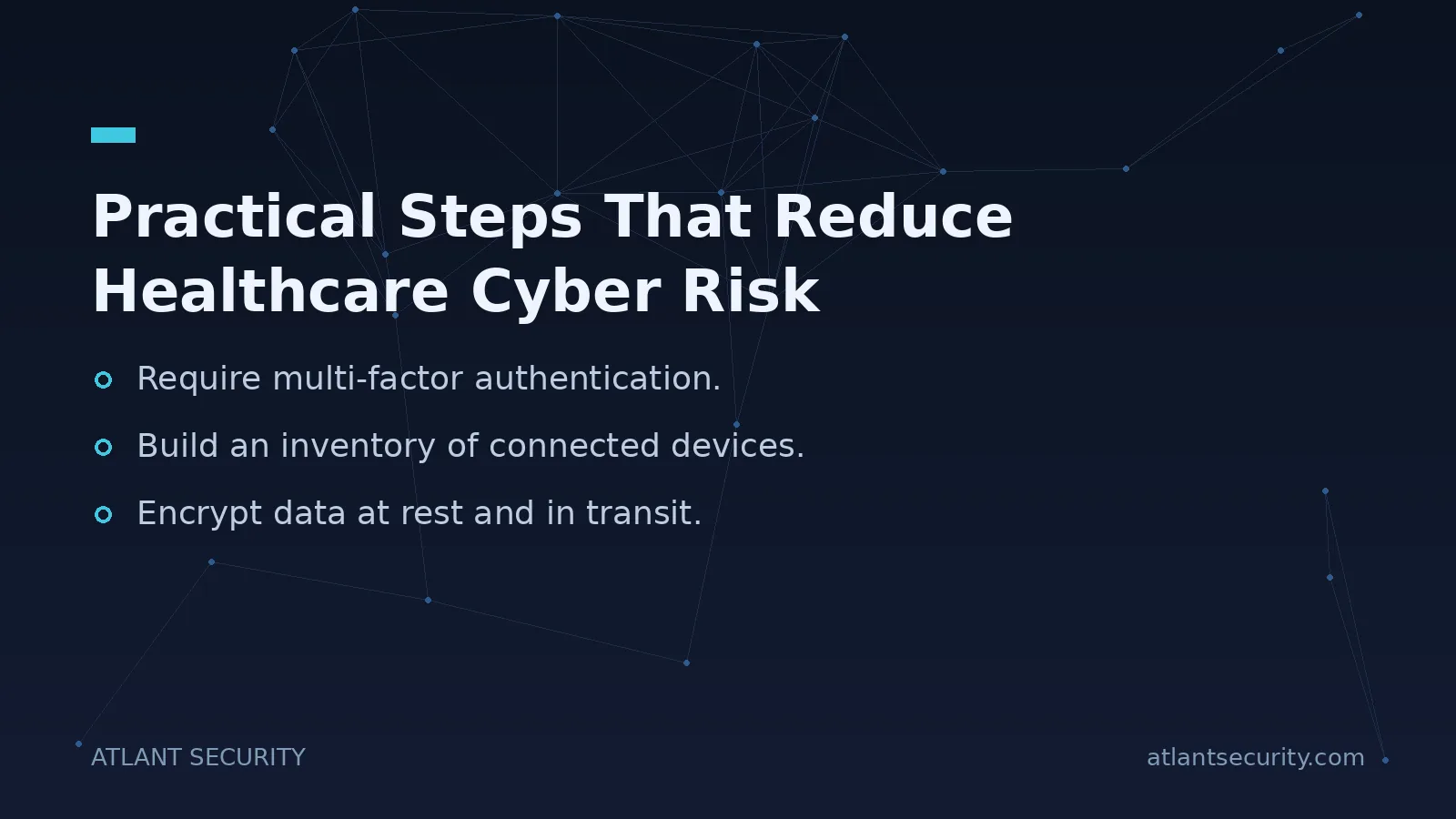
Practical Steps That Reduce Healthcare Cyber Risk
Once you know where you stand, the improvements that move the needle in healthcare are not exotic. They are the fundamentals, applied with discipline in a difficult environment.
- Segment the network aggressively. Medical devices, clinical workstations, guest wifi, and administrative systems should not share a flat network. Segmentation is the control that contains an infusion pump compromise so it does not become an enterprise ransomware event.
- Enforce least privilege on records access. Clinicians should reach the records relevant to their role and their patients, and access should be logged. Broad, unmonitored access to the full EHR is both a breach risk and a compliance problem.
- Require multi-factor authentication. Especially for remote access, email, and administrative accounts. Stolen credentials are the most common entry point, and MFA blocks the majority of those attempts.
- Build an inventory of connected devices. You need to know every device on the network, its operating system, and its patch status. For devices that cannot be patched, compensate with segmentation and monitoring.
- Encrypt data at rest and in transit. Encryption turns a lost laptop or intercepted transfer into a non-event rather than a reportable breach.
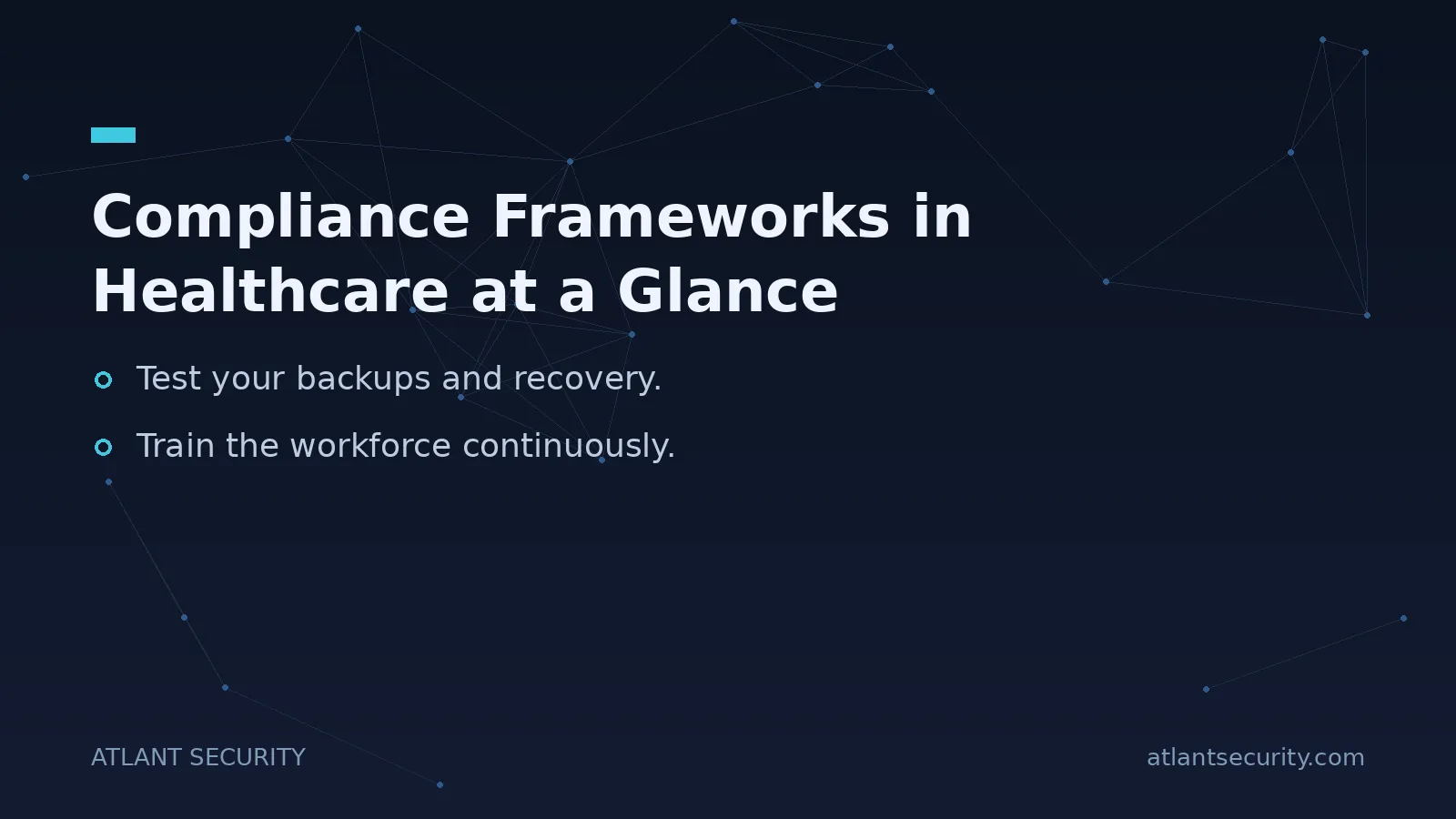
- Test your backups and recovery. Isolated, tested backups are your best defense against ransomware. The time to discover your backups do not restore is not during an active incident.
- Train the workforce continuously. Clinical staff are busy and targeted. Short, frequent, realistic training and a simple way to report suspicious messages do more than an annual slide deck.
Compliance Frameworks in Healthcare at a Glance
Healthcare organizations often juggle several obligations at once. Understanding what each one is actually for helps you avoid duplicating effort.
| Framework | Primary Focus | Applies To |
|---|---|---|
| HIPAA | Protection of patient health information | US healthcare providers, plans, and their vendors |
| GDPR | Personal data protection and patient rights | Organizations handling EU residents' data |
| SOC 2 | Security controls for service providers | Health tech and SaaS vendors serving healthcare |
| ISO 27001 | Information security management system | Organizations wanting a certifiable security program |
If you are a health technology vendor rather than a provider, your customers will increasingly ask for SOC 2 or ISO 27001 readiness before they sign. Getting ahead of that requirement removes a common obstacle in enterprise healthcare sales cycles.
Where Healthcare Security Programs Fall Short
A few recurring failures explain most of the healthcare incidents I have investigated. Flat networks where a single compromised device reaches clinical systems. Medical devices nobody inventoried and nobody is monitoring. Access that was granted years ago and never reviewed. Backups that were never tested until the day they were needed. And a compliance mindset that mistook a passed audit for actual security.
None of these require a huge budget to fix. They require honest assessment and disciplined follow-through. The organizations that protect patient data well are the ones that treat security as an ongoing operational responsibility, not a once-a-year project. If you want a clear, prioritized view of where your healthcare IT security stands, that starts with an audit and a conversation.
Frequently Asked Questions
Does HIPAA compliance mean our systems are secure?
No. HIPAA sets a baseline and requires you to perform a risk analysis and protect patient data, but it does not prescribe a secure configuration. I have assessed organizations that passed their compliance reviews and were still highly exploitable. Treat compliance as the floor. Real security comes from testing your defenses against how attackers actually operate and fixing what you find.
How do we secure medical devices that cannot be patched?
When you cannot patch or install security software on a device, you compensate with the environment around it. Put those devices on segmented network zones so they cannot reach clinical or administrative systems directly, monitor their traffic for anything abnormal, and restrict which systems can communicate with them. Segmentation and monitoring are how you protect a device you cannot harden directly.
What is the biggest cybersecurity threat to healthcare organizations?
Ransomware remains the most damaging threat because it attacks availability, and in healthcare downtime directly affects patient care. The usual entry points are stolen credentials and phishing. The most effective defenses are multi-factor authentication, network segmentation to contain spread, and tested, isolated backups so you can recover without paying.
How often should a healthcare organization conduct a security audit?
At minimum annually, and again after any significant change such as a new clinical system, a merger, or a major infrastructure shift. Between full audits, continuous vulnerability scanning and access reviews keep you aware of new gaps. The environment changes constantly as devices and users come and go, so a once-and-done assessment goes stale quickly.
Who is responsible for security of patient data in the cloud?
Cloud and EHR vendors secure their platforms, but you remain responsible for how you configure and use them, including access controls, sharing settings, and user management. This shared responsibility is where most avoidable exposures occur. Misconfigured access to a cloud-hosted records system is your risk to manage, not the vendor's.
We are a small clinic. Do these risks really apply to us?
Yes, and often more so. Attackers frequently target smaller healthcare providers precisely because they have the same valuable data with fewer security resources. The good news is that the highest-impact controls, such as MFA, backups, segmentation, and staff training, are achievable at any size. A right-sized audit will focus you on the few things that matter most for your situation.
Protecting patient data is a responsibility that sits at the intersection of security, compliance, and patient safety. If you want an honest assessment of where your healthcare IT security stands and a prioritized plan to strengthen it, book a discovery call and we will start with the questions that matter most for your organization.

Alexander Sverdlov
Founder of Atlant Security. Author of 2 information security books, cybersecurity speaker at the largest cybersecurity conferences in Asia and a United Nations conference panelist. Former Microsoft security consulting team member, external cybersecurity consultant at the Emirates Nuclear Energy Corporation.