

Incident Response · Ransomware · June 2026
Ransomware Negotiation Services: When They Help, When to Avoid Them, and What to Do Instead
Ransomware negotiation services are a real professional category, and under the right conditions they genuinely move outcomes. But the reflex to "get a negotiator on the phone" is one of the most expensive mistakes a company can make in the early hours of an attack. The decision to negotiate is not an emergency workaround. It is a deliberate choice made with breach counsel, your cyber insurer, and sanctions-screening guidance, after you already know whether you have anything to negotiate about.
Key Takeaways
- Negotiation is a decision, not a reflex. If you have clean, recoverable backups, a sanctions-listed threat actor, or evidence the data is already public, then paying or negotiating may accomplish nothing or create new legal exposure. The disciplined path is to scope first, then decide with counsel and your insurer.
- Paying can be unlawful. The U.S. Treasury's OFAC has published advisories making clear that payments to sanctioned actors carry civil and criminal exposure for the paying company, regardless of who conducts the negotiation. Sanctions screening is not optional due diligence; it is a legal requirement before any payment is made.
- Professional negotiation genuinely helps in specific circumstances: buying time to finish recovery, obtaining proof-of-life for the data, gathering intelligence about the actor, and reducing an initial demand. These are real benefits, but only relevant when the underlying math makes payment a rational option.
- Double and triple extortion mean payment no longer resolves the incident. Modern ransomware groups routinely encrypt files, exfiltrate data, and threaten customers or partners separately. Paying the encryption ransom does not recover leaked data, silence secondary extortion, or stop the data from being sold. Payment buys less than it used to.
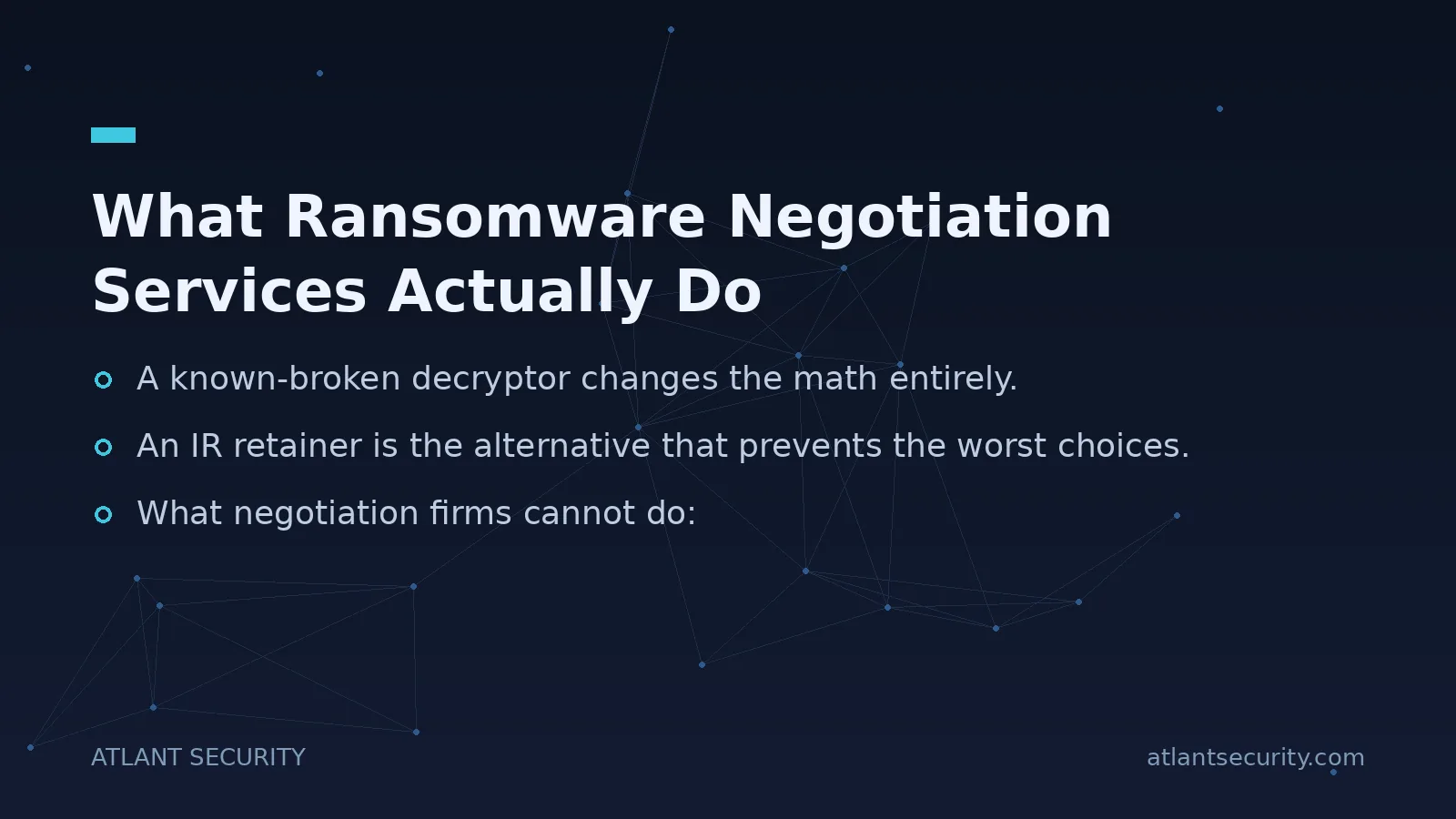
- A known-broken decryptor changes the math entirely. Threat intelligence services track decryptors and many are known to fail or cause further data loss. Paying for a non-functional key is money spent for nothing, and this is a check that should be made before any payment decision, not after.
- An IR retainer is the alternative that prevents the worst choices. Companies with a tested incident response plan, immutable backups, and a retained response firm almost never face a binary pay-or-lose scenario. The investment in preparation is a small fraction of the cost of a negotiated ransom.
The call came in on a Wednesday afternoon. The CEO of a 60-person professional services firm had just been handed a ransom note by the IT manager who had found it on the file server. The note named a demand of $380,000, gave a four-day deadline, and included a link to a dark-web chat portal with a countdown timer. The CEO had already been on the phone with a contact who had given her the name of a "ransomware negotiation specialist." Her question to us was simple: how fast can we get them engaged?
We told her we could engage a negotiator in hours, but that doing so right now would almost certainly waste money and might create legal problems. The reason was something nobody had checked yet: whether the firm had functional backups. We put the negotiator question on hold and spent the next 90 minutes on what mattered. The IT manager found two things. First, the firm's file server backups were clean, current to 18 hours earlier, and stored in an immutable cloud bucket the attacker had never reached. Second, the threat actor group named in the ransom note had been added to OFAC's Specially Designated Nationals list seven weeks prior, making any payment a potential sanctions violation without prior Treasury authorization.
There was no good reason to negotiate. Engaging a negotiator would have cost a retainer fee, opened a dialogue that creates its own obligations and risks, and any eventual payment would have required a specific license from the Treasury or exposed the company to civil penalties. We isolated the encrypted systems, stood up a clean environment from the backups, engaged breach counsel, and had the company's most critical functions running by the end of the following day. The total cost was around $40,000 in incident response fees, some downtime, and a timeline log that the firm's insurer accepted without question.
That outcome was not luck. It was the product of checking the most basic question before reaching for the most dramatic option. Ransomware negotiation services exist for situations where the negotiated path is genuinely the best path. In this firm's case, it was not, and discovering that early saved them a significant sum and a potential regulatory problem. The goal of this article is to give you the framework to make that determination correctly, before the clock starts and the pressure begins.
Section 1
What Ransomware Negotiation Services Actually Do
The term "ransomware negotiation service" covers a range of providers whose actual work varies considerably. At the serious end of the market, these are firms with former law enforcement, intelligence, and cybersecurity backgrounds. They monitor threat actor infrastructure, maintain dossiers on known groups and their behavior patterns, speak the language of these criminal organizations, and know from experience which demands are real and which are opening gambits. They serve a genuine function. At the less serious end, some providers are primarily skilled at charging high fees for email exchanges with attackers that a competent IT manager could conduct independently.
The core services a legitimate negotiation firm provides fall into four categories. The first is intelligence. A professional firm can often identify the threat actor group from the ransom note, the encryption method, and the infrastructure used, and that identification tells you a great deal about the likelihood of a functional decryptor, the group's history of following through on promises, and whether they are on a sanctions list. This intelligence has value regardless of whether you ultimately pay.
The second is time. A skilled negotiator can extend the deadline, often significantly, through a combination of expressed willingness to engage and requests for proof-of-life. That extended window may be exactly what your technical team needs to finish testing the recovery from backups, or what your legal team needs to complete sanctions screening and get counsel's advice on the payment decision. Buying time without committing to payment is one of the most valuable things a negotiator actually provides.
The third is demand reduction. Ransomware actors frequently set initial demands at multiples of what they will accept. Professional negotiators, who conduct many of these engagements and understand the going discount rates for different actor groups, consistently achieve reductions of 30 to 70 percent from the opening demand. If payment is ultimately the right decision, paying $120,000 instead of $350,000 is a material outcome and the negotiator's fee earns itself many times over.
The fourth is proof-of-life and decryptor validation. Before any payment is made, a professional negotiator obtains a sample decryption from the attacker, typically a small set of files you provide encrypted, which are returned decrypted as proof that the key works. This validation step is essential because a significant share of decryptors for some groups are known to be unreliable, corrupting files instead of restoring them. Proof-of-life does not guarantee the key will work at scale, but it is a necessary check, and skipping it is how companies pay and still lose their data.
What negotiation firms cannot do: They cannot guarantee the attacker deletes exfiltrated data. They cannot make a sanctions-listed payment legal. They cannot recover data that the attacker has already published. They cannot prevent a second extortion demand after the first is paid. And they cannot turn a bad recovery situation into a good one if the underlying decision to pay was wrong. Negotiators are a tool, not a solution.
Section 2
When Professional Negotiation Genuinely Helps
There is a real set of circumstances where a professional negotiator improves the outcome in a meaningful way. These are not edge cases; they are the situations that a significant share of ransomware victims actually find themselves in. The key is identifying whether your situation fits the profile before engaging, not reflexively calling a negotiator because the ransom note is frightening.
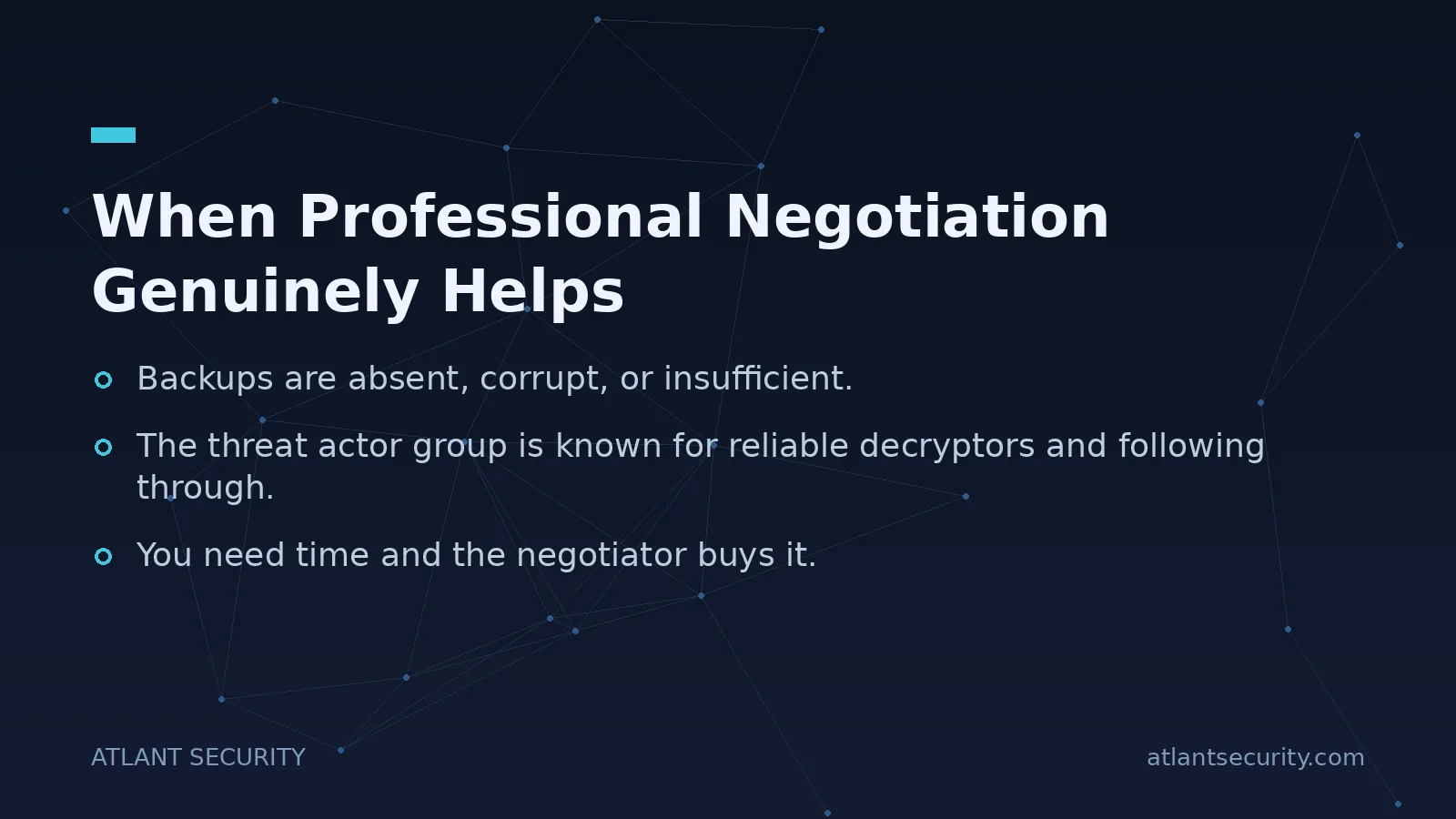
Backups are absent, corrupt, or insufficient. If you cannot recover from backups - because they were encrypted in the same attack, because testing reveals they are incomplete, or because recovery would take weeks and the business cannot survive weeks of downtime - then the negotiated payment path becomes a realistic option. This is the scenario negotiation services were built for, and where their ability to reduce demands, validate decryptors, and buy time translates directly into a better outcome than the alternative.
The threat actor group is known for reliable decryptors and following through. Threat intelligence distinguishes actor groups by their operational behavior. Some groups run what security researchers call "professional" operations: they provide working decryptors, they negotiate in good faith to a final number, and they do not typically re-attack the same victim. When the group identified from the ransom note is in this category and the demand is within a range the business can survive, the pay-and-recover path has a track record that makes it a rational choice.
You need time and the negotiator buys it. Even if the ultimate decision is to recover without paying, buying two additional weeks through an extended negotiation while your team restores critical systems can be worth the negotiator's retainer on its own. The countdown clock on the ransom portal is a pressure tactic, and a professional negotiator knows how to neutralize it without committing your company to anything.
The data exfiltration threat is credible and the business impact is severe. In double or triple extortion scenarios, even a company with good backups may face a separate calculation about the exfiltrated data. If the data includes material non-public financial information, patient records, or information that creates regulatory exposure upon disclosure, the negotiation about deletion (with all its caveats about enforceability) may be a separate decision from the encryption recovery decision. These are complex judgment calls that benefit from a sophisticated negotiator and invariably require counsel's input.
Section 3
When Negotiation Is the Wrong Move
The situations where you should not negotiate, or not pay, even if you negotiate, are more common than the situations where you should. Understanding this clearly before an incident happens is what separates organizations that make deliberate decisions from those that react.
Clean, recoverable backups exist. This is the most important disqualifier and the most frequently overlooked in the panic of the first hours. If you can recover all or nearly all of your critical data from tested, offline or immutable backups within a timeframe the business can absorb, there is rarely a rational case for paying a ransom. The cost of the recovery, the IR retainer, and potentially some overtime and a few days of downtime will almost certainly be less than the ransom demand, and you retain control of the outcome rather than depending on a criminal to provide a working key. Verify your backups before you do anything else.
The threat actor is on a sanctions list. OFAC's Specially Designated Nationals and Blocked Persons list includes a number of ransomware operators and groups. Making a payment to a sanctions-listed entity - whether you make it directly or a negotiation firm makes it on your behalf - creates civil and potentially criminal exposure under the International Emergency Economic Powers Act. The fact that you did not know the actor was sanctioned is a factor OFAC weighs but does not eliminate liability. Sanctions screening is a required step before any payment is made or seriously contemplated, and if the actor is sanctioned, the path forward runs through counsel and potentially a license application to Treasury, not through a negotiation portal.
The exfiltrated data is already published. The extortion threat in double-extortion scenarios is that the attacker will publish your data unless paid. Once the data is already on a leak site, that threat is moot. Payment at that point cannot un-publish the data, cannot prevent it from being downloaded by third parties who have already accessed it, and cannot create any verifiable obligation on the attacker's part to remove it. Paying after publication is paying for a promise that cannot be kept about something that has already happened.
The group's decryptor is known to be unreliable. Threat intelligence services maintain records on the decryptors used by known ransomware groups. Some groups provide tools that reliably restore files at scale. Others provide tools that work on small samples for the proof-of-life but corrupt files at scale, or that decrypt with significant data loss, or that simply stop working partway through a large recovery. Paying for a broken tool is one of the worst outcomes in a ransomware incident, because you have now paid the ransom and still need to recover from backups, in a best case, or accept data loss in a worse one. This check should be made with threat intelligence before any payment is authorized.
The double and triple extortion reality: Most active ransomware groups now conduct at least two simultaneous threats: encrypting files and threatening to publish exfiltrated data. Some add a third layer, contacting the victim's customers, partners, or regulators directly. Payment of the encryption ransom resolves only the first threat, and only partially. Attackers who receive payment regularly return with a second demand for the data, exploiting the fact that the victim has already demonstrated willingness to pay. Each payment validates the model and creates an expectation of further payments.
The negotiation costs money and time you do not have. Even in situations where none of the hard disqualifiers apply, the engagement cost of a professional negotiation firm runs from several thousand dollars to tens of thousands just to open the engagement, independent of any eventual payment. That cost is not always justified when the underlying reason for engaging - usually the absence of viable backups - could have been prevented at a fraction of the price. The economics of negotiation only make sense when the alternative to paying the (reduced) demand is substantially worse. If your IR firm can restore your environment from backups for $30,000 in fees and you have those backups, spending $15,000 on a negotiator to potentially reduce a $200,000 ransom to $120,000 and then paying the $120,000 anyway is arithmetically worse than the recovery path.
| Factor | Consider negotiation / payment | Do not negotiate / pay |
|---|---|---|
| Backups | Absent, encrypted, or recovery exceeds business tolerance | Clean, tested, offline or immutable backups within acceptable RTO |
| Sanctions status | Actor not on OFAC SDN list (confirm with counsel) | Actor is on SDN list - payment may be unlawful |
| Decryptor reliability | Group has track record of working decryptors; proof-of-life validated | Decryptor known to be broken or unreliable at scale |
| Data exfiltration | Data not yet published; actor has history of honoring deletion | Data already on leak site; deletion unenforceable regardless |
| Insurer involvement | Insurer notified, payment pre-approved under policy terms | Payment would void coverage; no coverage exists |
| Business impact | Downtime cost exceeds ransom; recovery time is unacceptable | Recovery cost is lower than the ransom + negotiation fees |
Section 4
The Sanctions Problem: Why OFAC Screening Is Not Optional
Of all the reasons not to pay a ransom without careful preparation, sanctions exposure is the one most companies fail to take seriously until it is too late. OFAC administers sanctions programs that prohibit U.S. persons and companies, and in some contexts non-U.S. companies with U.S. touchpoints, from transacting with designated entities. The Treasury issued a formal advisory specifically about ransomware payments, warning that payments to sanctioned actors risk civil penalties even when the payer did not know the actor was sanctioned.
This creates a practical problem. Ransomware operators do not disclose their sanctions status. Many operate under group names that change over time, use infrastructure in multiple jurisdictions, and deliberately obscure their identity during negotiations. The ransom note that arrives on your file server will not say "this is LockBit 3.0" or "this actor is on the OFAC SDN list." Identifying the actor requires threat intelligence, and checking that identification against the SDN list requires a deliberate step that companies under pressure tend to skip.
The practical requirement is this: before any payment is made, and preferably before any substantive negotiation that might imply a path to payment, the threat actor must be identified to the extent possible and screened against OFAC's SDN list and any other relevant sanctions lists. This is not a step you can delegate to the negotiation firm alone. It requires counsel's involvement, and depending on the jurisdiction and facts, it may require a formal legal opinion. If the screening returns a match or a credible concern, the path forward runs through an application for a specific OFAC license before any funds move, not through a faster negotiation.
How a professional negotiation firm handles sanctions: Any legitimate negotiation firm will conduct its own sanctions screening and will decline to facilitate payments to actors it identifies as sanctioned. However, actor identification is imperfect, and even a professional firm's due diligence does not create a legal safe harbor for your company. The paying entity bears the legal responsibility for the payment, which is why your own counsel must be involved and must independently assess sanctions exposure before money moves. Do not treat the negotiator's sanctions check as a substitute for your own legal advice.
There is also a disclosure consideration. In some contexts, particularly in the United States, a company that makes or facilitates a ransomware payment may have reporting obligations to FinCEN under anti-money-laundering regulations. Several legislative proposals that have moved through Congress in recent years would create mandatory reporting requirements for ransomware payments; depending on the timing of your incident, this may already be law or may be actively under consideration. This is another area where counsel's current advice, not general knowledge from an article, is what you need.
The practical takeaway is that the decision to pay any ransom - not just to negotiate, but to pay - must be made with an attorney who is current on sanctions law and has been briefed on the specific facts of your incident. This is not bureaucracy. It is the minimum necessary to avoid a situation where you pay to recover from an attack and subsequently receive a civil penalty notice from Treasury for having done so.
Section 5
The Anatomy of a Double and Triple Extortion Attack
The ransomware playbook has changed substantially over the last several years, and the version that most company leaders have in their heads - attacker encrypts files, company pays for key, files are restored, incident is over - no longer matches how most professional ransomware operations actually work. Understanding the current model is essential for evaluating what payment can and cannot accomplish.
Modern ransomware operations almost universally involve data exfiltration before encryption. The attacker spends time inside your network - often days or weeks - moving laterally, identifying the most sensitive data, and copying it to infrastructure they control before the encryption phase begins. The encryption is the visible event that triggers your awareness; the exfiltration is the event that happened quietly before you knew anything was wrong.
Once you receive the ransom note, the threat landscape has typically already expanded to include two separate extortion levers. The first is the encryption ransom: pay this or your files stay encrypted. The second is the exfiltration threat: pay this or we publish your data on our leak site, share it with your competitors, or notify your regulators. Many groups manage both threats simultaneously and expect to receive separate payments for each. Some groups additionally contact the victim's major customers or partners directly, threatening to publish data about them unless they pressure the victim to pay, creating a third lever.
The practical implication is that paying the encryption ransom does not end the incident. It ends the encryption phase. The attacker still holds the exfiltrated data and can return with a new demand at any point - days, weeks, or months later. This is documented behavior across major ransomware groups, not speculation. Companies that pay the initial demand are statistically more likely to be targeted a second time, because they have demonstrated that they will pay.
For a company evaluating the negotiation option, this changes the math significantly. If you pay $200,000 for a decryptor and receive a second demand of $150,000 for the data six weeks later, you have spent $350,000 and still face the threat of publication. The alternative, recovering from backups and accepting whatever data risk the exfiltration created, was cheaper and no worse on the data-publication outcome. This calculation should be part of the decision framework when the negotiated-payment path is being considered.
Section 6
What to Do Instead: Containment, Scoping, and Clean Recovery
The alternative to the negotiation-and-payment path is not passivity. It is a disciplined, sequenced technical and legal response that, when executed correctly, often produces a faster and cheaper outcome than the negotiated path, and does not leave the company dependent on a criminal's cooperation for its recovery.
Step 1: Contain without destroying evidence. Disconnect affected systems from the network, leave them powered on, and resist any impulse to clean or rebuild before forensic images are taken. The evidence on those systems is what allows the technical team to scope the breach, and it is also what the insurer and any regulator will ask for. Everything else in the response depends on preserving this evidence. This means the first people you call are whoever can safely isolate systems, followed immediately by breach counsel and your insurer's hotline.
Step 2: Scope the incident with forensic rigor. Before any decision about negotiation, payment, or public communication is made, you need defensible answers to the core questions: how did the attacker get in, what did they access, where did they go, was data exfiltrated and if so what, and are they still present in the environment. A professional IR firm engaged through counsel conducts this analysis from forensic images rather than the live systems, preserving the integrity of both the evidence and the investigation. This scoping work is also what determines whether the backup-recovery path is viable: if the backups are intact and complete, the math on payment changes dramatically.
Step 3: Check the three disqualifying conditions before any payment discussion. Sanctions status, backup viability, and decryptor reliability. If any one of the three eliminates the case for payment, the conversation about negotiation ends there and recovery resources go into the backup restoration path. If all three clear, the payment discussion can proceed with counsel's involvement. This check takes hours, not days, and it is the minimum required due diligence before anyone even opens a conversation with the attacker.
Step 4: Execute clean recovery from verified sources. If backup recovery is the right path, execute it after eradication, not before. Restoring into an environment the attacker still controls gives them a rebuilt, clean target. Eradication means removing every foothold: backdoor accounts, stolen credentials still in use, persistence mechanisms, attacker-controlled VPN or remote access. Rebuild from known-good images, force credential resets across the estate, and monitor the restored environment actively for the first 30 days.
The IR retainer changes the picture entirely: Companies that have an incident response retainer in place before an attack do not face a binary choice between "negotiate and pay" and "scramble to find a responder." The retainer firm picks up a single call, already knows your environment from pre-engagement work, has pre-agreed rates that do not involve emergency surcharges, and can be forensically imaging your systems within hours rather than days. The retainer fee, typically $6,000 to $25,000 per year for a small or mid-sized company, is not insurance. It is preparation that eliminates the conditions under which paying a ransom becomes the only option.
Section 7
The Role of the IR Retainer and How It Changes Your Options
The single most consequential decision a company makes about ransomware preparedness is not what to do during an attack. It is whether to have an incident response retainer before the attack. A retainer agreement with a professional IR firm changes the economics, the speed, and the quality of the response in ways that nothing else replicates.
A retainer is a pre-agreement with a response firm that guarantees prioritized response, pre-negotiated rates, and a relationship that means the responders already have some baseline familiarity with your environment and your technology stack. When the ransom note appears, you call one number and the response begins in hours, not days. There is no time lost finding a qualified firm, no time spent on intake that eats the first day, and no premium pricing that emergency engagements without a retainer typically carry.
The pre-engagement work that typically accompanies a retainer - a network architecture review, an asset inventory, a tabletop exercise - also produces dividends beyond the retainer itself. Companies that go through a pre-engagement process with an IR firm commonly discover undocumented systems, backup gaps, and detection blind spots that would have made a ransomware attack far more damaging. Many IR firms require a pre-engagement scoping session precisely because responding effectively to an incident requires understanding the environment. That same understanding reveals vulnerabilities that can be addressed before any attacker finds them.
For insurers, a retainer also creates useful documentation. Most cyber insurance policies favor companies with documented IR plans and tested response capabilities; some policies offer premium credits for companies with retainers in place. More importantly, the retainer means the insurer's condition about using approved vendors is automatically satisfied if the retainer firm is on the insurer's panel, which is typically the case with firms that work in this space regularly.
The companies that almost never face the negotiate-or-not decision are the ones where the backup architecture and the retainer together eliminate the conditions that make payment rational. Their backups are immutable, tested quarterly, and documented in an IR plan that names the recovery time objective. Their retainer firm knows where those backups live and how to restore from them. When the ransom note appears, the recovery path is already clear. The question of whether to negotiate answers itself: there is nothing to negotiate about.
For companies that do not yet have this infrastructure, the practical starting point is not comprehensive. An immutable backup copy of the most critical data, a one-page incident response plan that names the incident commander and the first three calls, and a conversation with a qualified IR firm about retainer options - these three items, achievable for most small and mid-sized companies within a few weeks and a modest budget, are what change the outcome of the attack that has not happened yet but will.
FAQ
Six Questions We Hear in the First Hour of a Ransomware Call
Is it legal to pay a ransom?
In most jurisdictions, paying a ransom is not itself a crime. However, the answer changes significantly depending on who you are paying. The U.S. Treasury's OFAC maintains a Specially Designated Nationals list that includes a number of ransomware operators and affiliated groups. Paying a sanctioned actor, even unknowingly, can trigger civil penalties under IEEPA and related statutes. The advisory OFAC issued on this topic is explicit that ignorance of sanctions status reduces but does not eliminate liability. Beyond OFAC, the U.S. has proposed and in some cases enacted reporting requirements for ransomware payments, and the landscape continues to evolve. The practical requirement is that the actor be identified to the best of your ability, screened against current sanctions lists, and that an attorney familiar with current law review the payment decision before any funds move. Doing this takes hours, not days, and it is not optional if you want to be confident the payment does not create a second legal problem on top of the first.
What does a ransomware negotiation firm actually do?
At the professional end of the market, these firms do four things well. They identify the threat actor group from the available evidence (ransom note, encryption method, infrastructure), which provides threat intelligence about the group's reliability, history, and sanctions exposure. They engage with the attacker to extend deadlines, buying time that the victim's technical team can use to assess the recovery path. They negotiate the demand down from the opening figure, often achieving reductions of 30 to 70 percent, which can be material if payment ends up being the right decision. And they manage the proof-of-life exchange - obtaining a small sample decryption before any payment is made to validate that the decryptor works. What they cannot do is enforce any agreement the attacker makes, recover data that has already been published, make a sanctioned payment legal, or guarantee the decryptor works at scale. They are transaction specialists operating under very unusual conditions, and their value is highest when the underlying decision to pay has already been made on good grounds, not as a substitute for making that decision carefully.
If we have backups, is there any reason to negotiate?
Rarely, and only in narrow circumstances. If your backups are tested, complete, immutable or offline, and recoverable within a timeframe the business can absorb, the encryption ransom is almost certainly not the right payment to make. The negotiator's fee plus any eventual payment will exceed the cost of a clean recovery in most small and mid-sized company scenarios. The one situation where negotiation might still be considered even with viable backups is the exfiltration threat: if data was exfiltrated and its publication would create severe regulatory or customer impact independent of the encryption, there may be a separate conversation about the data threat. But this decision is also usually resolved in favor of accepting the data risk and notifying the appropriate parties, rather than paying for a promise that cannot be enforced. Clean backups are your single most powerful defense against ransomware, and if they exist and are verified intact, use them.
Will paying guarantee we get our data back, or that leaked data is deleted?
No, on both counts, and these are the two commitments that victims most want to believe when they pay. On data recovery: the decryptor is the attacker's product, and its quality varies substantially by group. Proof-of-life testing validates that a specific set of sample files can be decrypted, but this does not guarantee the tool will work on all file types, at scale across a large environment, or without errors that cause data corruption. A number of decryptors used by active groups are documented by threat intelligence researchers as causing data loss even when they nominally function. On data deletion: there is no mechanism to verify that an attacker has actually deleted exfiltrated data, no audit trail, no independent confirmation. The attacker's promise to delete is worth approximately nothing. There are documented cases of groups demanding a second payment for data that the victim had already paid to have deleted. This is not exceptional behavior; it is the logical extension of a model that depends on creating and exploiting leverage. Paying buys a decryptor key of uncertain quality and a promise of unknown sincerity. Know that before the check is written.
How does cyber insurance affect the decision to negotiate or pay?
Cyber insurance is deeply intertwined with the ransomware response, and the interplay is more complicated than most policyholders realize. Most policies that cover ransomware events require prompt notification to the insurer, typically within 24 to 72 hours of the incident. They require the use of approved vendors for both incident response and negotiation services. They may require the insurer's pre-approval before any payment is made. And they contain conditions about preserving evidence, not making admissions, and not voluntarily incurring costs that fall outside the policy's coverage. Violating any of these conditions - including paying a ransom without the insurer's involvement, or engaging a negotiation firm that is not on the insurer's approved list - can void coverage for the entire event. The insurer hotline should be the second or third call you make, behind only whoever can isolate your systems. They will route you to approved counsel and forensics, and their involvement is what keeps the claim alive through the decisions that follow. If you are considering a ransomware insurance purchase, read the conditions on vendor approval and payment authorization carefully before you need them.
Can a small company without a security team handle this?
Yes, and the first 24 hours matter more for a small company, not less, because the margin for error is narrower and the resources to absorb a mishandled incident are smaller. You do not need an in-house security team to respond well. What you need is three things in place before the incident: a one-page incident response plan that names who is in charge and lists the first calls, backups that are tested, immutable or offline, and documented; and ideally an IR retainer that turns those first calls into a single phone number answered in minutes. The sequence in this article scales to a ten-person company as cleanly as it does to a 500-person one. The companies that suffer the worst outcomes after a ransomware attack are not predominantly small. They are predominantly unprepared, regardless of size. The smallest meaningful preparation investment, a few hours writing down the plan and verifying the backups, is worth more than any technology purchase made after the attack has already started.
Next step
Dealing with ransomware right now, or want to be ready before you ever are?
If you are in the middle of a ransomware incident, reach out immediately. We will help you scope the situation, check the three disqualifying conditions, and make the negotiate-or-recover decision with the discipline it requires - not as a panic reflex. If the attack has not happened yet, we build the IR plan, verify your backups, conduct the tabletop exercise, and put the retainer in place so you never face a binary choice between paying a criminal and losing your business. The cheapest hour of security spending you will ever make is the one that takes that choice off the table.
Talk to our incident response team →