
Quick answer
Continuous penetration testing means your web apps, APIs, networks, and cloud are re-tested automatically on a schedule and on every deploy, instead of once a year. Pentestas does exactly this: an AI-driven platform that scans your entire attack surface, chains multi-step attacks with Claude, and ships verified, exploit-grounded findings you can act on the same day.
A traditional penetration test is a photograph. Someone points a camera at your systems for two weeks, hands you a PDF, and then reality keeps moving. You ship code the next morning. You spin up a new S3 bucket on Tuesday. A dependency picks up a fresh CVE on Thursday. By the time your annual pentest report is printed, it describes a system that no longer exists.
The uncomfortable truth is that attackers do not test you once a year. They test you continuously. So the only honest way to keep pace is to test yourself continuously too. That is the entire idea behind continuous penetration testing, and it is exactly what Pentestas was built to deliver.
What is continuous penetration testing?
Continuous penetration testing is the practice of running real, exploit-driven security tests against your systems on an ongoing basis rather than as a one-off engagement. Instead of a single point-in-time snapshot, you get a living view of your attack surface that updates as your code, infrastructure, and cloud footprint change.
The distinction that matters is exploit-driven. A nightly vulnerability scan that spits out a thousand "possible" issues is not a pentest. It is noise. A continuous pentest confirms what an attacker could actually do: which findings chain together, which are reachable from the internet, and which would genuinely put your data at risk. That is the gap Pentestas closes.
Meet Pentestas: AI pentests, human-grade results
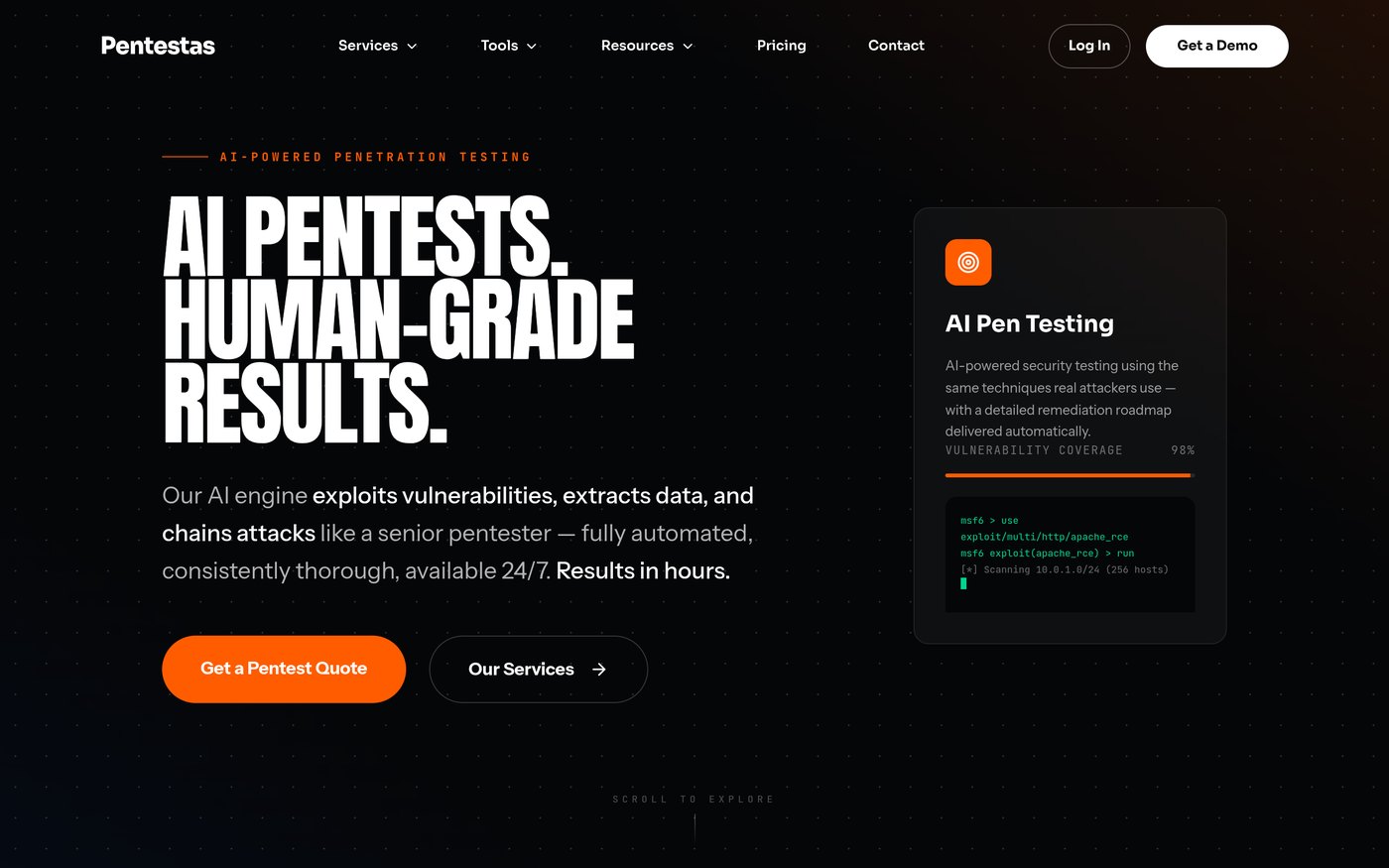
Pentestas is an AI-driven penetration testing platform. It scans your web apps, APIs, networks, and cloud estate, synthesises multi-step attack chains with Claude, and ships verified, exploit-grounded findings instead of generic scanner noise. The tagline on the homepage sums up the philosophy neatly: AI pentests, human-grade results, fully automated, consistently thorough, available 24/7.
The last three words are the point. "Consistently thorough" and "available 24/7" are the properties that turn a pentest from an event into a process. A human pentester is brilliant but expensive, and cannot re-run the full suite against your app every time you merge a pull request. An automated engine can, and Pentestas is engineered so that automation does not mean a downgrade in quality.
Everything it scans
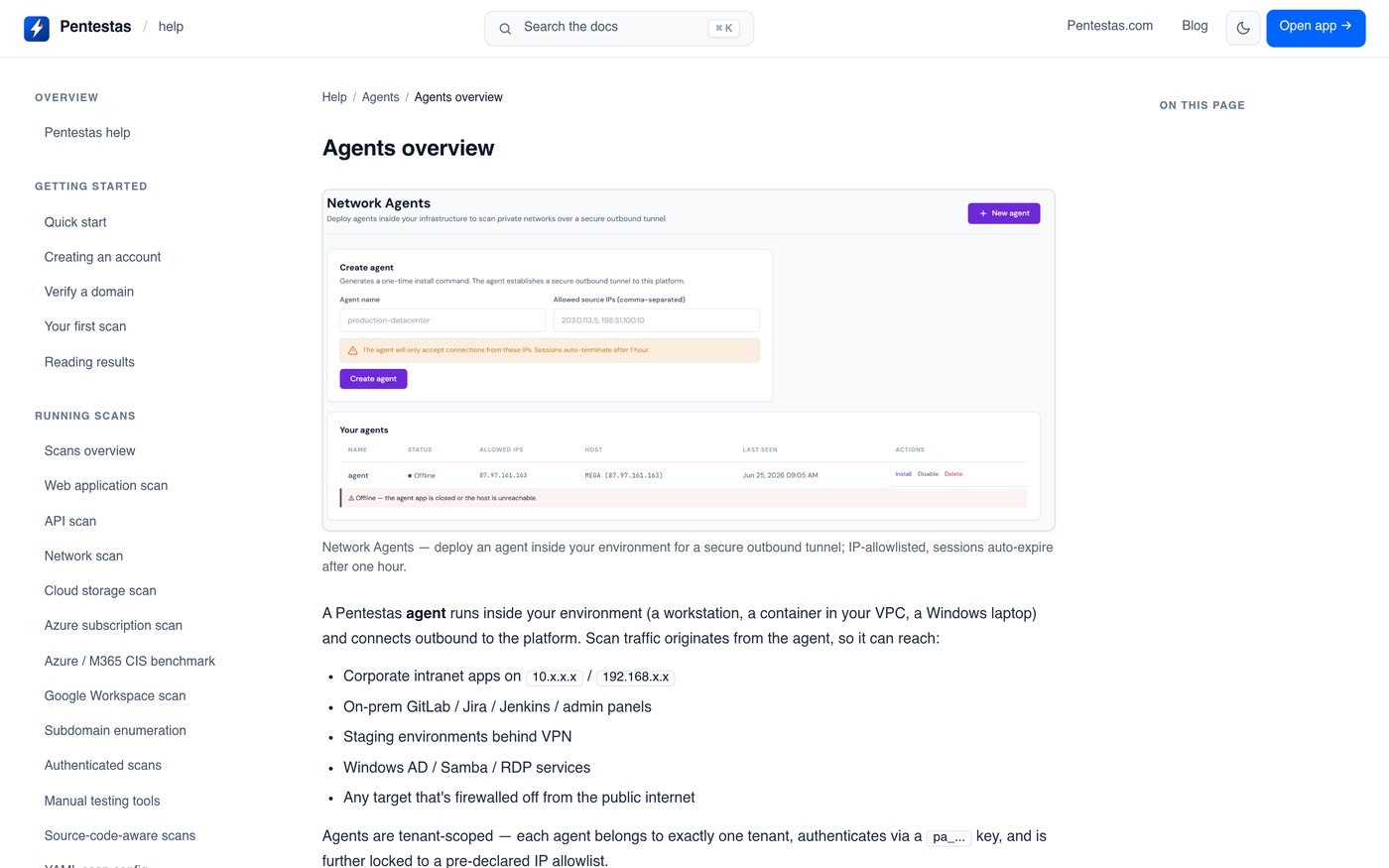
Continuous coverage is only meaningful if it spans your whole attack surface. Pentestas runs a broad set of scan families from a single platform:
- Web application - full OWASP Top 10 coverage against any browser-facing app.
- API - REST, GraphQL, gRPC, and SOAP endpoints, driven from your OpenAPI or Postman collections.
- Network and server - hosts, IP ranges, and subnets for perimeter audits and open-port review.
- Cloud storage - S3, Azure Blob, and GCS buckets checked for enumeration and public ACL exposure.
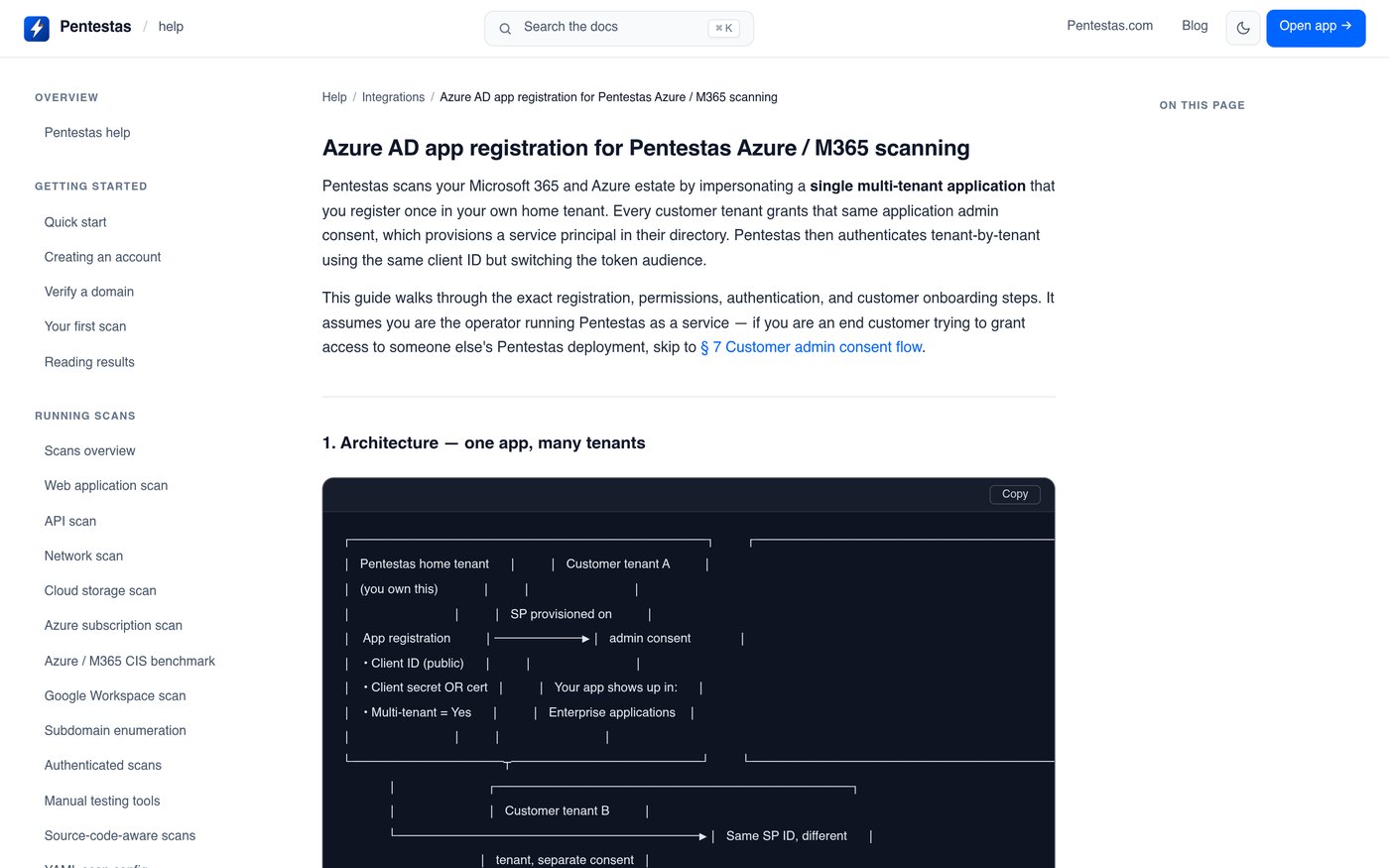
- Azure subscription - IAM, roles, NSGs, Key Vault, Storage, and App Service, with read-only service principal access.
- Google Workspace - users, groups, DLP policies, retention, and OAuth apps.
- Subdomain enumeration - map your full external attack surface from a bare domain.
- CIS benchmarks - Azure and M365 configuration checked against the CIS baseline.
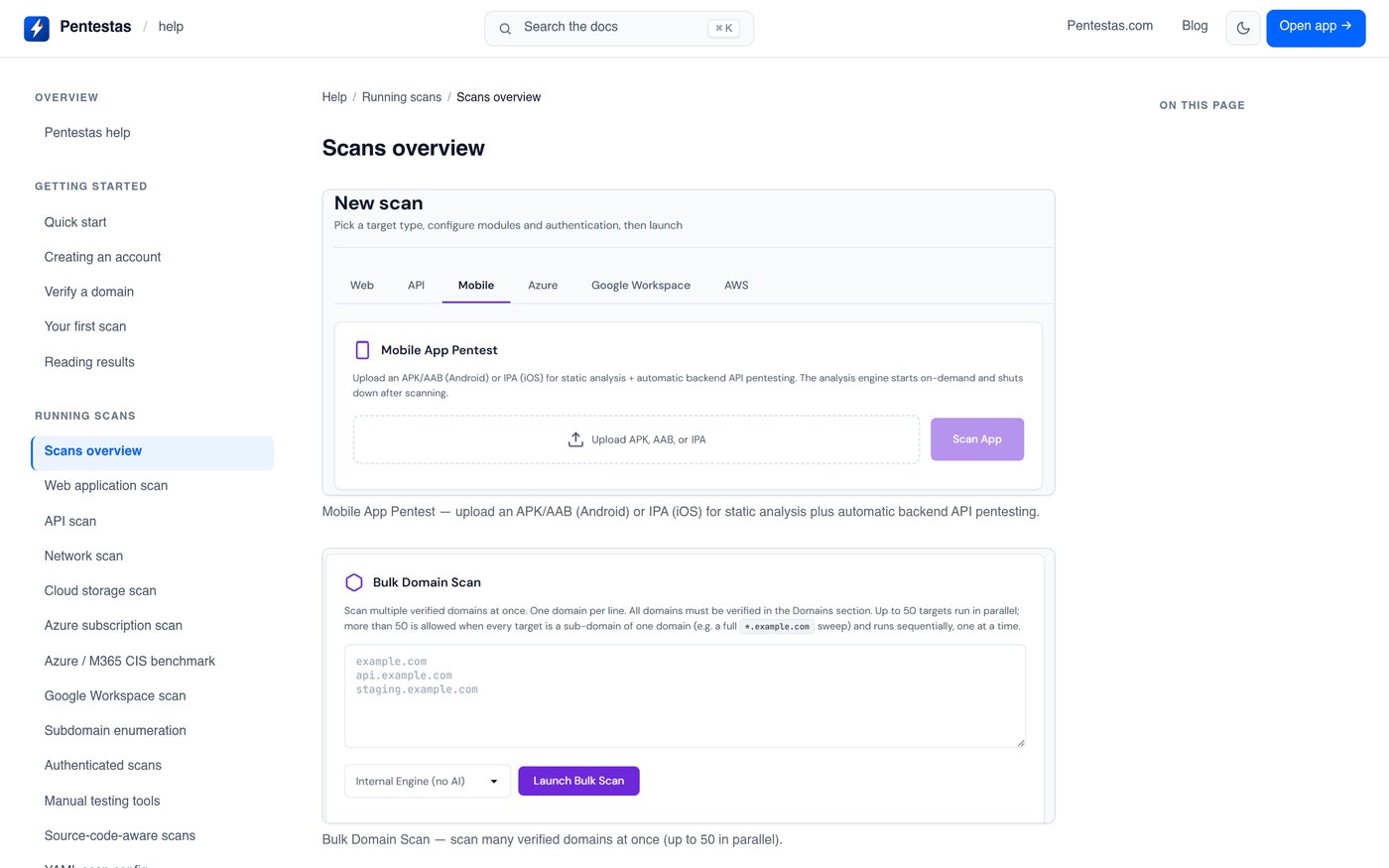
For everything that does not live on the public internet, Pentestas ships local agents for Linux and Windows (.NET). They let you test intranet apps, on-premises services, and internal networks, and can even capture an authenticated browser session so the scanner tests your app as a logged-in user rather than bouncing off the login page.
The AI layer: where the noise dies
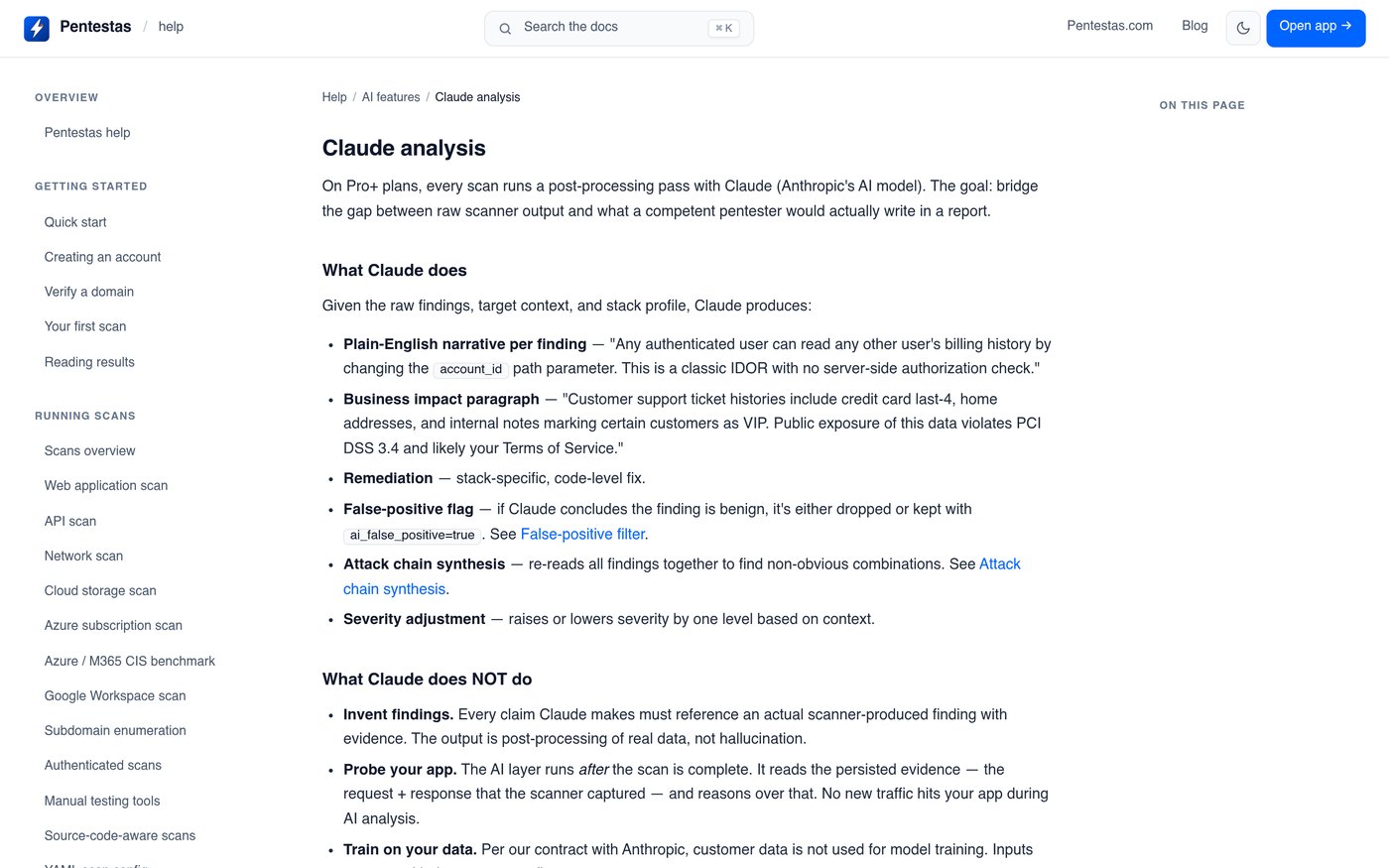
Anyone can bolt a large language model onto a scanner and call it "AI-powered." Pentestas does something more disciplined. After a scan completes, a Claude-based analysis layer re-reads every finding and does the work a senior pentester would do on report day:
- Writes a plain-English narrative of what an attacker could actually do with the finding.
- Assesses business impact in terms of data exposure and compliance, not just a CVSS number.
- Produces stack-specific remediation with code-level fixes tailored to your detected technologies.
- Flags benign results as false positives so they can be filtered out of your queue.
- Synthesises attack chains: the non-obvious combinations where three medium findings become one critical compromise path.
Crucially, there are guardrails that keep this honest. Claude is not allowed to invent findings: every claim it makes must reference an actual scanner-produced finding with evidence. It generates no new traffic, working only on the request and response pairs already captured during the scan. And your data is never used for model training. This is why the findings are described as exploit-grounded, and why you can trust them enough to act on the same day.
Findings you can actually triage
Pentestas grades every finding on a five-level severity scale mapped cleanly onto CVSS 3.1 bands: CRITICAL (9.0 to 10.0), HIGH (7.0 to 8.9), MEDIUM (4.0 to 6.9), LOW (0.1 to 3.9), and INFO (0.0). Each finding arrives with the evidence request and response pair, numbered validation steps to reproduce it, a CVSS vector, and CWE plus OWASP categorisation. On Pro plans, the AI narrative and business-impact summary sit right alongside.
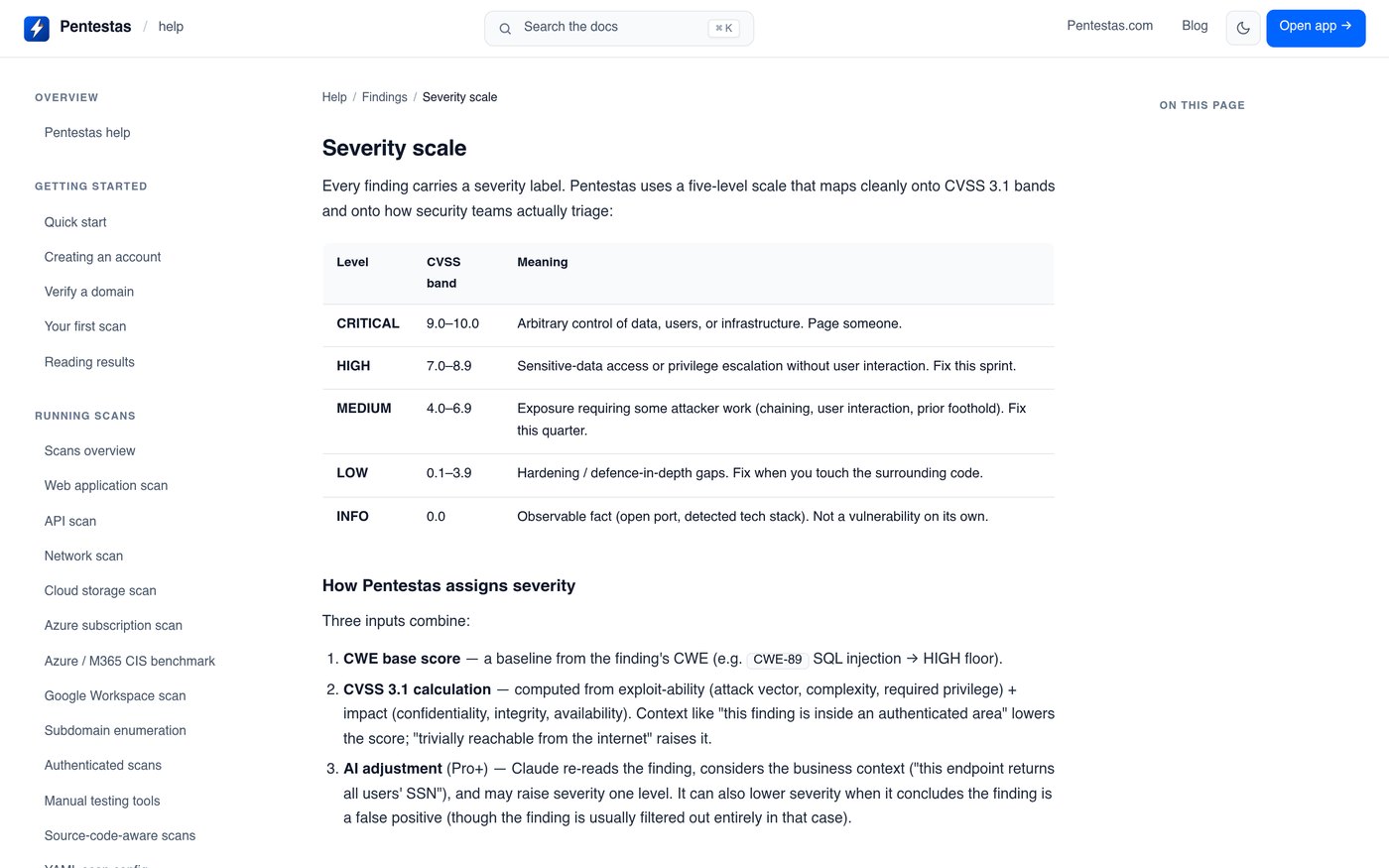
One detail deserves a callout because it shows real pentester thinking baked into the product: Pentestas separates severity from priority. Severity is a property of the finding. Priority is a property of your team's roadmap. A HIGH-severity issue in a staging environment can and should rank below a MEDIUM affecting your production checkout flow. Tools that conflate the two bury your team in a flat list of red. Pentestas gives you the information to triage like an adult.
Continuous by design
This is where Pentestas stops being "a scanner" and becomes continuous penetration testing in the true sense. Scans can be scheduled daily, weekly, monthly, or on any cron expression you like. They can be triggered from the dashboard, the REST API, a local agent, or straight from your CI/CD pipeline so that every deploy is followed by a fresh test of what you just shipped.
Results route out through webhooks and Slack, which means a new critical finding can open a ticket, ping the on-call channel, or fail a build automatically. You are not logging in to check. The platform tells you the moment your risk posture changes. That closed loop - test on every change, alert on every regression - is the difference between security theatre and security operations.
Reports for every audience
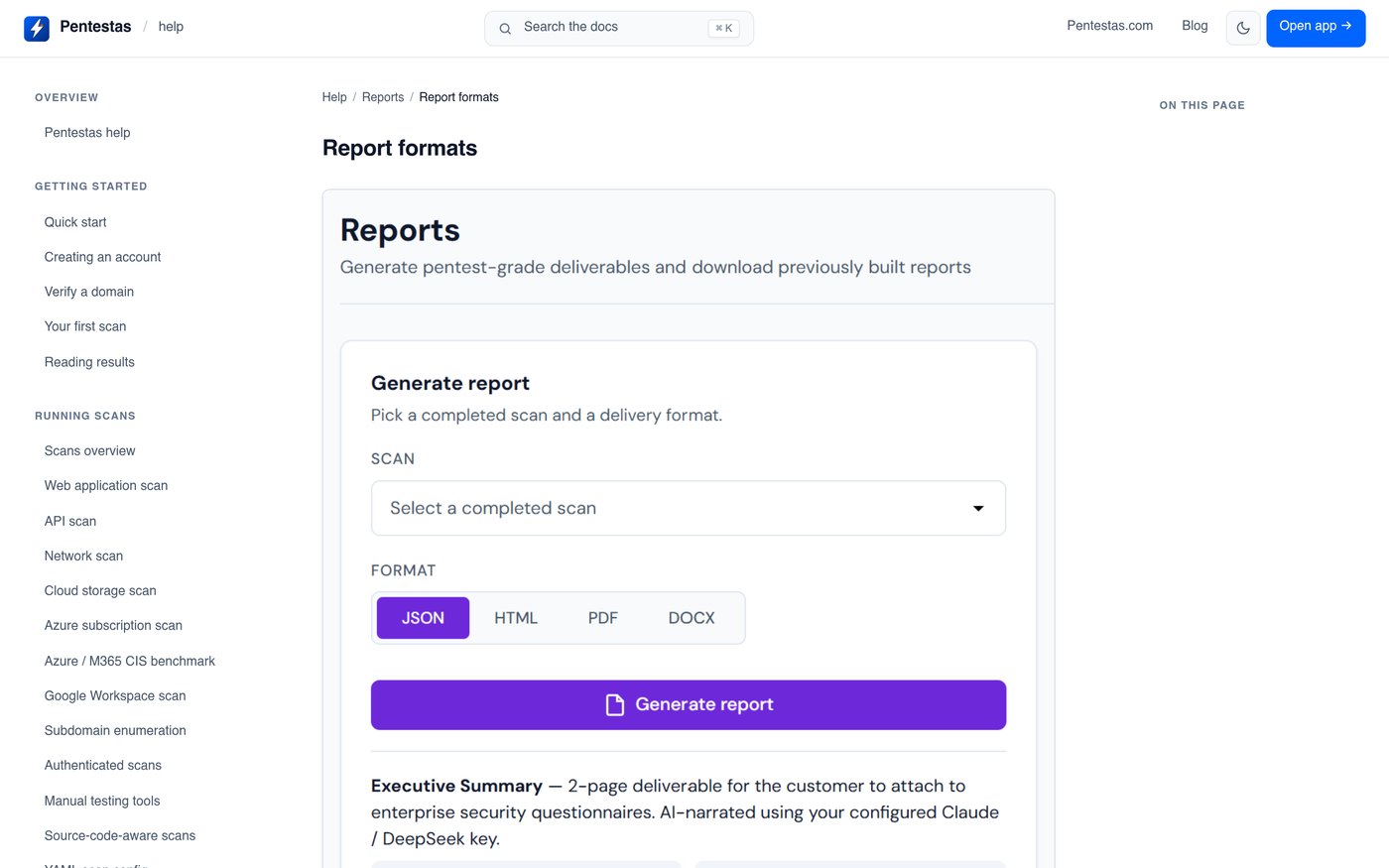
A finding nobody reads fixes nothing. Pentestas generates reports in HTML (searchable, live at a URL), PDF (executive summary plus per-chain detail plus the full finding list), DOCX (editable for consultancies customising per engagement), and JSON (the full machine-readable schema for SIEM and GRC tooling). Every report leads with an executive summary: target, scan duration, date, finding counts by severity, and the top three attack chains with combined impact.
On Pro plans you can white-label the output with your own logo, brand colour, cover text, and footer, which makes Pentestas a genuine force multiplier for MSSPs and consultancies delivering pentests to their own clients. And because JSON reports carry the full finding, chain, and metadata schema, you can track how your vulnerability posture trends across scans over time - the metric that actually proves a security programme is working.
Live in minutes, not weeks
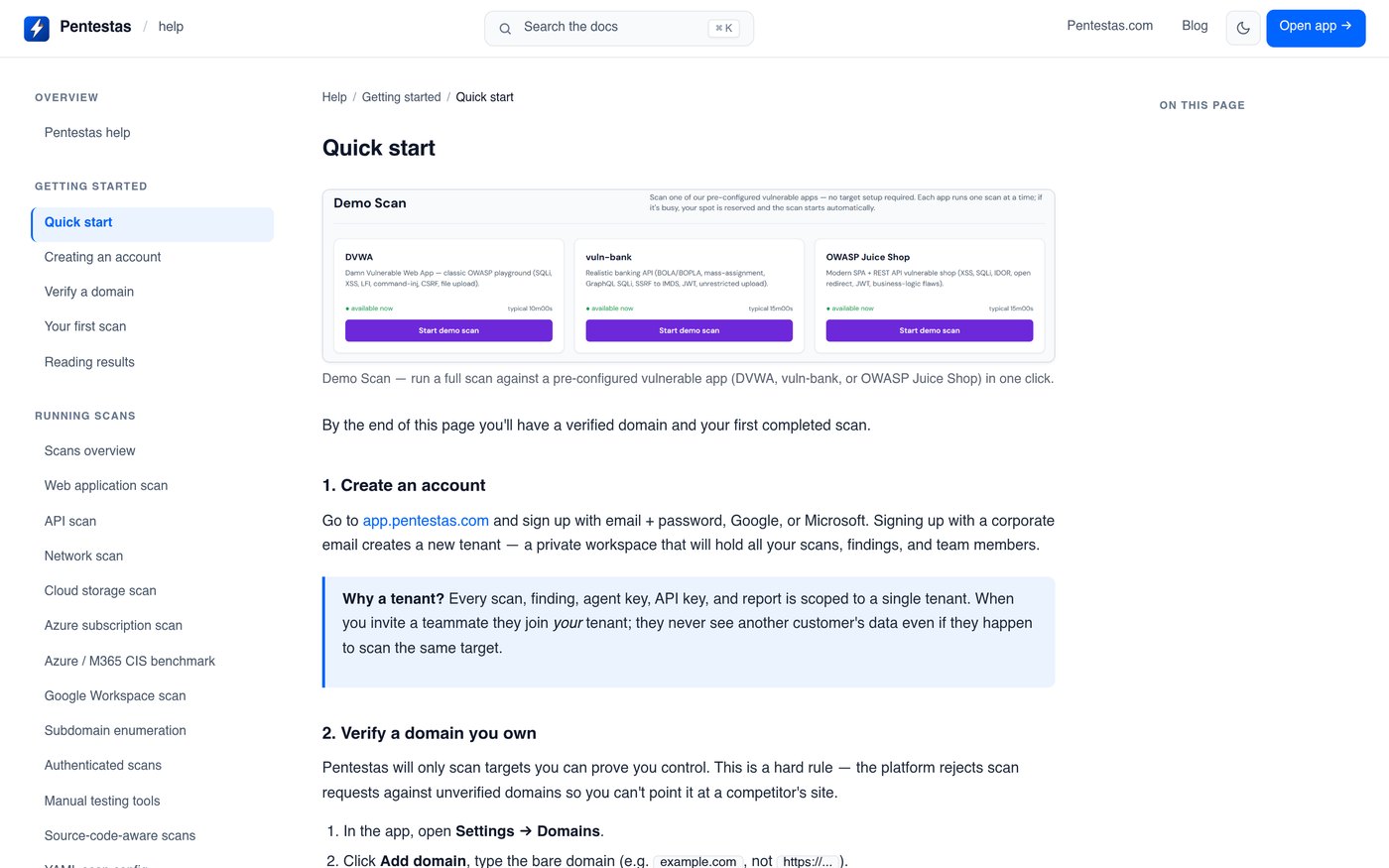
Booking a traditional pentest can take longer than the test itself: scoping calls, statements of work, scheduling a consultant six weeks out. Pentestas collapses that to minutes. You sign up with email, Google, or Microsoft, verify a domain with a single DNS TXT record, pick your scan types, and start. The scan begins within seconds, and you watch live progress move through its phases: crawling, attack surface mapping, payload testing, and AI analysis.
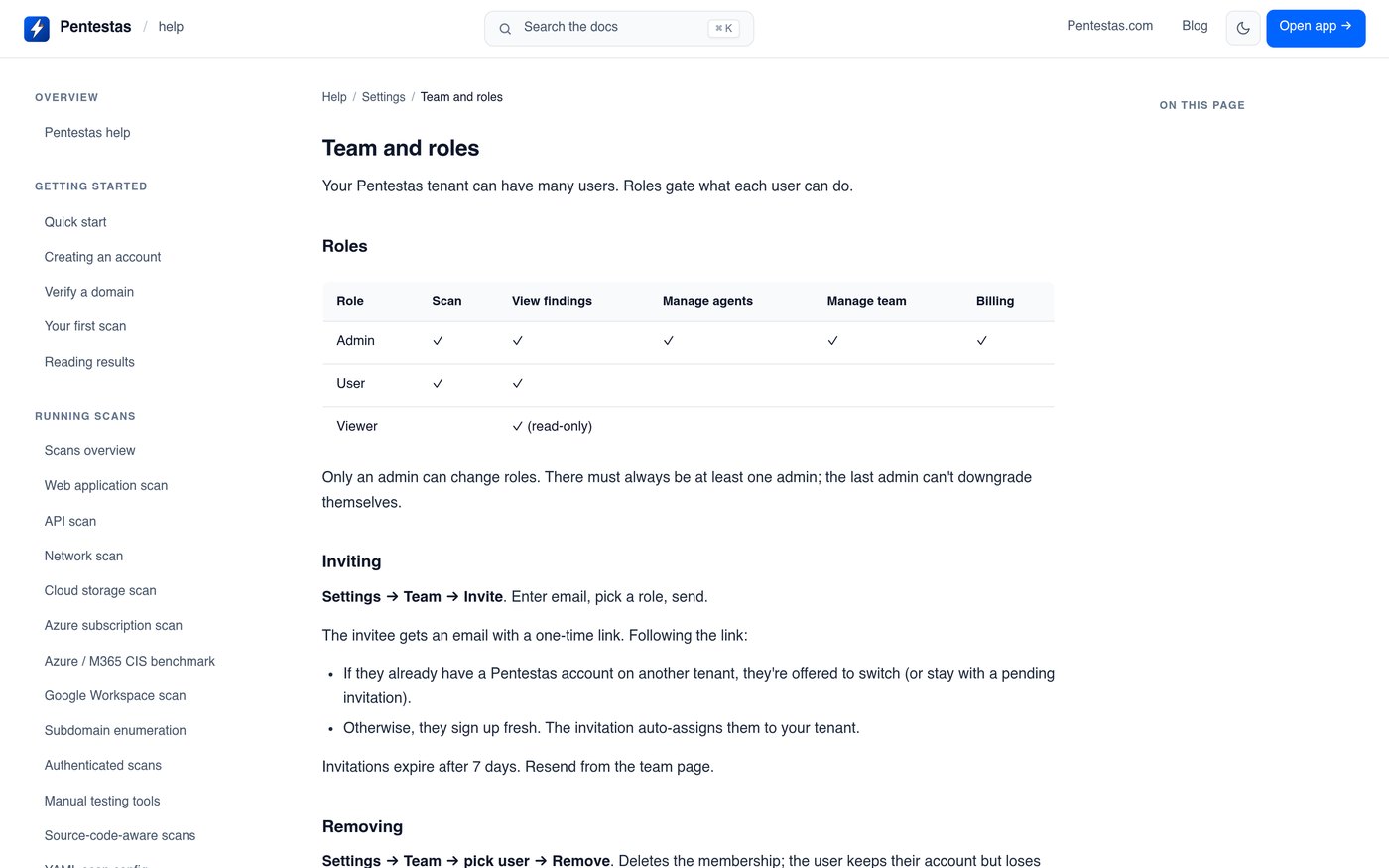
Access control is built for teams from day one, with roles and permissions so developers, security engineers, and auditors each see what they should. It scales from a solo founder verifying one domain to a security team managing a whole portfolio.
Who continuous pentesting is for
If you ship software regularly, live in the cloud, or have to prove security to customers and auditors, point-in-time testing is no longer enough. Pentestas fits SaaS companies that deploy daily, security teams stretched across web, API, and cloud, MSSPs and consultancies who want to deliver more tests without hiring more pentesters, and any organisation preparing for SOC 2, ISO 27001, or similar frameworks where continuous evidence beats an annual scramble.
It also pairs naturally with human expertise. Continuous automated testing handles the breadth - the every-deploy, every-endpoint coverage no human can sustain - and frees your specialists to focus on the deep, creative work that genuinely needs a human brain. That is the model we believe in, and it is why Pentestas exists.
Frequently asked questions
What is continuous penetration testing?
Continuous penetration testing runs real, exploit-driven security tests against your systems on an ongoing basis - on a schedule and on every deploy - rather than as a single once-a-year engagement. It gives you a living view of your attack surface that stays current as your code and cloud change.
How is Pentestas different from a vulnerability scanner?
A vulnerability scanner lists possible issues and leaves you to sort truth from noise. Pentestas confirms what an attacker could actually do: it synthesises multi-step attack chains with Claude, grounds every finding in real evidence, and flags false positives, so you get verified, exploit-grounded findings instead of a thousand maybes.
Can Pentestas run on a schedule and in CI/CD?
Yes. Scans can be scheduled daily, weekly, monthly, or on a custom cron expression, and triggered from the dashboard, REST API, local agents, or your CI/CD pipeline. Results route out via webhooks and Slack so a new critical finding can fail a build or open a ticket automatically.
What can Pentestas test?
Web applications, APIs (REST, GraphQL, gRPC, SOAP), networks and servers, cloud storage (S3, Azure Blob, GCS), Azure subscriptions, Google Workspace, subdomains, and Azure/M365 CIS benchmarks. Linux and Windows agents extend testing to internal and on-premises systems.
Does the AI invent findings?
No. The Claude analysis layer is constrained so that every claim must reference an actual scanner-produced finding with evidence. It generates no new traffic, works only on request and response pairs captured during the scan, and your data is never used for model training.
How fast can I get my first scan running?
Minutes. You sign up with email, Google, or Microsoft, verify a domain with a single DNS TXT record, choose your scan types, and start. The scan begins within seconds and shows live progress through crawling, attack surface mapping, payload testing, and AI analysis.
Test yourself as often as attackers do
Stop trusting a once-a-year snapshot. Point Pentestas at your apps, APIs, and cloud, and get verified, exploit-grounded findings on autopilot.
Start continuous pentesting with Pentestas