Your Company Just Got Hacked: The Hour-by-Hour Action List for the First 24 Hours
Alexander Sverdlov
Security Analyst

Key Takeaways
- Contain, do not erase. Isolating a compromised machine from the network preserves the attacker's footholds for analysis; wiping or rebuilding it destroys the evidence you need to scope the breach and the proof your insurer and any regulator will ask for. Pull the network cable or disable the port, do not power the machine down and do not reimage it.
- The order of your phone calls decides whether your claim gets paid. The first call is to whoever can isolate systems. The second is to breach counsel or your cyber insurer's hotline, not your regular IT vendor and not the affected customers. Counsel hires the forensic firm so the investigation sits behind legal privilege.
- Several legal and regulatory clocks start the moment you have a reasonable belief a breach occurred, not when you finish investigating. GDPR gives 72 hours to notify a supervisory authority, many US state laws and contracts impose their own windows, and a delayed notification is itself a finding. Start the clock log in hour one.
- Do not pay, promise, or negotiate a ransom in the first 24 hours. That is a deliberate decision made later with counsel, your insurer, and sanctions-screening advice. Paying can be unlawful if the actor is on a sanctions list, and a rushed payment rarely restores data cleanly anyway.
- A company with a written incident response plan and a retainer contains a breach in hours and pays a fraction of what an unprepared company pays. The unprepared company spends the first six hours deciding who to call while the attacker is still moving.
- The single most expensive mistake is silence followed by a clumsy disclosure. Customers, regulators, and insurers forgive a breach that was handled with discipline far more readily than one that was hidden, mishandled, or disclosed in a panic three weeks later.
The message arrived at 06:14 on a Tuesday. The operations director of a 90-person logistics company had opened her laptop to a desktop wallpaper she did not recognize and a text file on the desktop that began "We have encrypted your files and exfiltrated 60 GB of your data." Her first three actions, taken in the eleven minutes before she called us, were the three most common and most damaging. She rebooted the laptop hoping it was a glitch. She called the company that manages their servers and told them to "fix it." And she started drafting an email to the two largest customers whose contract folders she could see named in the ransom note.
Each of those instincts is human, and each one makes the next 24 hours worse. The reboot risked triggering further encryption and wiped volatile memory that would have shown us how the attacker got in. The call to the server vendor, who immediately began "cleaning" machines, started destroying the evidence trail before anyone had mapped how far the intruder had reached. And the draft to customers, sent before anyone knew the actual scope, would have committed the company to a version of events that turned out to be wrong, the kind of premature statement that lawyers and regulators read back to you later.
We stopped all three. Over the next 40 minutes we isolated the affected machines without powering them off, stood up an out-of-band communication channel because their email could no longer be trusted, and started a simple timestamped log of every action and decision. Breach counsel was on the line within the hour, the cyber insurer's hotline was notified, and only then did a forensic image get taken. The customer emails waited until hour 30, when the company actually knew what had and had not been accessed, and could say so accurately.
The breach was real and serious. But it was contained by the end of the first day, the insurance claim was paid in full, the regulator closed its file without action because the notification was timely and complete, and not one customer was lost. The difference between that outcome and a catastrophe was not luck or budget. It was doing a small number of correct things in the correct order during a window when every instinct pushes you the other way. This article is that order, written down, so you have it before you need it.
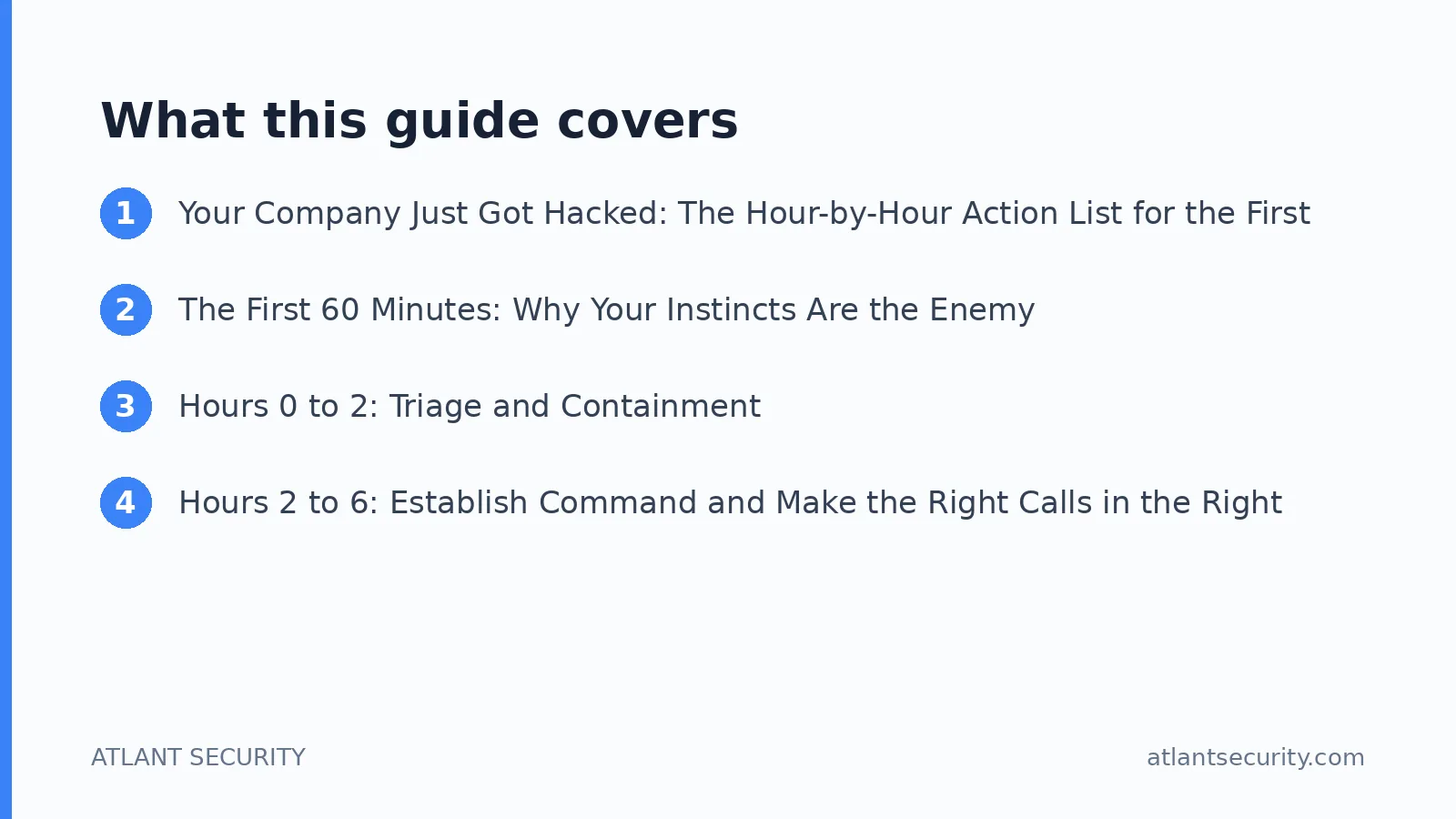
Section 1
The First 60 Minutes: Why Your Instincts Are the Enemy
A breach triggers the same fight-or-flight response as any sudden threat, and under that pressure people reach for the actions that feel like progress: make it go away, get the expert on the phone, warn the people who matter. In a cyber incident, all three of those reflexes are traps, because they optimize for feeling in control rather than for the two things that actually determine the outcome - preserving evidence and stopping the spread.
The first reflex is to clean up. Wipe the machine, restore from backup, reimage the laptop, delete the suspicious files. This feels decisive and it is the worst thing you can do in the first hour. The compromised systems hold the only record of how the attacker got in, what they touched, and whether they are still inside. Destroy that record and you cannot scope the breach, which means you cannot tell a customer or a regulator what was and was not affected, which means you have to assume the worst about everything. Cleaning up early does not shrink the incident; it makes the entire estate suspect.
The second reflex is to call your regular IT support first. They are who you call when the email is down, so they are who you call now. The problem is that general IT support is not incident response, and their natural instinct is exactly the cleanup that destroys evidence. Worse, if they start remediating before counsel is involved, the work is not protected by legal privilege, which means every message, every note, and every half-formed theory they produce can later be demanded in litigation or by a regulator. The right early calls go to people whose job is containment and to counsel who can shield the investigation.
The third reflex is to warn people - customers, partners, the wider team - immediately. Transparency is right, but speed without accuracy is a liability. A breach notification is a statement of fact that you will be held to. Send it in hour one, before anyone has scoped what happened, and you will almost certainly say something that turns out to be false: that data was not accessed when it was, or that the incident is contained when it is not. The disciplined move is to prepare to communicate, control the channel, and notify the legally required parties on the legal clock, while holding public statements until you can make them accurate.
The one rule for the first hour: isolate, do not eradicate. Disconnect compromised machines from the network (unplug the cable, disable the switch port, or remove them from wireless) but leave them powered on. Powered-on and isolated preserves both the disk evidence and the volatile memory that often holds the clearest signs of how the attacker is operating. Powering off or wiping throws that away, and you only get one chance to capture it.
Section 2
Hours 0 to 2: Triage and Containment
The goal of the first two hours is narrow: stop the bleeding and protect the evidence, without destroying either. You are not trying to understand the whole breach yet, and you are not trying to fix anything. You are trying to deny the attacker further movement while keeping everything they touched intact for analysis.
Confirm it is real, then assume it is bigger. Verify that what you are seeing is an actual incident and not a false alarm, but the moment it is confirmed, work on the assumption that the attacker has been inside longer and reached further than the first symptom suggests. The visible ransom note or the one alerting machine is rarely the whole story; intruders typically move laterally for days or weeks before they are noticed. Treat the known-bad machine as the tip, not the iceberg.
Isolate the affected systems. Remove compromised machines from the network while leaving them running. If you have endpoint protection with a network-isolation feature, use it. If not, physically disconnect: unplug the network cable, disable the port, disconnect from wireless. For cloud and SaaS, the equivalent is to revoke the attacker's access: disable suspected-compromised user accounts, revoke active sessions and refresh tokens, and rotate the credentials and API keys you have reason to believe are exposed. Containment in the cloud is about sessions and tokens, not cables.
Protect your lifelines: identity, backups, and communications. Three assets decide whether you recover quickly or not at all. Your identity system (the directory or identity provider that controls who can log in) is the master key; if the attacker holds privileged access there, isolating one laptop accomplishes nothing. Your backups are your way home, and modern attackers hunt for and destroy backups before they trigger encryption, so confirm your backups are intact, offline or immutable, and out of the attacker's reach. And your normal communications may be compromised, so assume email and chat are being read and move incident coordination to an out-of-band channel.
Start the log now. Open a simple document - on a clean device, not the network you are investigating - and timestamp every observation, decision, and action from this point forward. Who saw what, when, what was isolated at what time, who was called. This log is not bureaucracy; it is the backbone of the regulator notification, the insurance claim, and any later legal defense, and it is impossible to reconstruct accurately after the fact. The teams that keep a clean timeline have a dramatically easier next three weeks.
Section 3
Hours 2 to 6: Establish Command and Make the Right Calls in the Right Order
By the two-hour mark the immediate spread should be contained and the evidence intact. Now the incident needs structure, because the most common failure mode from here is not technical - it is the chaos of ten people taking uncoordinated actions, contradicting each other on calls, and nobody owning the decisions. The fix is to establish command and to make a short series of phone calls in a deliberate order.
Name an incident commander. One person owns the response, makes the calls that need making, and is the single point of coordination. This is usually not the most senior person in the company and usually not the most technical; it is the person who can run a calm process under pressure. Everyone else has a defined role: technical lead, communications lead, legal liaison, and a scribe who keeps the timeline log. Decisions route through the commander so the response moves in one direction.
The order of calls is the part people get wrong. The first call is to whoever can isolate and contain - internal IT, your managed security provider, or your incident response retainer. The second call is to breach counsel or, if you have cyber insurance, the insurer's 24-hour incident hotline, which will route you to approved counsel and forensics. Counsel matters here for a specific reason: when counsel engages the forensic firm, the investigation and its findings are generally protected by legal privilege, which keeps your own internal theories and the raw forensic detail out of an opponent's hands later. Call the forensic firm directly, without counsel, and you may waive that protection.
Why the insurer call cannot wait: Most cyber insurance policies require you to notify the insurer promptly and to use their approved vendors. Bring in your own forensic firm or pay a ransom without the insurer's involvement and you can void coverage for the whole event, even a legitimate one. The insurer hotline is not a bureaucratic hurdle to clear later; it is a gate you must pass through early, and it usually connects you to experienced counsel and responders faster than you could find them yourself at 3am.
Take the forensic image before anyone remediates. Once counsel and the responders are engaged, the team captures forensic images of the affected systems - a complete, verifiable copy of the disk and, where possible, memory - before any cleanup begins. This image is the evidence base for scoping the breach, satisfying the insurer, and answering the regulator. It is also what lets the team safely rebuild later, because you can analyze the copy while restoring the live system. Remediating before imaging is the irreversible mistake that the first-hour discipline was protecting against.
Decide who does not need to act yet. Part of establishing command is preventing well-meaning people from making things worse. The sales team does not email customers. The marketing team does not post anything. Individual engineers do not start "checking" or "cleaning" systems on their own initiative. Everyone is told, clearly and early, that the only actions taken are the ones the incident commander has authorized. Uncoordinated helpfulness during an incident is a leading cause of destroyed evidence and contradictory public statements.
Section 4
Hours 6 to 12: The Legal, Regulatory, and Insurance Clocks
While the technical team scopes the breach, a parallel set of clocks is running, and most of them started the moment you had a reasonable belief that an incident occurred - not when the investigation finishes. Missing a notification deadline is its own violation, independent of how well you handled everything else, so the legal liaison's job in this band is to map every clock that applies to you and calendar each deadline against the timeline log.
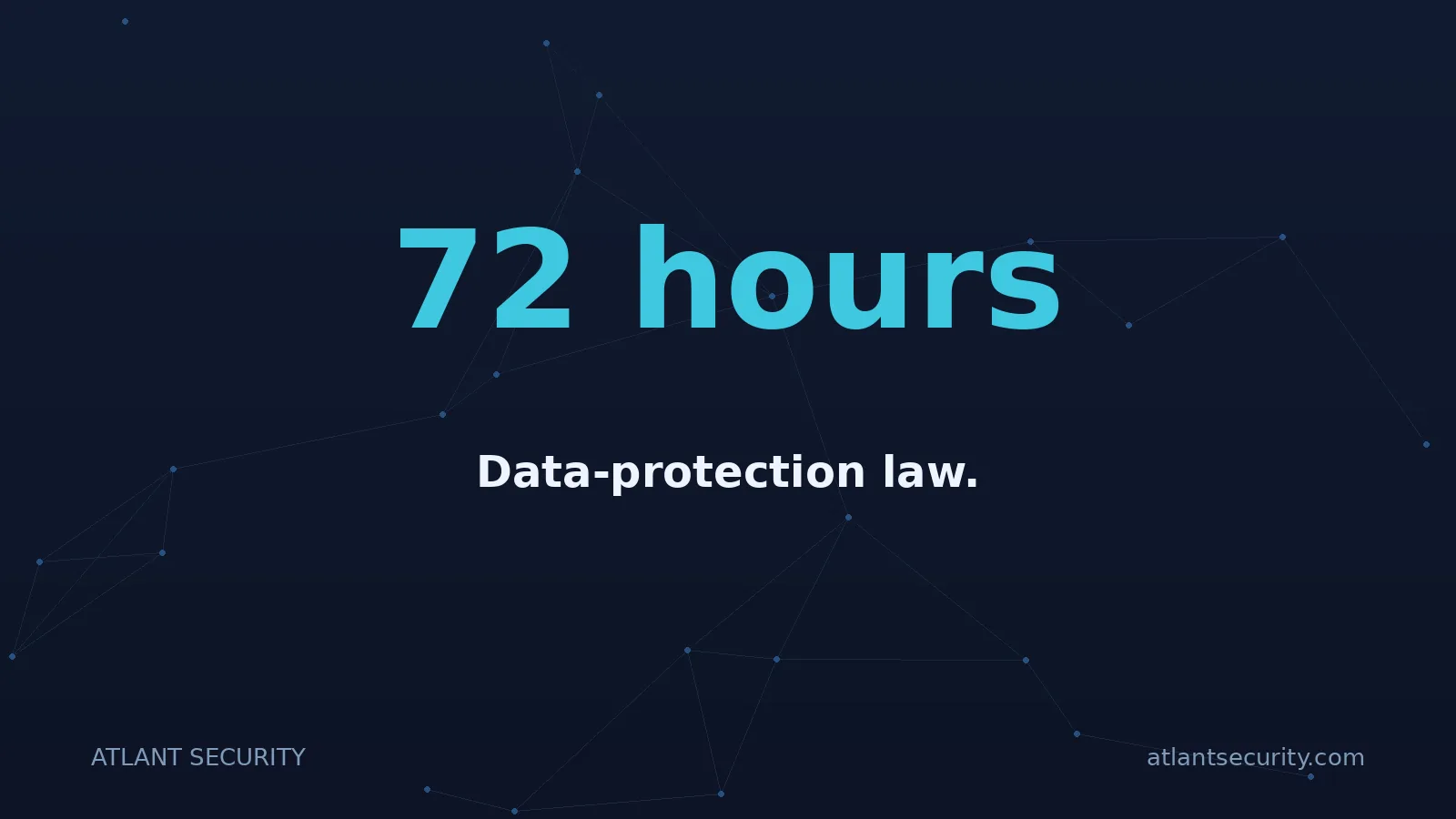
Data-protection law. If you hold personal data on people in the EU or UK, the GDPR gives you 72 hours from becoming aware of a personal-data breach to notify the relevant supervisory authority, unless the breach is unlikely to result in a risk to individuals. The notification can be made in stages as you learn more, which is precisely why an early, honest "we are investigating and will update you" beats waiting for certainty. In the United States, all states have breach-notification laws with their own definitions and timelines, and sector rules like HIPAA add their own. The point is not to memorize every statute; it is to identify in hour six which regimes apply to your data and what each one demands.
Contractual obligations. Your customer contracts almost certainly contain breach-notification clauses, often stricter than the law - 24 or 48 hours is common in enterprise agreements. These are easy to forget in the moment and expensive to miss, because a missed contractual notification is a breach of contract on top of the security incident. The legal liaison pulls the relevant contracts and adds each notification window to the clock map. If you process data on behalf of other businesses, you likely have a duty to notify them quickly so they can meet their own obligations.
Regulators and law enforcement. Depending on your sector and country, you may have additional regulators to notify (financial, health, critical-infrastructure) and a decision to make about involving law enforcement. Reporting to law enforcement does not usually slow your recovery and can help later, but it is a decision made with counsel, not a reflex. In the EU, NIS2 and DORA impose their own incident-reporting timelines on the entities they cover, frequently including an early warning within 24 hours. Know before the incident whether these apply to you, because reading the regulation for the first time at hour eight is not a good place to be.
Insurance conditions. Beyond the initial notification, your policy has conditions you must keep meeting: using approved vendors, getting consent before incurring major costs, preserving evidence, and not admitting liability publicly. The legal liaison and the incident commander keep these front of mind, because the difference between a paid claim and a denied one is often a procedural condition that was easy to satisfy and easy to forget under pressure.
Section 5
Hours 12 to 24: Scope, Eradicate, and Begin Clean Recovery
The final band of the first day is where the work shifts from holding the line to taking back control. By now the forensic team should have an emerging picture of how the attacker got in and where they went, and that picture drives three activities that must happen in order: finish scoping, eradicate the attacker's access completely, and only then begin recovery from clean sources.
Finish scoping before you declare anything. Scoping answers the questions everyone is asking: how did they get in, what did they reach, was data taken, and are they still inside. You cannot communicate accurately or notify completely until you have defensible answers, which is why the customer email that felt urgent in hour one was a trap. The forensic timeline, built from the images and logs, is what turns "we think" into "we have determined," and that distinction is the whole difference in how a regulator and a court read your response.
Eradicate, do not just clean the obvious. Eradication means removing every foothold the attacker established: the malware, yes, but also the backdoor accounts they created, the legitimate credentials they stole and are still using, the persistence mechanisms they planted, and any access they retained through your remote-access tools or VPN. This is why scoping has to come first - eradicate only what you can see and the attacker walks back in through the access you missed. Reset credentials broadly, force re-authentication everywhere, and rebuild compromised systems from known-good images rather than trying to disinfect them in place.
The recovery trap: The pressure to "get back to business" peaks in this band, and it pushes teams to restore systems before eradication is complete. Restore into an estate the attacker still controls and you simply hand them your recovered environment - often within hours. Worse, if your backups were compromised before the attack triggered, restoring them reintroduces the intruder. Recovery starts only once eradication is verified and your restore source is confirmed clean. Slower-but-clean beats fast-but-reinfected every time.
Begin recovery from confirmed-clean sources. With the estate eradicated, restore systems and data from backups you have verified are untouched, bringing the most critical business functions back first. Re-enable accounts only after their credentials are reset and multi-factor authentication is confirmed. Monitor the restored environment closely, because the period right after recovery is when a missed foothold reveals itself. The goal of the first 24 hours is not full recovery - that often takes days or weeks - but to have a contained incident, a clean understanding of scope, an eradication plan in motion, and the first critical systems coming back safely.
Communicate, finally, and accurately. Now you can do what your hour-one instinct wanted: tell people. With scope established and counsel's input, you notify regulators on their clock, inform affected customers and partners with accurate information, and brief your team. The message is calmer and far more credible than anything you could have sent at the start, because it says what happened, what was and was not affected, and what you are doing - all of it true. Discipline in the first hours is what earns you a credible voice on the first day.
Section 6
The Five Mistakes That Turn a Bad Day Into a Catastrophe
Across the incidents we respond to, the companies that suffer the worst outcomes rarely suffer because the attack was unusually sophisticated. They suffer because of a handful of avoidable mistakes made in the first hours, each one turning a contained problem into a compounding one.
6.1 Wiping or rebuilding before imaging
The instinct to clean the infected machine destroys the only evidence of how the breach happened and how far it reached. Without that evidence you cannot scope the incident, which forces you to assume the worst about everything, which makes the notification, the claim, and the recovery all larger and more expensive. Isolate and image first; clean later, from the copy.
6.2 Paying or promising a ransom in a panic
A rushed ransom decision in the first hours is almost always wrong. Payment may be unlawful if the actor is subject to sanctions, it can void insurance if made without the insurer's involvement, and it frequently fails to restore data cleanly or stop a second extortion demand. Whether to pay is a deliberate decision made later with counsel, the insurer, and sanctions screening - never a reflex in hour two.
6.3 Notifying customers before you know the scope
A premature public statement commits you to a version of events that the investigation often contradicts. Saying "no data was accessed" and then discovering it was is far more damaging than an initial "we are investigating and will update you within 24 hours." Notify on the legal clock, but make public statements only once you can make them accurately.
Practitioner note: The most damaging sentence we see in early breach communications is a confident negative - "customer data was not affected" - issued before scoping is complete. It feels reassuring to write and it is the line most likely to be proven false. If you must communicate before scope is known, describe the process you are following, not conclusions you have not yet earned.
6.4 Letting everyone "help" without coordination
Uncoordinated action during an incident is a leading cause of destroyed evidence, contradictory statements, and missed steps. Engineers cleaning systems on their own initiative, salespeople reassuring customers, managers posting updates - each well-meaning action can undo the disciplined response. One incident commander, defined roles, and a rule that nothing happens without authorization keep the response coherent.
6.5 Restoring before eradicating
The pressure to resume operations pushes teams to restore systems while the attacker still holds access, which simply hands back the recovered environment. Recovery is the last step, after scoping and verified eradication, from a restore source confirmed to be clean. Companies that skip this step often find themselves re-encrypted within days, this time with depleted backups and exhausted goodwill.
Section 7
What a Disciplined First Day Actually Produces
A well-run first 24 hours does not end with the company fully recovered. It ends with a set of concrete outputs that make the next three weeks survivable and that prove, to everyone who will later ask, that the incident was handled responsibly. If you have these by the end of day one, you are in a strong position regardless of how serious the breach turned out to be.
A contained incident. The attacker no longer has active access, the spread has stopped, and the most critical systems are either safely isolated or beginning clean recovery. Containment is the single most important deliverable of the first day, because every hour the attacker retains access is an hour the damage grows.
A timestamped incident log. A clean, contemporaneous record of what was observed, decided, and done, by whom and when. This log is the backbone of the regulator notification, the insurance claim, and any legal defense, and it is the artifact that most distinguishes a professional response from a scramble.
Forensic images and a working scope. Verifiable copies of the affected systems and an emerging, evidence-based understanding of entry point, lateral movement, data access, and persistence. This is what lets you say what happened with confidence rather than guessing, and it is impossible to recreate if the evidence was destroyed in hour one.
A clock map with deadlines calendared. Every legal, regulatory, and contractual notification window identified and tracked, with the relevant ones already actioned or scheduled. Nothing is more avoidable than a missed deadline that becomes its own violation, and nothing is easier to miss in the chaos without a deliberate map.
An engaged team of the right people. Counsel retained and the investigation under privilege, the insurer notified and conditions being met, forensic responders working, and an incident commander running a coordinated process. The breach is no longer happening to you; you are managing it.
What separated the logistics company's outcome: By the end of day one they had every item on this list. The claim was paid because the insurer had been notified in hour two and their vendors used throughout. The regulator closed its file because the 72-hour notification was timely, staged, and accurate. No customer left because the eventual notification, sent at hour 30, was true and showed a company in control. The same breach, handled by reflex, would have cost them the claim, a regulatory finding, and at least their two largest accounts.
Section 8
Prepared vs Unprepared: What the Difference Costs
The reason this action list is worth reading before you need it is that the single biggest factor in how a breach plays out is how prepared you were when it started. The prepared company executes the sequence above because someone wrote it down and practiced it. The unprepared company spends the first six hours - the most valuable hours - deciding who to call, while the attacker keeps moving.
The unprepared path. Discovery, then confusion. Hours lost debating whether it is real, who owns it, and what to do. The instinctive mistakes get made: a machine wiped, a vendor cleaning systems, a panicked email sent. Counsel and the insurer are brought in late, after privilege is muddied and coverage conditions are already at risk. Scoping is harder because evidence is gone, so the company over-notifies and over-assumes. The incident drags for weeks, the claim is contested, and customer trust erodes with every contradictory update.
The prepared path. Discovery, then a plan. The incident commander is named in minutes because the role was assigned in advance. The first calls go to a retainer number that collapses containment, counsel, and forensics into one engagement. The clocks are known because someone mapped them before the incident. Containment happens in the first band, scoping in the third, and the first day ends with the situation managed rather than spiraling. The same attack, the same data, a fraction of the cost and disruption.
Preparation does not have to be elaborate. The minimum that changes the outcome is a one-page incident response plan that names the incident commander and their backup, lists the first three phone numbers (containment, counsel or insurer, forensics), states the rule "isolate, do not wipe," and points to where the contracts and the cyber policy live. Pin it somewhere reachable without the network, because the network may be exactly what is down. A retainer with a response firm turns those first three calls into one and guarantees someone experienced answers at 3am.
| Readiness level | What you have in place | Time to contain | Indicative readiness cost |
|---|---|---|---|
| Nothing prepared | No plan, no numbers, no retainer | Days, often with reinfection | USD 0 now, far more later |
| One-page plan | Commander named, first calls listed, rules written | Same day | USD 1,500 - 4,000 to build |
| Plan + tested backups | Plus immutable backups and a tabletop exercise | Hours | USD 5,000 - 12,000 a year |
| IR retainer | One number, guaranteed response, pre-agreed terms | First call answered in minutes | USD 6,000 - 25,000 a year |
The figures above are the cost of being ready. The cost of not being ready is measured in lost claims, regulatory penalties, prolonged downtime, and lost customers, and it dwarfs every line in the table. Preparation is the cheapest security spending a company ever makes, precisely because it converts the most expensive hours of a breach - the first six - from wasted time into contained progress.
FAQ
Six Questions We Get in the First Hour of a Breach Call
Should I shut down the affected computers to stop the attack?
No. Disconnect them from the network, but leave them powered on. Disconnecting stops the attacker from spreading further or communicating with the machine, while keeping it running preserves the volatile memory that often holds the clearest evidence of how the attacker is operating and what they have accessed. Powering off discards that memory permanently, and wiping or rebuilding destroys the disk evidence too. The rule that matters in the first hour is isolate, do not eradicate. Pull the cable, disable the port, or use your endpoint tool's isolation feature, and wait for the forensic team to image the system before anything is cleaned.
Who should I call first when I discover a breach?
In order: first, whoever can isolate and contain your systems - internal IT, your managed security provider, or your incident response retainer. Second, breach counsel or your cyber insurer's 24-hour hotline, because counsel engaging the forensic firm keeps the investigation under legal privilege and notifying the insurer early protects your coverage. Third, the forensic responders, who image and scope. Last, and only once you know what happened, regulators and affected customers on the legal clock. The two calls people get wrong are calling their generic IT vendor first, who tends to destroy evidence by cleaning up, and emailing customers first, before anyone knows the actual scope.
Should we pay the ransom to get our data back quickly?
Not as a first-day reflex. Whether to pay is a deliberate decision made later with counsel, your insurer, and sanctions-screening advice, never a panicked transaction in hour two. Paying can be unlawful if the attacker is on a sanctions list, it can void your insurance if done without the insurer's involvement, and it frequently does not restore data cleanly or prevent a second extortion demand. In the first 24 hours your effort goes into containment, evidence, and clean recovery from backups. If backups are intact and the breach is contained, payment is often unnecessary, and that determination can only be made once scoping is done.
How fast do I legally have to report a breach?
It depends on who your data concerns and what you have agreed to, and the clocks start when you have a reasonable belief a breach occurred, not when you finish investigating. Under the GDPR, if personal data of EU or UK individuals is affected, you have 72 hours to notify the relevant supervisory authority unless the breach is unlikely to pose a risk to people. US state laws and sector rules like HIPAA add their own windows, and your customer contracts often impose stricter ones, sometimes 24 or 48 hours. In the EU, NIS2 and DORA add reporting timelines for covered entities, often with an early warning inside 24 hours. The practical step is to map every clock that applies to you in the first hours and calendar each deadline, because a late notification is its own violation regardless of how well you handled the rest.
When and what should we tell our customers?
Tell them when you can be accurate, which is usually after scoping, not in the first hour. A notification is a statement of fact you will be held to, and a premature "no data was accessed" that later proves false does more damage than an initial breach itself. If a legal or contractual clock requires notification before scoping is complete, describe the process you are following and commit to a specific update time rather than asserting conclusions you have not earned. When you do communicate fully, say what happened, what was and was not affected, and what you are doing about it - all of it true. A disciplined, accurate notification, even of a serious breach, preserves trust far better than silence or a clumsy reversal.
We are a small company with no security team. Can we even do this?
Yes, and the first 24 hours matter even more for you, because you have less room to absorb a mishandled incident. You do not need an in-house team; you need three things prepared in advance: a one-page plan that names who is in charge and lists the first calls, confirmed backups that are offline or immutable, and ideally an incident response retainer that turns those first calls into a single number answered within minutes. Everything in this article scales down to a small business - the sequence is the same, just with fewer people. The companies that recover well are not the ones with the biggest security budgets; they are the ones who decided who to call and what to do before the morning the ransom note appeared.

Alexander Sverdlov
Founder of Atlant Security. Author of 2 information security books, cybersecurity speaker at the largest cybersecurity conferences in Asia and a United Nations conference panelist. Former Microsoft security consulting team member, external cybersecurity consultant at the Emirates Nuclear Energy Corporation.