

Put this guidance into practice. Explore Atlant Security’s ecommerce security services for platform reviews, payment and API testing, prioritized remediation, and ongoing security leadership.
We have probably seen your problem before. Our smallest client had eight employees. Our largest secures the nuclear power plant of the United Arab Emirates. Whatever shape yours is, tell us about it and we will tell you how we would fix it.
Ecommerce Security · March 2026
What an ecommerce security audit covers, platform-specific risks for Shopify, WooCommerce, and Magento, PCI DSS requirements, common vulnerabilities like card skimming and account takeover, and exactly what the process costs and how long it takes.
In early 2024, a client of ours - a direct-to-consumer brand doing roughly $12 million a year through a custom Magento storefront - called us on a Friday afternoon. Their payment processor had flagged unusual activity: over 4,200 customer credit card numbers had been siphoned over a six-week period. The culprit was a Magecart-style JavaScript skimmer injected into their checkout page through a compromised third-party analytics plugin.
The skimmer was elegant in its simplicity. It loaded only on the payment page, captured card data in real time, and exfiltrated it to an external domain disguised as a legitimate CDN. Their internal team - three developers and a part-time IT manager - had no idea. The malicious code had been sitting in production for 41 days before the payment processor’s fraud detection system caught the pattern.
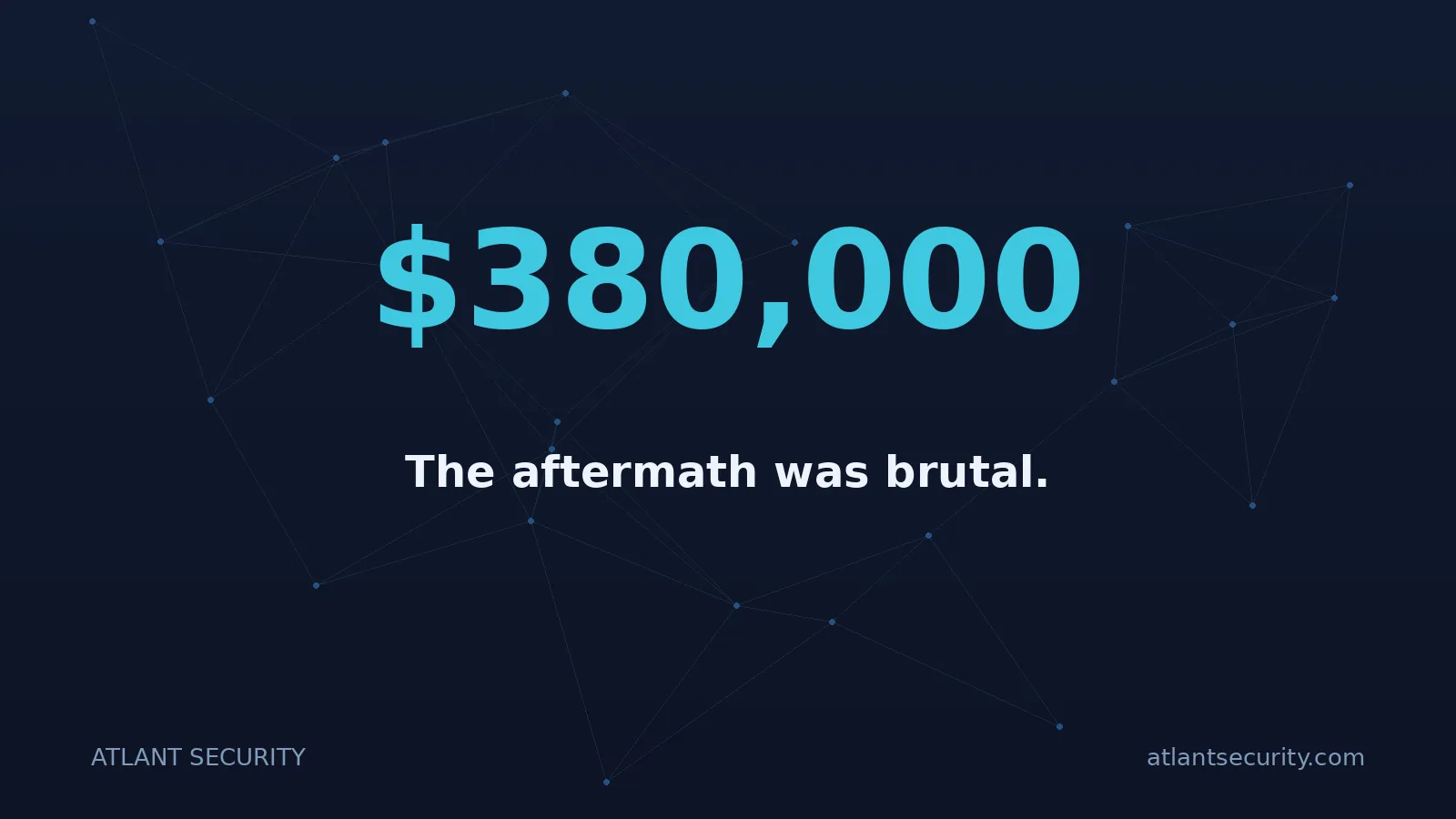
The aftermath was brutal. $380,000 in fraud liability. A mandatory PCI forensic investigation that cost another $85,000. Customer notification expenses. Legal fees. And the hardest hit of all: a 34% drop in conversion rate over the following quarter as customers lost trust in the checkout experience.
When we performed the incident response and subsequent ecommerce security audit, we found that the skimmer was just the visible symptom. Underneath it were 27 additional vulnerabilities: an admin panel accessible without IP restrictions, outdated Magento patches going back 14 months, three abandoned plugins with known CVEs, and no Content Security Policy headers on any page.
That experience crystallized something I’d been telling ecommerce operators for years: a generic security assessment is not enough for online stores. Ecommerce platforms handle payment data, customer PII, inventory systems, and dozens of third-party integrations in ways that traditional web applications simply do not. They require a specialized audit that understands the unique attack surface of digital commerce. This guide explains exactly what that audit involves, what it costs, and why every online store - from a $500K Shopify shop to a $100M enterprise platform - needs one.
Key Takeaways
- An ecommerce security audit evaluates payment flows, customer data handling, platform configurations, third-party integrations, and supply chain risks - areas that generic IT audits routinely miss.
- Platform matters: Shopify, WooCommerce, Magento, and custom builds each carry distinct security profiles, default configurations, and vulnerability patterns.
- PCI DSS 4.0 compliance is mandatory for every merchant that accepts card payments - the Self-Assessment Questionnaire type you need depends on how you process transactions.
- Card skimming (Magecart), account takeover, inventory manipulation, and coupon/promo abuse are the most common ecommerce-specific attacks auditors look for.
- A thorough ecommerce security audit typically takes 2-6 weeks and costs between $8,000 and $60,000+ depending on platform complexity, transaction volume, and compliance requirements.
Understanding the Scope
What an Ecommerce Security Audit Actually Covers
A standard IT security audit evaluates network infrastructure, access controls, policies, and general application security. An ecommerce security audit includes all of that - and then layers on the specific concerns that make online retail uniquely vulnerable.
Think about what an ecommerce platform actually does. It accepts and processes payment card data in real time. It stores customer personally identifiable information - names, addresses, email, phone numbers, purchase history. It integrates with shipping providers, tax calculators, inventory management systems, marketing platforms, and customer service tools. It runs promotional logic that touches pricing, discounts, and loyalty programs. And it does all of this on a public-facing application accessible to anyone with a web browser.
That combination of payment processing, PII storage, extensive third-party integrations, and public exposure creates an attack surface that is fundamentally different from a SaaS dashboard or an internal enterprise application.
Ecommerce Audit vs. Generic IT Audit - Key Differences
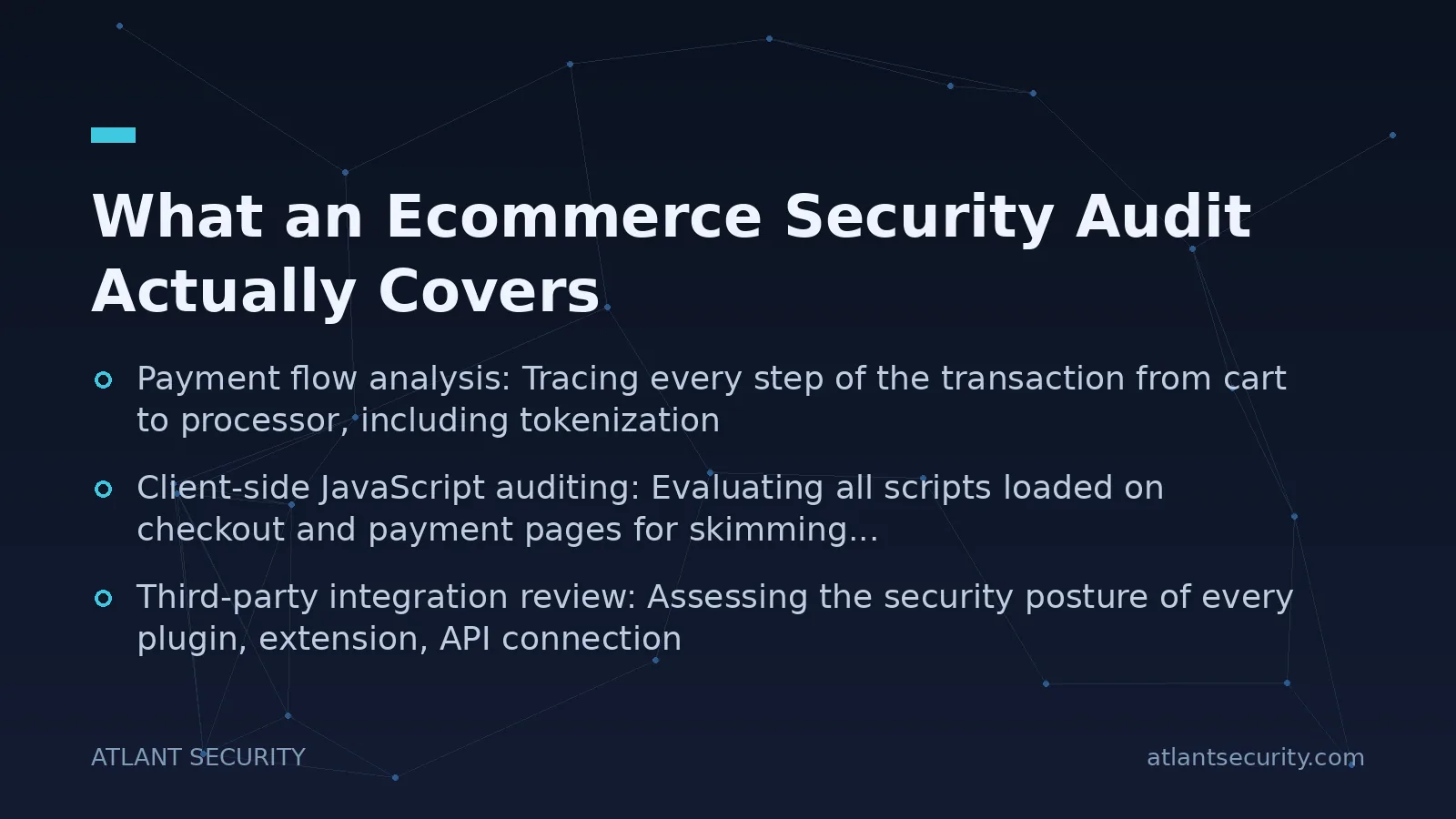
- Payment flow analysis: Tracing every step of the transaction from cart to processor, including tokenization, encryption in transit, and PCI scope boundaries.
- Client-side JavaScript auditing: Evaluating all scripts loaded on checkout and payment pages for skimming risks, which generic audits almost never cover.
- Third-party integration review: Assessing the security posture of every plugin, extension, API connection, and embedded widget across the storefront.
- Business logic testing: Probing pricing rules, discount codes, loyalty programs, and inventory systems for manipulation vulnerabilities.
- Platform-specific configuration review: Evaluating the security settings, permissions, and hardening of your specific ecommerce platform against known best practices.
In our experience delivering ecommerce cybersecurity services, the issues we find most often in online stores are ones that a traditional IT auditor would not even think to test: a Magecart injection vector in a third-party chat widget, an exposed GraphQL endpoint leaking customer order data, or a promotional code system that allows unlimited stacking to reduce any order to $0.01.
Platform Analysis
Platform-Specific Security: Shopify, WooCommerce, Magento & Custom Builds
The platform your store runs on fundamentally shapes your security posture, your audit scope, and the vulnerabilities you’re most likely to face. Here is what we evaluate for each major platform:
Shopify & Shopify Plus
Shopify is a managed platform, which means Shopify itself handles server infrastructure, SSL certificates, PCI compliance for the core checkout, and platform-level patching. This substantially reduces your attack surface - but it does not eliminate it.
What we audit on Shopify stores: third-party app permissions (many Shopify apps request far more access than they need, including full customer data and order history), custom Liquid theme code for XSS and data leakage, admin account security (MFA enforcement, role-based access, staff account hygiene), API key management (especially custom or private apps with excessive scopes), and webhook configurations that may transmit sensitive data to insecure endpoints.
WooCommerce (WordPress)
WooCommerce inherits every security concern of WordPress - and adds payment processing on top. This is the platform where we consistently find the most vulnerabilities during ecommerce security audits.
Critical audit areas include: WordPress core and plugin update status (the average WooCommerce store runs 25-40 plugins, and outdated ones are the single most common attack vector), hosting environment security (shared hosting is especially risky for ecommerce), wp-admin access controls (brute force protection, login URL obfuscation, IP restrictions), database security (default table prefixes, exposed phpMyAdmin), and payment gateway configuration (whether card data touches your server or is handled entirely by the gateway via tokenization).
Adobe Commerce (Magento)
Magento is powerful and flexible - and that flexibility means a larger attack surface. The platform has historically been a prime target for Magecart attackers, and self-hosted Magento installations require significant security expertise to maintain.
Our Magento audits focus on: patch level verification (Adobe releases critical security patches frequently, and many merchants fall behind), admin panel security (custom admin URLs, two-factor authentication, session management), file integrity monitoring (detecting unauthorized modifications to core files, a hallmark of Magecart compromises), extension security review (third-party Magento extensions are a known attack vector), and server configuration hardening (web server, PHP settings, database access controls).
Custom-Built & Headless Commerce
Custom platforms - whether built on frameworks like Next.js with a headless CMS and Stripe integration, or fully bespoke applications - require the deepest audit scope. There are no platform-level guardrails, no managed security features, and no community-maintained security patches to rely on.
For custom builds, a comprehensive ecommerce security audit includes full web application penetration testing, API security assessment (REST and GraphQL), authentication and session management review, server and cloud infrastructure evaluation, CI/CD pipeline security, and a thorough code review focused on payment handling and data storage logic.
| Platform | Infrastructure Responsibility | Primary Risk Area | Typical Audit Depth | PCI Scope |
|---|---|---|---|---|
| Shopify / Plus | Managed by Shopify | Apps & custom code | Moderate | SAQ A |
| WooCommerce | Merchant (self-hosted) | Plugins & hosting | Deep | SAQ A-EP or SAQ D |
| Magento / Adobe Commerce | Merchant (self-hosted) | Patches & extensions | Deep | SAQ A-EP or SAQ D |
| Custom / Headless | Merchant (full control) | Everything | Comprehensive | SAQ D (typically) |
Compliance Requirements
PCI DSS 4.0 Requirements for Ecommerce Merchants
If your online store accepts credit or debit card payments, you are subject to PCI DSS (Payment Card Industry Data Security Standard). This is not optional. It is a contractual requirement from every major card brand, and non-compliance can result in fines ranging from $5,000 to $100,000 per month, increased transaction fees, and ultimately the revocation of your ability to accept card payments.
PCI DSS 4.0 - which became the mandatory standard in March 2025 - introduced several requirements that are especially relevant to ecommerce. Understanding them is critical context for any ecommerce security audit.
Key PCI DSS 4.0 Changes Affecting Ecommerce
- Requirement 6.4.3: All payment page scripts must be inventoried, authorized, and monitored for integrity. This directly targets Magecart and card skimming attacks.
- Requirement 11.6.1: A mechanism must detect and alert on unauthorized changes to HTTP headers and payment page content. Weekly manual checks are no longer sufficient.
- Requirement 8.3.6: Passwords must be at least 12 characters (up from 7), and MFA is required for all access to the cardholder data environment.
- Requirement 12.3.1: A targeted risk analysis must be performed for each PCI DSS requirement where the entity is allowed flexibility in how frequently the activity is performed.
SAQ Types: Which One Applies to Your Store?
The Self-Assessment Questionnaire (SAQ) is how most ecommerce merchants validate PCI compliance. The type you need depends on how your store handles card data:
| SAQ Type | Applies When | Requirements | Common Platforms |
|---|---|---|---|
| SAQ A | All payment processing is fully outsourced (iframe or redirect) | 22 controls | Shopify, BigCommerce, hosted checkout |
| SAQ A-EP | Payment page is on your site but card data is submitted directly to processor via JavaScript/API | 139 controls | WooCommerce with Stripe.js, Magento with Braintree, custom checkouts |
| SAQ D | Card data touches your server (stored, processed, or transmitted) | 300+ controls | Custom payment processing, legacy integrations |
A well-scoped ecommerce security audit will determine exactly which SAQ type applies to your store, identify gaps against the relevant PCI DSS requirements, and provide a remediation roadmap to achieve and maintain compliance. Many of the merchants we work with are surprised to discover they qualify for a simpler SAQ type once their payment integration is properly configured - which can significantly reduce their compliance burden and audit costs.
The shift from SAQ A-EP to SAQ A can save a mid-sized merchant $15,000-$30,000 annually in compliance costs. But the switch requires a properly configured payment integration - which is exactly what the audit validates.
Deep Dive
The Five Critical Audit Areas for Every Online Store
1. Payment Processing Security
This is the highest-stakes area of any ecommerce security audit. We trace the complete lifecycle of a payment transaction: from the moment a customer enters card data, through tokenization and encryption, to the payment gateway, processor, and acquirer. We verify that card data never touches your server (when it shouldn’t), that TLS configurations are current, that tokenization is implemented correctly, and that payment confirmation flows don’t inadvertently expose sensitive data in URLs, logs, or error messages.
We also evaluate alternative payment methods - digital wallets, buy-now-pay-later services, cryptocurrency gateways - each of which introduces its own integration security concerns.
2. Customer Data Protection
Beyond payment data, ecommerce stores collect and store significant customer PII: names, addresses, email addresses, phone numbers, purchase history, wishlists, and sometimes dates of birth or government IDs for age-restricted products. An ecommerce security audit evaluates how this data is stored (encryption at rest), transmitted (encryption in transit), accessed (role-based controls), retained (data minimization and deletion policies), and protected from exfiltration (DLP controls, API rate limiting).
We also assess compliance with privacy regulations - GDPR, CCPA, and similar state-level laws - that impose specific requirements on how customer data is collected, used, and shared with third parties.
3. Admin Access & Internal Controls
The admin panel of an ecommerce platform is the keys to the kingdom. From it, you can view every customer record, export order data, modify pricing, issue refunds, and - in many platforms - inject custom code directly into the storefront. Our audit evaluates: who has admin access and at what permission level, whether MFA is enforced for all administrative accounts, whether access is restricted by IP or VPN, how admin sessions are managed (timeout, concurrent session limits), and whether there is an audit trail of administrative actions.
In roughly 60% of the ecommerce audits we perform, we find at least one former employee or contractor who still has active admin access. This is one of the simplest and most common findings - and one of the most dangerous.
4. Third-Party Integrations & Supply Chain
The average ecommerce store integrates with 15-30 third-party services: payment gateways, shipping providers, email marketing platforms, analytics tools, review aggregators, chatbots, loyalty programs, ERP systems, and more. Each integration is a potential attack vector. The Magecart attack that compromised British Airways in 2018 entered through a third-party JavaScript tag. The 2024 Polyfill.io supply chain attack affected over 100,000 websites, many of them ecommerce stores.
If the gap between annual tests is what worries you, continuous AI penetration testing closes it. Same coverage across web apps, APIs, cloud and internal network, evidence you can hand a developer, and a turnaround measured in days.
Our ecommerce security audit inventories every third-party script, API connection, and plugin; evaluates the permissions granted to each; assesses the security posture of critical vendors; verifies that Subresource Integrity (SRI) hashes are in place for external scripts; and reviews Content Security Policy (CSP) headers to restrict what scripts can execute on payment pages.
5. Supply Chain & Fulfillment Security
Modern ecommerce doesn’t end at checkout. Fulfillment partners, dropshipping suppliers, warehouse management systems, and returns processing platforms all handle customer data and can introduce security risks. We evaluate how order data is transmitted to fulfillment partners, what data they can access, how returns and refund workflows handle sensitive information, and whether there are contractual security requirements in place with key supply chain partners.
Threat Landscape
Common Ecommerce Vulnerabilities Auditors Look For
While ecommerce stores are vulnerable to all the standard web application threats (SQL injection, XSS, CSRF, broken authentication), they also face a set of attack types that are unique to online retail. These are the ecommerce-specific vulnerabilities we test for in every audit:
Ecommerce-Specific Attack Types
- Card Skimming (Magecart): Malicious JavaScript injected into checkout pages to capture payment card data in real time. This can enter through compromised third-party scripts, vulnerable plugins, or direct server compromise. Magecart attacks have hit major brands including British Airways, Ticketmaster, Newegg, and thousands of small and mid-sized stores. Our audit tests for active skimmers and assesses your defenses against injection.
- Account Takeover (ATO): Attackers use credential stuffing (automated login attempts using breached username/password pairs from other sites) to hijack customer accounts. Once inside, they can make fraudulent purchases with saved payment methods, steal loyalty points, redirect shipments, or harvest personal data. We test login rate limiting, bot detection, password policies, and MFA availability for customer accounts.
- Inventory Manipulation: Sophisticated attackers exploit race conditions or API vulnerabilities to manipulate inventory counts, hold items in carts indefinitely (denying them to legitimate customers), or purchase limited-edition products using automated bots before humans can. We test cart and inventory APIs for race conditions, quantity manipulation, and bot resistance.
- Coupon & Promo Abuse: Attackers reverse-engineer coupon generation algorithms, exploit stacking logic to apply multiple discounts beyond intended limits, or use automated tools to brute-force valid coupon codes. We have seen cases where promotional logic flaws allowed attackers to reduce order totals to near-zero. Our audit tests all discount, referral, and loyalty program logic for manipulation.
- Price Manipulation: In poorly designed checkout flows, attackers can intercept and modify price values in client-side code, hidden form fields, or API requests. Server-side price validation is essential, yet roughly 15% of the custom ecommerce builds we audit lack proper server-side verification of order totals.
- Gift Card Fraud: Attackers enumerate gift card numbers and PINs through predictable generation patterns, brute-force attacks on balance-check pages, or application logic flaws that leak valid card numbers. We test gift card systems for enumeration resistance and rate limiting.
Beyond these ecommerce-specific threats, a comprehensive audit also covers the OWASP Top 10, API security (especially important for headless commerce and mobile apps), server-side request forgery (SSRF), insecure direct object references (IDOR) that could allow customers to view other customers’ orders, and authentication/session management weaknesses.
Process & Timeline
The Ecommerce Security Audit Process, Step by Step
Here is what the process looks like when we conduct an ecommerce security audit, from initial scoping to final deliverables:
Phase 1: Discovery & Scoping (Days 1-3)
We document your ecommerce platform, hosting environment, payment integration architecture, third-party services, and business-specific requirements (compliance obligations, transaction volume, seasonal peaks). This phase determines the audit scope, SAQ applicability, and testing methodology. You provide access credentials, architecture documentation, and identify key stakeholders.
Phase 2: Automated Scanning & Reconnaissance (Days 3-7)
We run automated vulnerability scanners, port scanners, SSL/TLS analyzers, and platform-specific security scanning tools. For WooCommerce, this includes WPScan and plugin vulnerability databases. For Magento, MageReport and custom integrity checks. We also enumerate all client-side JavaScript, third-party resources, and API endpoints.
Phase 3: Manual Testing & Deep Analysis (Days 7-21)
This is the core of the audit. Our security engineers manually test payment flows, authentication mechanisms, business logic, admin access controls, API endpoints, and third-party integrations. We attempt to replicate real-world attack scenarios: Magecart injection, account takeover via credential stuffing, inventory manipulation, coupon abuse, and price tampering. We also review platform configurations, server hardening, and data handling practices against PCI DSS requirements and industry best practices.
Phase 4: Reporting & Prioritization (Days 21-28)
We compile findings into a detailed report that includes: an executive summary for leadership and board-level stakeholders, technical findings with severity ratings (Critical, High, Medium, Low, Informational), evidence and reproduction steps for each finding, a PCI DSS gap analysis with specific requirement mappings, and a prioritized remediation roadmap with estimated effort levels. Critical findings - particularly active skimmers or data exposure - are reported immediately upon discovery, not held until the report phase.
Phase 5: Remediation Support & Verification (Days 28-42+)
We present findings to your team, answer technical questions, and provide guidance on remediation approaches. After your team implements fixes, we perform re-testing of critical and high-severity findings to verify they have been properly addressed. For clients pursuing SOC 2 readiness or PCI certification, we provide gap closure support to ensure audit findings translate into compliance progress.
The ecommerce brands that benefit most from security audits are the ones that schedule them proactively - before peak season, before a platform migration, or before entering a new market - not after they’ve already been breached.
Investment
Ecommerce Security Audit Cost Breakdown
Ecommerce security audit costs vary based on platform type, store complexity, transaction volume, number of third-party integrations, and compliance requirements. Here is what the market looks like in 2026:
| Store Profile | Audit Scope | Cost Range | Timeline |
|---|---|---|---|
| Shopify store ($500K-$2M revenue) | App review, config audit, PCI validation | $8,000 - $15,000 | 1-2 weeks |
| WooCommerce store ($1M-$10M revenue) | Full platform + hosting + plugin audit | $15,000 - $30,000 | 2-3 weeks |
| Magento / Adobe Commerce ($5M-$50M) | Comprehensive: platform, server, extensions, PCI | $25,000 - $50,000 | 3-5 weeks |
| Custom / Headless ($10M-$100M+) | Full-scope: app, API, infra, code review, PCI | $40,000 - $80,000+ | 4-6 weeks |
| Enterprise multi-store ($100M+) | Multi-region, multi-platform, full PCI + compliance | $80,000 - $150,000+ | 6-10 weeks |
What Drives Audit Costs Up (and Down)
- More integrations = higher cost. Each third-party service requires individual assessment. A store with 40 plugins will cost more to audit than one with 10.
- Self-hosted platforms cost more. WooCommerce and Magento audits include server and hosting environment assessment. Shopify does not.
- PCI compliance adds scope. If PCI DSS gap analysis is included, expect a 25-40% increase in cost and timeline.
- Annual retainers reduce per-audit cost. Clients who engage for annual or semi-annual audits typically see 15-25% lower per-engagement costs and faster turnaround due to existing institutional knowledge.
- Re-testing is often included. Most reputable audit firms include one round of re-testing for critical and high-severity findings in the initial engagement price.
To put these costs in perspective: the average cost of an ecommerce data breach in 2025 was $4.1 million according to IBM’s Cost of a Data Breach Report, and that figure does not account for the conversion rate impact, customer lifetime value lost, or brand damage that ecommerce businesses specifically experience. A $20,000 audit that prevents even one significant incident pays for itself hundreds of times over.
Common Questions
Frequently Asked Questions About Ecommerce Security Audits
1. How often should an ecommerce store get a security audit?
At minimum, annually. High-volume stores ($10M+ in revenue) or those in regulated industries should consider semi-annual audits. You should also conduct an audit before and after major platform migrations, before peak selling seasons (Black Friday, holiday), and after any security incident. PCI DSS requires an annual validation of compliance, but the underlying security assessment should be more frequent than the compliance cycle.
2. Do I need a security audit if I use Shopify? Shopify is already PCI compliant.
Yes. Shopify’s PCI compliance covers their infrastructure and core checkout, not your store. Your third-party apps, custom theme code, admin access practices, API integrations, and business processes are all outside Shopify’s compliance scope. We have found significant vulnerabilities in Shopify stores - including apps with excessive data access, custom code with XSS flaws, and admin accounts without MFA - that Shopify’s platform security does not address.
3. Will the audit cause downtime or affect our store’s performance?
No. Professional ecommerce security audits are designed to be non-disruptive. We coordinate testing windows to avoid peak traffic periods, use rate-limited scanning to prevent performance impact, and test destructive operations (like account lockout thresholds) in staging environments when possible. In over 200 ecommerce audits, we have never caused an unplanned outage.
4. What is the difference between an ecommerce security audit and a penetration test?
A penetration test focuses specifically on finding and exploiting technical vulnerabilities in your application and infrastructure. An ecommerce security audit is broader: it includes penetration testing but also covers PCI DSS compliance, platform configuration review, third-party integration assessment, business logic analysis, policy and process evaluation, and supply chain risk assessment. Think of a penetration test as one important component of a comprehensive ecommerce security audit.
5. What do we receive when the audit is complete?
You receive a comprehensive report that includes: an executive summary suitable for board or investor presentations, a detailed technical findings report with severity ratings (Critical, High, Medium, Low, Informational), evidence and proof-of-concept demonstrations for each finding, a PCI DSS gap analysis mapped to specific requirements, a prioritized remediation roadmap with estimated effort levels, and a follow-up re-test of critical and high findings after your team implements fixes.
6. Can you audit our store during Black Friday or peak season?
We can, but we recommend against it. Active scanning during your highest-traffic periods introduces unnecessary risk and makes it harder to distinguish audit-generated traffic from real attacks in your logs. The ideal timing is to complete the audit 6-8 weeks before peak season, giving your team enough time to remediate critical findings before the traffic surge.
7. How do you handle it if you find an active breach during the audit?
If we discover evidence of an active compromise - such as a card skimmer on your checkout page, unauthorized admin access, or data exfiltration - we notify you immediately through a pre-established emergency communication channel. We do not wait for the final report. We provide immediate containment recommendations, assist with evidence preservation for potential law enforcement involvement, and can transition into an incident response engagement if needed.
8. Do you work with our development team, or is this a separate process?
Both. The audit itself is conducted independently to maintain objectivity, but we work closely with your development team during the scoping phase (to understand your architecture) and the remediation phase (to explain findings and recommend implementation approaches). Many of our ecommerce clients find that the audit process upskills their development team on security best practices, which has lasting value beyond the specific findings.
Final Thoughts
Your Checkout Page Is Your Most Valuable - and Vulnerable - Asset
Every ecommerce business, regardless of size or platform, operates on a foundation of customer trust. Shoppers hand over their credit card numbers, home addresses, and personal information because they believe your store will protect that data. An ecommerce security audit is how you verify that belief is justified - and how you identify and fix the gaps before an attacker finds them first.
The client I mentioned at the beginning of this article - the one who lost $380,000 to a Magecart attack - is now one of our ongoing retainer clients. They get audited twice a year. Their checkout pages run Content Security Policy headers that block unauthorized scripts. They have automated file integrity monitoring on their Magento installation. And their conversion rate has fully recovered, because their customers can see the security trust signals they have invested in.
The cost of that semi-annual audit program is less than 3% of what the single breach cost them. That is the math that every ecommerce operator needs to understand.
In ecommerce, security is not a cost center - it is a conversion driver. Customers buy from stores they trust, and trust is built through verified, demonstrable security practices.
Protect Your Ecommerce Revenue with a Security Audit
Schedule a free consultation with our ecommerce security team to discuss your store’s specific risks.
Our initial conversation includes: a 30-minute discussion of your platform, integrations, and security concerns; a preliminary risk assessment based on your store profile; estimated scope, timeline, and investment; and honest guidance on whether an audit is the right next step. No obligation, no pressure.
Published: March 2026 · Author: Alexander Sverdlov, Atlant Security
This article is for informational purposes only and does not constitute legal or professional advice. Pricing ranges reflect 2026 U.S. market estimates and may vary based on scope, platform, geography, and specific compliance requirements. Organizations should evaluate security audit providers based on their specific needs and circumstances.
Running an online store?
Security work scoped for ecommerce: the checkout path, the payment integration, the plugins and the admin accounts, with PCI DSS scope settled before anyone spends money securing the wrong systems.
See ecommerce security services