
We have probably seen your problem before. Our smallest client had eight employees. Our largest secures the nuclear power plant of the United Arab Emirates. Whatever shape yours is, tell us about it and we will tell you how we would fix it.
If you run a licensed financial institution in Singapore, the Monetary Authority of Singapore expects your technology risk management to be measurable, tested, and defensible. The MAS Technology Risk Management Guidelines set the bar, and the Notice on Technology Risk Management makes parts of it legally binding. Choosing who reviews your compliance is a decision that shapes whether you walk into a supervisory conversation with confidence or with a list of gaps you did not know you had. I have run more than 200 security assessments across 14 countries since 2013, and the difference between a useful audit and a wasted one comes down to who does it and how they scope it. This guide explains what separates a strong MAS TRM auditor from a weak one, and how to choose.
Need hands-on MAS TRM compliance help?
Atlant Security provides MAS TRM compliance consulting: fixed price, led by a former Microsoft security consultant, and you review the readiness report before you pay. See the service and book a strategy call →
What MAS TRM Actually Covers
The TRM Guidelines are broad. They span technology risk governance and oversight, the systems development life cycle, IT service management, data centre resilience, network and infrastructure security, access controls, cryptography, and incident management. The accompanying Notice on TRM adds enforceable requirements, including the obligation to report relevant incidents to MAS. A common misconception is that MAS TRM is only about firewalls and patching. It is really about whether your board and senior management can demonstrate that technology risk is understood, owned, and controlled across the institution.
Any auditor you engage needs to understand that breadth. Someone who tests your perimeter but cannot evaluate your governance, your third-party arrangements, or your incident reporting readiness has only covered a fraction of what MAS looks at.
What Separates a Strong MAS TRM Auditor
Over the years I have seen the good, the mediocre, and the outright unhelpful. The auditors worth engaging share a set of traits that have nothing to do with how large their brand is.
| Trait | Why It Matters for MAS TRM |
|---|---|
| Guidelines fluency | They can map findings to specific TRM sections, not generic best practice. |
| Technical depth | They test cloud, identity, network, and application controls hands-on, not by questionnaire alone. |
| Clear reporting | Findings are prioritised by risk with actionable remediation, not a raw scanner dump. |
| Regulatory context | They understand MAS supervisory expectations and incident reporting obligations. |
| Independence | They did not build the controls they are now assessing. |
The reporting quality point is the one buyers underrate most. I have reviewed audit reports handed to me by new clients that were hundreds of pages of tool output with no prioritisation and no clear read on what actually mattered. A report you cannot act on is not assurance; it is paperwork. A good MAS TRM assessment tells you the three things that would fail you in a supervisory review and exactly how to fix them.
Why the Wrong Auditor Costs More Than It Saves
Picking on price alone is the most expensive mistake I see. An inexperienced reviewer misses material gaps, which means you believe you are compliant when you are not. That gap surfaces later, usually during an incident or a supervisory review, when the cost of remediation and the reputational exposure are far higher. An auditor who does not know MAS specifically will produce findings framed against the wrong expectations, and you end up redoing the work. APIs, payment logic, cloud identities and multi-tenant isolation are where fintech breaks; fintech penetration testing is scoped to exactly those surfaces and produces reproducible findings your engineers can act on.
The other failure mode is the opposite: an enormous, generic engagement that bills heavily, tests broadly, and still does not close the questions MAS cares about. Scope discipline matters. You want depth where your risk concentrates, not uniform shallow coverage everywhere.
How to Choose Your MAS TRM Auditor
Here is the process I would follow if I were on the buying side.
- Ask how they map findings to the TRM Guidelines. A strong partner will reference specific sections and the TRM Notice, not just say "we cover MAS". If they cannot, they are selling you a generic audit with a Singapore label.
- Confirm hands-on testing. Compliance you can prove comes from testing controls, not from a self-assessment questionnaire. Ask what they will actually attempt against your systems. A real penetration test and configuration review beats a checklist every time.
- Match their skills to your architecture. If you run heavily on cloud, the auditor must understand cloud identity, storage exposure, and misconfiguration. Most serious findings in financial platforms today are cloud misconfigurations, so cloud security expertise is not optional.
- Review a sample report. Ask to see a redacted deliverable. Is it prioritised? Is remediation specific? Could your engineers act on it tomorrow?
- Check independence. The team assessing your controls should not be the team that built or operates them. MAS values objectivity, and so should you.
What a MAS TRM Assessment Involves
A thorough engagement is closer to a health check across your whole technology estate than a single test. Expect it to cover:
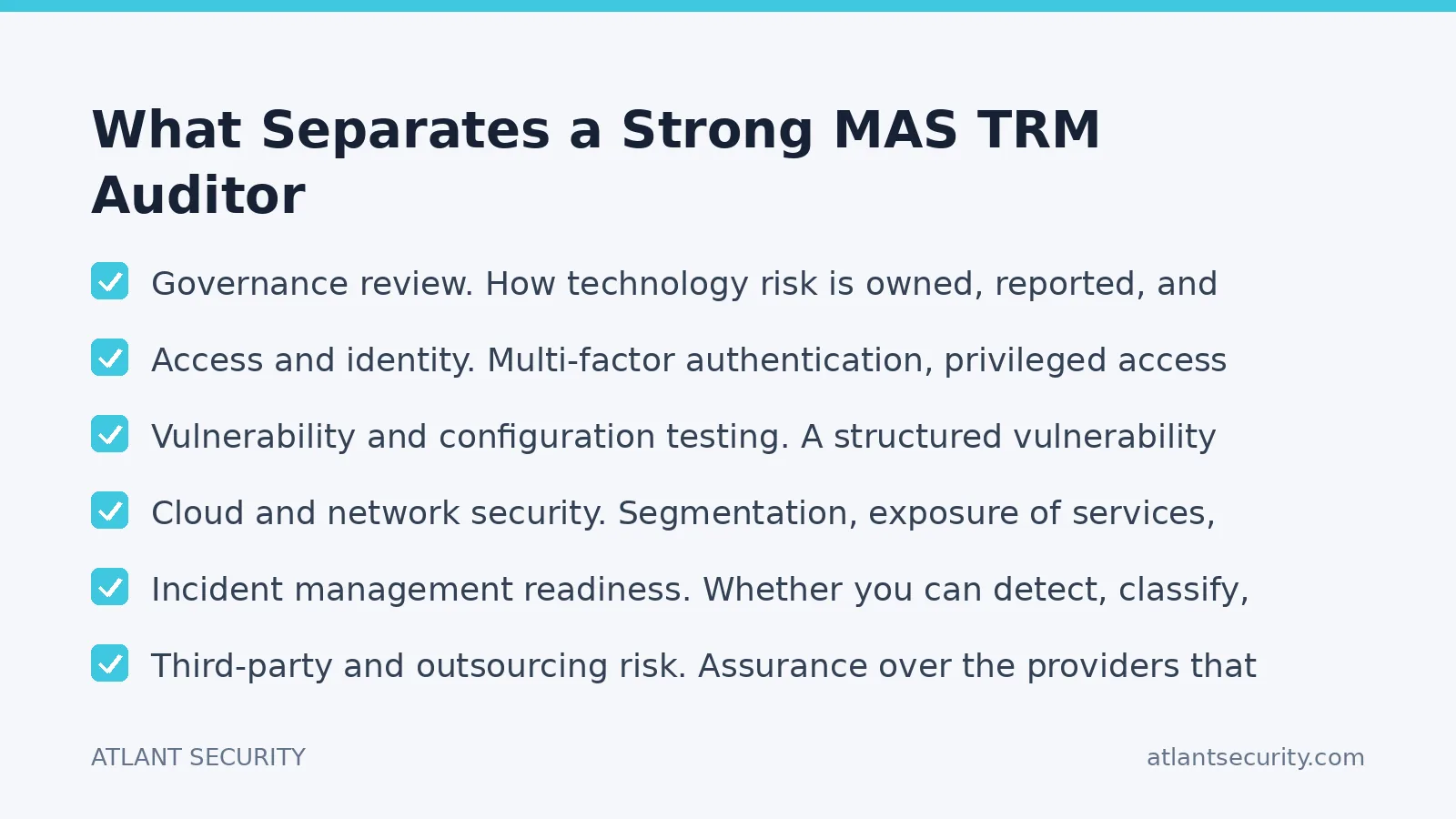
- Governance review. How technology risk is owned, reported, and overseen by senior management and the board.
- Access and identity. Multi-factor authentication, privileged access controls, joiner-mover-leaver processes, and segregation of duties.
- Vulnerability and configuration testing. A structured vulnerability assessment across internet-facing and internal systems.
- Cloud and network security. Segmentation, exposure of services, encryption in transit and at rest, and key management.
- Incident management readiness. Whether you can detect, classify, and report incidents to MAS within the required timelines.
- Third-party and outsourcing risk. Assurance over the providers that handle your data and systems.
The output should be a risk-prioritised report with a remediation roadmap. If you want that work led personally on a fixed scope, that is exactly what our MAS TRM compliance service delivers, and you review the readiness report before you pay.
Budgeting for the Engagement
Costs vary with the size of your institution, the complexity of your architecture, and how much remediation support you need alongside the assessment. Rather than quoting figures that will not match your situation, here is how to think about the components so you can compare proposals fairly.
| Component | What You Are Paying For |
|---|---|
| Gap assessment | Mapping current state against TRM Guidelines and Notice |
| Technical testing | Hands-on vulnerability and penetration testing of key systems |
| Cloud review | Configuration and identity review of your cloud estate |
| Remediation support | Guidance or hands-on help closing the gaps found |
| Reassessment | Retesting to confirm fixes actually hold |
The cheapest quote is rarely the best value. What you are really buying is confidence that a supervisory review or a real incident will not surface something you missed. For fintechs that need ongoing security leadership rather than a one-off review, a fintech virtual CISO arrangement spreads that expertise across the year at a predictable cost.
Getting the Most From Your Auditor
Even the best auditor produces a weak result if you set them up badly. Before the engagement, gather your current policies, network diagrams, asset inventory, cloud account access, and prior test reports. Run an internal gap review first so you are not paying an external team to discover the obvious. And treat the report as the start of the work, not the end. The value is in closing the findings and being able to prove they are closed, which is what MAS ultimately wants to see.
Frequently Asked Questions
Is a MAS TRM audit legally required?
The TRM Guidelines are supervisory guidance rather than law, but the Notice on Technology Risk Management sets legally binding requirements for relevant financial institutions, including incident reporting. In practice MAS expects regulated institutions to demonstrate their technology risk management against the Guidelines, so a structured assessment is effectively a business necessity even where a specific audit is not mandated by statute.
How long does a MAS TRM assessment take?
A focused engagement for a mid-sized institution typically runs a few weeks from kickoff to final report, depending on the size of your estate and how quickly you can provide access and documentation. Remediation of the findings usually takes longer than the assessment itself and should be planned for. If you run a bank, the scoping conversation is different from a SaaS company's: a bank pentest starts from core banking dependencies and privileged access, not from the marketing site.
Can we use an overseas auditor?
You can, provided they genuinely understand MAS expectations and can map findings to the TRM Guidelines and Notice. What matters is regulatory fluency and technical depth, not the passport of the reviewer. An overseas team that treats MAS as interchangeable with another jurisdiction's rules will produce findings you have to reframe.
What happens if MAS finds gaps in our technology risk management?
MAS can require remediation, impose additional supervisory scrutiny, and in serious cases take enforcement action. The bigger risk for most institutions is that undetected gaps become the entry point for an actual incident, which then triggers mandatory reporting and the associated fallout. Finding and closing gaps proactively is always cheaper than discovering them under pressure.
How is MAS TRM different from a generic security audit?
A generic audit tests security against broad best practice. A MAS TRM assessment maps your controls specifically to the Guidelines and Notice, covers governance and outsourcing risk that generic tests often skip, and evaluates your readiness to meet MAS incident reporting obligations. The framing and the coverage are what make it fit for a Singapore financial institution.
How do we get started?
Begin with a gap assessment against the TRM Guidelines so you know where you stand, then prioritise remediation by risk. If you want that scoped and led personally on a fixed price, contact Atlant Security and we can map out the engagement.
Facing a MAS inspection?
We map the MAS TRM Guidelines and Notice 655 to your actual systems, hand you a prioritised gap report in about two weeks, then implement the missing controls with your team and prepare the board pack.
See MAS TRM compliance