

Compliance · March 2026
A plain-English breakdown of SOC 2 Type 1 vs Type 2 - what each audit actually tests, how timelines and costs differ, and a practical decision framework so you pick the right one.
A few years ago, I was on a call with the CTO of a 60-person B2B SaaS company. They had just landed a huge enterprise prospect - the kind of deal that makes the whole company hold its breath. Then the procurement team sent over a security questionnaire. Question number four: "Please provide your most recent SOC 2 Type II report."
The CTO looked at me through the webcam and said, with genuine confusion: "We already did SOC 2. We got our Type 1 report three months ago. Isn't that the same thing?"
It wasn't. They had to go back to their auditor, start a monitoring period, and wait another six months before they could close that deal. The enterprise prospect was patient - barely - but the CTO told me afterward that those six months felt like watching a soufflé through the oven door, praying nothing collapsed.
That story plays out constantly. The difference between SOC 2 Type 1 and Type 2 is one of the most misunderstood distinctions in compliance - and picking the wrong one (or not understanding the relationship between them) can cost you months, deals, and real money. This guide breaks it all down so you can make the right call the first time.
Key Takeaways
- Type 1 evaluates whether your controls are properly designed at a single point in time. Type 2 evaluates whether those controls operate effectively over a period (typically 3-12 months).
- Most enterprise buyers require a Type 2 report. A Type 1 alone rarely satisfies procurement teams at large organizations.
- Type 1 is faster and cheaper - but it is not a shortcut. Think of it as a stepping stone, not a destination.
- The total cost difference is roughly $15,000-$30,000 for Type 1 vs. $30,000-$100,000+ for Type 2, depending on complexity.
- The smartest path for most companies: do a SOC 2 readiness assessment first, get your Type 1, then immediately begin your Type 2 observation period.
Foundation
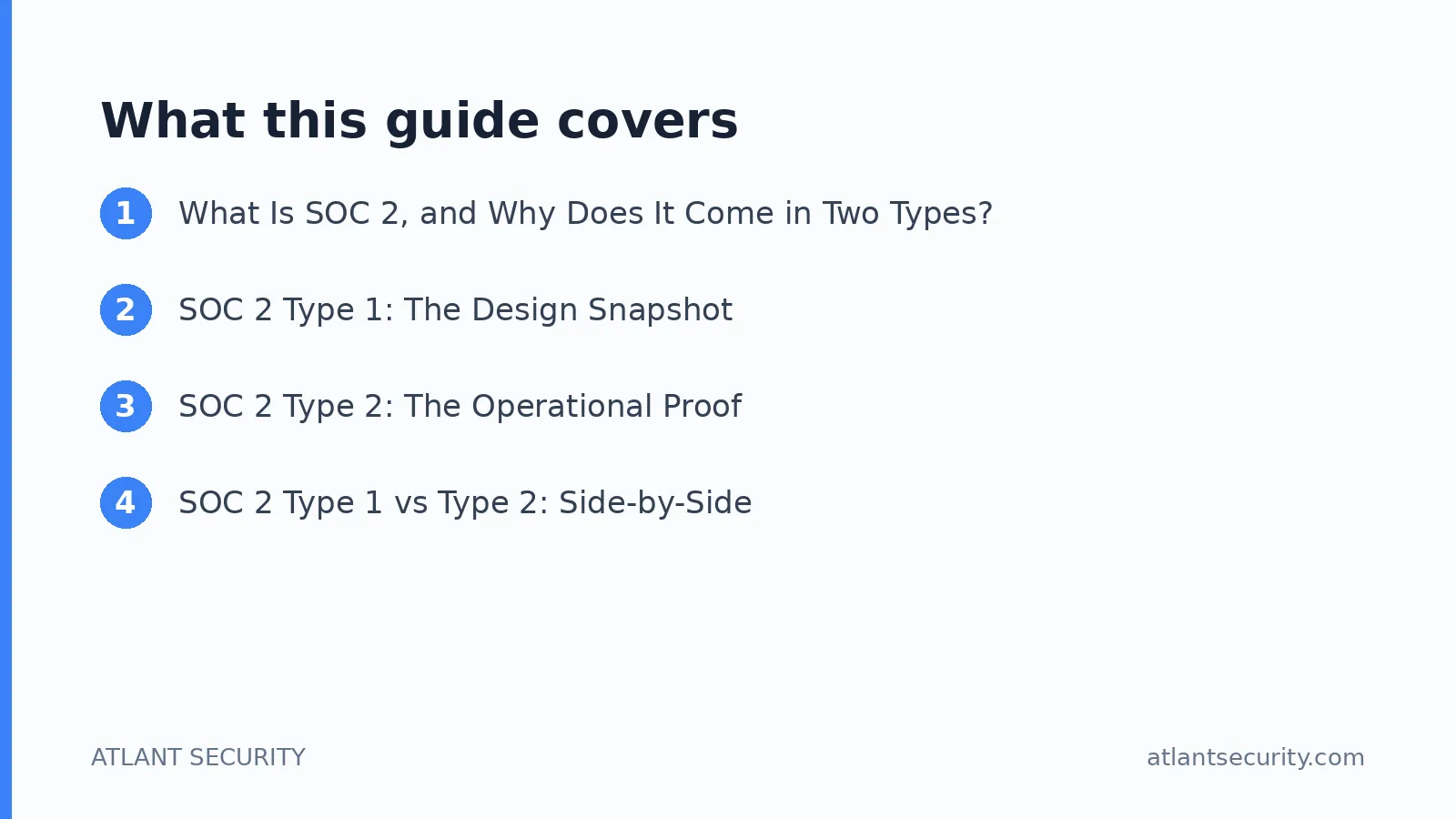
What Is SOC 2, and Why Does It Come in Two Types?
SOC 2 (System and Organization Controls 2) is a compliance framework developed by the American Institute of Certified Public Accountants (AICPA). It defines criteria for managing customer data based on five Trust Services Criteria: Security, Availability, Processing Integrity, Confidentiality, and Privacy.
Unlike prescriptive frameworks like PCI DSS that tell you exactly what to do, SOC 2 is principles-based. It says "you must protect data from unauthorized access" but lets you decide how. That flexibility is powerful - and also why organizations need an independent CPA firm to audit whether the controls you chose actually work.
The AICPA created two report types because there are two fundamentally different questions buyers need answered:
The Two Questions SOC 2 Answers
- Type 1: "Have you designed the right controls?" - Evaluated at a specific point in time.
- Type 2: "Do those controls actually work over time?" - Evaluated over an observation period (minimum 3 months, typically 6-12 months).
Both report types are issued by an independent CPA firm (your auditor). Both cover the same Trust Services Criteria. The difference is entirely about depth of evidence and duration of testing.
Deep Dive
SOC 2 Type 1: The Design Snapshot
A SOC 2 Type 1 report evaluates whether your security controls are suitably designed as of a specific date. Think of it like a building inspection that checks whether the blueprints meet code - but doesn't yet verify that the plumbing actually works day after day.
What the auditor examines:
- Your system description (how your infrastructure, software, people, procedures, and data flows operate)
- Whether controls are in place that address the relevant Trust Services Criteria
- Whether those controls are designed in a way that could reasonably achieve the stated objectives
What the auditor does NOT examine:
- Whether controls have been operating consistently over time
- Historical evidence of control execution (logs, tickets, review records)
- Whether exceptions or failures occurred during a monitoring period
Type 1 in Practice
Your auditor visits (virtually or in person), reviews your policies, interviews key personnel, inspects configurations, and confirms that the right controls exist as of a single date - say, March 15, 2026. The resulting report says: "As of March 15, 2026, Company X's controls were suitably designed to meet the Security criteria." That's it. No comment on whether those controls worked last week, last month, or will work tomorrow.
Typical timeline: 4-8 weeks from kickoff to report issuance (assuming you're already audit-ready).
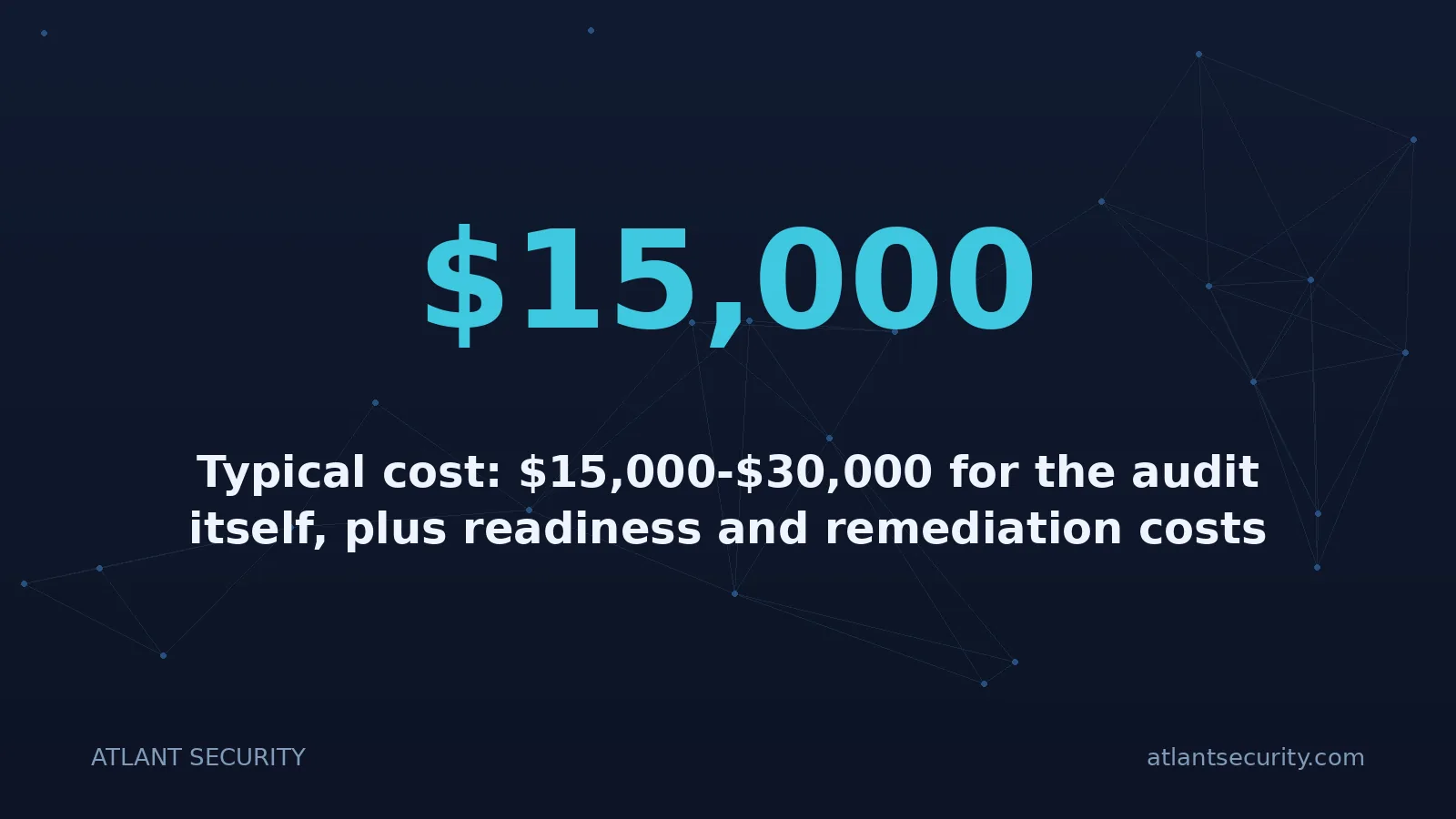
Typical cost: $15,000-$30,000 for the audit itself, plus readiness and remediation costs that vary widely.
Deep Dive
SOC 2 Type 2: The Operational Proof
A SOC 2 Type 2 report evaluates whether your controls are suitably designed and whether they operated effectively over a defined observation period. This is the full exam. It doesn't just check the blueprints - it moves into the building and watches the plumbing run for months.
What the auditor examines (everything in Type 1, plus):
- Evidence that controls operated consistently throughout the observation period
- Samples of access reviews, change management tickets, incident response logs, backup verification records
- Whether any control exceptions or deviations occurred - and if so, how they were addressed
- Continuous monitoring evidence (SIEM alerts, vulnerability scan results, patching cadence)
Why Type 2 Carries More Weight
Enterprise procurement teams, SOC analysts reviewing vendor security, and compliance officers all understand a simple truth: a control that exists on paper means very little if nobody can prove it ran correctly for the last six months. Type 2 is the report that provides that proof.
When a Fortune 500 company asks for your SOC 2 report, they almost always mean Type 2. If you hand them a Type 1, expect a follow-up question: "When will your Type 2 be ready?"
Observation period: Minimum 3 months. Most common: 6 months for a first-time Type 2, then 12 months annually after that. Some auditors and buyers prefer a full 12-month window from day one, but this is uncommon for first-timers.
Typical timeline: 6-14 months total (observation period + fieldwork + report issuance).
Typical cost: $30,000-$60,000 for the audit itself. Total project cost including remediation, tooling, and consultant support can reach $80,000-$150,000+ for complex environments.
Comparison
SOC 2 Type 1 vs Type 2: Side-by-Side
| Dimension | SOC 2 Type 1 | SOC 2 Type 2 |
|---|---|---|
| What It Tests | Control design (are controls in place?) | Control design + operating effectiveness |
| Time Frame | Single point in time (one date) | Observation period (3-12 months) |
| Evidence Required | Policies, configs, system description | All of Type 1 + operational logs, samples, tickets |
| Audit Duration | 4-8 weeks | 6-14 months (including observation) |
| Audit Fee (Typical) | $15,000 - $30,000 | $30,000 - $60,000 |
| Total Project Cost | $25,000 - $60,000 | $50,000 - $150,000+ |
| Buyer Acceptance | Accepted by some; often as interim step | Universally accepted; required by most enterprises |
| Report Shelf Life | Typically shared for 6-12 months | Valid for 12 months; renewed annually |
| Exceptions Noted | Design deficiencies only | Design + operational exceptions (with details) |
| Best For | Early-stage companies, quick wins, bridge reports | Enterprise sales, long-term trust, recurring compliance |
Decision Framework
When to Choose Type 1 vs. Type 2
This isn't always an either-or decision. Most companies end up doing both - Type 1 first, then Type 2. But your specific situation determines the right starting point and sequence.
Choose Type 1 First When...
- You're doing SOC 2 for the first time and need to validate your control design before committing to a longer observation period.
- You have an urgent deal and need something credible to show a prospect within 2-3 months. A Type 1 can serve as a bridge while your Type 2 observation period runs.
- Your security program is relatively new and you want an independent check on whether your controls are designed correctly before you invest in proving they operate over time.
- Budget is tight. A Type 1 lets you demonstrate commitment to compliance at a lower initial cost.
- You're a startup in early stages (pre-Series B, under 100 employees) and your buyers will accept a Type 1 with a letter of intent for Type 2.
Go Directly to Type 2 When...
- Your buyers explicitly require Type 2. If the RFP or security questionnaire says "Type II," a Type 1 won't satisfy them.
- You already have mature security operations. If you've been running controls consistently for 6+ months, you may not need the Type 1 stepping stone.
- You're in a regulated industry (fintech, healthtech, enterprise SaaS) where Type 2 is table stakes.
- You want to avoid paying for two separate audit engagements. Some auditors charge almost as much for Type 1 as Type 2, making the combined cost hard to justify.
- Your competitors already have Type 2 reports. In competitive markets, a Type 1 can signal immaturity rather than progress.
The Hybrid Strategy (Most Common)
The most common - and often smartest - approach: get your Type 1 and immediately begin your Type 2 observation period. Here's the typical timeline:
- Months 1-2: SOC 2 readiness assessment and gap remediation
- Month 3: Type 1 audit fieldwork and report issuance
- Months 3-9: Type 2 observation period begins (overlapping with or immediately after Type 1)
- Months 9-10: Type 2 fieldwork and report issuance
Total time to Type 2 report: roughly 9-12 months. You get a Type 1 to share at month 3 and a Type 2 by month 10. This is the path most vCISO engagements follow.
Cost Analysis
Realistic Cost Breakdown: Type 1 vs. Type 2
The audit fee is just one part of the total cost. Here's what the full picture looks like for a typical SaaS company (50-200 employees, cloud-native, Security + Availability criteria):
| Cost Component | Type 1 Only | Type 1 + Type 2 | Type 2 Direct |
|---|---|---|---|
| Readiness Assessment | $5,000 - $15,000 | $5,000 - $15,000 | $5,000 - $15,000 |
| Gap Remediation | $5,000 - $30,000 | $5,000 - $30,000 | $5,000 - $30,000 |
| GRC Platform (Vanta, Drata, etc.) | $5,000 - $15,000/yr | $5,000 - $15,000/yr | $5,000 - $15,000/yr |
| Audit Fee (Type 1) | $15,000 - $30,000 | $15,000 - $30,000 | - |
| Audit Fee (Type 2) | - | $30,000 - $60,000 | $30,000 - $60,000 |
| Consultant / vCISO Support | $0 - $15,000 | $10,000 - $40,000 | $10,000 - $40,000 |
| Internal Staff Time | 40-80 hours | 120-300 hours | 100-250 hours |
| Estimated Total | $25,000 - $60,000 | $60,000 - $150,000 | $50,000 - $130,000 |
Why "Type 1 + Type 2" Costs More Than "Type 2 Direct"
You're paying for two separate audit engagements. Some auditors offer bundled pricing if you commit to both upfront, which can save 10-20%. Always ask. If your controls are already mature and your buyers demand Type 2, skipping Type 1 can save $15,000-$25,000 and a few weeks of audit coordination.
Avoid These
7 Common Mistakes Companies Make with SOC 2 Type 1 vs. Type 2
Mistakes That Cost Real Time and Money
1. Treating Type 1 as the finish line. A Type 1 report is a milestone, not a destination. If your goal is to sell to enterprises, you need Type 2. Plan for it from day one - even if you start with Type 1. Companies that treat Type 1 as "done" often lose momentum and take 18+ months to finally get their Type 2.
2. Not starting the observation period early enough. Your Type 2 observation period can begin before or immediately after your Type 1 audit. If you wait months after Type 1 to "start" Type 2, you've wasted time. Discuss the observation window with your auditor during Type 1 planning.
3. Choosing the wrong observation period length. A 3-month observation window is the minimum, but some buyers won't accept it. Six months is the sweet spot for first-time Type 2 reports. Ask your largest prospects what they expect before committing to a window length.
4. Assuming Type 1 controls will "just work" during Type 2. Controls that look good on paper at a point in time frequently break down operationally. Quarterly access reviews get skipped. Change management tickets go undocumented. Backup tests don't happen. The gap between design and operation is where most Type 2 exceptions are found.
5. Picking an auditor based on price alone. The cheapest auditor may produce a report that sophisticated buyers won't respect. Conversely, the most expensive Big Four firm may be overkill for a Series A startup. Match your auditor to your buyer expectations. Ask prospects which audit firms they trust.
6. Not investing in a GRC platform. Manual evidence collection for Type 2 is brutal. Platforms like Vanta, Drata, or Secureframe automate continuous monitoring and evidence collection, reducing internal staff burden by 60-80%. The $5,000-$15,000/year investment pays for itself in saved engineering hours.
7. Skipping the readiness assessment. Going straight to audit without a proper readiness assessment is like taking a final exam without studying. Audit exceptions and qualified opinions are expensive to fix after the fact and can delay your report by months. A readiness assessment with an experienced consultant or virtual CISO costs a fraction of a failed audit.
Audit Details
What Auditors Actually Test in Each Type
Understanding what auditors look for helps you prepare the right evidence. Here's a concrete breakdown by control area:
| Control Area | Type 1 Evidence | Type 2 Evidence (Additional) |
|---|---|---|
| Access Control | MFA enabled, RBAC policy documented, access provisioning process defined | Quarterly access review logs, termination evidence, samples of provisioning/deprovisioning tickets |
| Change Management | Change management policy, approval workflow configured in CI/CD | Sample of 25-40 change tickets with approvals, code reviews, deployment logs over the period |
| Incident Response | IR plan documented, roles assigned, communication template ready | Evidence of IR drills, actual incident logs (if any), post-incident review documentation |
| Monitoring & Logging | SIEM configured, alerting rules defined, log retention policy set | Samples of alert investigations, evidence of log review cadence, uptime records |
| Risk Assessment | Risk register exists, methodology documented | Evidence of annual risk assessment completion, risk treatment plans with progress tracking |
| Vendor Management | Vendor management policy, critical vendor list, DPAs signed | Annual vendor review records, security questionnaire results, SLA monitoring evidence |
| Business Continuity | BC/DR plan documented, RTO/RPO defined, backup configs verified | Backup restore test logs, DR drill results, evidence that RTO/RPO targets were met |
Notice the pattern: Type 1 asks "does this exist and is it properly configured?" Type 2 asks "can you prove it ran correctly, consistently, for the entire period?" The jump in evidence burden is substantial - which is exactly why Type 2 carries more weight with buyers.
Practical Guide
Decision Flowchart: Which SOC 2 Report Do You Need?
Work through these questions in order. Your answers will point you to the right approach.
Question 1: Do any of your current or target customers explicitly require SOC 2 Type 2?
Yes: You need Type 2. The question is whether to do Type 1 first as a bridge (see Question 3).
No / Not sure: Move to Question 2.
Question 2: Are you selling to enterprises (500+ employees) or regulated industries?
Yes: Plan for Type 2. Even if they haven't asked yet, they will. Enterprise vendor management programs almost universally require Type 2.
No: Type 1 may be sufficient for now, but budget for Type 2 within 12 months.
Question 3: Do you have a deal waiting that requires compliance proof in the next 3 months?
Yes: Get your Type 1 now (fastest path to a report) while simultaneously starting your Type 2 observation period. Share the Type 1 with the prospect and provide a timeline for Type 2.
No: If your controls are mature, skip Type 1 and go directly to Type 2.
Question 4: Have your security controls been running consistently for 6+ months?
Yes: Strong candidate to go directly to Type 2. Your existing operational evidence may cover the observation period.
No: Start with Type 1 to validate your control design, then build operational discipline during the Type 2 observation period.
Question 5: What's your total budget for compliance this year?
Under $40,000: Type 1 only is realistic. Plan for Type 2 in the next fiscal year.
$40,000-$80,000: Type 1 + Type 2 is achievable with a focused scope (Security criteria only, lean tooling).
$80,000+: Full Type 2 with multiple Trust Services Criteria, GRC platform, and consultant support.
FAQ
Frequently Asked Questions
Can I skip Type 1 and go straight to Type 2?
Yes, absolutely. There is no AICPA requirement to do Type 1 before Type 2. If your controls are mature and you have 6+ months of operational evidence, going directly to Type 2 can save time and money. However, many first-time organizations benefit from the Type 1 as a "practice run" that validates their control design before the higher-stakes Type 2 engagement.
How long is a SOC 2 report valid?
SOC 2 reports don't technically "expire," but industry convention treats them as valid for 12 months. After that, buyers expect a new report. Most organizations with Type 2 reports renew annually with a rolling 12-month observation period. If your report is older than 12 months, expect prospects to ask for a bridge letter or updated report.
What happens if my Type 2 audit finds exceptions?
Exceptions are noted in the report but don't necessarily mean you "fail." SOC 2 reports include a section where the auditor describes any deviations found and management's response. Most buyers understand that a few minor exceptions with documented corrective actions are normal. What raises red flags is a pattern of systemic failures or unaddressed exceptions. Work with your auditor and vCISO to remediate issues proactively during the observation period.
Do I need to include all five Trust Services Criteria?
No. Security is the only mandatory criterion. Most startups and SaaS companies start with Security only or Security + Availability. Adding criteria increases scope, cost, and timeline. Let your buyer requirements drive which criteria to include - don't over-scope your first audit. You can always add criteria in subsequent years.
Can I use the same auditor for Type 1 and Type 2?
Yes, and it's usually recommended. Using the same auditor for both engagements provides continuity - they already understand your environment, system description, and control design. Many auditors offer bundled pricing for Type 1 + Type 2. Just make sure you're satisfied with their quality before committing to the bundle.
Is SOC 2 Type 2 the same as ISO 27001 certification?
No. While both address information security management, they're different frameworks. SOC 2 is governed by the AICPA and primarily used in North America. ISO 27001 is an international standard (ISO/IEC) with global recognition. SOC 2 is an attestation report issued by a CPA firm; ISO 27001 is a certification issued by an accredited certification body. Many companies pursuing global enterprise sales eventually get both. A thorough security audit can help you understand which frameworks your buyers actually require.
Bottom Line
The Bottom Line on SOC 2 Type 1 vs. Type 2
Here's the truth that nobody in the compliance industry wants to say plainly: Type 1 is not real compliance. It's a progress report. It tells the world you've designed the right controls. That matters - it's a legitimate achievement. But it doesn't prove those controls work.
Type 2 is the report that builds actual trust. It's the one that closes enterprise deals, satisfies vendor risk assessments, and demonstrates that your security program isn't just a stack of PDFs in a Google Drive folder.
The right approach for most companies:
- Start with a readiness assessment to understand where you stand
- Get your Type 1 to validate control design and give yourself something to share with prospects
- Immediately begin your Type 2 observation period - don't wait
- Invest in automation (GRC platform + continuous monitoring) to reduce the operational burden
- Get expert support from a virtual CISO or compliance consultant who has guided dozens of companies through this exact process
The difference between a smooth SOC 2 journey and a painful one almost always comes down to planning. Know which report you need, understand the timeline, and build the right team around you.
The companies that get SOC 2 right aren't the ones with the biggest security budgets. They're the ones who planned the Type 1 to Type 2 transition before they ever engaged an auditor.
Ready to Start Your SOC 2 Journey?
Whether you need a readiness assessment, Type 1 guidance, or a full Type 2 program, we can help you build the right plan.
Our initial consultation is free and includes: an honest assessment of your current readiness, a recommended timeline for Type 1 and/or Type 2, and realistic cost estimates based on your specific environment. No pressure, no obligation.
Published: March 2026 · Author: Alexander Sverdlov
This article is for informational purposes only and does not constitute legal or professional advice. Cost estimates reflect 2026 U.S. market ranges and may vary based on scope, environment complexity, auditor selection, and geography. Organizations should evaluate their specific requirements before choosing an audit path.
