

We have probably seen your problem before. Our smallest client had eight employees. Our largest secures the nuclear power plant of the United Arab Emirates. Whatever shape yours is, tell us about it and we will tell you how we would fix it.
Compliance · March 2026
A deep technical comparison of ISO 27001 and SOC 2 covering scope, cost, audit process, geographic relevance, timelines, and when to pursue one or both. Written for CTOs, CISOs, and compliance leaders who need clarity, not buzzwords.
Two years ago, I sat across the table from the CTO of a Series B fintech company headquartered in London with a rapidly growing customer base in the United States. His sales team had just lost their third enterprise deal in a row. The first prospect wanted to see an ISO 27001 certificate. The second required a SOC 2 Type II report. The third asked for both.
He looked at me and asked the question I have heard hundreds of times since: “Which one do we actually need?”
The answer, as it often does in compliance, started with “It depends.” But after walking him through the specifics - his customer geography, the type of data he processed, his sales pipeline, and his budget - the path became clear. Within fourteen months, his company held both certifications and closed $4.2 million in previously stalled deals.
This guide is the conversation I wish I could have with every founder, CTO, and CISO who faces the same question. It covers everything: what ISO 27001 and SOC 2 actually are, where they overlap, where they diverge, what each one costs, and a practical framework for deciding which path fits your business. No filler, no acronym soup - just the information you need to make a confident decision.
Key Takeaways
- ISO 27001 is an international standard recognized globally; SOC 2 is a North American attestation framework dominant in the US and Canada
- ISO 27001 certifies your entire ISMS (Information Security Management System); SOC 2 attests to specific controls over a defined period
- First-time ISO 27001 certification typically costs $40,000-$180,000+ and takes 9-18 months; SOC 2 Type II runs $30,000-$150,000+ and takes 6-15 months
- Many companies serving both US and international markets pursue both - and the overlap in controls means the second certification is significantly cheaper
- Your decision should be driven by customer geography, contractual requirements, industry norms, and long-term business strategy - not trends
Table of Contents
- What Is ISO 27001?
- What Is SOC 2?
- ISO 27001 vs SOC 2: The Complete Comparison Table
- Deep-Dive: Where the Two Frameworks Diverge
- Real Cost Comparison
- When to Choose ISO 27001, SOC 2, or Both
- Industry & Geography Decision Framework
- Leveraging the Overlap: Pursuing Both Efficiently
- Frequently Asked Questions
- Next Steps
Framework Overview
What Is ISO 27001?
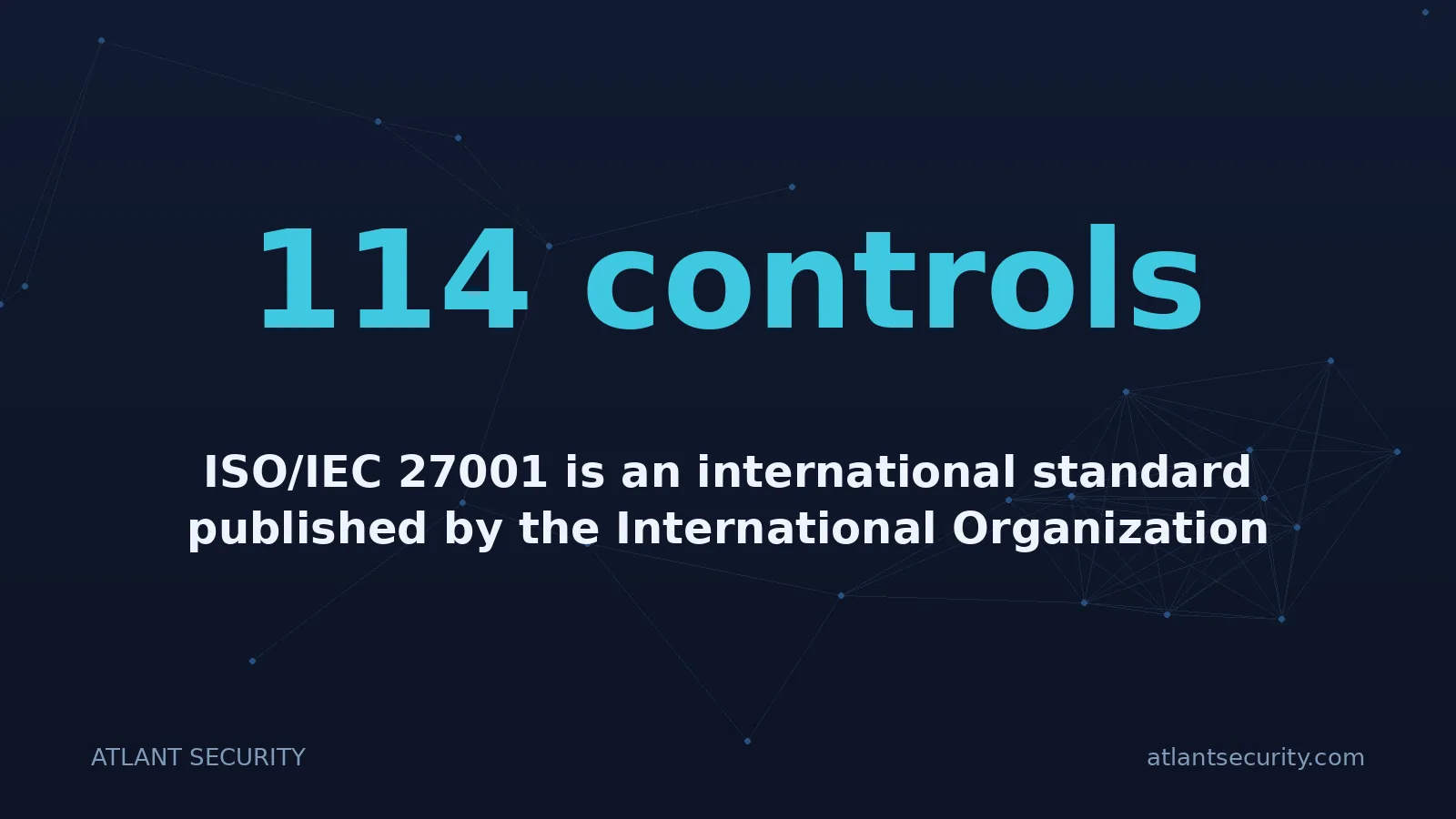
ISO/IEC 27001 is an international standard published by the International Organization for Standardization (ISO) and the International Electrotechnical Commission (IEC). It specifies requirements for establishing, implementing, maintaining, and continually improving an Information Security Management System (ISMS). The current version, ISO 27001:2022, replaced the 2013 edition and reorganized Annex A controls from 114 controls across 14 domains into 93 controls across four themes: Organizational, People, Physical, and Technological.
The standard follows a risk-based approach. You identify your information assets, assess the threats and vulnerabilities that could compromise their confidentiality, integrity, or availability, and then select and implement controls proportional to those risks. The ISMS wraps all of this into a management framework with executive commitment, internal audit, management review, and a continuous improvement cycle based on Plan-Do-Check-Act.
ISO 27001 certification is granted by an accredited certification body (CB) - an independent third-party auditor accredited by a national accreditation body such as UKAS (UK), ANAB (US), or JAS-ANZ (Australia/New Zealand). The certification is valid for three years, with surveillance audits in years one and two and a full recertification audit in year three.
ISO 27001 at a Glance
Governing Body: ISO/IEC (International)
Current Version: ISO/IEC 27001:2022
Core Structure: Clauses 4-10 (mandatory management requirements) + Annex A (93 reference controls)
Certification Validity: 3 years with annual surveillance audits
Global Recognition: Accepted in 160+ countries; often a contractual or regulatory requirement in Europe, Asia-Pacific, and the Middle East
Framework Overview
What Is SOC 2?
SOC 2 (System and Organization Controls 2) is an attestation framework developed by the American Institute of Certified Public Accountants (AICPA). It evaluates an organization’s controls relevant to one or more of the five Trust Services Criteria (TSC): Security (required), Availability, Processing Integrity, Confidentiality, and Privacy. Unlike ISO 27001, SOC 2 does not result in a “certification” - it produces an attestation report issued by a licensed CPA firm.
SOC 2 comes in two types. A Type I report evaluates the design and implementation of controls at a single point in time. A Type II report evaluates the design, implementation, and operating effectiveness of controls over a specified review period, typically six to twelve months. Type II is the standard that most enterprise buyers require because it demonstrates that controls are not just documented but consistently applied.
The beauty and the challenge of SOC 2 is its flexibility. The AICPA provides the criteria, but you define the controls. Two companies can both hold a SOC 2 Type II report with wildly different security postures depending on their control descriptions, scope, and the auditor’s rigor. This is why sophisticated buyers don’t just ask if you have a SOC 2 - they ask to read the report.
SOC 2 at a Glance
Governing Body: AICPA (United States)
Current Version: TSC 2017 (with 2022 point of focus updates)
Core Structure: 5 Trust Services Criteria - Security (Common Criteria), Availability, Processing Integrity, Confidentiality, Privacy
Report Validity: Typically 12 months; annual re-attestation expected by most customers
Geographic Strength: Dominant in the US and Canada; increasingly requested in Australia and the UK for companies selling to US enterprises
Head-to-Head
ISO 27001 vs SOC 2: The Complete Comparison Table
The table below captures every meaningful dimension where ISO 27001 and SOC 2 differ. Bookmark this - it is the single reference most compliance leaders wish they had when the conversation started.
| Dimension | ISO 27001 | SOC 2 |
|---|---|---|
| Governing Body | ISO/IEC (International) | AICPA (United States) |
| Type of Assurance | Certification (pass/fail) | Attestation report (opinion-based with findings detail) |
| Scope | Entire ISMS - org-wide or defined business units; must include Clauses 4-10 and applicable Annex A controls | Specific system(s) or service(s); you define the boundaries. Only Security criteria is mandatory; other TSC are optional |
| Control Framework | 93 controls across 4 themes (Annex A of ISO 27001:2022) | Trust Services Criteria (based on COSO); controls are custom-defined by the organization |
| Geographic Recognition | Global - standard in Europe, APAC, Middle East, Africa, and Latin America | Primarily North America; growing recognition in Australia, UK, and Israel |
| Who Performs the Audit | Accredited Certification Body (e.g., BSI, Schellman, A-LIGN, TUV) | Licensed CPA firm (e.g., Deloitte, KPMG, Schellman, Prescient Assurance) |
| Audit Process | Stage 1 (documentation review) + Stage 2 (implementation audit) for initial; annual surveillance + triennial recertification | Type I (point-in-time design review) or Type II (operating effectiveness over 3-12 month period); annual renewal |
| Certification/Report Validity | 3 years (with annual surveillance audits) | 12 months (annual re-attestation expected) |
| Initial Timeline | 9-18 months (readiness + certification) | 6-15 months (readiness + observation period + audit) |
| Initial Cost (SMB) | $40,000-$80,000 (consulting + CB fees) | $30,000-$70,000 (consulting + CPA fees) |
| Initial Cost (Mid-Market) | $80,000-$180,000+ | $70,000-$150,000+ |
| Annual Maintenance Cost | $15,000-$50,000 (surveillance audit + ongoing ISMS operation) | $25,000-$80,000 (annual Type II audit + continuous monitoring) |
| Deliverable to Customers | ISO 27001 certificate (one page, often shared publicly) | SOC 2 report (60-150+ pages, shared under NDA) |
| Prescriptiveness | Moderate - Annex A provides reference controls but allows flexibility in implementation | Low - criteria are defined but you design your own controls; highly flexible |
| Risk Assessment | Mandatory, formal, documented risk assessment and treatment plan (Clause 6.1.2) | Required under Common Criteria (CC3.1-CC3.4) but less prescriptive about methodology |
| Continuous Improvement | Explicitly required (Clause 10) - nonconformities, corrective actions, management review | Not explicitly required but expected through monitoring controls (CC4.1-CC4.2) |
| Internal Audit Requirement | Mandatory (Clause 9.2) - must be planned and executed at regular intervals | Not required by the framework, though many companies perform them as best practice |
| Management Involvement | Deep - leadership commitment (Clause 5), resource allocation, management review (Clause 9.3) | Expected at governance level (CC1.1-CC1.5) but less formally structured |
| Physical Security | Covered by Annex A Theme 3 (Physical controls) - 14 controls | Addressed if relevant under CC6.4-CC6.5, but can be scoped out for cloud-only environments |
| Best Suited For | Companies selling internationally, enterprises in regulated industries, EU-focused businesses | US SaaS companies, startups selling to US enterprises, service providers needing quick market proof |
Technical Analysis
Deep-Dive: Where the Two Frameworks Diverge
Certification vs. Attestation: Why It Matters
This is not a semantic distinction. An ISO 27001 certification is a binary outcome - you either meet the requirements or you do not. The certificate itself is a single page that states the scope, the certification body, and the validity dates. It can be shown to any prospect, posted on your website, and referenced in marketing material without restriction.
A SOC 2 report, by contrast, is a detailed narrative document typically running 60 to 150 or more pages. It includes the auditor’s opinion, a description of your system, the control criteria tested, the tests performed, and the results - including any exceptions or qualifications. Most companies share SOC 2 reports only under NDA because the report contains detailed information about internal systems and any control failures.
The practical implication: ISO 27001 is better for broad trust signaling (“we are certified”), while SOC 2 is better for detailed due diligence (“here is exactly what we do and how we were tested”). Enterprise procurement teams in the US increasingly want both - the certificate for the vendor management spreadsheet and the report for the security team to review.
Scope Flexibility
ISO 27001 requires you to define the scope of your ISMS, but the standard expects a holistic approach. You must address the context of the organization (Clause 4.1), interested parties (Clause 4.2), and define boundaries that make operational sense. Scoping out critical functions is possible but gets scrutinized heavily during the audit. Most auditors expect the ISMS to cover the majority of the organization’s information-related operations.
SOC 2 scoping, on the other hand, is system-level. You can define a single product, a single platform, or a specific service as the scope. This is one reason startups favor SOC 2 - you can scope it to your SaaS platform and exclude corporate functions that might not be mature yet. However, sophisticated buyers are aware of this and will scrutinize what is excluded from the report just as carefully as what is included.
Control Specificity
ISO 27001 Annex A provides 93 named controls organized into four themes. For each applicable control, you must document its implementation in your Statement of Applicability (SoA). If you exclude a control, you must justify the exclusion. The companion standard ISO 27002:2022 provides implementation guidance for each control, giving you a well-defined framework to work within.
SOC 2 provides criteria, not controls. The Trust Services Criteria describe what must be achieved (for example, “the entity implements logical access security measures to protect against unauthorized access”) but not how. You design your own controls and map them to the criteria. This flexibility is powerful for mature organizations but can lead to weaker implementations when companies choose the path of least resistance simply to pass the audit.
The Management System Requirement
This is arguably the biggest structural difference. ISO 27001 mandates a formal management system: leadership commitment (Clause 5), planning (Clause 6), support including competence and awareness (Clause 7), operation (Clause 8), performance evaluation through monitoring and internal audit (Clause 9), and improvement through corrective action (Clause 10). The ISMS is a living, breathing operational framework - not a one-time project.
SOC 2 expects governance controls (the CC1 series), but it does not require the formal Plan-Do-Check-Act management structure that ISO 27001 demands. In practice, this means companies pursuing ISO 27001 tend to build more durable, self-sustaining security programs. The ones who treat SOC 2 as a checkbox exercise often find themselves scrambling every year before the audit window opens.
Practitioner Insight
In our experience running 200+ security assessments across 14 countries since 2013, the organizations that pursue ISO 27001 first and then layer SOC 2 on top tend to have fewer audit findings, lower annual compliance costs, and stronger security cultures. The management system discipline from ISO 27001 creates a foundation that makes SOC 2 almost effortless. Going the other direction - SOC 2 first, then ISO 27001 - typically requires more rework because the management system components were never built.
Budget Planning
Real Cost Comparison: ISO 27001 vs SOC 2
Cost is the question that derails more compliance planning conversations than any other. The ranges below reflect what we have seen across our client base in 2025 and 2026 - from 20-person SaaS startups to 2,000-employee enterprises. Your actual cost will depend on organizational complexity, current security maturity, the number of in-scope systems, and whether you use a consulting partner or go it alone.
ISO 27001 Cost Breakdown
| Cost Category | Startup / SMB | Mid-Market | Enterprise |
|---|---|---|---|
| Gap Assessment & Readiness | $8,000-$20,000 | $15,000-$40,000 | $30,000-$75,000 |
| ISMS Build & Documentation | $10,000-$25,000 | $20,000-$50,000 | $40,000-$100,000 |
| Internal Audit | $3,000-$8,000 | $6,000-$15,000 | $10,000-$30,000 |
| Certification Body (Stage 1 + Stage 2) | $12,000-$25,000 | $20,000-$45,000 | $35,000-$80,000 |
| GRC Tooling (annual) | $6,000-$15,000 | $12,000-$30,000 | $25,000-$60,000 |
| Total Initial Investment | $39,000-$93,000 | $73,000-$180,000 | $140,000-$345,000 |
| Annual Maintenance (Yr 2+) | $15,000-$35,000 | $30,000-$60,000 | $50,000-$120,000 |
SOC 2 Type II Cost Breakdown
| Cost Category | Startup / SMB | Mid-Market | Enterprise |
|---|---|---|---|
| Readiness Assessment | $7,000-$18,000 | $12,000-$35,000 | $25,000-$60,000 |
| Policy & Control Development | $8,000-$20,000 | $15,000-$40,000 | $30,000-$80,000 |
| GRC Tooling (annual) | $6,000-$15,000 | $12,000-$30,000 | $25,000-$60,000 |
| CPA Audit (Type II) | $15,000-$35,000 | $25,000-$55,000 | $40,000-$90,000 |
| Total Initial Investment | $36,000-$88,000 | $64,000-$160,000 | $120,000-$290,000 |
| Annual Maintenance (Yr 2+) | $20,000-$45,000 | $35,000-$70,000 | $60,000-$140,000 |
Hidden Cost Warning
The numbers above capture direct consulting and audit fees. They do not include the internal time investment, which is often the largest cost. Expect your team to spend 200-500 hours on a first-time ISO 27001 certification and 150-400 hours on an initial SOC 2 Type II. For a mid-level security engineer at $75/hour fully loaded, that is $15,000-$37,500 in opportunity cost for ISO and $11,250-$30,000 for SOC 2.
Also factor in tooling costs: a GRC platform (Vanta, Drata, Secureframe, or similar) typically runs $6,000-$30,000 per year and serves both frameworks. If you are pursuing both certifications, the tooling investment is shared - one of the most significant cost efficiencies of the dual approach.
For a detailed breakdown of SOC 2 costs specifically, including how to reduce them, see our guide: SOC 2 Readiness.
Decision Guide
When to Choose ISO 27001, SOC 2, or Both
Choose ISO 27001 First When…
- Your customers are primarily in Europe, Asia-Pacific, or the Middle East. ISO 27001 is the lingua franca of information security in these regions. In Germany alone, it is frequently a contractual prerequisite for enterprise procurement. In Japan, Australia, Singapore, and the UAE, ISO 27001 carries far more weight than SOC 2.
- You operate in a regulated industry with international presence. Financial services, healthcare, critical infrastructure, and government adjacent sectors outside North America almost universally require or strongly prefer ISO 27001.
- You want a structured, long-term security program. The ISMS requirement builds discipline that pays dividends for years. If your goal is genuine security maturity rather than checking a box, ISO 27001 is the better starting point.
- You need a single certification that covers the broadest geography. One ISO 27001 certificate is recognized in over 160 countries. One SOC 2 report is meaningful primarily in two.
- You are planning to pursue additional ISO standards. ISO 27001 integrates naturally with ISO 27701 (privacy), ISO 22301 (business continuity), and ISO 9001 (quality management) through shared management system structures.
Choose SOC 2 First When…
- Your customers are primarily US-based enterprises. SOC 2 Type II is the standard security diligence requirement in American B2B procurement. If you are a SaaS company selling to US mid-market and enterprise buyers, this is likely the first thing they will ask for.
- You need to demonstrate compliance quickly. A SOC 2 Type I can be completed in as little as 2-4 months, giving you a preliminary report to unblock deals while you work toward the more rigorous Type II. ISO 27001 does not have an equivalent fast-track mechanism.
- You are an early-stage startup with limited resources. SOC 2’s flexible scoping lets you certify a single product or service without building a full management system. For a 30-person startup, this can mean $15,000-$30,000 less in initial investment compared to ISO 27001.
- Your buyers want detailed control evidence, not just a certificate. The SOC 2 report gives customers and their security teams visibility into exactly what controls exist, how they were tested, and whether any exceptions were found. Some mature procurement teams actually prefer this transparency.
- You are in the US cloud/SaaS ecosystem. AWS, Azure, and GCP all publish their own SOC 2 reports, and the shared responsibility model documentation aligns naturally with SOC 2 scoping. The ecosystem is built around it.
Pursue Both When…
- You sell to both US and international enterprise customers. This is increasingly the norm for growth-stage SaaS companies. US buyers want SOC 2; European and APAC buyers want ISO 27001. Having both eliminates security as a blocker in any geography.
- You are in a competitive market where trust is a differentiator. Holding both certifications signals a level of security maturity that single-framework companies cannot match. In competitive deals, this advantage is real and measurable.
- You handle sensitive data across multiple regulatory jurisdictions. Financial data, healthcare records, personally identifiable information - if your data footprint crosses borders, dual certification provides the broadest assurance coverage.
- You have already achieved one and the incremental cost of the second is low. Once you have a mature ISO 27001 ISMS, adding SOC 2 is typically 40-60% cheaper than starting from scratch because the controls, policies, and evidence largely overlap. The same is true in reverse, though with more rework on the management system side.
Strategic Planning
Industry & Geography Decision Framework
Use the matrix below as a starting point. Match your primary industry and customer geography to find the recommended path. Remember that these are guidelines, not rules - your specific contractual requirements and sales pipeline should always be the final deciding factor.
| Industry | US / Canada Customers | EU / UK / APAC Customers | Global Customers |
|---|---|---|---|
| SaaS / Cloud Software | SOC 2 first | ISO 27001 first | Both (ISO first) |
| Financial Services / Fintech | SOC 2 + SOC 1 | ISO 27001 | Both (ISO first) |
| Healthcare / HealthTech | SOC 2 + HIPAA | ISO 27001 | ISO 27001 + SOC 2 |
| E-Commerce / Retail Tech | SOC 2 first | ISO 27001 | Both (SOC 2 first) |
| Government / GovTech | FedRAMP / SOC 2 | ISO 27001 | ISO 27001 + SOC 2 |
| Managed Service Providers | SOC 2 first | ISO 27001 first | Both |
| Manufacturing / IoT | SOC 2 (if SaaS layer) | ISO 27001 | ISO 27001 |
| Legal / Professional Services | SOC 2 | ISO 27001 | Both |
Regional Nuances Worth Knowing
United Kingdom: Post-Brexit, ISO 27001 remains the dominant standard. However, UK-based companies selling SaaS to US enterprises increasingly pursue SOC 2 alongside it. The UK Cyber Essentials scheme is a separate requirement for government contracts but does not replace either framework.
Australia & New Zealand: ISO 27001 is the primary standard requested by Australian enterprises and government agencies. SOC 2 is gaining traction specifically among SaaS companies selling to US-headquartered multinationals operating in ANZ.
Middle East (UAE, Saudi Arabia, Qatar): ISO 27001 is often a regulatory or contractual requirement. SOC 2 is rarely requested in the region. Companies targeting the Middle East market should prioritize ISO 27001 without question.
European Union: ISO 27001 is deeply embedded in the EU procurement ecosystem. Under GDPR Article 42, ISO 27001 is referenced as a mechanism to demonstrate appropriate security measures. NIS2 Directive compliance can also leverage ISO 27001 controls. SOC 2 is occasionally requested by EU subsidiaries of US companies but is not standard.
Efficiency Strategy
Leveraging the Overlap: Pursuing Both Efficiently
The good news for companies that need both: ISO 27001 and SOC 2 share approximately 70-80% of their underlying control requirements. Access control, change management, incident response, risk assessment, vendor management, encryption, logging, and awareness training are core to both frameworks. The differences are largely in structure, documentation format, and governance mechanisms - not in the actual security work.
Here is how we typically sequence the dual-certification approach with our clients:
Step 1: Unified Gap Assessment (Month 1-2). We assess your current state against both frameworks simultaneously. The output is a single roadmap that identifies shared gaps, framework-specific gaps, and the most efficient remediation sequence. This alone can save 30-40% compared to running two separate assessments. Start with our IT security audit services to establish your baseline.
Step 2: Build the ISMS with SOC 2 Mapping (Month 2-8). We build the ISO 27001 ISMS first because it provides the most complete foundation. As we develop each policy, control, and process, we simultaneously map it to the relevant SOC 2 Trust Services Criteria. The Statement of Applicability doubles as a control matrix for both frameworks.
Step 3: ISO 27001 Certification Audit (Month 9-12). Complete the Stage 1 and Stage 2 audits. By this point, your controls have been operating for several months, which also starts building the evidence trail for your SOC 2 observation period.
Step 4: SOC 2 Type II Audit (Month 10-15). The observation period can overlap with or immediately follow the ISO audit. Because the controls are already implemented and documented, the SOC 2 audit is primarily an evidence collection and reporting exercise.
Step 5: Unified Maintenance. Both frameworks share a single GRC platform, a single evidence repository, and a single internal audit program. Annual effort for maintaining both is typically only 30-40% more than maintaining one alone.
Cost Savings of the Dual Approach
Pursuing both sequentially (separate projects): $70,000-$180,000+ for an SMB
Pursuing both as an integrated program: $50,000-$130,000 for an SMB
Typical savings: 25-35% on initial investment, plus 30-40% lower annual maintenance costs. For a mid-market company, this translates to $30,000-$70,000 in first-year savings and $15,000-$30,000 annually thereafter.
A virtual CISO can manage both frameworks as part of a unified security program, providing strategic oversight without the cost of a full-time hire. This is particularly effective for companies in the 50-500 employee range where a dedicated CISO may not yet be justified.
Common Questions
Frequently Asked Questions: ISO 27001 vs SOC 2
1. Can I use an ISO 27001 certification to satisfy SOC 2 requirements, or vice versa?
No. They are different frameworks issued by different bodies and produce different deliverables. An ISO 27001 certificate cannot substitute for a SOC 2 report, and a SOC 2 report cannot substitute for an ISO 27001 certificate. However, the underlying controls overlap significantly, so having one makes achieving the other much faster and cheaper.
2. Which is harder to achieve: ISO 27001 or SOC 2?
ISO 27001 is generally more demanding because of the management system requirements (internal audit, management review, corrective action, continuous improvement). SOC 2 has more flexibility in how you implement controls. However, a rigorous SOC 2 Type II with multiple Trust Services Criteria included can be equally time-consuming. “Harder” depends on your starting maturity and internal resources.
3. How much control overlap exists between ISO 27001 and SOC 2?
Approximately 70-80% of the control requirements are shared or closely aligned. Both require access control, encryption, incident response, change management, vendor risk management, security awareness training, logging and monitoring, and risk assessment. The differences are primarily in governance structure (ISO requires a formal ISMS) and documentation format (SOC 2 requires detailed control descriptions for the auditor’s report).
4. Should a startup pursue SOC 2 Type I first or go straight to Type II?
It depends on sales urgency. If you have deals stalled today because buyers need a SOC 2, a Type I can be completed in 2-4 months and provides immediate credibility while you build toward Type II. If you have 9-12 months of runway before SOC 2 becomes a hard requirement, skip Type I and go straight to Type II. The cost of a Type I ($15,000-$30,000) is essentially throwaway once you have a Type II.
5. Do I need a consultant or can I do this in-house?
Technically, both can be achieved in-house. Practically, most companies under 1,000 employees benefit from consultant guidance for the first certification. In-house teams typically underestimate the documentation effort and make scoping mistakes that lead to audit failures or delays. A good consultant will pay for themselves by reducing your timeline by 3-6 months and helping you avoid the most common pitfalls. After the first certification, many companies maintain in-house with lighter advisory support.
6. What happens if we fail an ISO 27001 or SOC 2 audit?
For ISO 27001, the certification body can issue minor nonconformities (which must be corrected within a set timeframe) or major nonconformities (which can prevent certification until resolved). You get an opportunity to remediate before a final decision. For SOC 2, the auditor can issue a qualified opinion that notes specific control exceptions. A qualified report is still a valid SOC 2 report - it just highlights areas of weakness, which your customers will see. Neither scenario is ideal, which is why readiness assessments before the formal audit are critical.
7. How long does each certification take to maintain annually?
ISO 27001 annual surveillance audits are typically 2-5 days of auditor time, plus 40-100 hours of internal preparation (evidence gathering, internal audit, management review). SOC 2 annual audits require 60-160 hours of internal preparation depending on scope, plus 1-3 weeks of auditor fieldwork. If you maintain both on a unified GRC platform, expect about 150-300 total internal hours per year for combined maintenance at the SMB level.
8. Is ISO 27001 becoming more common in the US?
Yes. ISO 27001 adoption in the US has been growing steadily, particularly among companies with international customers, those subject to CMMC requirements (which maps well to ISO 27001), and organizations that want a more structured security program. Many US enterprise buyers now accept ISO 27001 alongside or in lieu of SOC 2. However, SOC 2 remains the default first request in most US B2B procurement processes.
9. Can a single auditor perform both the ISO 27001 and SOC 2 audit?
Not exactly. ISO 27001 audits must be performed by an accredited certification body, and SOC 2 audits must be performed by a licensed CPA firm. However, some firms hold both accreditations (for example, Schellman and A-LIGN). Using a single firm for both audits can reduce cost and coordination overhead because they already understand your environment from the first audit.
10. What about ISO 27701 or SOC 2 Privacy criteria for GDPR compliance?
ISO 27701 extends ISO 27001 with privacy-specific controls and maps directly to GDPR requirements. It requires an existing ISO 27001 certification as a prerequisite. SOC 2’s Privacy Trust Services Criteria covers similar ground but through the AICPA’s framework. For organizations subject to GDPR, ISO 27001 + ISO 27701 is generally the stronger combination. For organizations subject primarily to US privacy laws (CCPA, state-level regulations), SOC 2 with the Privacy criteria may be sufficient.
Getting Started
Your Next Steps
The ISO 27001 vs SOC 2 decision is ultimately a business decision, not a technical one. Both frameworks will improve your security posture. Both will open doors with new customers. The right choice depends on where those customers are, what they require, and how quickly you need to get there.
Here is what we recommend as your immediate next steps:
1. Audit your sales pipeline. Look at every deal that stalled or was lost due to compliance requirements in the last 12 months. Categorize by which framework was requested. This data alone often makes the decision obvious.
2. Assess your current state. Before committing to either path, understand your starting position. A comprehensive IT security audit will reveal which controls you already have in place and where the gaps are. This shapes both your timeline and your budget.
3. Talk to your customers. Ask your top 10 prospects and customers directly: “What security certifications would increase your confidence in working with us?” Their answers should weigh heavily in your decision.
4. Engage an experienced partner early. The most expensive mistake in compliance is starting down the wrong path and having to course-correct six months in. A 30-minute conversation with an experienced advisor can save you tens of thousands of dollars and months of wasted effort.
Whether you need SOC 2 readiness support, ISO 27001 certification guidance, or a virtual CISO to manage your compliance program end-to-end, clarity on the right path is always the first step.
Not Sure Which Framework Fits Your Business?
We help companies navigate the ISO 27001 vs SOC 2 decision every week. Our initial consultation is free and includes a preliminary assessment of which path makes the most sense for your specific situation.
No obligation, no sales pressure - just honest guidance from a team that has run 200+ security assessments across 14 countries since 2013.
Published: March 25, 2026 · Author: Alexander Sverdlov
This article is for informational purposes only and does not constitute legal or professional advice. Pricing ranges reflect 2025-2026 market estimates and may vary based on organizational complexity, geographic region, and vendor selection.
Ready to turn the requirements into a certificate?
ISO 27001 readiness: every clause and Annex A control assessed against your environment, the gaps closed with your team, and the evidence pack built for Stage 1 and Stage 2. Fixed price, agreed up front.
See ISO 27001 readiness