

Fintech Compliance · March 2026
A practical guide to navigating PCI DSS, SOC 2, ISO 27001, DORA, MAS TRM, NY DFS, and GDPR as a growing fintech. Includes framework comparisons, stage-by-stage roadmaps, and how to avoid the compliance failures that sink funding rounds.
Key Takeaways
- Fintech compliance consulting helps companies navigate overlapping frameworks - PCI DSS, SOC 2, ISO 27001, DORA, MAS TRM, NY DFS, and GDPR - without building a full-time compliance team prematurely
- The right compliance strategy depends on your growth stage: pre-seed fintechs need different controls than Series C companies preparing for enterprise clients
- Multi-jurisdiction fintechs face compounding complexity - a single product serving the US, EU, and Singapore could require five or more simultaneous compliance programs
- Build vs. buy vs. outsource is the defining decision: internal hires cost $180K-$350K/year per specialist, while consultants deliver the same outcomes at 40-60% less
- The most expensive compliance mistake isn’t a fine - it’s a lost enterprise deal or failed funding round due to missing certifications
Three years ago, I sat across the table from the founders of a Series A payments startup in Singapore. They had an elegant product, solid traction, and a term sheet from a top-tier VC sitting on the table. Everything looked perfect - until the due diligence questionnaire arrived.
Forty-seven pages of security and compliance questions. PCI DSS scope. SOC 2 readiness. MAS TRM alignment. Data residency commitments. Incident response documentation. The founders stared at it like it was written in hieroglyphics.
They called us on a Friday evening. By Monday morning, we had assessed their gaps, prioritized the critical items, and drafted a realistic compliance roadmap that satisfied the VC’s security team. The round closed three weeks later.
But here is what stuck with me: these were smart, experienced founders. They had built payment infrastructure that processed thousands of transactions daily. They understood security intuitively. What they did not understand - and what almost cost them millions - was how the compliance landscape works when you are a fintech operating across borders.
That experience crystallized something I had been seeing for years: fintech compliance is not just harder than compliance in other industries - it is a fundamentally different game. And navigating it without expert guidance is one of the most expensive risks a fintech founder can take. This guide is everything I wish I could have handed those founders before that Friday night phone call.
The Challenge
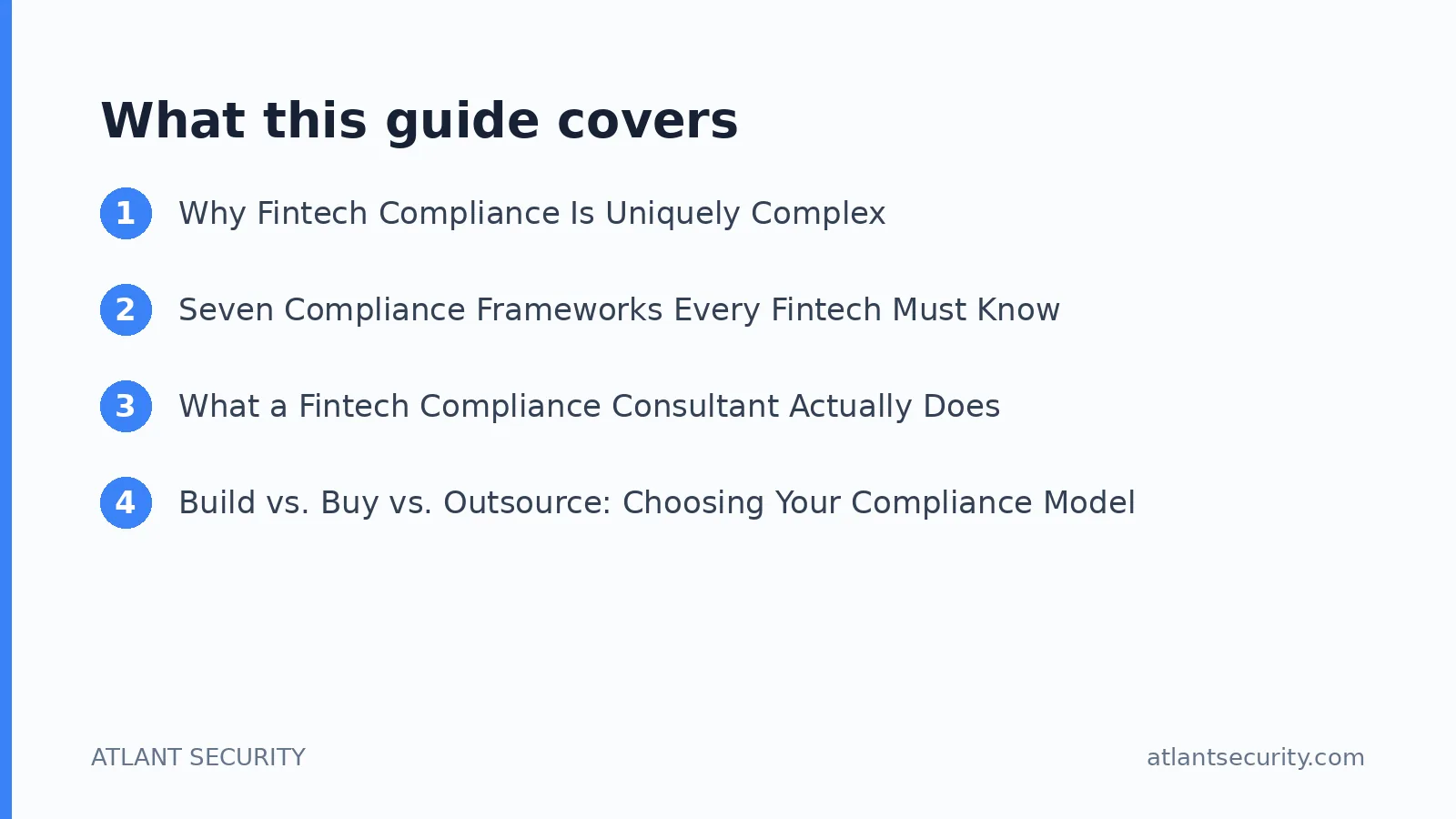
Why Fintech Compliance Is Uniquely Complex
If you have worked in SaaS compliance, you probably think SOC 2 is the main event. If you come from healthcare, HIPAA dominates your world. But fintech? Fintech compliance is a multi-framework, multi-jurisdiction puzzle where the pieces keep changing shape.
Here is why fintech is different from every other vertical:
1. Multi-framework overlap. A typical fintech handling payments in Europe and the US simultaneously needs PCI DSS (because you touch card data), SOC 2 (because enterprise clients demand it), GDPR (because European users), and potentially DORA (because EU financial services regulation). Each framework has different controls, different audit cycles, and different evidence requirements. But many controls overlap - and knowing where they overlap is where a fintech compliance consultant saves you months of duplicated work.
2. Multi-jurisdiction complexity. A lending platform operating in New York, London, and Singapore faces NY DFS Part 500 cybersecurity requirements, FCA regulations, and MAS TRM guidelines - simultaneously. Each regulator has its own expectations for risk assessments, incident reporting timelines, board-level oversight, and third-party management. Miss one, and you are not just facing fines - you could lose your license to operate in that market entirely.
3. Velocity vs. rigor tension. Fintechs move fast. Compliance programs demand rigor. These two forces are constantly in tension. A traditional bank spends 18 months preparing for an audit. A fintech at Series A does not have 18 months - they have a partner integration deadline in 90 days and an enterprise prospect that needs a SOC 2 report by end of quarter.
4. Financial data sensitivity. Fintech applications handle some of the most sensitive data that exists: bank account numbers, transaction histories, credit scores, identity documents, payment card data. The regulatory bar is higher because the consequences of a breach are existential - both for your users and your company.
5. Investor and partner scrutiny. Unlike most SaaS companies, fintechs face compliance pressure from three directions simultaneously: regulators, enterprise partners (banks, payment networks, insurance carriers), and investors. Each group evaluates compliance differently, and each can block your growth if you come up short.
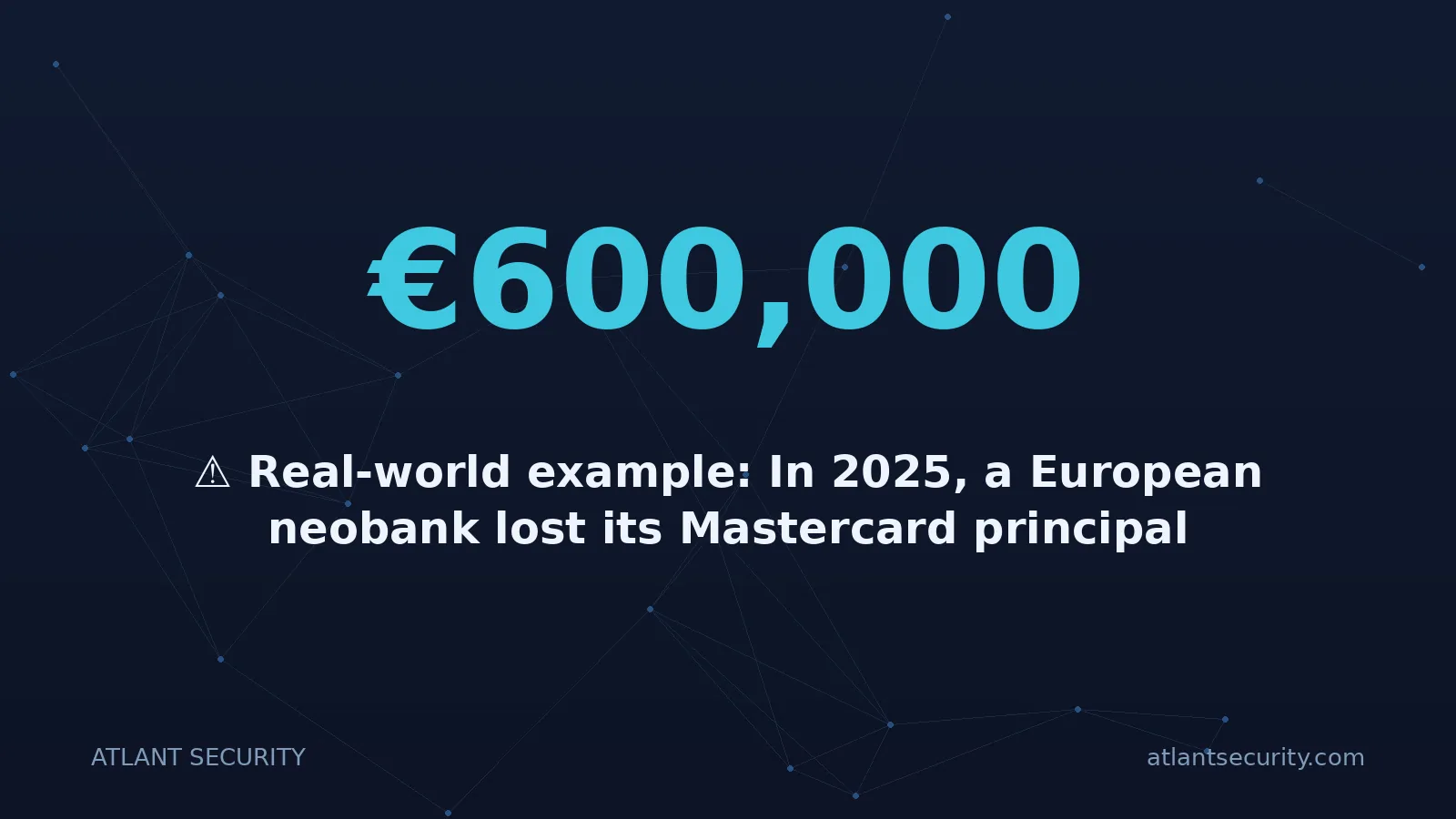
Real-world example: In 2025, a European neobank lost its Mastercard principal membership - not because of a security incident, but because their PCI DSS compliance documentation had lapsed during a rapid infrastructure migration. They had the technical controls in place; they just could not prove it on paper. The remediation cost them four months and over €600,000 in consulting fees, re-assessment, and lost revenue. A fintech compliance consultant would have flagged the documentation gap before it became a crisis. For a fintech the test that matters is the one against your payment logic and your API authorisation model, which is why pentesting fintech APIs is a separate engagement from a generic web pentest.
Framework Comparison
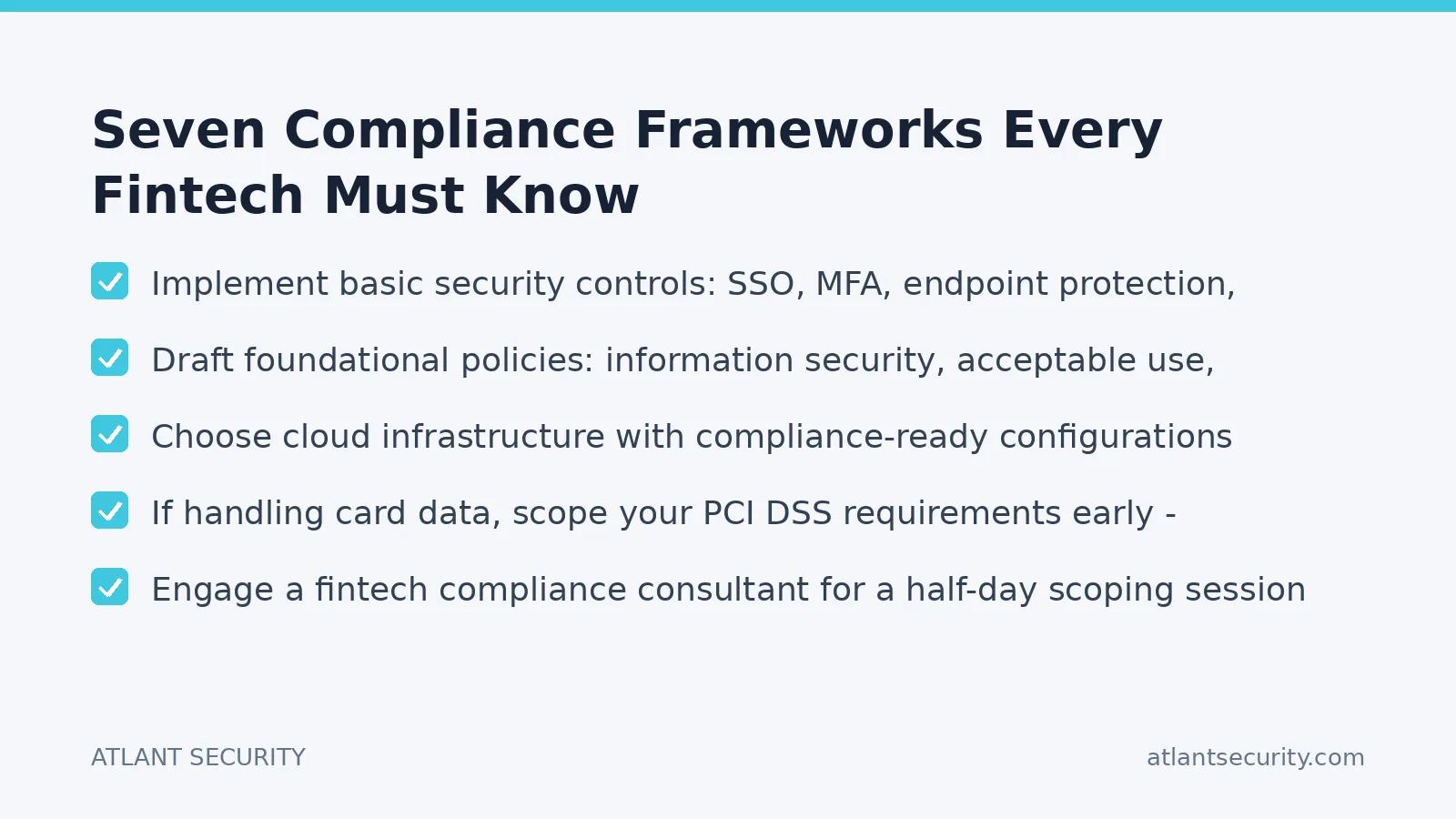
Seven Compliance Frameworks Every Fintech Must Know
One of the first things a fintech compliance consultant does is map which frameworks apply to your specific business model, geographies, and customer segments. Below is a side-by-side comparison of the seven frameworks most relevant to fintechs in 2026.
| Framework | Scope | Who Needs It | Timeline | Typical Cost | Mandatory? |
|---|---|---|---|---|---|
| PCI DSS 4.0 | Cardholder data protection; 12 requirement domains covering network security, encryption, access control, monitoring | Any fintech storing, processing, or transmitting payment card data | 3-9 months | $50K-$500K+ | Yes (contractual via card networks) |
| SOC 2 | Trust service criteria: security, availability, processing integrity, confidentiality, privacy | B2B fintechs, any company whose clients request audit reports | 3-6 months (Type I) / 6-12 months (Type II) | $30K-$150K | No (market-driven) |
| ISO 27001 | Information security management system (ISMS) covering risk assessment, controls, continuous improvement | Fintechs targeting international enterprise clients, EU market entry | 6-14 months | $40K-$200K | No (but often contractually required) |
| DORA | Digital operational resilience: ICT risk management, incident reporting, resilience testing, third-party risk | EU-regulated financial entities and their critical ICT third-party providers | 6-18 months | $75K-$400K | Yes (EU regulation, effective Jan 2025) |
| MAS TRM | Technology risk management: IT governance, software development, IT service management, cyber surveillance | Financial institutions regulated by the Monetary Authority of Singapore | 4-12 months | $60K-$300K | Yes (regulatory guideline) |
| NY DFS Part 500 | Cybersecurity program, CISO appointment, access controls, encryption, incident response, annual certification | Financial services companies licensed or regulated by NY DFS (including fintech licensees) | 4-10 months | $50K-$250K | Yes (state regulation) |
| GDPR | Data protection and privacy: lawful processing, data subject rights, breach notification, DPIAs, cross-border transfers | Any fintech processing personal data of EU/EEA residents | 3-12 months | $25K-$200K | Yes (EU regulation) |
Pro tip: If you are a fintech processing payments in the EU while serving US enterprise clients, you likely need PCI DSS + SOC 2 + GDPR at minimum - and possibly DORA if your clients are regulated financial entities. A fintech compliance consultant maps these overlaps on day one and builds a unified control framework so you are not duplicating 40% of your effort across parallel programs. Learn more about our approach to SOC 2 readiness and ISO 27001 readiness.
Scope of Work
What a Fintech Compliance Consultant Actually Does
The title “fintech compliance consultant” covers a surprisingly broad set of responsibilities. Unlike a general IT auditor who checks boxes against a single framework, a fintech compliance consultant operates at the intersection of security engineering, regulatory strategy, and business enablement.
Gap assessment and framework mapping. The engagement starts with understanding where you are today versus where you need to be. This means reviewing your current policies, technical controls, organizational processes, and data flows against each applicable framework. The consultant produces a gap analysis that quantifies exactly what is missing and what already satisfies multiple frameworks simultaneously.
Unified control framework design. Rather than implementing PCI DSS controls, then SOC 2 controls, then ISO 27001 controls as separate workstreams, an experienced fintech compliance consultant builds a single, unified control framework. One access control policy satisfies PCI DSS Requirement 7, SOC 2 CC6.1, ISO 27001 A.9, and DORA Article 9. This approach can reduce total implementation effort by 30-50%.
Policy and procedure development. Frameworks require documented policies - information security policy, acceptable use policy, incident response plan, business continuity plan, vendor management policy, data classification policy, and more. A consultant drafts these to be both auditor-ready and operationally practical. The worst outcome is a beautiful policy document that nobody follows.
Technical control implementation guidance. Consultants advise on which tools, configurations, and architectures satisfy compliance requirements. This includes encryption standards, logging and monitoring setup, access control configurations, vulnerability management programs, and secure development lifecycle practices. They work alongside your engineering team - not in place of them.
Audit preparation and management. When the auditor arrives, your consultant ensures evidence is organized, personnel are briefed, and scope is clearly defined. They translate between auditor-speak and engineering-speak, resolve findings in real-time, and manage remediation timelines. This alone can shave weeks off an audit engagement.
Ongoing compliance operations. Compliance is not a one-time event. Frameworks require continuous monitoring, periodic risk assessments, annual reviews, and evidence collection throughout the year. A consultant can establish these processes, train your team to execute them, or provide ongoing fractional compliance leadership through a fintech virtual CISO engagement.
Regulatory liaison and incident support. When regulators come knocking - or when a security incident triggers notification obligations - having a consultant who understands both the technical details and the regulatory expectations is invaluable. They help you communicate effectively, meet notification deadlines (72 hours under GDPR, 72 hours under NY DFS), and manage remediation in a way that satisfies regulatory scrutiny.
Bottom line: A fintech compliance consultant does not replace your team - they accelerate it. They bring the cross-framework expertise and regulatory context that would take an internal hire years to develop, then transfer that knowledge to your organization over time. See how an IT security audit fits into this broader compliance picture.
Decision Framework
Build vs. Buy vs. Outsource: Choosing Your Compliance Model
Every fintech eventually faces this question: should we build an internal compliance team, buy compliance automation tools, or outsource to a fintech compliance consulting firm? The answer depends on your stage, budget, complexity, and how central compliance is to your competitive positioning.
| Factor | Build (Internal Team) | Buy (Automation Tools) | Outsource (Consultants) |
|---|---|---|---|
| Annual Cost | $180K-$350K per specialist (salary + benefits) | $15K-$80K/year (platform licenses) | $50K-$250K/year (retainer or project-based) |
| Time to Value | 3-6 months (recruiting + onboarding) | 2-4 weeks (deployment) | 1-2 weeks (engagement kickoff) |
| Multi-Framework Depth | Limited to hire’s experience; rarely covers 4+ frameworks deeply | Template-driven; good for common frameworks, shallow on niche ones | Team-based expertise across dozens of frameworks and jurisdictions |
| Scalability | Scales linearly with headcount (expensive) | Scales well for evidence collection; cannot replace judgment | Scales on demand; add/remove bandwidth as needed |
| Best For | Series C+ with ongoing, complex regulatory obligations | Companies with established programs needing efficiency | Pre-seed through Series B; rapid certification needs; multi-framework programs |
| Key Risk | Single point of failure; institutional knowledge loss if they leave | Tool-driven compliance without understanding; false sense of security | Dependency if knowledge transfer is not prioritized |
Our recommendation for most fintechs: Start with outsourced fintech compliance consulting to establish your foundational program and achieve initial certifications. Layer in automation tools to reduce the operational burden of evidence collection and continuous monitoring. Hire internally only when the volume and complexity of ongoing compliance work justifies a dedicated full-time role - typically at Series B or later.
The hybrid approach works best: consultants provide the strategy and cross-framework expertise, automation tools handle the repetitive evidence gathering, and your internal team (even if it is just one person) owns the day-to-day execution. This model gives you the breadth of expertise you need without the $500K+ annual cost of building a three-person compliance team from scratch.
Growth Stages
Compliance Roadmap by Fintech Growth Stage
One of the most common mistakes fintechs make is trying to do everything at once - or worse, doing nothing until a prospect or regulator forces the issue. The right compliance investments depend on where you are in your growth journey.
Pre-Seed / Seed (0-20 employees)
Priority: Establish security foundations that scale. Do not invest in formal certifications yet - but build as if you will need them in 12 months.
Actions:
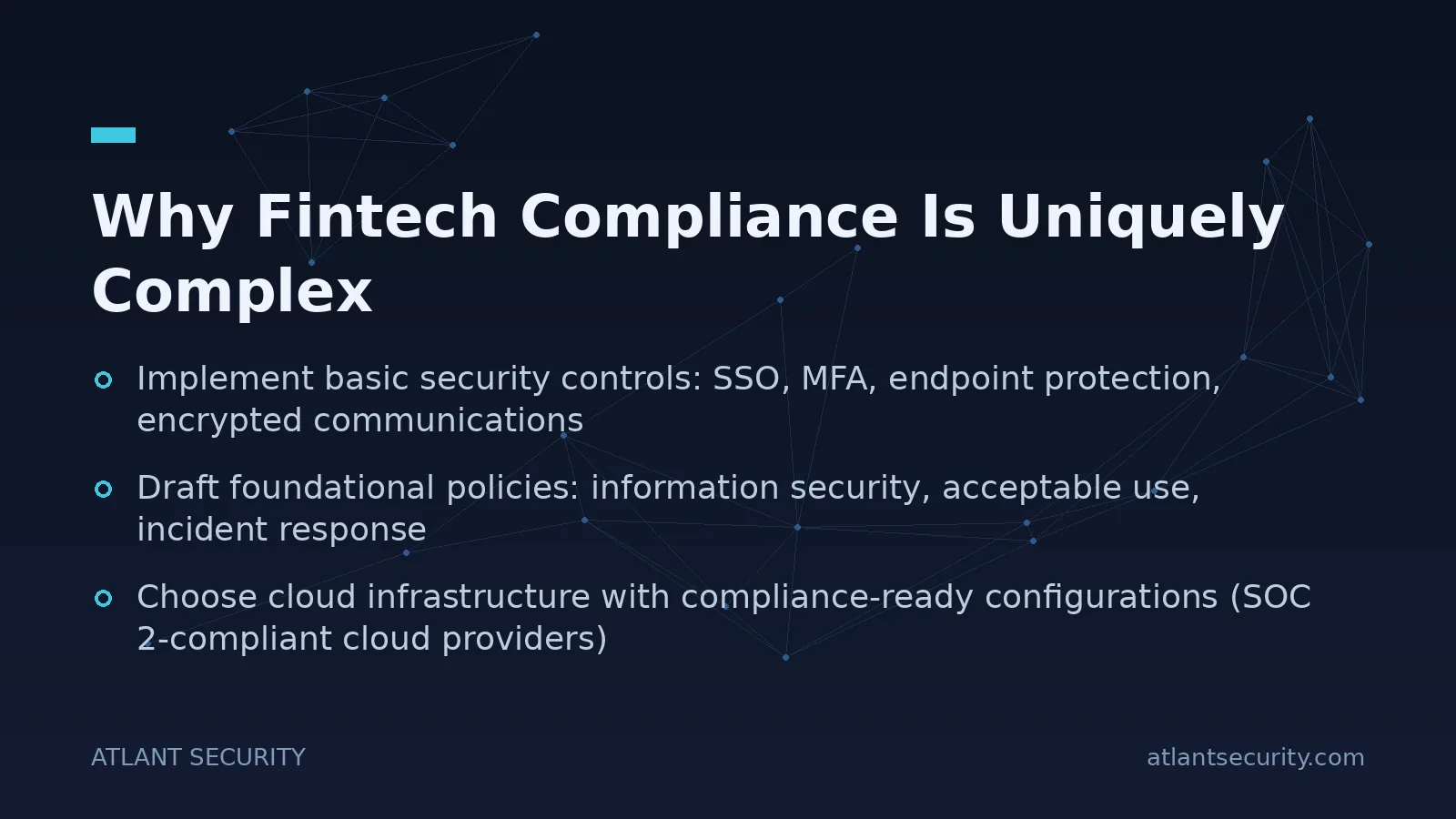
- Implement basic security controls: SSO, MFA, endpoint protection, encrypted communications
- Draft foundational policies: information security, acceptable use, incident response
- Choose cloud infrastructure with compliance-ready configurations (SOC 2-compliant cloud providers)
- If handling card data, scope your PCI DSS requirements early - architecture decisions made now determine compliance cost later
- Engage a fintech compliance consultant for a half-day scoping session ($2K-$5K) to map your regulatory landscape
Budget: $5K-$15K total for foundational work
Series A (20-80 employees)
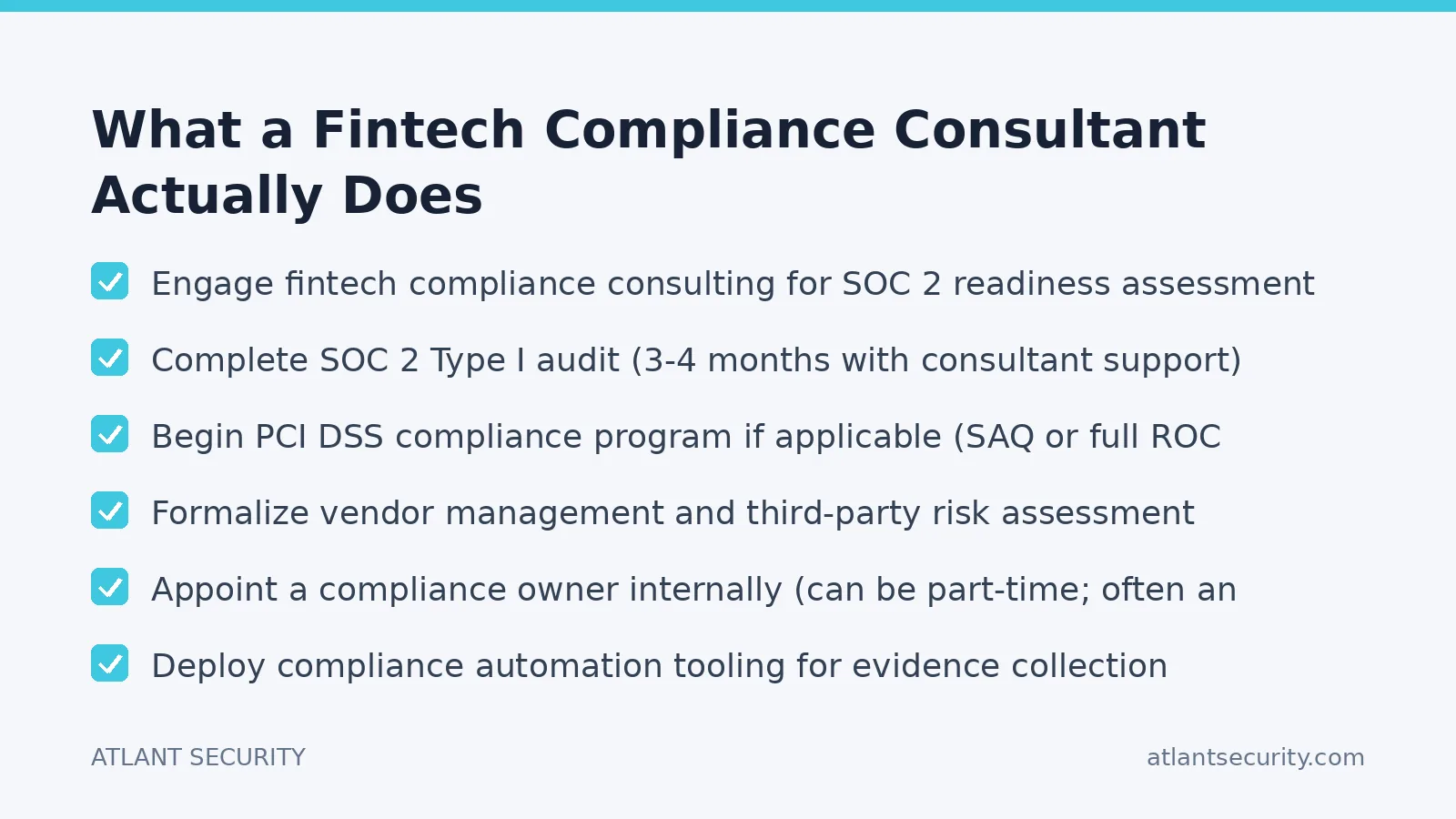
Priority: Achieve your first formal certification. SOC 2 Type I is typically the highest-ROI starting point for B2B fintechs. If you process cards, PCI DSS compliance is non-negotiable.
Actions:
- Engage fintech compliance consulting for SOC 2 readiness assessment and remediation
- Complete SOC 2 Type I audit (3-4 months with consultant support)
- Begin PCI DSS compliance program if applicable (SAQ or full ROC depending on transaction volume)
- Formalize vendor management and third-party risk assessment processes
- Appoint a compliance owner internally (can be part-time; often an engineering or operations lead)
- Deploy compliance automation tooling for evidence collection
Budget: $50K-$120K (consulting + audit fees + tooling)
Series B (80-250 employees)
Priority: Expand certifications to match your market. Add ISO 27001 for international credibility. Achieve SOC 2 Type II. Begin jurisdiction-specific compliance (DORA, MAS TRM, NY DFS) based on your markets. For designated financial entities we run this as a dedicated engagement through a DORA TLPT provider: scope your authority validates, targeted threat intelligence, and the evidence pack the supervisor signs off.
Actions:
- Complete SOC 2 Type II audit (12-month observation period)
- Pursue ISO 27001 certification to unlock international enterprise deals
- Implement DORA requirements if serving EU financial entities
- Build out formal risk management program with quantitative risk assessment
- Consider hiring a first dedicated compliance professional (or engage a fintech virtual CISO)
- Establish compliance committee with cross-functional representation
Budget: $120K-$300K/year (mix of internal, consulting, and tooling)
Series C+ / Growth Stage (250+ employees)
Priority: Mature your compliance program into a competitive advantage. Proactive regulatory engagement. Compliance as a revenue enabler, not a cost center.
Actions:
- Build internal compliance team (GRC manager, compliance analysts, privacy officer)
- Maintain multi-framework certifications with integrated audit cycles
- Implement advanced threat detection and response capabilities
- Conduct regular penetration testing and red team exercises
- Retain fintech compliance consultants for specialized projects: new market entry, M&A due diligence, regulatory examinations
- Prepare compliance documentation for IPO readiness (SOX-adjacent controls)
Budget: $300K-$800K+/year (internal team + retained consultants + tooling + audit fees)
Lessons Learned
Common Fintech Compliance Failures and How to Avoid Them
After working with dozens of fintechs across multiple continents, we have seen the same failure patterns repeat. Here are the seven most common compliance failures and the specific actions that prevent them.
1. Treating compliance as a one-time project. The most pervasive failure. A fintech sprints to achieve SOC 2 Type I, celebrates, and then lets the program atrophy. When the Type II observation period begins, evidence gaps appear everywhere. The fix: build compliance into your operational cadence from day one. Monthly evidence reviews, quarterly risk assessments, continuous control monitoring. Compliance is a program, not a project.
2. Scoping PCI DSS too broadly. Fintechs that fail to segment their cardholder data environment (CDE) end up with their entire infrastructure in scope for PCI DSS. This multiplies cost and complexity by 5-10x. The fix: work with a fintech compliance consultant to architect your CDE with clear network segmentation, tokenization strategies, and scope-reduction techniques before you build. Every dollar spent on scoping saves ten dollars in compliance.
3. Ignoring GDPR until the first European customer. Data protection by design is a GDPR requirement - not an afterthought. Retrofitting privacy controls into an application built without them is painful and expensive. The fix: implement privacy-by-design principles during product development. Data minimization, purpose limitation, consent management, and data subject access request workflows should be architected in, not bolted on.
4. Underestimating third-party risk. Your compliance posture is only as strong as your weakest vendor. Fintechs routinely use dozens of third-party services - cloud providers, payment processors, KYC/AML providers, analytics platforms - without assessing their compliance posture. The fix: implement a formal vendor risk assessment program. Classify vendors by data access and criticality. Require SOC 2 reports or equivalent assurance from critical vendors. Include compliance requirements in every vendor contract.
5. Documentation that exists but is not followed. Auditors do not just read your policies - they test whether your organization actually follows them. We have seen fintechs with pristine policy documents that bear no resemblance to actual operations. The fix: write policies that reflect how you actually work, not how you aspire to work. Then close the gap between documentation and practice through training, automation, and management oversight.
6. No incident response testing. Having an incident response plan is a requirement across virtually every framework. Having one that has never been tested is almost as dangerous as not having one at all. The fix: conduct tabletop exercises at least twice per year. Simulate realistic scenarios - ransomware, data breach, insider threat, vendor compromise. Document the exercise, findings, and improvements made. Auditors love seeing evidence of tested plans.
7. Delaying compliance until it blocks a deal. This is the failure we see most often at the Series A and B stage. A major enterprise prospect requires SOC 2 or ISO 27001, and the fintech scrambles to comply under extreme time pressure. Rush engagements cost 2-3x more than planned programs and produce weaker outcomes. The fix: start your compliance program at least one quarter before you expect to need the certification. If you are raising a Series A, begin SOC 2 readiness work during your seed stage. The investment pays for itself in deal velocity and reduced risk premiums on your next round.
Costly lesson: A Series B insurtech we worked with lost a $4M annual contract because they could not produce a SOC 2 Type II report within the prospect’s 60-day vendor onboarding window. They had the technical controls in place - they simply had not started the formal audit process. By the time they engaged us, the prospect had selected a competitor. The certification ultimately cost $85K and four months. The lost revenue from that single deal was 47x the cost of the compliance program they had been delaying.
Common Questions
Frequently Asked Questions About Fintech Compliance Consulting
1. How much does fintech compliance consulting cost?
Costs vary widely based on scope, frameworks, and company size. A focused SOC 2 readiness engagement for a 30-person fintech typically runs $30K-$60K. Multi-framework programs covering PCI DSS, SOC 2, and ISO 27001 simultaneously range from $80K-$200K. Ongoing retainer-based fintech compliance consulting - including virtual CISO services - typically costs $8K-$20K per month. These figures exclude audit fees paid to the certifying body, which are separate.
2. Which compliance framework should a fintech pursue first?
It depends on your business model and customers. B2B fintechs selling to US enterprise clients should start with SOC 2 - it is the most commonly requested audit report in vendor due diligence. If you process payment card data, PCI DSS is non-negotiable and often must come first. Fintechs targeting European markets should prioritize GDPR, and those serving EU-regulated financial institutions will need to address DORA. A fintech compliance consultant helps you sequence these correctly based on your revenue targets and market entry timeline.
3. How long does it take to achieve SOC 2 compliance as a fintech?
With experienced fintech compliance consulting support, most fintechs can achieve SOC 2 Type I in 3-4 months from engagement kickoff, assuming moderate existing maturity. SOC 2 Type II requires an additional 6-12 month observation period after controls are implemented. The most common bottleneck is not technical implementation - it is establishing the operational processes (access reviews, change management, risk assessments) that auditors need to observe in practice.
4. Can one consultant handle multiple compliance frameworks simultaneously?
An individual consultant rarely has deep expertise across all seven major fintech frameworks. This is why team-based fintech compliance consulting firms outperform solo practitioners. The ideal engagement model is a lead consultant who understands the full landscape and can design a unified control framework, supported by specialists for framework-specific requirements (e.g., PCI QSA-certified assessors for PCI DSS, privacy specialists for GDPR). Ask any prospective consultant about their team depth before engaging.
5. Do we need a full-time CISO for fintech compliance?
Not at every stage. NY DFS Part 500 requires a qualified CISO, but the regulation explicitly permits this role to be fulfilled by a third party. Many fintechs at the Series A and B stage use a fintech virtual CISO to satisfy regulatory requirements and provide strategic security leadership at a fraction of the cost of a full-time hire ($250K-$450K/year for a qualified fintech CISO in major markets). A virtual CISO can also own the compliance program, manage audit relationships, and report to the board.
6. What is the difference between a compliance consultant and an auditor?
Critically different roles. A fintech compliance consultant helps you prepare for compliance - assessing gaps, building controls, writing policies, implementing technical safeguards. An auditor independently evaluates whether your controls meet the framework requirements. Most frameworks require auditor independence, meaning the same firm typically cannot both consult and audit. Your consultant gets you ready; your auditor certifies the result. Both are necessary, but engaging a consultant first dramatically improves audit outcomes and reduces the chance of costly findings.
7. How do compliance requirements change when a fintech expands internationally?
Significantly. Each new jurisdiction introduces additional regulatory requirements, data residency obligations, and local compliance expectations. Expanding from the US to the EU adds GDPR and potentially DORA. Entering Singapore triggers MAS TRM and PDPA. Launching in the UK means FCA oversight. The compliance effort does not scale linearly - it compounds, because each jurisdiction has unique requirements that only partially overlap with your existing program. This is precisely where fintech compliance consulting delivers the highest ROI: a consultant who has navigated these expansions before can sequence your compliance investments and avoid the $100K+ cost of learning through trial and error.
8. What should I look for when hiring a fintech compliance consulting firm?
Five criteria matter most. First, fintech-specific experience - generic security consultants lack the regulatory context that fintech demands. Second, multi-framework fluency - your consultant should be able to map controls across PCI DSS, SOC 2, ISO 27001, and applicable regional regulations without hesitation. Third, team depth - avoid single-practitioner firms for complex engagements. Fourth, auditor relationships - experienced consultants know which audit firms work well with fintechs and can facilitate introductions. Fifth, knowledge transfer commitment - the goal is building your internal capability, not creating permanent dependency. Ask for references from fintechs at a similar stage and with similar framework requirements.
Ready to Build Your Fintech Compliance Program?
Whether you are preparing for your first SOC 2 audit, navigating PCI DSS scope, or expanding into new regulatory jurisdictions, our fintech compliance consulting team can help.
Our initial consultation is free and includes: a 30-minute discussion of your compliance landscape, preliminary gap assessment, framework prioritization recommendations, and realistic timeline and budget estimates. No obligation, no sales pressure.
Published: March 2026 · Author: Alexander Sverdlov
This article is for informational purposes only and does not constitute legal, financial, or professional compliance advice. Cost ranges reflect 2026 market estimates and may vary based on scope, geography, company size, and specific regulatory requirements. Organizations should consult qualified professionals for advice specific to their circumstances.
