

WealthTech · Sales Enablement · May 2026
Cybersecurity for WealthTech Vendors: How to Sell to RIAs Without Losing Six Months in Security Review
If you sell software to Registered Investment Advisers (portfolio management, CRM, planning, reporting, trading APIs), your sales cycle has two phases that matter: the technical demo and the security review. The first one you have practiced. The second one kills more deals than price ever has. Here is the security posture that closes those deals.
Key Takeaways
- RIAs are not Fortune 500 buyers but they evaluate vendor security like one. Reg S-P 2024 amendments and SEC examination focus made vendor due diligence materially stricter in the past 24 months.
- SOC 2 Type 2 is table stakes. The deals you are losing today are the ones where you have SOC 2 but no RIA-specific evidence: wire-fraud protection, custodian integration security, fiduciary-data handling, IRP with 24-hour notification commitment.
- The custodian marketplace certifications (Schwab Marketplace, Fidelity Connect, Pershing Vendor Network) are distribution channels as much as security validations. Getting on them shortens the sales cycle dramatically for the right type of WealthTech.
- A public trust portal with eight specific documents answers 80% of RIA security questionnaires before they are asked. Three days to build, indefinite ROI.
- The seven contract clauses that make or break RIA vendor deals are not standard SOC 2 territory. Most WealthTech founders learn them by losing the first big deal.
- For a Series A WealthTech selling into RIAs, the right security spend is $80K to $180K in year one. Less than that and your sales cycle hits a wall. More than that and you are over-investing relative to your revenue.
In February we got an email from the CEO of a WealthTech startup that had built a sophisticated client onboarding tool for RIAs. They had 11 paying customers, all small RIAs, $400K ARR, and a pipeline of 47 prospects including three regional broker-dealer-affiliated RIA networks worth a combined $1.4M ARR if they all closed. The product was good. The sales motion was working. The problem was security review.
Of the 47 prospects, 31 had asked for a SOC 2 report (they had Type 1, in progress on Type 2), 19 had sent vendor security questionnaires of varying length, and 6 had asked specifically about Reg S-P notification commitments and SEC examination support. The CEO had personally responded to each one. Average response time was 11 business days, average ping-pong cycle was three rounds, and the conversion rate from "received questionnaire" to "signed contract" was 18%. The deals that died in security were not losing on capability or price. They were dying on response time and inconsistent answers.
Two months later, that conversion rate is 41%. Average response time is 36 hours. Two of the three regional network deals signed. Below is what changed.
Step One
What RIAs Actually Ask in Vendor Security Questionnaires
RIA security questionnaires range from a 6-question email to a 280-question spreadsheet template provided by a regional broker-dealer network. The content varies, but eight question categories appear in nearly every one. Build clean, consistent, defensible answers to these eight and you have pre-answered the bulk of nearly every RIA's review.
The trap most WealthTech founders fall into is preparing for categories 1 through 6 (the SOC 2 universe) and then improvising answers to 7 and 8. Category 8 answers carry the most weight in RIA decision-making because they are the questions the RIA CCO genuinely worries about. "Will your incident report help me meet my Reg S-P 30-day notification requirement?" is a real-world concern, not a checkbox.
Step Two
The Custodian Marketplace Certifications: Distribution Disguised as Security Validation
The three largest custodians serving the US RIA market run vendor marketplace programs that combine security review with distribution. The naming changes over time; the substance has stabilized.
| Custodian program | What it actually is | Time and cost to get in |
|---|---|---|
| Schwab Advisor Services / Marketplace | Vendor security and integration review, listing in their advisor-facing tech directory. Strong distribution effect for products RIAs trust at Schwab. | 4-8 months end-to-end; nominal fee plus integration work. Annual recertification. |
| Fidelity Institutional / Integrations | Similar program for Fidelity-custodied RIAs. Security review plus API integration certification. | 3-6 months; integration work cost varies by complexity. |
| Pershing X / Vendor program | Particularly important if your target market includes BNY Mellon Pershing-custodied RIAs and IBDs. | 4-9 months; substantive security and operational review. |
| LPL ClientWorks / Vendor integrations | Aimed at LPL-affiliated advisors. Highly structured process. | 6-12 months; LPL's standards are among the strictest of the major channels. |
Strategic implication: pick one marketplace before you pursue all of them. The security work you do for the first one is 70% reusable for the rest. Most WealthTech founders we work with start with Schwab Advisor Services because it represents the largest RIA-custodied AUM, but the right answer depends on your target customer concentration. The certification is a forcing function that produces a defensible security program; the distribution effect is the additional benefit.
Step Three
The Eight-Document Trust Portal That Closes RIA Deals Faster
A trust portal is a single page on your domain (typically trust.yourcompany.com or yourcompany.com/trust) where prospects download security documentation without emailing your sales team. For WealthTech selling to RIAs, eight documents matter. Together they pre-answer 80% of typical questionnaires.
The trust portal pays back in two specific ways. First, it shrinks sales-cycle security review from 4 to 8 weeks down to 5 to 10 days because the prospect can self-serve most documentation. Second, it gives your sales team a single URL to send when a prospect asks "what can you share?" instead of relying on the CEO or engineering lead to remember which documents to attach. Send the URL; let the prospect download what they need.
Step Four
The Seven Contract Clauses That Make or Break RIA Deals
Beyond SOC 2 and standard SaaS terms, RIAs increasingly require specific contractual commitments. These are not negotiated each time; they live in your master services agreement and your DPA. Get them in print once and the redline conversations stop.
Clause 6 (indemnification carve-out for regulatory penalties) is the one most WealthTech founders push back on. The RIA position is reasonable: if your security failure causes their Reg S-P violation, they should not absorb the SEC penalty under a standard liability cap. The negotiation is usually about thresholds and sub-limits, not about the principle. Plan for that conversation in advance instead of having it in week 11 of a sales cycle.
Step Five
Year-One Security Investment for WealthTech Selling to RIAs
For a Series A or post-Series-A WealthTech company (10 to 60 employees, $500K to $5M ARR) targeting RIAs, the right total year-one security investment is in this range:
| Investment | Year 1 USD | What it unlocks |
|---|---|---|
| SOC 2 Type 1 then Type 2 | $28,000 to $55,000 | Table-stakes audit report. Required by 95% of RIA prospects. |
| Penetration test (annual) | $8,000 to $18,000 | Independent technical validation; executive summary for trust portal. |
| Trust portal build + DPA template | $5,000 to $12,000 | Cuts sales-cycle security review time by 5x. |
| Custodian marketplace certification (first one) | $15,000 to $40,000 | Distribution channel + security validation. Schwab, Fidelity, or Pershing. |
| Compliance automation tool (Vanta/Drata) | $5,000 to $14,000 | Reduces ongoing SOC 2 evidence work. Not a substitute for the human work. |
| Fractional CISO or compliance lead | $15,000 to $36,000 | Single point of accountability; saves engineering hours. |
| Email security, EDR, MFA hardware keys | $4,000 to $8,000 | Technical baseline. Often already in place. |
| Total range | $80,000 to $183,000 |
For perspective: a single signed RIA contract at $30K to $60K ARR per year pays back the entire upper-range investment in two to three deals. Most WealthTech founders close one deal in the security-review queue per quarter that they would have lost without this posture. The math works at any reasonable conversion lift.
How Atlant Security Helps WealthTech Vendors
RIA-Ready Security Posture for WealthTech in 90 Days
If you sell to RIAs and your security review is bottlenecking deals, we build the full posture in 90 days: SOC 2 Type 1 (or Type 2 readiness), penetration test executive summary, the eight-document trust portal, the seven RIA-specific contract clauses for your MSA, custodian marketplace certification preparation, and the Reg S-P notification commitment that distinguishes you in vendor questionnaires.
The economics of this changed recently. AI-driven pentesting runs the same OWASP Top 10, API, cloud and network checks a human tester works through, chains the findings into proof-of-concept evidence, and returns results in five to ten days with retesting included once you have fixed things. That turns testing after every release from an aspiration into a line item.
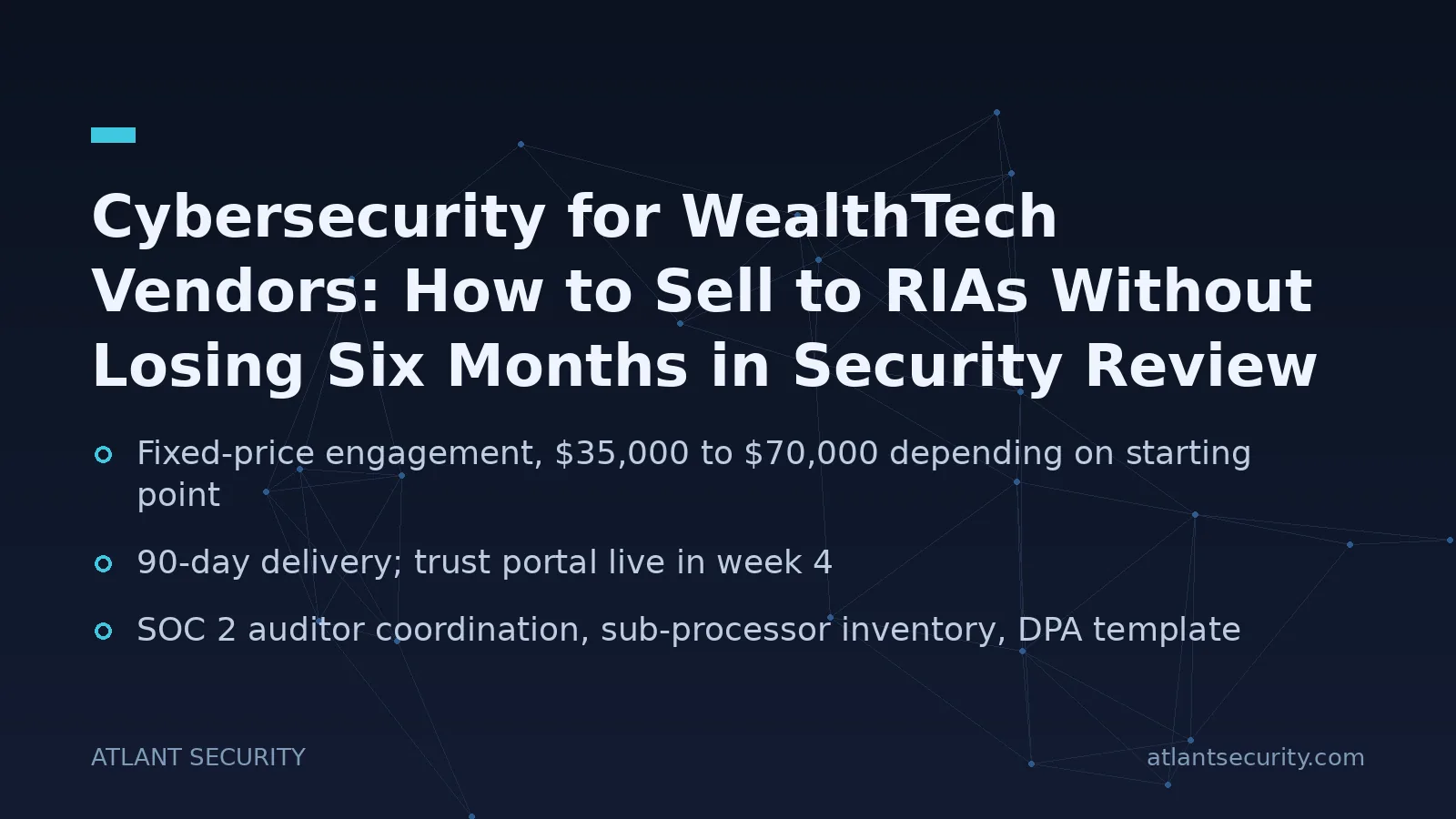
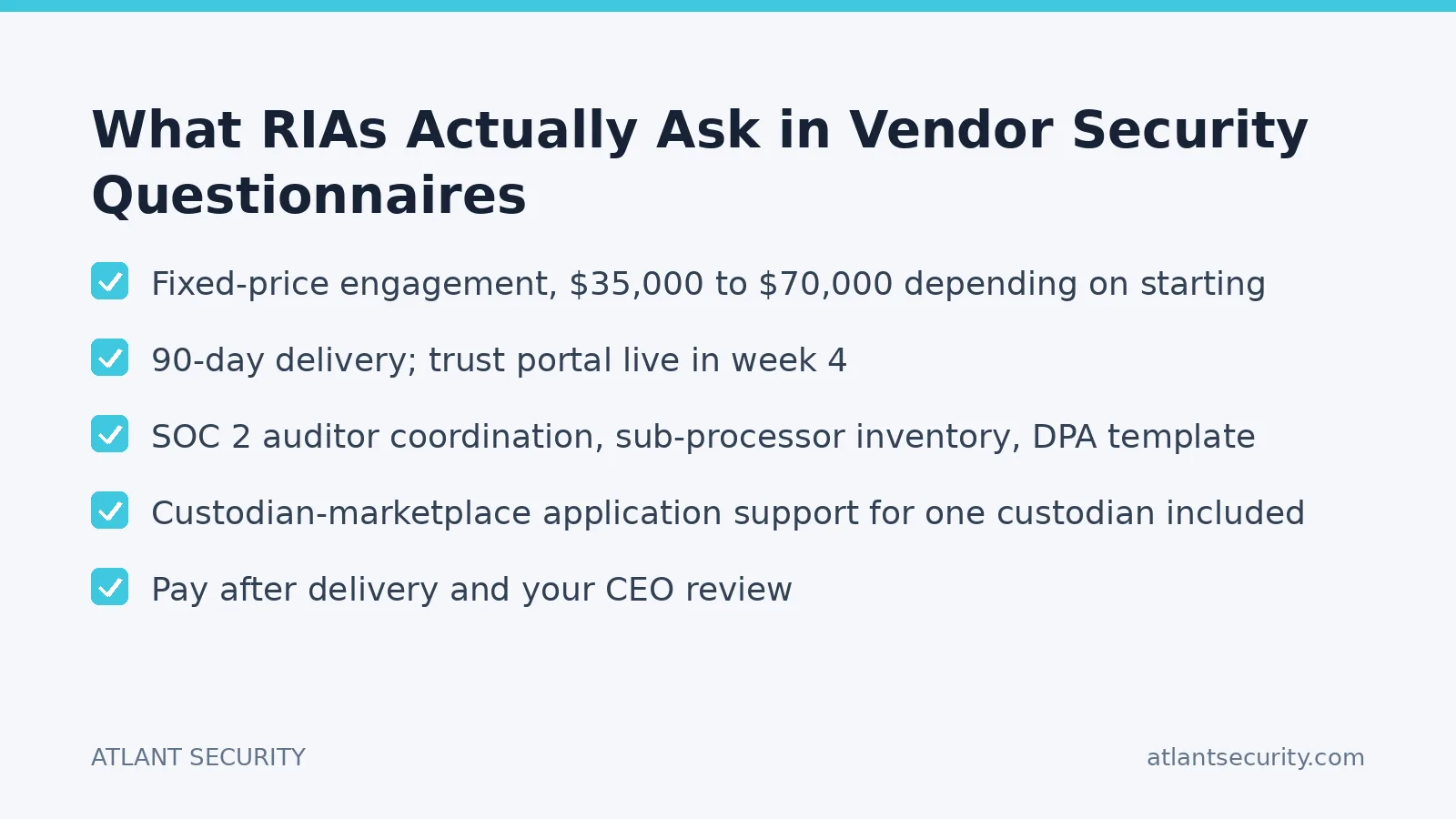
- Fixed-price engagement, $35,000 to $70,000 depending on starting point
- 90-day delivery; trust portal live in week 4
- SOC 2 auditor coordination, sub-processor inventory, DPA template
- Custodian-marketplace application support for one custodian included
- Pay after delivery and your CEO review
Frequently Asked
Questions WealthTech Founders Ask Us
We have 4 paying RIA customers. Do we really need SOC 2 yet?
At 4 customers, you can probably get away without SOC 2 if those customers signed before SOC 2 came up. At 10 customers in pipeline you cannot. The honest decision tree: if you intend to grow past 15-20 RIA customers, start SOC 2 now. The Type 1 process takes 90 to 120 days, and Type 2 needs 6 months of observation. You want the report ready before the prospects start asking, not after.
Which custodian marketplace should we target first?
Look at your current customer concentration. If 70% of your customers custody at Schwab, start with Schwab. If you have a clean slate, Schwab Advisor Services represents the largest single share of RIA AUM by custodian. Fidelity is a close second and increasingly the better fit for growth-stage RIAs. Pershing skews toward broker-dealer-affiliated firms; LPL is a closed network with its own scrutiny.
Can we use Vanta or Drata as our security program?
Vanta and Drata are excellent for evidence collection and audit readiness. They are not security programs. The pattern we see: companies that use Vanta as their compliance scaffolding combined with a fractional CISO or external security partner close RIA deals faster than companies using Vanta alone. The tool collects evidence; a human writes the policies, makes the architecture calls, owns the auditor relationship, and answers the prospect's CCO when they call with a question.
An RIA prospect wants us to commit to 4-hour incident notification. Is that reasonable?
4 hours is aggressive for confirmed-and-investigated incidents. Counter with two tiers: initial notification of suspected incidents within 24 hours (faster than Reg S-P requires, well within SOC 2 standards), and full report within 72 hours. Most RIA prospects accept this when you explain the difference between "we think something happened" and "we confirmed what happened, here is the impact." Always-on 4-hour SLAs for confirmed-investigated incidents are uncommon outside of payment-processor contracts.
We are an AI company that processes RIA data through a model. Is the security review different?
Yes, materially. RIAs are increasingly cautious about AI tools that process client data through third-party models (OpenAI, Anthropic, etc.). Expect questions about model provider data retention, training data exclusion, prompt logging, output handling, hallucination risk, and explainability. The trust portal needs a dedicated AI-handling section. Building a defensible answer here is its own engagement; we have a separate post on this specifically.
Are RIAs really stricter than other B2B SaaS buyers?
Stricter on certain things, looser on others. RIAs care less about exotic technical controls than enterprise CISOs and far more about regulatory alignment (Reg S-P, SEC examination support), fiduciary-data handling, and incident notification timeliness. The size of the buying organization is smaller (most RIAs are 5 to 50 employees) but the questions are more pointed because they map to a regulatory framework the buyer is personally accountable for. Treat them as small organizations with the security expectations of a regulated financial institution.
The hardest deals to close in WealthTech are the ones where you had product-market fit, pricing alignment, and a champion at the RIA, then lost it in week 9 because the CCO could not get a satisfactory answer to her seventh follow-up security question. The product was right. The price was right. The buyer wanted to sign. But the security review never got to "approved" and the budget cycle closed.
The fix is not to be more responsive. The fix is to be unnecessary in the response loop. A trust portal, a pre-written DPA, a SOC 2 report current within the last 6 months, a published incident notification commitment, and a clean answer to "how do you support our Reg S-P obligations?" lets the CCO answer her own questions and close the deal on her timeline, not yours.
Want a no-obligation review of your current security posture against what RIAs ask? Book a 30-minute consultation or email alexander@atlantsecurity.com directly.
Related services from Atlant Security: DFNS & Stablecoin Audit, IT Security Audit, Virtual CISO. Book a discovery call to discuss your specific situation.
