

SOC 2 · Tooling vs Expertise · May 2026
Compliance automation platforms turn a 95 percent green dashboard into a sales asset, but procurement teams still reject the resulting reports, auditors still issue qualifications, and founders still wonder why the engagement cost twice the platform's quoted number. Here is what Vanta, Drata, and Secureframe actually do well, where their automation runs out of road, and what a vCISO does that no tool will ever replace. Numbers and engagement patterns from a decade of compliance work and 27 startups that ran the hybrid model in the last 18 months.
Key Takeaways
- Vanta, Drata, and Secureframe automate configuration evidence collection across cloud and SaaS, surface drift, and package material for the auditor. They do not make policy decisions, define data classification, run access reviews, train people, decide what counts as an incident, or stand up missing infrastructure.
- A vCISO produces the judgment artifacts that the tool cannot produce: a defensible risk register, a scoped control set tied to your business, an incident-response playbook your team will actually use, vendor due diligence with real teeth, and the meeting cadence that keeps the program alive after Year 1.
- Across 27 SOC 2 engagements we delivered in the last 18 months, the average dashboard score 30 days before audit was 91 percent green. The average number of auditor findings was 8. The dashboard score and the audit outcome are not the same metric.
- Tool-only engagements cost $11,000 to $18,000 in Year 1 for tooling plus internal time, then $28,000 to $52,000 when the audit reveals gaps that need remediation. vCISO-only engagements cost $36,000 to $72,000 in Year 1 with no tool. The hybrid (tool + fractional vCISO) lands at $42,000 to $66,000 all-in with fewer surprises and a defensible posture after Year 1.
- The four moments where the tool runs out: scoping the audit, writing policies that match your environment, incident response under pressure, and vendor risk decisions with real consequences. In each of these, judgment from someone who has done it before is what produces a clean outcome.
- If your dashboard is 90 percent green and your auditor is asking detailed questions you cannot answer in writing, you are running the "tool without operator" pattern. The fix is a 90-day vCISO engagement before audit fieldwork begins, not a tool upgrade.
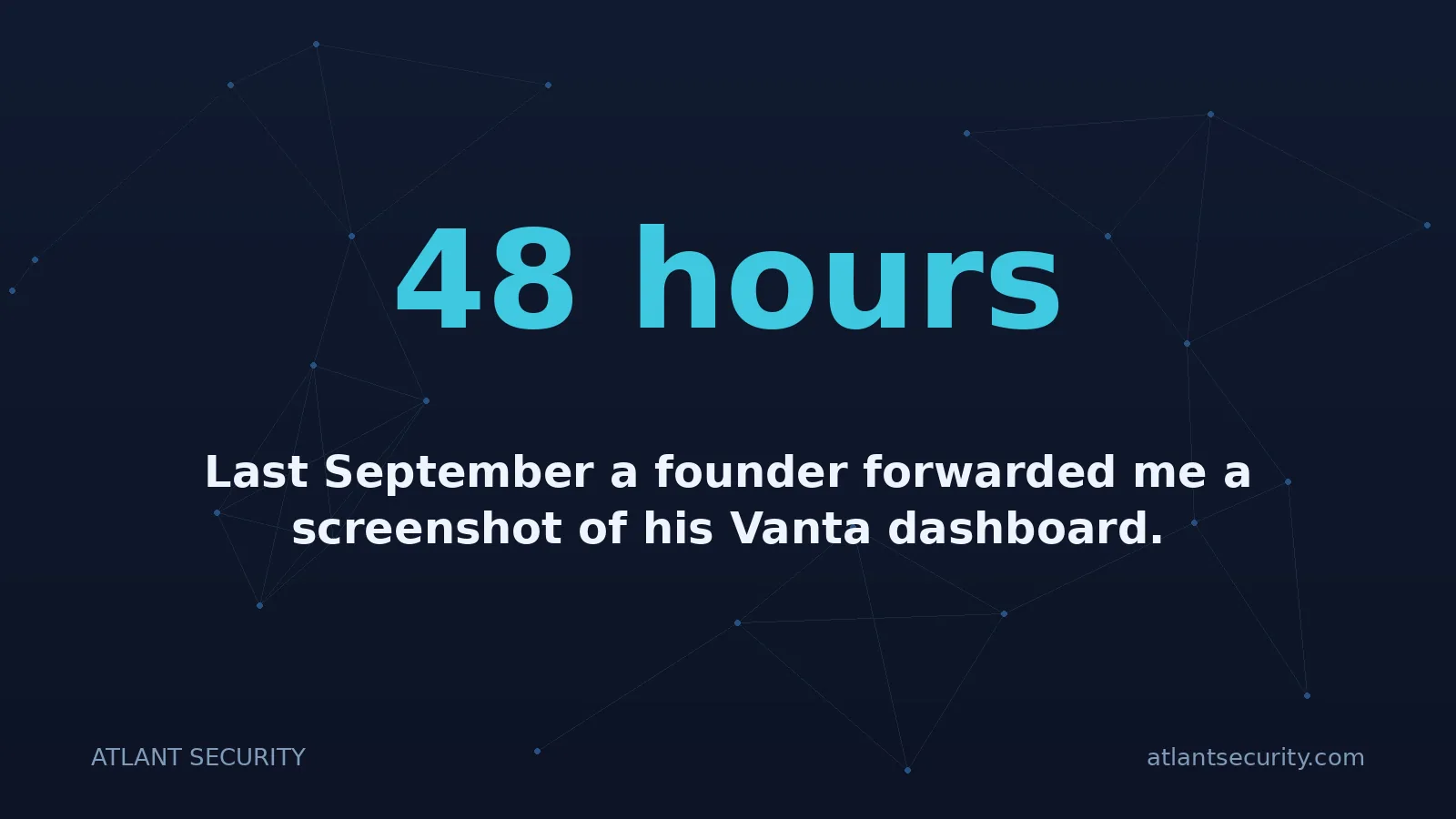
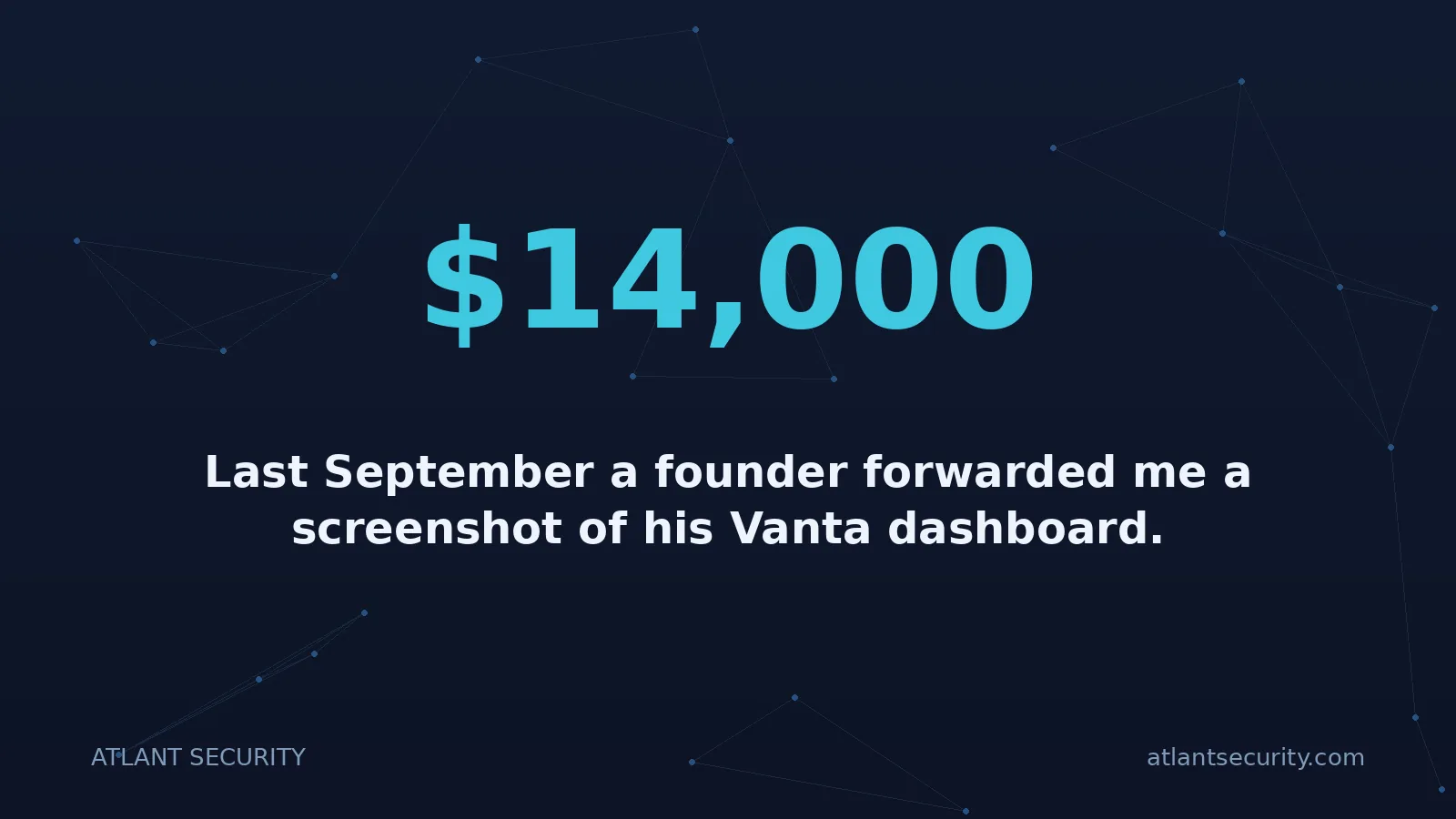
Last September a founder forwarded me a screenshot of his Vanta dashboard. Ninety-four percent green across the Security Trust Services Criterion. The audit window opened in two weeks. He wrote one line above the image: "We are basically done, right?" I asked him three questions back. Who approved the access review process and when did it last run? Where was the documented decision on which production data is classified as confidential? What was the last incident the team responded to under the documented playbook? The reply took 48 hours and changed all three answers. The access review had not run since the platform was installed. Confidentiality classification was a placeholder copied from a template. The last incident was a 2024 outage handled in Slack with no postmortem and no record of customer notification timing. The audit went to fieldwork three weeks later and came back with seven findings. The founder spent another $14,000 on remediation and the report was issued six weeks late.
This post is the long version of why that pattern keeps happening, and what we have learned from running both sides of the engagement. I have worked on 27 SOC 2 engagements in the last 18 months across SaaS startups from 12 to 220 employees. Roughly two-thirds ran on Vanta, Drata, or Secureframe. About 30 percent had a fractional or full-time CISO in place at the start. The rest had a founder doing the work directly, with predictable consequences.
If you are weighing whether to buy a compliance tool, hire a vCISO, or do both, this is the calibration set. If you bought a tool last quarter and are not sure what is actually getting done, the section on dashboard-versus-audit-reality is the diagnostic. And if you are sitting at 91 percent green with an audit in five weeks, jump to the recovery plan at the end.
One note before we start. Vanta, Drata, and Secureframe are genuinely good products. We work with all three regularly. This post is not a tear-down. It is a clarification of what those products solve and what they do not, written so the buying decision is made on the actual scope of the problem rather than on the marketing scope.
Step One
What Vanta, Drata, and Secureframe Actually Do
All three platforms operate on the same architecture. You connect them to your cloud accounts (AWS, GCP, Azure), your identity provider (Okta, Google Workspace, Microsoft Entra), your code hosting (GitHub, GitLab), your HRIS (Rippling, Gusto, BambooHR), and a handful of business tools (Slack, Jira, vendor management). The platform polls each integration on a schedule, runs configuration checks against a control framework (SOC 2, ISO 27001, HIPAA, PCI), and writes evidence packages into a portal the auditor can read.
The genuine value comes in five places. First, evidence collection happens continuously instead of in a frantic two-week sprint before audit. Second, configuration drift is surfaced the day it occurs, not the day the auditor asks for screenshots. Third, the policy library gives you a working draft for every required document instead of starting from a blank page. Fourth, the auditor portal eliminates the email back-and-forth that used to consume four full days of an engagement. Fifth, the vendor management module forces a structured intake for every new SaaS the company signs.
All of this is real and worth paying for. The 70 percent of our clients who use one of the three platforms save roughly 60 to 80 internal hours of evidence collection in Year 1, compared to running the same audit on spreadsheets. None of them ran a meaningfully shorter audit than the 30 percent who did not. The tool moves work earlier and makes it more visible. It does not eliminate the work.
Step Two
What a vCISO Actually Does in a SOC 2 Engagement
A virtual CISO (fractional, part-time, on retainer - the model varies) is a senior security leader who carries the program week to week. In a SOC 2 engagement the vCISO produces a specific set of artifacts that auditors test against and that the tool cannot generate. The list below is the working scope from our standard engagement letter.
The risk register. The tool will give you a checklist of 80 controls. The vCISO produces a risk register tied to your actual environment, threat model, and customer commitments. The register tells the auditor why each control exists, what risk it mitigates, and what residual risk you have accepted in writing. Auditors do not read the dashboard; they read the register.
The scoped control set. SOC 2 lets you choose which Trust Services Criteria to include and how to scope the entities, systems, and services covered. The tool ships with the maximum scope. The vCISO scopes it down to what your buyers actually require and what your business can realistically operate. The difference is typically 20 to 30 controls and 60 to 100 internal hours per year.
The incident response playbook. The tool ships a template. The vCISO tailors the playbook to your stack, your team, and your customer commitments. The first paragraph names the on-call engineer. The decision tree maps to your real escalation channels. The customer-notification clause matches the SLAs in your master service agreement. The tabletop exercise that proves it works gets run twice a year by the vCISO with the engineering team.
Vendor due diligence with consequence. The tool collects vendor intake forms. The vCISO reads the responses, runs the assessment that flags real risk, and tells the procurement team to delay or reject the vendor when the responses are weak. Half of our clients have killed a vendor procurement decision in the last twelve months on vCISO recommendation. The tool would have flagged the same vendor green if the responses were green.
The Year 1 to Year 2 transition. SOC 2 Type 1 is a snapshot. Type 2 is an operating-period observation. The transition between them is where most companies fall over. The vCISO designs the operating cadence (quarterly access reviews, monthly vendor reviews, weekly change-management sign-offs, biannual training) and holds it together for the first twelve months. The tool tracks the cadence after it is designed; it cannot design it.
The auditor relationship. Auditors are people. The vCISO who has worked with that auditor twice before knows which evidence the partner accepts and which evidence triggers a follow-up question. The same evidence package gets accepted in one engagement and questioned in another based on framing. The vCISO carries that institutional knowledge across engagements; the tool does not.
Step Three
The Four Moments Where Automation Hits a Wall
The boundary between tool and operator is not abstract. There are four specific moments in a SOC 2 engagement where the dashboard goes quiet and a human has to make a call. If you do not have an operator in those moments, the audit will surface them as findings or, worse, your customers will surface them as breaches.
Scoping. The most expensive scoping mistake we see is including subsidiaries the auditor did not need to test. A founder accepts the tool's default scope, signs the auditor engagement letter, then discovers in week 8 that the EU subsidiary is being tested separately, doubling the fieldwork. Reversing the scope mid-engagement costs three weeks and roughly $8,000. The vCISO catches this in week 1.
Policies. The tool's policy library is excellent for a 20 percent edit. It is not safe to ship the templates as written. We have seen auditors flag templates that reference encryption standards a client does not use, jurisdictions where the company does not operate, and data classifications the engineering team has never heard of. The vCISO does the 20 percent edit, gets the policy approved by the executive team, and assigns ownership for ongoing maintenance.
Incident response. The tool will tell you to run a tabletop. It will not run one. A tabletop done poorly is worse than no tabletop because the documented failure mode becomes evidence against you. The vCISO designs the scenario (a credential leaked through a third-party SaaS, a customer reporting unauthorized access, a malware alert from your EDR), runs the exercise, produces the report, and tracks the action items to closure.
Vendor risk. A high-risk vendor is one whose breach would expose customer data, take down your production environment, or compromise your authentication. The tool will accept the vendor if their intake form is filled out. The vCISO reads the vendor's SOC 2 report (which is often the wrong scope, an older period, or has carve-outs that matter), runs the diligence call, and tells the procurement team whether the risk is acceptable. This is judgment, not data.
Step Four
The Real Cost Comparison Across Three Models
Most founders compare the Vanta sticker price against the vCISO retainer and choose the cheaper one. The real comparison runs across the all-in cost of the engagement, the post-audit remediation cost, and the operating cost of Year 2. The numbers below come from our 27 engagements over the last 18 months.
Model A is the tool-only path. The sticker price looks low because tooling is a line item and internal time usually is not. When you load the engineering hours into the budget at $110 per hour and the founder hours at $200 per hour, internal time becomes the largest expense in the engagement. The median is 8 auditor findings, mostly on policy framing, evidence interpretation, and process documentation. Remediation runs $8,000 to $24,000.
Model B is the vCISO-only path. We have run it twice in the last 18 months with clients who had unusual stacks (mainframe and on-premise data) where the standard automation tools did not integrate cleanly. The audit outcome was excellent (2 findings median), but the vCISO carried more hours because every piece of evidence was collected manually. Without the tool's continuous monitoring, drift between audits requires more frequent vCISO time, so Year 2 cost stays high.
Model C is the hybrid: a tool for evidence collection and a fractional vCISO for judgment. This is what we recommend for almost every client and what we run when we are the operator. The all-in cost lands $20,000 to $30,000 below the tool-only path once internal time and remediation are honestly counted. The audit outcome is consistently the best of the three models, and the posture survives into Year 2 without a rebuild.
Step Five
Decision Tree: Which Model Fits Your Company
The three models are not equally suited to every company. The decision tree below is what we walk through on a discovery call. It has worked across every engagement we have signed in the last twelve months.
The tool-only model is the right answer when you have an in-house security engineer who has personally taken a company through SOC 2 in the last three years. That engineer brings the judgment that the tool cannot. Even then we recommend a one-month vCISO sanity check in the weeks before audit, because a single set of outside eyes catches things an internal owner does not.
The vCISO-only model is the right answer when your stack does not integrate cleanly with the major automation platforms. Mainframe, embedded systems, on-premise databases, or air-gapped environments do not light up the dashboard, and trying to force the tool to fit produces brittle evidence. A disciplined evidence runbook in Notion or Confluence with the vCISO running collection wins here.
For everyone else - which is roughly 80 percent of the SaaS companies we work with - the hybrid model is the answer. Pair a tool with a fractional vCISO sized at 12 to 20 hours per month for the audit phase and 6 to 10 hours per month after. The combined cost is lower than tool-only once internal time and remediation are loaded honestly.
Step Six
How the Hybrid Engagement Actually Runs
The hybrid model is not just "buy a tool and hire a person." It is a specific operating cadence. The cadence below comes from 19 hybrid engagements over the last 15 months. The roles are sharply divided so neither side wastes time on work the other side owns.
| Activity | Tool owns | vCISO owns |
|---|---|---|
| Audit scope and TSC selection | - | Full ownership |
| Policy library and drafts | Templates + reminders | Edits, sign-off, training |
| Cloud / SaaS config evidence | Continuous collection | Exception review |
| Access reviews | Scheduling, reminders | Reviewer training, escalation |
| Vendor management | Intake form, risk scoring | Diligence calls, approve/reject |
| Incident response plan | Template | Custom playbook, tabletops |
| Risk register | - | Authored, reviewed quarterly |
| Auditor relationship | Evidence portal | Partner contact, scoping |
| Security training | Delivery, tracking | Threat-specific modules, sign-off |
| Board reporting | - | Quarterly deck, attendance |
The split is clean once you map it. The tool owns everything that can be polled, scheduled, or templated. The vCISO owns everything that requires interpretation, judgment, or relationships. The handoff points are the moments where the tool produces output and the vCISO consumes it: a vendor intake form is filled out (tool) and a diligence call gets scheduled (vCISO); a policy draft is generated (tool) and an edit cycle runs with engineering (vCISO).
In practice, the vCISO time profile for a 16-week SOC 2 Type 1 engagement looks like this: 20 hours in weeks 1-3 for scoping and auditor selection, 12 hours per month in weeks 4-10 for the readiness phase, 16 hours in weeks 11-13 for evidence review and tabletop facilitation, and 24 hours in weeks 14-16 for audit fieldwork support and report review. Total: 90 to 130 hours.
After audit, the vCISO time profile drops to 6 to 10 hours per month for the operating period. That covers quarterly risk register reviews, monthly vendor diligence on high-risk procurements, monthly access review oversight, two tabletops per year, and one board update per quarter. This is the cadence that keeps a clean Type 1 from drifting into a messy Type 2.
Step Seven
Three Failure Modes We See Repeatedly
When a tool-only engagement goes wrong, it usually goes wrong in one of three ways. Each has a name. Each has a recovery plan. If you recognize your situation in any of these, the fix is targeted vCISO time, not a tool upgrade or vendor switch.
Failure mode 1: The 95% green dashboard trap
The dashboard shows 95% green. Audit fieldwork opens. Auditor asks "show me your risk register" and there is no register. Auditor asks "who approved this access review" and the approver field is the founder, signing the review they ran on themselves. Auditor flags 8 findings on policy framing and process documentation.
Fix: A 60-day vCISO engagement starting six weeks before audit. Risk register authored, key policies edited, two tabletops run, vendor diligence on high-risk vendors done.
Failure mode 2: The scope mismatch
Tool ships with maximum scope; founder accepts it. Audit engagement letter includes EU subsidiary, R&D entity, and three SaaS products as separate scopes. Fieldwork triples. Cost overruns are $20,000 to $35,000, timeline overruns are 6 to 10 weeks.
Fix: Re-scope conversation with the auditor before fieldwork starts. Some scopes can be deferred to Year 2, some can be carved out entirely. vCISO drives the conversation; auditor will not propose this unprompted.
Failure mode 3: The vendor risk blind spot
Tool collects vendor intake forms. All vendors show green. Six months later a vendor with privileged access to your data has a breach. You discover their SOC 2 report covered a different product, the audit period ended before the breach window, and the carve-out covered the affected service. You had no early warning.
Fix: Tier vendors by risk; the top tier gets a quarterly vCISO-led diligence call, not a quarterly form. Read the actual SOC 2 reports, not the vendor's marketing summary. Track scope changes and audit period drift.
All three of these are recoverable. None of them require throwing out the tool. The fix is to add the human judgment layer that the tool was never going to supply, scope it tightly, and pay only for the time you need.
How Atlant Security Helps
Hybrid SOC 2 Delivery: Tool + vCISO Without the Surprises
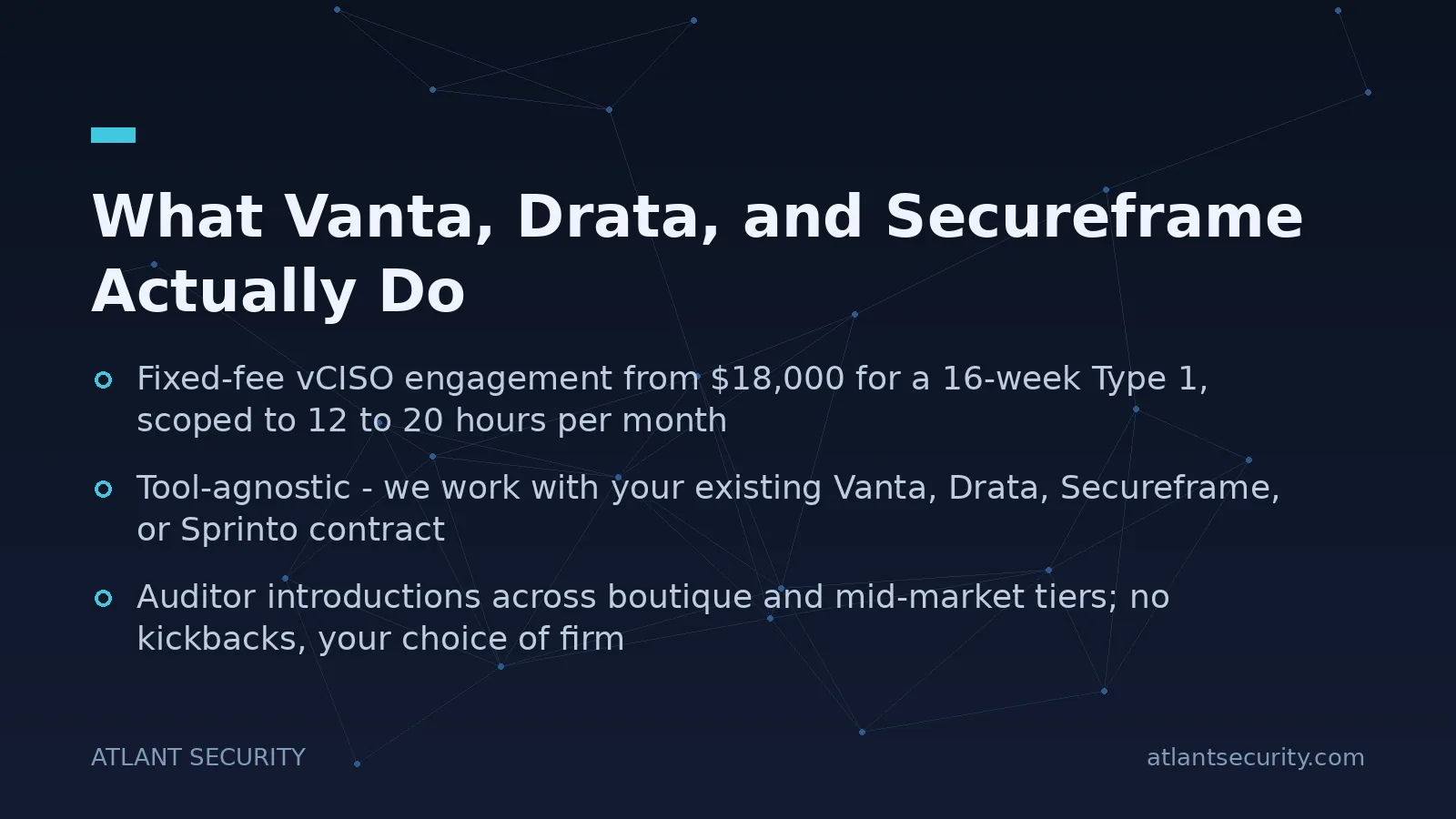
We have run 19 hybrid SOC 2 engagements in the last 15 months. We provide the fractional vCISO who carries the program, integrates with your tool of choice (Vanta, Drata, Secureframe, or Sprinto), and produces the judgment artifacts the tool cannot generate. Founders work directly with a senior CISO-level consultant who has done this enough times to skip the rookie mistakes.
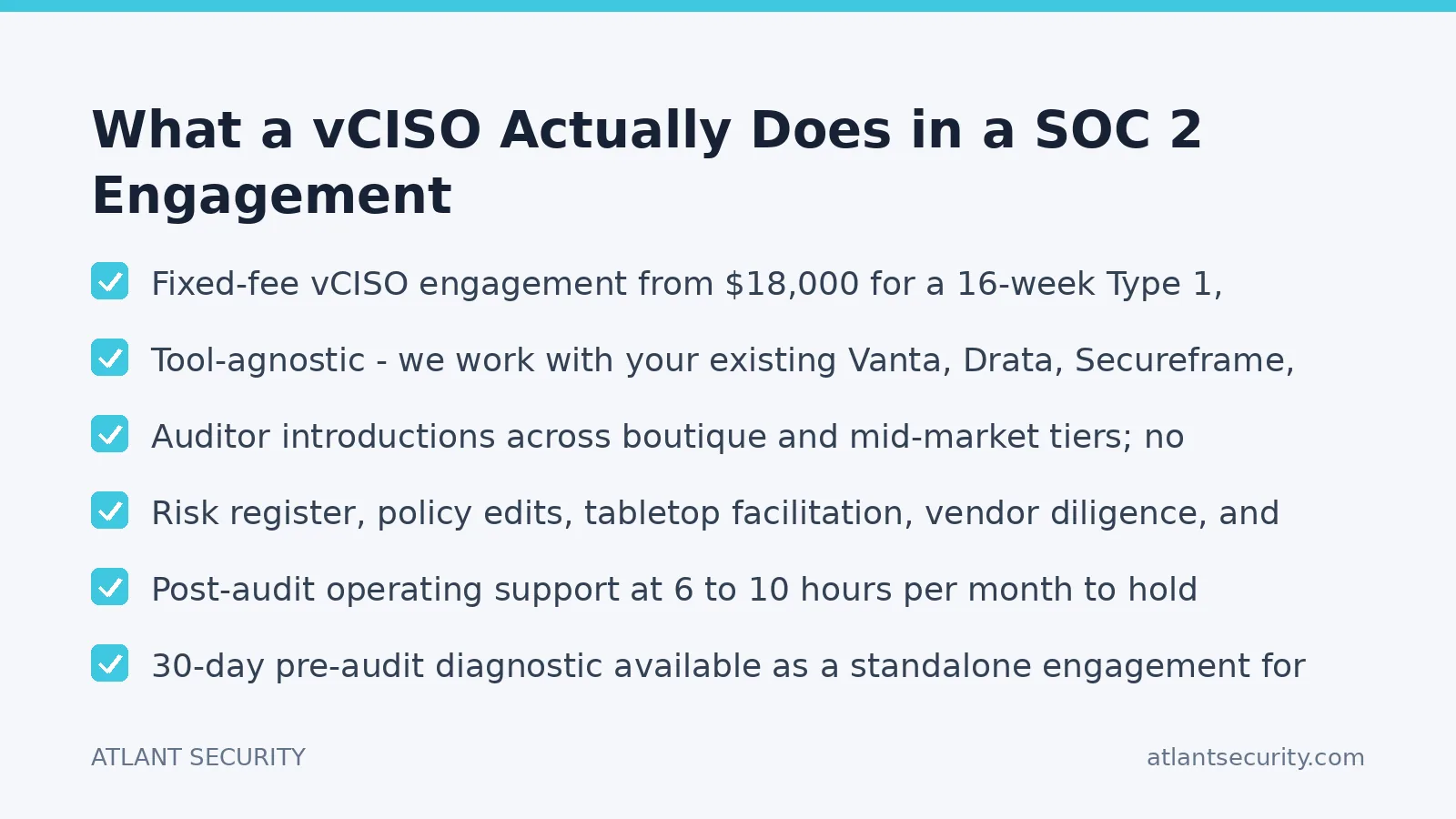
- Fixed-fee vCISO engagement from $18,000 for a 16-week Type 1, scoped to 12 to 20 hours per month
- Tool-agnostic - we work with your existing Vanta, Drata, Secureframe, or Sprinto contract
- Auditor introductions across boutique and mid-market tiers; no kickbacks, your choice of firm
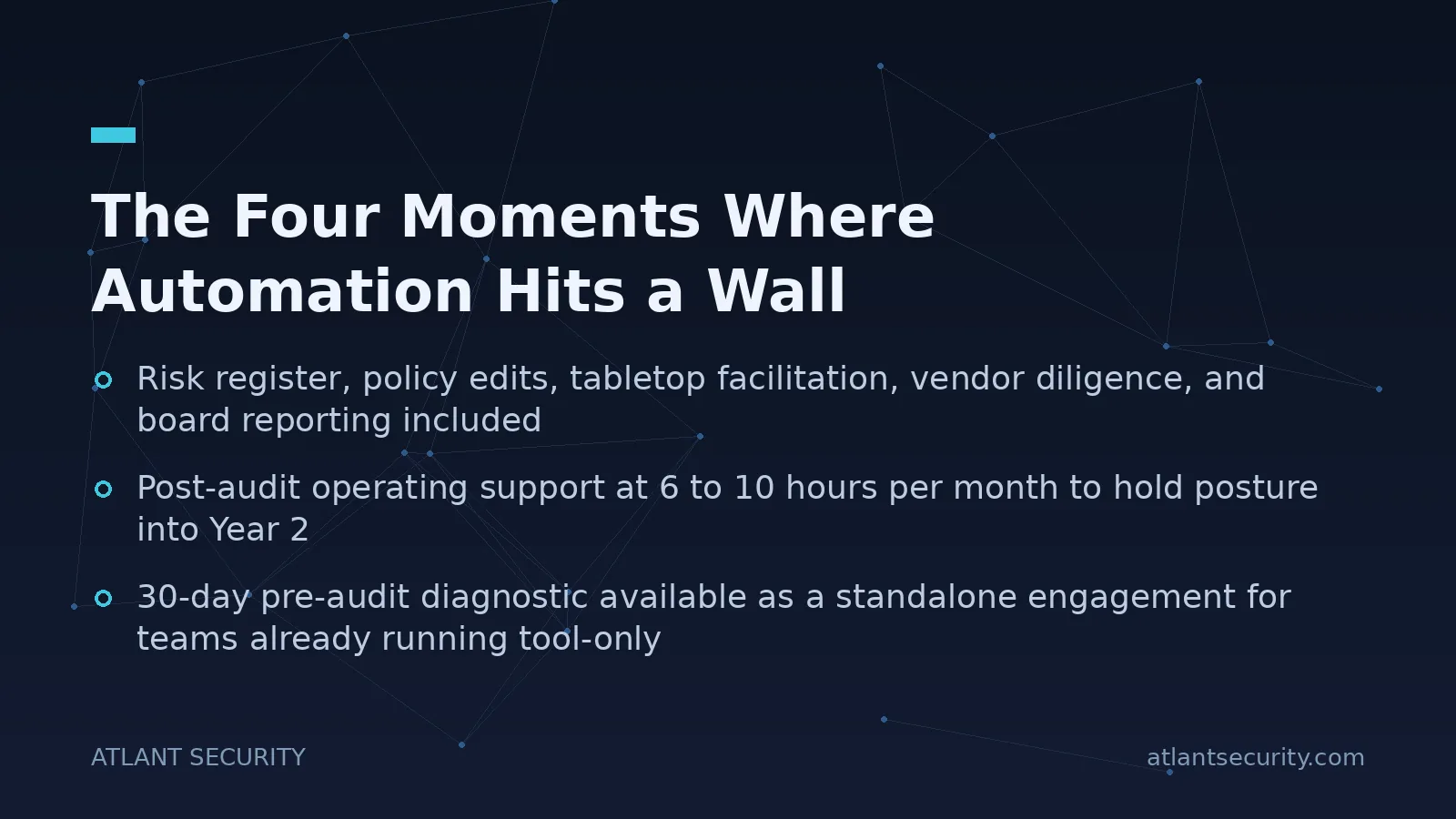
- Risk register, policy edits, tabletop facilitation, vendor diligence, and board reporting included
- Post-audit operating support at 6 to 10 hours per month to hold posture into Year 2
- 30-day pre-audit diagnostic available as a standalone engagement for teams already running tool-only
Frequently Asked
Questions Founders Ask Before Choosing
Can we do SOC 2 with only Vanta and no vCISO?
Yes, but only cleanly if you have an in-house security engineer who has personally taken a company through SOC 2 in the last three years and who has 20+ hours per month to spend on it. If that person does not exist on your team, the tool-only path runs into the failure modes in this post: dashboard-to-audit gap, scope drift, and vendor risk blind spots. The fix is to budget 12 to 20 hours per month of fractional vCISO time alongside the tool.
Is a vCISO better than a full-time CISO?
For a startup under 100 employees, a fractional vCISO is almost always the right model. A full-time CISO at $200,000 to $320,000 fully loaded is overkill for the workload of a single SOC 2 engagement plus operating cadence. The vCISO buys you seniority and judgment at 10 to 20 hours per month. The transition point to a full-time hire usually arrives when the team is 120+ employees, the customer base includes regulated industries, or a second compliance framework (ISO 27001, HIPAA, FedRAMP) is in active scope.
Which tool is best: Vanta, Drata, or Secureframe?
All three are competent. The differences are at the margin: Vanta has the broadest integration catalog and the most polished UI; Drata has stronger custom-framework support and is often preferred by mid-market teams; Secureframe pricing is the most aggressive at the small-team tier. Choose the tool your auditor integrates with most cleanly - that saves more time than any feature comparison. Switching tools mid-program is painful and rarely pays off.
How many hours of vCISO time do we need?
During an active SOC 2 Type 1 engagement (16 weeks): 90 to 130 hours total, weighted toward weeks 1-3 (scoping) and weeks 14-16 (audit fieldwork). After the audit, in operating mode: 6 to 10 hours per month for one framework. Add 4 to 6 hours per month per additional framework. A team that is also running NIS2 or DORA on top of SOC 2 should plan for 16 to 22 hours per month of vCISO time.
Our audit is in 6 weeks and our dashboard is 90% green. Help?
This is the most common reason teams call us. The diagnostic takes one week: we read your dashboard, talk to your auditor, review your policies, and identify the 6 to 10 things most likely to surface as findings. The remediation usually takes 4 to 5 weeks of focused work: risk register authored, key policies rewritten, one tabletop run with documentation, vendor diligence on the top three risk vendors, and an evidence quality pass. Most teams come out with 1 to 2 findings instead of the 7 to 9 they would have had.
Does the same logic apply to ISO 27001 or HIPAA?
Yes, with a sharper boundary. ISO 27001 has more documentation requirements that the tool will not generate (Statement of Applicability, ISMS scope, risk treatment plan), so the vCISO layer is more important. HIPAA technical safeguards map well to the tool, but the administrative safeguards and the Business Associate Agreement layer are pure vCISO work. NIS2 and DORA include obligations the standard tools have only just started to map; expect more vCISO time on those frameworks for the next 12 months.
If you are reading this with a tool subscription already in place and an audit on the horizon, the next step is the diagnostic: take the four moments in section three and ask whether you have a clear owner for each. If three or four of them are unowned, the call before audit fieldwork is the cheapest call you will make this year.
If you have not bought a tool yet, do not start there. Start with auditor selection and scope, and let those decisions inform which tool fits. The tool is a multiplier on a working program; it is not the program. Build the program first.
Need a pre-audit diagnostic or a hybrid engagement scoped for your team? Book a 30-minute consultation or email alexander@atlantsecurity.com directly.
Related services from Atlant Security: SOC 2 Readiness, SaaS Security Audit, Virtual CISO. Book a discovery call to discuss your specific situation.
