
Sales Enablement · Vendor Trust · May 2026
When a Fortune 500 prospect requires SOC 2 and your audit is six months away, a Third-Party Security Attestation Letter from a credible firm closes the trust gap in two weeks. Here is what makes the letter credible, what belongs inside it, when it actually works, and how the two-week engagement runs, written from a decade of issuing these for sales-critical deals.
Key Takeaways
- A Third-Party Security Attestation Letter is a signed letter from an independent security firm confirming that an external assessment took place, the scope of that assessment, and that no critical findings remain open at the time of issue
- It is not SOC 2, not ISO 27001, and does not pretend to be. It is the answer to the procurement reviewer's actual question: "has someone independent looked at this company's security?"
- A credible letter has five mandatory components: scope statement, methodology summary, attestation language, qualified signature, and a referenced technical report
- Typical cost: $5,000 to $15,000. Typical timeline: two weeks from kickoff to signed letter. Typical validity: twelve months with an optional half-day refresh
- In our practice, the letter resolves enterprise procurement objections in roughly four out of five cases. The remaining one in five requires SOC 2 because the buyer's policy hard-codes it
- The wrong move is to self-attest on company letterhead, fabricate a "compliance summary," or buy a screenshot of a Vanta dashboard. Procurement teams have seen all three and know what they are worth
In April we got a call from the founder of a healthtech startup in Boston. They had eleven employees, a contract worth $1.2 million on the table with a regional health system, and a security questionnaire that listed SOC 2 Type 2 as a "strict prerequisite." Their last conversation with their auditor had ended with the words "earliest realistic Type 1 readiness is October." It was April 14. Their procurement deadline was April 30.
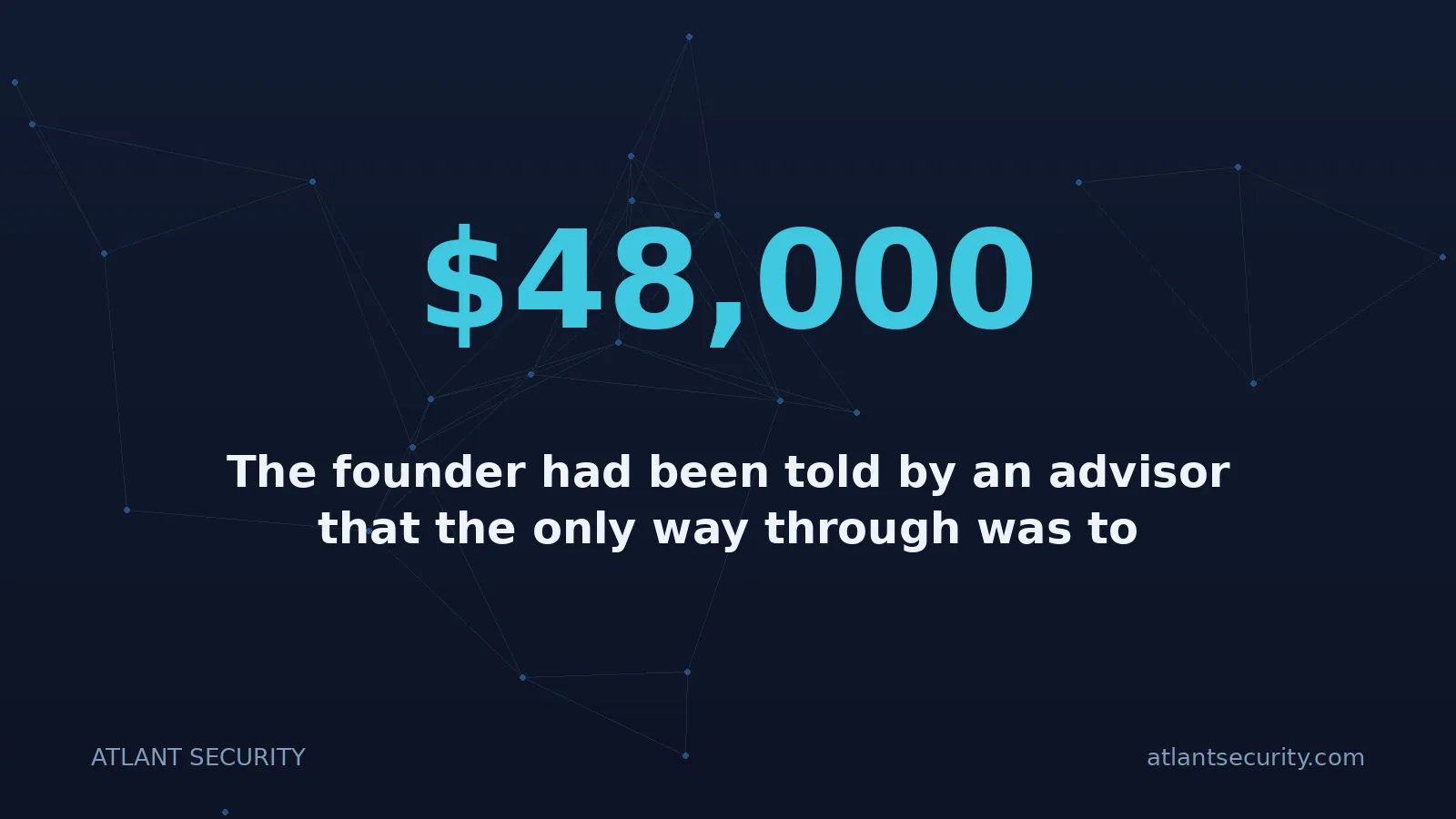
The founder had been told by an advisor that the only way through was to "fast-track" SOC 2. He had quotes for $48,000 in audit and tooling fees and a four-month timeline. The deal would be dead in two weeks. He wanted to know if there was a faster lane.
There was. We spent ten business days on the assessment, issued a Third-Party Security Attestation Letter on Atlant Security letterhead on April 28, and the contract closed on May 2. The procurement team accepted the letter as a "compensating control" against the SOC 2 requirement, with a written commitment from the startup to complete a Type 1 within nine months. Two weeks of focused work replaced four months of compliance theater.
This post is the long version of what was in the letter, why it was credible, when this approach works, and when it does not. The short version: most enterprise procurement teams do not actually require SOC 2 - they require evidence that someone independent has vouched for you. The letter is one of the most efficient ways to provide that evidence.
Step One
What a Third-Party Security Attestation Letter Actually Is
A Third-Party Security Attestation Letter (we will call it "the letter" from here) is a signed document, on the letterhead of an independent security firm, that confirms three things: an external security assessment of the company occurred, the assessment had a defined scope, and at the time the letter was issued there were no unresolved critical findings (or, if any remain, they are listed with remediation commitments and target dates).
The letter is short. The full version we issue is one and a half pages. It is intentionally focused: the procurement reviewer wants to know who looked at you, what they looked at, and what they concluded. Anything more is for the technical report that accompanies the letter.
It is also not new. Variations of this artifact have been used in vendor risk management for at least two decades. What changed is that procurement teams started receiving so many incomplete or low-quality letters from boutique firms (or, occasionally, firms that did not exist at all) that the bar for what counts as credible has risen. A modern letter has to be defensible to a skeptical Vendor Risk Management (VRM) reviewer at a Fortune 500 financial institution. That reviewer reads dozens per month and has well-developed instincts about what makes one credible.
Here is what the letter is not. It is not a compliance certification. It does not assert SOC 2, ISO 27001, PCI-DSS, or any other standard has been audited and found compliant - because that is not what happened. It does not transfer liability from the firm to the customer. It does not replace SOC 2 forever; in our advice it is most often a bridge to SOC 2, valid for the twelve months it takes to complete a Type 1.
The letter belongs to a category of artifacts that procurement teams call "compensating controls" - documentation that addresses the underlying risk concern even though it is not the standard initially asked for. Not every procurement function accepts compensating controls. The ones that do (in our experience, four out of five enterprise buyers) accept them when the documentation is concrete, recent, and signed by someone they can call.
Step Two
The Question Behind the Question
When a Fortune 500 procurement team requires SOC 2, they usually do not need SOC 2 in the strict sense. The contractual language often reads "SOC 2 Type 2 or equivalent independent attestation," and the operative word is or. Most reviewers cannot quote the AICPA Trust Services Criteria from memory. What they are doing is following a checklist: has this vendor been independently assessed by a credible third party in the last twelve months, and is that assessment documented in writing?
If you can answer yes, you are usually past procurement. If you answer no, the questionnaire becomes a 200-question slog because the reviewer has to compensate by asking everything they would otherwise have read in the SOC 2 report.
There are three categories of reviewer you will encounter. Knowing which one you have changes everything about how the letter should be positioned.
The Risk-Based Reviewer
Roughly 50 percent of procurement reviewers. They are looking at the substance of the security posture and using the report or letter to triangulate risk. They will accept a third-party attestation letter, especially when paired with a redacted technical report. They will read the report. Specific evidence wins them over.
The Checklist Reviewer
Roughly 30 percent. Their procurement playbook lists "SOC 2 Type 2" as a tick-box. They have authority to accept compensating controls but rarely use it. The letter has to be presented with a clear sentence: "This letter functions as a compensating control for the SOC 2 requirement until our Type 1 is delivered in [date]." Pair with a written commitment to deliver SOC 2 by the date.
The Policy-Locked Reviewer
Roughly 20 percent. Their internal policy hard-codes SOC 2 Type 2 with no exceptions, often because the buyer is a regulated financial institution where their own auditor requires it. The letter will not unlock the deal. The path here is either a SOC 2 sprint, a smaller pilot scope that does not trigger the requirement, or accepting that the deal will close after your SOC 2 is in hand. Recognize the policy-locked reviewer early.
The fastest way to identify which reviewer you have is to ask. A short email to your sales counterpart with the question "Is the SOC 2 Type 2 requirement a strict policy or is there flexibility for an equivalent independent attestation?" often gets a clear answer in 24 hours. If the answer is "let me check," you usually have flexibility. If the answer is "no, our regulator requires SOC 2," you have a policy-locked reviewer and the strategy must change.
Step Three
The Five Parts of a Credible Attestation Letter
The credibility of a letter is determined by what is in it and who signed it. Below is the anatomy that VRM reviewers look for. A letter missing any of these five components will be questioned, often informally over email, and the review will stretch from days to weeks.
The single most common reason letters fail review is that the scope statement is vague. "We have assessed the security of [Company] and found it to be in good standing" is a sentence that means nothing. A scope statement that holds up looks more like this: "Atlant Security performed a 14-day technical and procedural assessment of [Company]'s production AWS environment in us-east-1, the SaaS application served from app.[company].com, the GitHub source repositories under the [Company] organization, and the Google Workspace tenant covering all 24 employees, between [start date] and [end date]." The reviewer can immediately see what was and was not examined.
The second most common failure is the absence of a referenced technical report. The letter is intentionally a one-and-a-half page summary because a procurement reviewer will not read more than that. But under NDA, that reviewer often does want the underlying 30-page report with findings, evidence, and recommendations. A letter without an accompanying report reads like a brochure. We deliver both as a matter of course.
Step Four
How the Letter Compares to SOC 2, ISO 27001, CSA STAR, and Self-Attestation
Procurement teams are not unsophisticated. They know the difference between a CPA-issued SOC 2 report and a security firm's attestation letter. The reason the letter still works is that it occupies a useful niche between "self-attestation" (which procurement does not trust) and "full SOC 2 audit" (which most early-stage companies cannot deliver in time). Below is the practical comparison that we walk new clients through on the discovery call.
| Option | Issued By | Cost | Timeline | Best For |
|---|---|---|---|---|
| Self-Attestation | Your CEO | $0 | 1 day | Friends and small SMB customers, never enterprise |
| 3rd-Party Attestation Letter | Independent security firm | $5K - $15K | 2 weeks | Sales-critical deals with enterprise prospects, 1-12 month bridge |
| CSA STAR Level 1 (CAIQ) | Self-published, CSA-listed | $0 - $5K | 2-4 weeks | Cloud SaaS providers; pairs well with the letter |
| CSA STAR Level 2 | Independent assessor | $10K - $25K | 1-3 months | Cloud-only companies wanting credibility short of full SOC 2 |
| SOC 2 Type 1 | CPA firm | $30K - $80K | 3-6 months | When 3+ enterprise prospects in one cycle require it |
| SOC 2 Type 2 | CPA firm | $50K - $120K | 12-18 months | Companies with 5+ enterprise customers, recurring questionnaires |
| ISO 27001 | Accredited registrar | $25K - $80K | 6-12 months | EU-heavy customer base, multinational sales motion |
A useful question to ask is what comes after the letter. Most clients use it as a bridge to SOC 2, with a written commitment to SOC 2 Type 1 within nine to twelve months. Some clients renew the letter annually instead and never pursue SOC 2 because their customer base is small and medium business rather than enterprise. Both are reasonable. The wrong answer is to renew the letter for three years and use it to avoid investing in a security program. Procurement teams notice when the same letter has been issued four years in a row with no progress toward a full standard.
Step Five
The Two-Week Engagement, Day by Day
Two weeks is not a marketing number. It is the actual cycle time from kickoff call to signed letter for a typical SaaS environment with 5 to 50 employees and a single production region. Larger or multi-region environments take three weeks. Below is what those two weeks look like from the inside.
A common worry is that we will find something so bad that we cannot issue a letter. It happens, but rarely - perhaps in five percent of engagements. The much more common pattern is that we find three or four things that need fixing before the letter is issued. Examples we have seen recently: an S3 bucket holding customer data without object encryption, an admin account without MFA, a forgotten subdomain pointing at a deprecated ALB, a CI/CD secret committed to a public repo. All four are usually fixable within 24 to 48 hours by an engineer who knows the environment. We sit with that engineer and verify the fix.
When we cannot issue a clean letter, we will not pretend we can. The letter then either lists the open finding with the remediation plan and target date (the buyer can decide whether to accept it as a known risk) or it is delayed until the issue is fully resolved. We have never had a client refuse the latter outcome once they understood why - the alternative is a letter that quietly fails procurement review and damages the relationship anyway.
Step Six
When the Letter Is the Wrong Answer
The letter is not always the right move. About one in eight discovery calls we run end with us recommending a different path. Below is the decision tree we walk through.
The two scenarios where we firmly recommend against the letter are the policy-locked buyer and the third consecutive renewal. Policy-locked is self-explanatory: a regulated financial institution whose external auditor inspects vendor evidence will not accept a letter, and trying to push one risks the relationship. The third-consecutive-renewal pattern is more subtle. It usually means the company has used the letter to avoid investing in real compliance work, and procurement teams have started asking why. At year three, the right move is SOC 2 Type 1, ISO 27001, or both.
A third scenario, less common, is when the buyer is asking for a SOC 2 because they themselves are subject to a regulation that requires their vendors to be SOC 2 audited (notably some HIPAA-covered entities, certain PCI-DSS Level 1 merchants, and financial institutions under the OCC Heightened Standards). Here the buyer's hands are tied even if their procurement team is willing. The letter does not solve this. The path is SOC 2 or a smaller commercial scope that does not trigger the regulation.
Step Seven
Pricing, Validity, and What "Pay After Delivery" Means
Our pricing for the third-party security attestation letter starts at $5,000 and ranges to about $15,000 depending on environment complexity. The mid-range, around $8,500, is the most common engagement. The price covers the full two-week assessment, the technical report, the signed letter, and a 30-minute follow-up call with the procurement team if requested.
What drives the price up: multi-region cloud deployments, a customer-data-processing pipeline that touches more than three SaaS services, on-premises infrastructure (rare in our client base, but not zero), regulated data classes such as PHI or cardholder data that require deeper testing. What does not drive the price up: number of employees under 75, marketing complexity, brand size.
We invoice after delivery. The invoice is sent on the day the letter is issued, with net-30 terms. Clients have asked us why we offer this. The honest answer is that we have done this work for nine years and we have never had a client refuse to pay after receiving a letter and report they were satisfied with. The risk we take is real but small. The trust this creates with founders running fast does most of the marketing work for us.
A typical letter is valid for twelve months from the date of issue. We document this on the letter itself. Reviewers do check the date. After twelve months, the letter is stale and the assessment must be refreshed. The refresh engagement is a half-day reassessment and a re-issued letter, priced at roughly 30 to 40 percent of the original engagement, taking three to five business days. This is the right cadence: annual refresh, with full re-engagement only if the production environment has changed materially.
If the letter is still in force when you deliver SOC 2 Type 1, you do not need to renew. Your SOC 2 report supersedes the letter for procurement purposes. Many of our clients use this exact path: letter on day 14, SOC 2 Type 1 on month 9 to 12, then SOC 2 takes over.
How Atlant Security Helps
Two-Week Third-Party Security Attestation
When SOC 2 is months away and the deal is on the line, our IT Security Audit delivers a credible independent assessment in two weeks. We review your environment against a 20-domain framework, document the evidence, and issue a signed attestation letter on Atlant Security letterhead suitable for sharing with enterprise procurement.
- Fixed pricing from $5,000 with a typical engagement at $8,500
- Two-week delivery from kickoff, three weeks for multi-region cloud
- Pay after you receive and review the report
- Senior consultant on every engagement, never juniors
- Signed letter and full technical report - one for procurement, one for your engineers
- 30-minute follow-up call with your prospect's VRM team if needed
Frequently Asked
Questions Founders Ask Us Every Week
Will a Third-Party Security Attestation Letter actually satisfy a Fortune 500 procurement team?
In our practice, yes - in roughly four out of five cases. The letter answers the underlying question that procurement is really asking: "has someone independent looked at this company's security in the last year?" The remaining one in five cases involves a buyer whose internal policy hard-codes SOC 2 with no exceptions, usually because their own regulator requires it. For those, the letter is a bridge while you start SOC 2.
How is this different from a SOC 2 Readiness Assessment?
A SOC 2 Readiness Assessment is the prep work for a future SOC 2 audit, scoped to AICPA Trust Services Criteria, and ends with a gap analysis report. It is not designed to be shared with a procurement team and does not produce a signed letter. The third-party attestation letter is purpose-built to be shared with procurement and is independent of any specific compliance framework. The two engagements can be combined - we do this regularly when a client wants both the immediate sales artifact and a clear path to SOC 2.
Can the letter be addressed to a specific customer?
Yes. We offer two formats: a generic letter on letterhead suitable for sharing with multiple prospects, and a customer-specific addressed version. Most clients use the generic letter as the default and request an addressed version for the largest prospects (where procurement explicitly asks for an addressed letter). There is no additional fee for the addressed version.
What happens if you find a critical issue mid-engagement?
We tell you immediately. Then one of three things happens. First option: the issue can be fixed in 24 to 48 hours and we re-verify, then issue a clean letter. Second option: the issue cannot be fixed in time but is bounded; we list it in the letter with severity, owner, and target remediation date. Third option: the issue is too material to issue a letter at all, and we recommend remediation followed by a re-assessment in four to eight weeks. The third option is rare, perhaps five percent of engagements.
Does the procurement team ever call you to verify the letter?
Yes, in roughly one in five engagements. The reviewer calls or emails the named consultant on the letter to verify it is genuine and to ask follow-up questions. We answer those questions truthfully and within the bounds of the NDA we signed with our client. Reviewers usually ask three things: was the assessment really independent (yes), did you actually look at production (yes), and how did the company respond to findings (we describe the remediation behavior we observed). The call typically lasts 10 to 15 minutes.
We are an EU-based company. Will the letter help with GDPR-driven vendor reviews?
Partially. GDPR Article 28 vendor due diligence requires evidence that processors implement appropriate technical and organizational measures. The letter is good evidence for this, especially when paired with a Data Processing Addendum and a clear subprocessor list. For higher-risk EU customers, ISO 27001 is often expected and the letter is a bridge rather than a substitute. We have done attestation work for European clients selling to European banks, German manufacturers, and Nordic government agencies; the letter cleared procurement in most of those cases.
If you are reading this with a procurement deadline less than 90 days out and a SOC 2 audit that is months away, the third-party security attestation letter is probably the right tool. Two weeks of focused work, a single signed letter on letterhead, a technical report you can share under NDA, and an answer to the question your prospect is actually asking. It is not a substitute for a real security program. It is a credible bridge while you build one.
If your deadline is longer or you have multiple enterprise prospects asking for SOC 2 in the same quarter, start the SOC 2 work now and use the letter as a parallel artifact for any deal that closes before the audit completes. Either way, the path is the same: make the underlying security real, then document it credibly, then keep documenting it on a cadence procurement teams expect.
Have a deal at risk this quarter? Book a 30-minute consultation or email alexander@atlantsecurity.com directly.
Related services from Atlant Security: SOC 2 Readiness, ISO 27001 Readiness, IT Security Audit. Book a discovery call to discuss your specific situation.
