

SOC 2 · Audit Economics · May 2026
A SOC 2 Type 1 is the cheapest way to satisfy enterprise procurement teams that hard-code "SOC 2 required" into their vendor contracts, and the most misquoted engagement in the security industry. Here is what 14 of our recent Type 1 engagements actually cost, how long they took, where the budget went, where the time disappeared, and the four cases where Type 1 was the wrong move.
Key Takeaways
- A typical SOC 2 Type 1 for a 10 to 50 person startup in 2026 costs $28,000 to $58,000 all-in, takes 14 to 22 weeks from kickoff to issued report, and consumes 240 to 380 internal hours across the founder, CTO, ops, and finance.
- The budget breaks into five buckets: auditor fee, readiness consulting, compliance tooling, internal time, and remediation. The first three are quoted; the last two are usually missed in early estimates.
- Auditor selection is the single biggest cost lever. The same Type 1 can run $14,000 with a boutique CPA or $42,000 with a Big-Four-adjacent firm. Procurement teams treat both reports identically until you sell to a Fortune 100 buyer.
- Vanta, Drata, and Secureframe are useful for evidence collection but do not shorten the audit. They shorten the gap analysis. Companies that buy tooling without readiness work spend the same total but move money from consulting to tooling.
- The fastest way to wreck a Type 1 timeline is scope creep mid-engagement (adding subsidiaries, adding the Trust Services Criterion for Confidentiality at week 8, splitting tenants). Lock scope in week 1 or accept three extra months.
- Type 1 is the wrong move when you have five or more enterprise prospects asking for Type 2 in the same quarter, when your largest buyer is a regulated bank that hard-codes Type 2, or when your environment is so immature that the Type 1 will read as a list of qualifications. There are clean alternatives for each case.
Earlier this year a Series A founder forwarded me a quote from a well-known compliance automation vendor. The pitch read: "SOC 2 Type 1 in 30 days for $11,500." The founder asked whether this was real. I told him yes, the number was real, and the engagement was real, but the $11,500 covered the auditor fee only, the 30 days only counted the audit window after the readiness work was done, and the readiness work was three months of his own engineering team's calendar at a fully loaded cost north of $40,000. The all-in number was $58,000 and 16 weeks. The marketing number was $11,500 and 30 days. Both were true. They described different things.
This post is the long version of what those engagements actually look like. We delivered or supported 14 SOC 2 Type 1 engagements over the last 12 months, across SaaS startups from 8 to 140 employees, in healthtech, fintech, devtools, and B2B HR. The numbers below are pulled from those 14, anonymized and rounded. They are not industry averages from a survey - they are what we saw with our own hands.
If you are a founder, head of security, or CTO trying to budget a Type 1 for 2026, this is the calibration set. If you are pricing engineering effort against compliance work, the timeline section will help you decide where the load actually lands. And if you are weighing Type 1 against Type 2 or against a third-party attestation letter, the last section walks through the four scenarios where Type 1 is the wrong tool.
One note before we start. Every cost number in this post is in 2026 US dollars. EU equivalents in our practice run roughly 15 percent lower for boutique auditors and 5 to 10 percent higher for tooling. UK numbers track the US within 5 percent. The structure of the engagement is identical across all three regions.
Step One
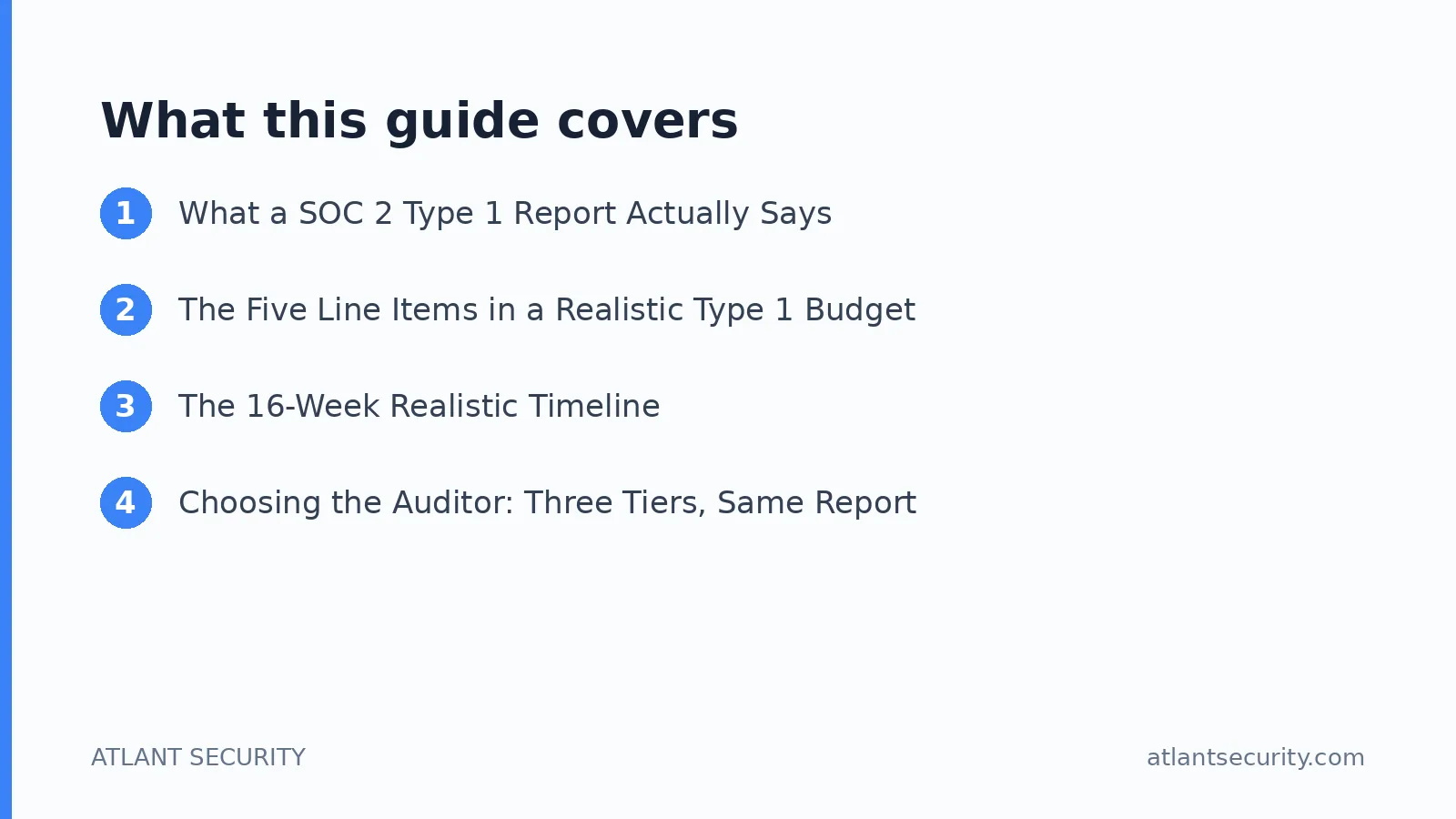
What a SOC 2 Type 1 Report Actually Says
A SOC 2 Type 1 report is a CPA firm's signed opinion that, as of a single specific date, your stated security controls are designed appropriately to meet the AICPA Trust Services Criteria you selected. Read that sentence twice. Two parts of it are usually misunderstood by procurement teams and by vendors selling automation.
First, "as of a single specific date" means a snapshot. The auditor visits, examines your controls, asks for evidence that the controls exist on that date, and issues an opinion. There is no observation window, no testing of operating effectiveness over time. If your access review process exists on the report date because someone ran it the previous afternoon, that counts. The Type 1 does not say the process has been running for six months. That is what Type 2 is for.
Second, "designed appropriately" is a lower bar than "operating effectively." The auditor inspects your policy, sees that it covers the criterion, looks at one or two pieces of evidence that the control exists, and judges whether the design would meet the criterion if it ran as written. The auditor is not testing whether it ran every month. This is why a Type 1 can be issued faster and for less money than a Type 2, and also why some buyers do not accept a Type 1 as a substitute.
There are five Trust Services Criteria you can select for a SOC 2: Security (always required), Availability, Processing Integrity, Confidentiality, and Privacy. Most startups select Security alone for their first Type 1, then add Availability and Confidentiality for the Type 2. A few healthtech and fintech companies add Privacy from the start. Adding criteria adds cost, scope, and time. Each additional criterion in our recent set added roughly $4,000 to $7,000 to the auditor fee and four to six weeks to the timeline.
A Type 1 is valid for twelve months from the report date in the eyes of most procurement teams, although the AICPA does not formally specify a validity period. After twelve months, buyers expect a fresh report. Most clients move directly to Type 2 within that twelve-month window so the second report covers a continuous operating period and does not leave a gap.
Step Two
The Five Line Items in a Realistic Type 1 Budget
Most founders see a vendor's banner ad, expect a single number, and miss the four other line items that determine the all-in cost. Below is the actual breakdown from the 14 Type 1 engagements we worked on recently. Numbers are medians, with the typical range in parentheses.
The auditor fee covers the CPA firm's work: planning, control testing, sample selection, evidence review, exception management, and the report itself. For a Type 1 with the Security criterion only, the median was $22,000. Add Availability and the median moves to $26,000. Add Confidentiality and you are at $30,000. Big-Four-adjacent firms quoted $38,000 to $42,000 for the same scope at the higher end. Boutique CPA firms specializing in SaaS Type 1 quoted $14,000 to $18,000.
The readiness consulting line item is where most companies leak money. Companies that buy a compliance tool and try to do readiness internally without help spent on average 280 internal hours and missed roughly 18 percent of the controls on the first auditor pass. The remediation phase that followed cost more in internal time than the consulting would have cost up front. The companies that hired a fractional CISO or readiness firm at the start spent $12,000 to $24,000 in consulting and roughly half the internal hours.
Compliance tooling is the most contested line item. Vanta, Drata, Secureframe, and Sprinto all advertise "SOC 2 in 30 days." For a 20 person startup with a clean GitHub setup, Google Workspace, and AWS, the year-one cost runs $7,000 to $14,000 depending on the vendor and the discount. The tool is genuinely useful for evidence collection during the audit. It is not magic. Companies that thought it was magic ended up with a tool that had auto-collected evidence for controls they had not yet implemented, then a frantic readiness sprint in weeks 6 to 10.
Internal time is the line item that gets quoted at zero in most pitches and turns out to be the largest in the actual ledger. The median across our 14 engagements was 320 internal hours. At a fully loaded engineering rate of $110 per hour and a founder-equivalent rate of $200 per hour, that lands at roughly $36,000 in internal cost. Companies that ran a tight readiness program landed at 220 hours; companies that started without one landed at 380 to 420.
Remediation is the wildcard. About half the companies in our set spent under $4,000 on remediation - usually buying MFA tokens, a logging service, or a vulnerability scanner they did not have. The other half spent $12,000 to $24,000 on items the readiness assessment turned up: a backup service for the production database, a vendor management platform, a single-sign-on rollout, an endpoint detection product. Plan for $5,000 to $15,000 here unless you already have an exhaustive security stack.
Step Three
The 16-Week Realistic Timeline
The marketing claim is "SOC 2 in 30 days." The reality across our 14 engagements is 14 to 22 weeks from kickoff to issued report, with 16 weeks as the median. The 30-day claim is true if you count only the auditor's testing window after readiness is done. Below is the timeline as we plan it on day one with founders.
Phase 1 is scoping and auditor selection, three weeks. The first decision is which Trust Services Criteria to include. We recommend Security only for a first Type 1 unless your buyers have explicitly asked for Availability or Confidentiality. The second decision is which CPA firm to engage. The third is the report date - the day the report opines on. We typically set this 14 weeks ahead of kickoff so the readiness work has room.
Phase 2 is readiness: weeks 4 through 10. The gap analysis identifies what is missing against the criteria. The control build is when policies are written, processes designed, and tools deployed. Remediation closes any gaps that turn up during evidence collection. This phase consumes about 70 percent of the elapsed timeline and 80 percent of the internal time. Founders who short-change this phase pay for it in week 14 when the auditor flags exceptions.
Phase 3 is evidence collection: weeks 11 through 13. If you are using a compliance tool, this is when its automation pays off. The tool pulls configuration evidence from AWS, Google Workspace, GitHub, and your HRIS. Manual evidence (board minutes approving the security policy, vendor security questionnaires, security training completion records) takes the same time it has always taken. Plan one full day per week of operations time during this phase.
Phase 4 is the audit itself plus the report: weeks 14 through 16. The auditor's fieldwork is typically five to eight business days. The auditor then needs another five to ten business days to draft the report, conduct internal partner review, and issue the signed opinion. We have never seen a credible Type 1 issued faster than seven business days post-fieldwork. If a vendor promises same-day report delivery, the report will not be from a recognized CPA firm.
Step Four
Choosing the Auditor: Three Tiers, Same Report
All SOC 2 reports are issued by CPA firms registered with the AICPA. The opinion language is the same. The Trust Services Criteria are the same. What differs is the firm's reputation, its clientele, the depth of its testing, and what it charges. From a procurement perspective, the report is accepted regardless of which tier issued it - up to a point. Below is the tier breakdown that matters.
Tier A boutique firms are the right choice for a first Type 1 in most cases. They specialize in SaaS, they staff their engagements with senior consultants who have done hundreds of these audits, and they price aggressively to win the relationship. Their reports are crisp and follow the standard AICPA template. Procurement teams at all but the largest enterprise buyers accept them without comment.
Tier B is the sweet spot when you have a Fortune 100 buyer in your pipeline whose vendor risk team will run a quick recognition check on the audit firm. The fee premium of $8,000 to $12,000 over Tier A buys a brand they can find in their internal vendor catalog. We have not seen a procurement team push back on a Tier B audit firm in the last three years.
Tier C (Big Four) is overkill for a Type 1 in 99 percent of cases. The fee delta over Tier B is $15,000 to $40,000 with no procurement-acceptance benefit for a typical enterprise SaaS sale. The exceptions are companies preparing for IPO, companies whose largest customers are global investment banks who explicitly require Big Four audits in their vendor master agreements, and companies in highly regulated industries where the Big Four have established methodology playbooks. If you are not in one of those categories, choose Tier A or B.
A practical tip: when interviewing auditors, ask for two references from companies similar to yours in size and stage, and ask those references three specific questions. How long was your fieldwork? Did the partner stay on the engagement throughout? Were there findings, and how were they handled? The answers tell you more than any pricing comparison.
Step Five
Compliance Tooling: What It Does and Does Not Do
Vanta, Drata, Secureframe, Sprinto, and Tugboat Logic all sell what is called "GRC automation": they connect to your AWS account, your Google Workspace tenant, your GitHub organization, and your HRIS, and they continuously check whether configuration matches a control framework like SOC 2. They generate evidence packages, surface drift, and offer policy templates. Each of them is competent. None of them does everything.
What the tool does well
Continuous configuration checks across cloud and SaaS, evidence packaging for the auditor, policy templates that pass first auditor review with light editing, automated reminders for access reviews and vendor reviews, integration with the auditor's portal so evidence can be shared without email.
What the tool does not do
Make policy decisions for you. Define your data classification scheme. Run your access reviews. Approve vendors. Train your employees. Decide what counts as a security incident in your environment. Choose your auditor. Negotiate the auditor's fee. Stand up missing infrastructure (logging, backup, MFA). All of these still take human judgment and time.
The trap to avoid
Buying the tool, watching the dashboard go from 30 to 95 percent green in a week, and concluding readiness is done. The 95 percent reflects automated configuration checks. The other half of SOC 2 (governance, training, incident response, vendor management, change management documentation) does not show up on those dashboards. Companies that confused dashboard percent with audit readiness ran into walls in week 12.
Across our 14 engagements, six used Vanta, four used Drata, two used Secureframe, one used Sprinto, and one ran without a tool. The companies that used a tool consistently spent less internal time on evidence collection (about 60 hours saved on average) but spent the same total internal time when readiness work is included. The tool moves the work earlier and makes it more visible. It does not eliminate it.
Our recommendation, with the caveat that vendor pricing changes constantly: pick the tool your auditor has the best integration with. The minor feature differences between Vanta, Drata, and Secureframe are dwarfed by the integration depth your auditor has with one of them. Ask the auditor before you sign a tooling contract. The auditor will save you a week of evidence-package back-and-forth.
Step Six
Where the 320 Internal Hours Actually Go
The biggest line in the budget is also the most invisible. Internal time gets tracked sloppily, costed at zero, and remembered as "we worked nights for two months." The numbers below come from time-tracking we ran across the 14 engagements with founders who agreed to log their hours.
| Role | Hours (median) | Where the time goes |
|---|---|---|
| CEO / Founder | 35 | Auditor selection, scoping, board approvals, security policy sign-off, two interview rounds with auditor |
| CTO / VP Engineering | 85 | Control build for production env, change management, access reviews, code review process documentation, vendor evidence |
| Engineering team (collective) | 75 | Tool integrations, IaC for security baselines, evidence runbook, MFA rollout, log forwarding, backup verification |
| Head of Operations / People | 55 | Onboarding-offboarding evidence, training rollout, vendor management process, security awareness program |
| Finance / Legal | 25 | Vendor contracts review, DPA signing, financial controls walkthrough, contract repository setup |
| Compliance / Security lead | 45 | Project management, evidence chasing, auditor liaison, gap remediation tracking, control owner enablement |
The two roles that consistently get under-estimated are the CTO and the head of operations. The CTO bears the largest share because every technical control - access reviews, change management, code review process, infrastructure-as-code, log forwarding - lands on engineering. Operations carries the people-side controls: hiring evidence, training rollout, vendor management. Founders without a dedicated head of operations end up doing this themselves, which usually means it gets done late.
A practical staffing tip: assign one person as the audit project manager. This is not a security person necessarily. It is the person who chases evidence, holds weekly stand-ups, and tells the founder when a deliverable is slipping. Without this role, time leaks at every handoff. With it, the timeline holds.
A second tip: do not assume your engineering team will absorb 75 hours invisibly. Block them off. The most expensive Type 1 timeline overruns we have seen all came from CTOs who promised the founder there would be "no engineering disruption." Engineering disruption is real. Two weeks of part-time work for two engineers is part of the budget.
Step Seven
Four Cases Where Type 1 Is the Wrong Move
Type 1 is the right answer for most growth-stage SaaS startups whose enterprise pipeline includes one to three buyers asking for SOC 2. It is the wrong answer in four scenarios we see repeatedly. The decision tree below is what we walk through on a discovery call.
Case 1: five-plus enterprise prospects asking for Type 2 in the same quarter. The Type 1 satisfies none of them. Each will eventually re-ask for the Type 2. The total cost of doing Type 1 then Type 2 is roughly $75,000 across two engagements; doing Type 2 directly costs $48,000 to $65,000 in a single 12-month engagement. The math says skip Type 1 if the pipeline is loaded.
Case 2: a regulated bank or insurer who hard-codes Type 2 in their vendor policy. Type 1 will not satisfy them. Worse, issuing a Type 1 first signals to procurement that you do not understand the requirement. Skip directly to Type 2 with a written commitment to deliver by a specific date - banks routinely accept the commitment with a security questionnaire as a bridge.
Case 3: an environment so immature that the Type 1 will read as a list of qualifications. A Type 1 with five qualifications is worse than no Type 1 - it documents in writing what is missing. We see this in pre-product-market-fit startups whose engineering team has never run an access review. Spend three months on baseline maturity work first, then start the Type 1.
Case 4: a deadline that is less than 90 days out and immovable. A Type 1 cannot be delivered in 90 days from a cold start. Ninety days is barely enough time for readiness, let alone evidence and audit. The right move here is a third-party security attestation letter as a two-week bridge while the Type 1 runs in parallel. Some procurement teams accept this; some do not. The conversation about which one you have should happen on day two.
If none of these four cases applies, Type 1 is almost always the right move. It satisfies the largest number of enterprise buyers per dollar spent, sets up a clean Type 2 the following year, and forces the security maturity work that you would have to do for Type 2 anyway.
How Atlant Security Helps
SOC 2 Type 1 Readiness, Without the Surprises
We have walked 14 startups through Type 1 in the last twelve months. We do the readiness work, prepare the evidence, manage the auditor relationship, and stand up the missing pieces of your security program before they become audit findings. Founders work directly with senior consultants, not juniors learning on the job.
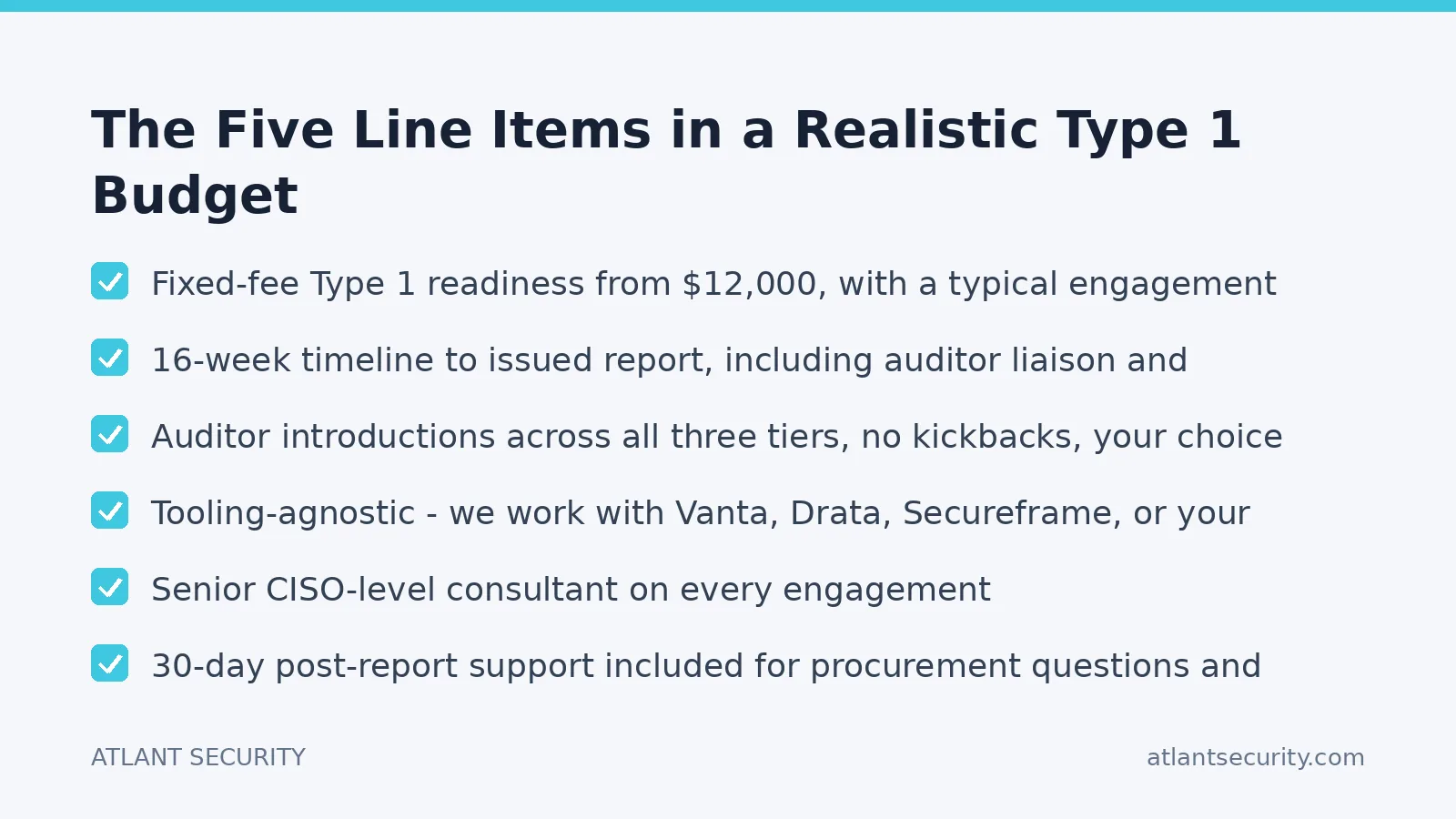
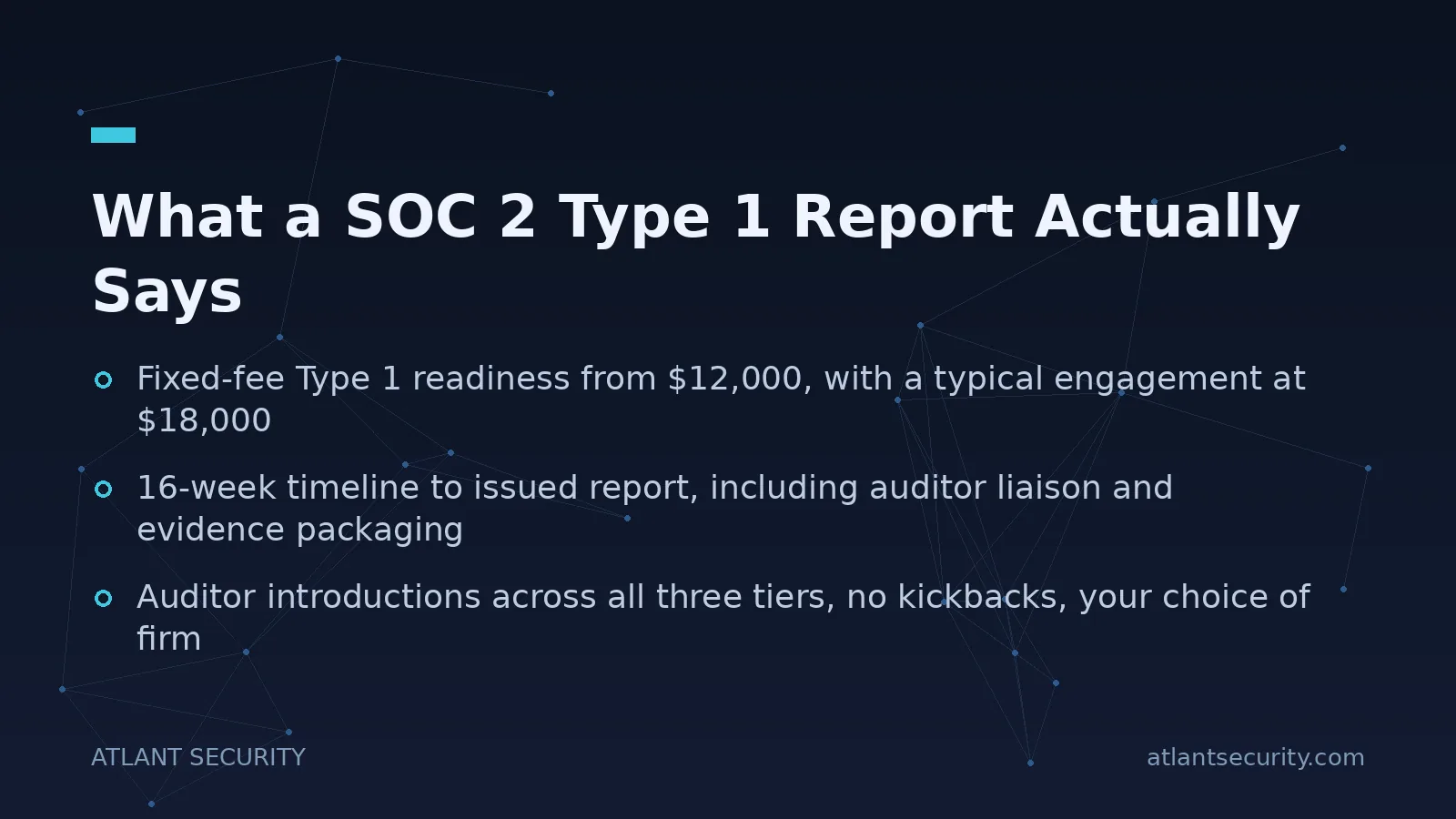
- Fixed-fee Type 1 readiness from $12,000, with a typical engagement at $18,000
- 16-week timeline to issued report, including auditor liaison and evidence packaging
- Auditor introductions across all three tiers, no kickbacks, your choice of firm
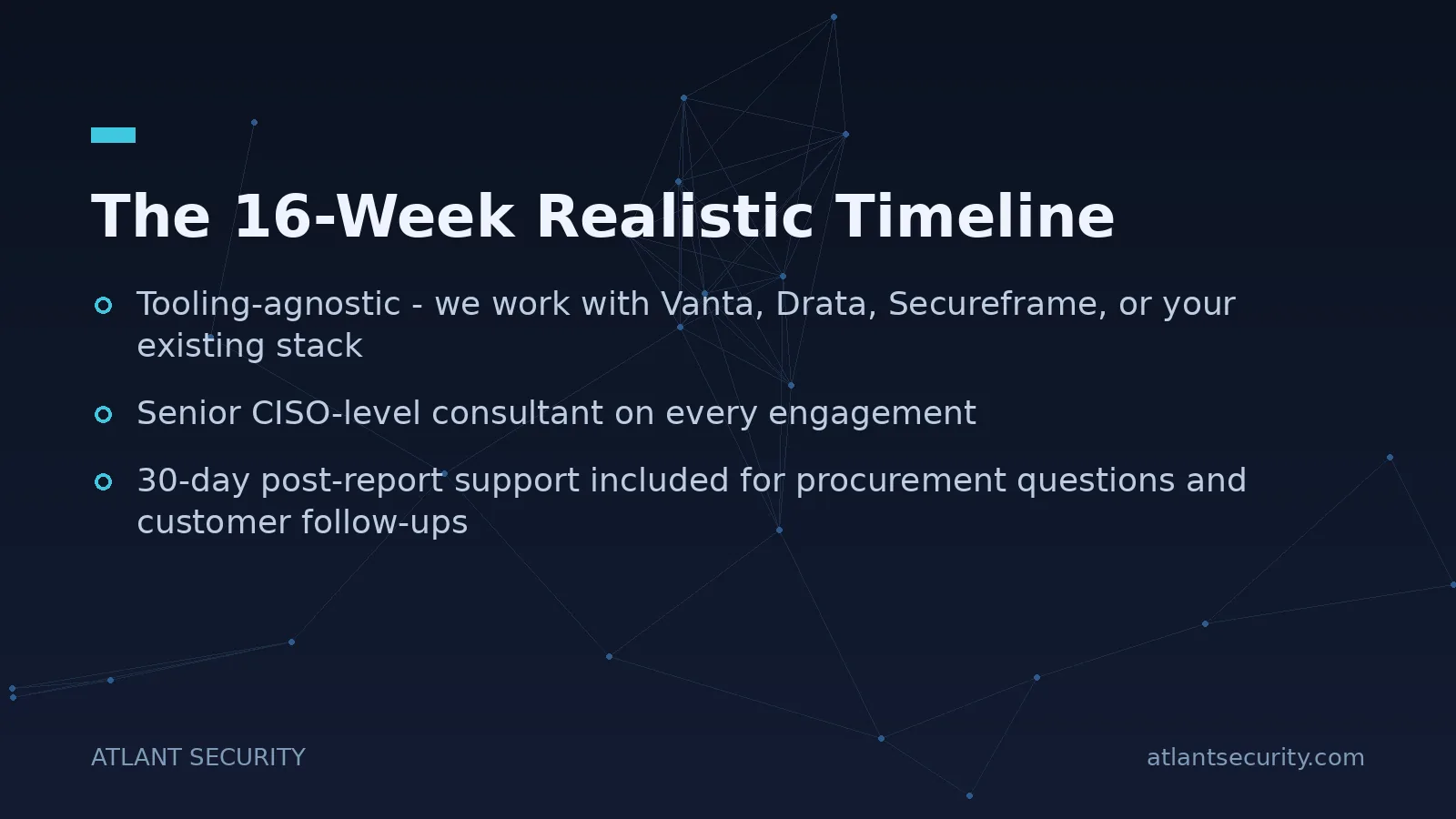
- Tooling-agnostic - we work with Vanta, Drata, Secureframe, or your existing stack
- Senior CISO-level consultant on every engagement
- 30-day post-report support included for procurement questions and customer follow-ups
Frequently Asked
Questions Founders Ask Before They Sign the SOW
Can we really do SOC 2 Type 1 in 30 days?
Only if the readiness work is already done. The "30 days" pitch counts the auditor's testing window after readiness, not the elapsed time from your first call about SOC 2. Realistically, from cold start to issued Type 1 report, plan 14 to 22 weeks. Companies that try to compress this aggressively either issue a Type 1 with multiple qualifications or fail audit and have to start over.
Do we need to use Vanta, Drata, or Secureframe?
No. About 70 percent of our clients do, and the tool is genuinely useful for evidence collection and continuous monitoring. The remaining 30 percent did Type 1 with spreadsheets, a documentation site, and disciplined evidence runbooks. The tooling decision is independent of the audit decision. Choose the tool your auditor integrates with most cleanly, or skip it if you have a security engineer who prefers manual evidence.
Will a Type 1 satisfy a Fortune 500 procurement team?
Usually yes, with one caveat. Most Fortune 500 procurement teams accept a Type 1 as evidence of design adequacy and ask when Type 2 is coming. The buyer's contract may require Type 2 within 9 to 12 months, which is a reasonable commitment to make at signing. The exceptions are regulated banks and insurers who hard-code Type 2 in their vendor policies; for those, Type 1 is not enough and you should plan Type 2 directly.
What is the cheapest way to do a credible Type 1?
Tier A boutique auditor at $14,000 to $18,000, no compliance tool (use a documentation site), readiness done internally with a fractional CISO at $8,000 to $12,000, no remediation buffer. All-in around $25,000 plus internal time. We have done this twice recently and both clients passed audit. It requires discipline. The risk is that you discover infrastructure gaps during evidence collection that take longer to fix without tooling support.
How long is a Type 1 valid for?
The AICPA does not specify a formal validity period. Procurement teams treat the Type 1 as valid for twelve months from the report date. After twelve months, expect a fresh report request. Most clients move directly to Type 2 within that twelve-month window so the Type 2 covers a continuous operating period and there is no gap in attestation between reports.
What happens if we get qualifications on our Type 1?
A qualified opinion lists specific control deficiencies and reduces the report's weight with procurement. Two or three minor qualifications are common in first-time Type 1 reports and rarely block deals. Five or more, or any qualification on the Security criterion as a whole, usually causes procurement to come back with follow-up questions. The fix is targeted remediation followed by a re-issued report or, more commonly, transitioning into Type 2 with the qualifications addressed during the operating period.
If you are reading this with a quote in hand and a procurement deadline on the calendar, the right next step is to validate the quote against the five line items in this post. Pull out the auditor fee, separate the readiness consulting, isolate the tooling, estimate your internal time honestly, and add a remediation buffer. The all-in number is what matters, not the auditor fee.
If you do not have a quote yet, start with auditor selection. Two boutique firms and one mid-market firm, three discovery calls of 45 minutes each, then choose. The auditor's preferred control list will shape every other decision. Buying tools or starting readiness work before this step is the single most common reason engagements run long.
Have a Type 1 budget that needs validation? Book a 30-minute consultation or email alexander@atlantsecurity.com directly.
Related services from Atlant Security: SOC 2 Readiness, Cybersecurity for Startups, IT Security Audit. Book a discovery call to discuss your specific situation.
