SOC 2 Cost Breakdown: What You Will Actually Spend in 2026
Alexander Sverdlov
Security Analyst

One of the most common questions I hear from founders is a simple one: "How much is SOC 2 going to cost us?" For many B2B companies it comes up the moment an enterprise prospect asks for a SOC 2 report before they will sign, and suddenly compliance becomes a deal-blocker rather than an afterthought.
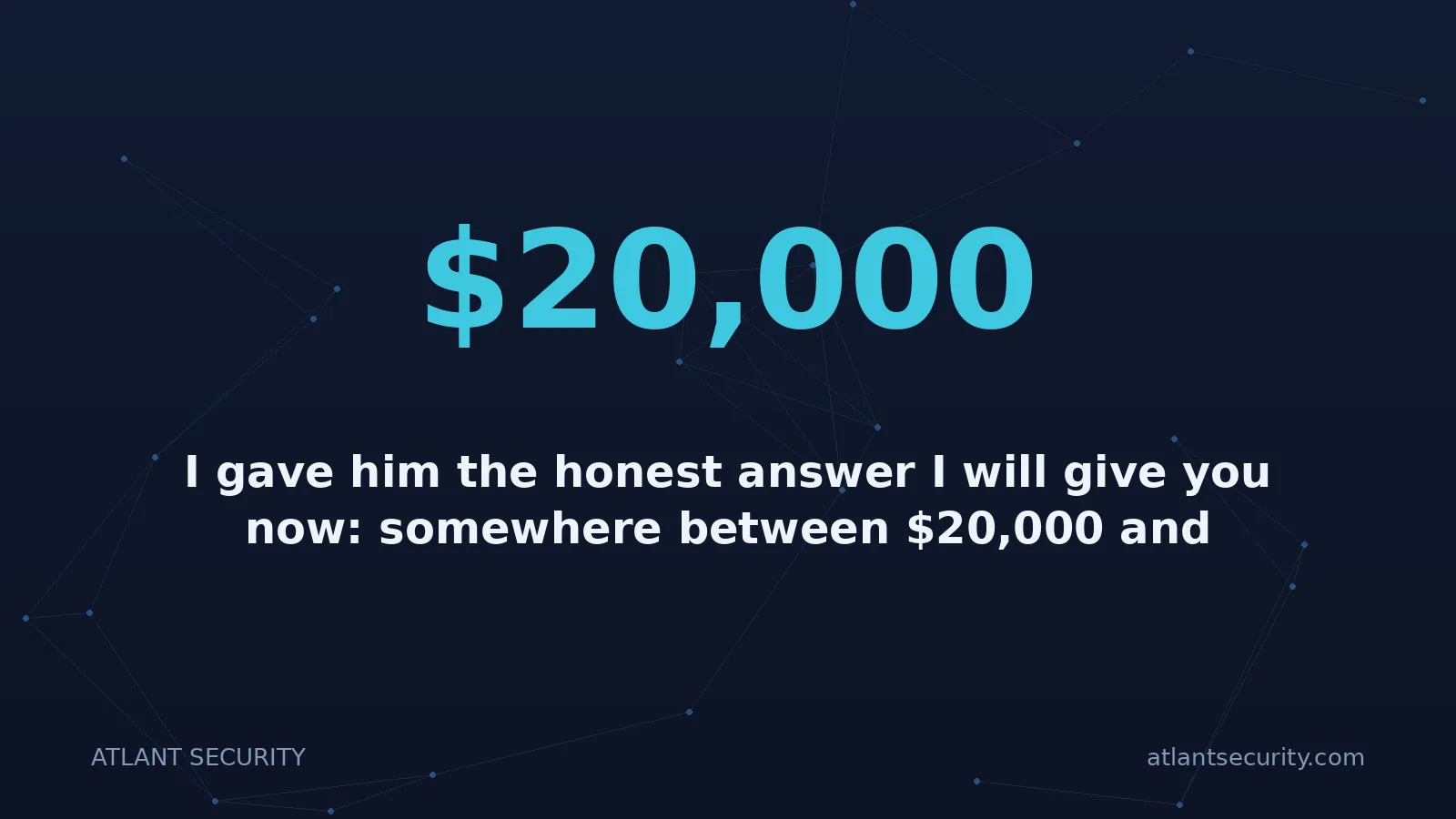
I gave him the honest answer I will give you now: somewhere between $20,000 and $300,000+ in the first year, depending on where you are starting from. That range is enormous, and that is precisely why this article exists. The SOC 2 cost question deserves a real answer - not a vague "it depends" hand-wave.
After guiding hundreds of companies through SOC 2 at Atlant Security, I have seen exactly where money goes, where companies overspend, and where the hidden costs lurk. This is the breakdown I wish someone had given me when I started doing compliance work a decade ago.
Key Takeaways - SOC 2 Cost at a Glance
First-year total cost: $20,000-$150,000 for startups, $60,000-$300,000+ for enterprises
Biggest single expense: Gap remediation and tooling (40-60% of total cost)
Auditor fees alone: $15,000-$80,000 depending on scope and firm
Ongoing annual cost: $18,000-$120,000 for Type II renewals and maintenance
Typical ROI timeline: 6-12 months, often paid back by a single enterprise deal
Cost Component #1
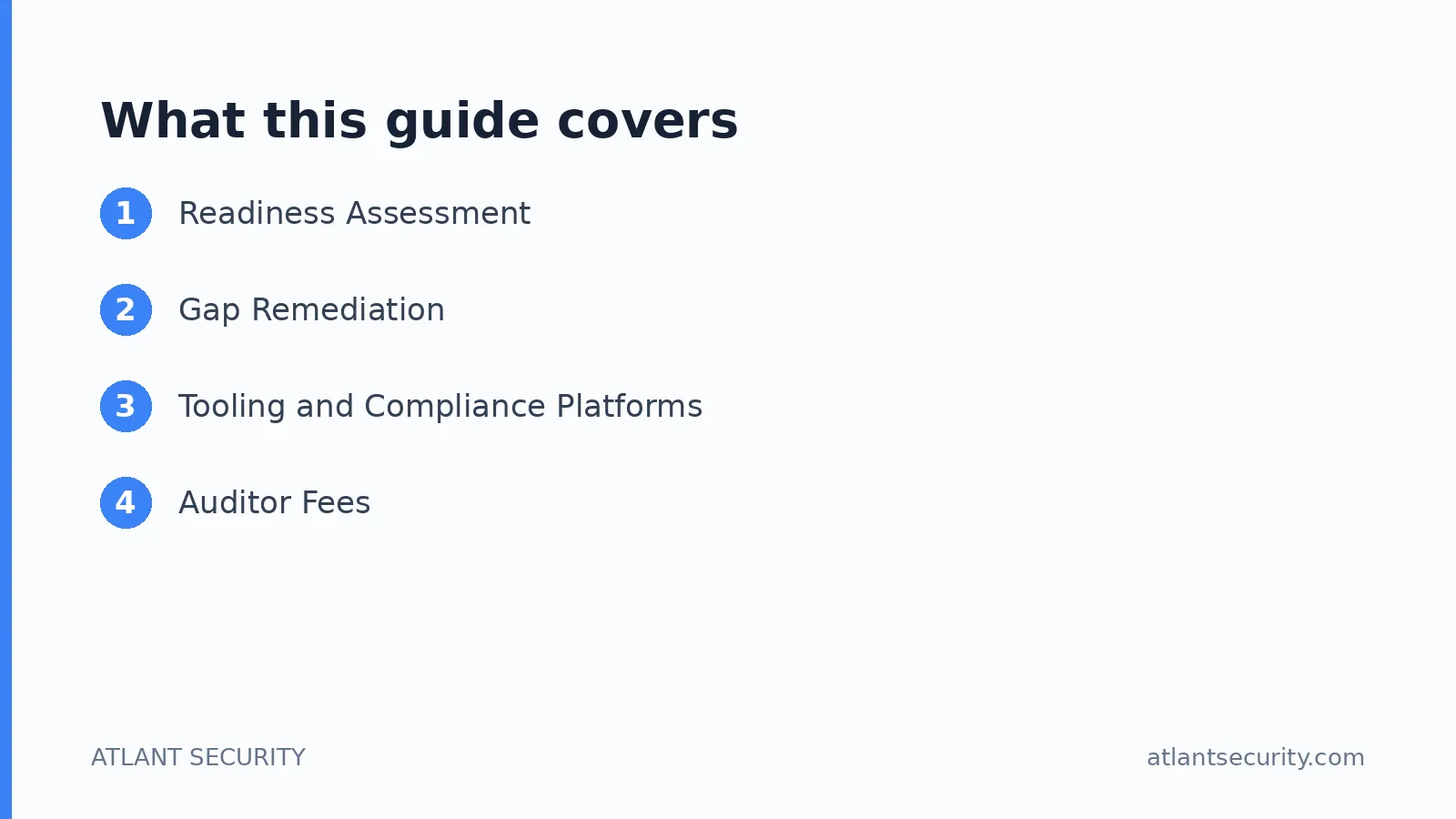
Readiness Assessment
A readiness assessment is the diagnostic step. A qualified consultant reviews your current security posture, maps it against SOC 2 Trust Services Criteria, and tells you exactly where the gaps are. Think of it as the MRI before surgery - you do not want to skip it.
Typical SOC 2 readiness assessment cost:
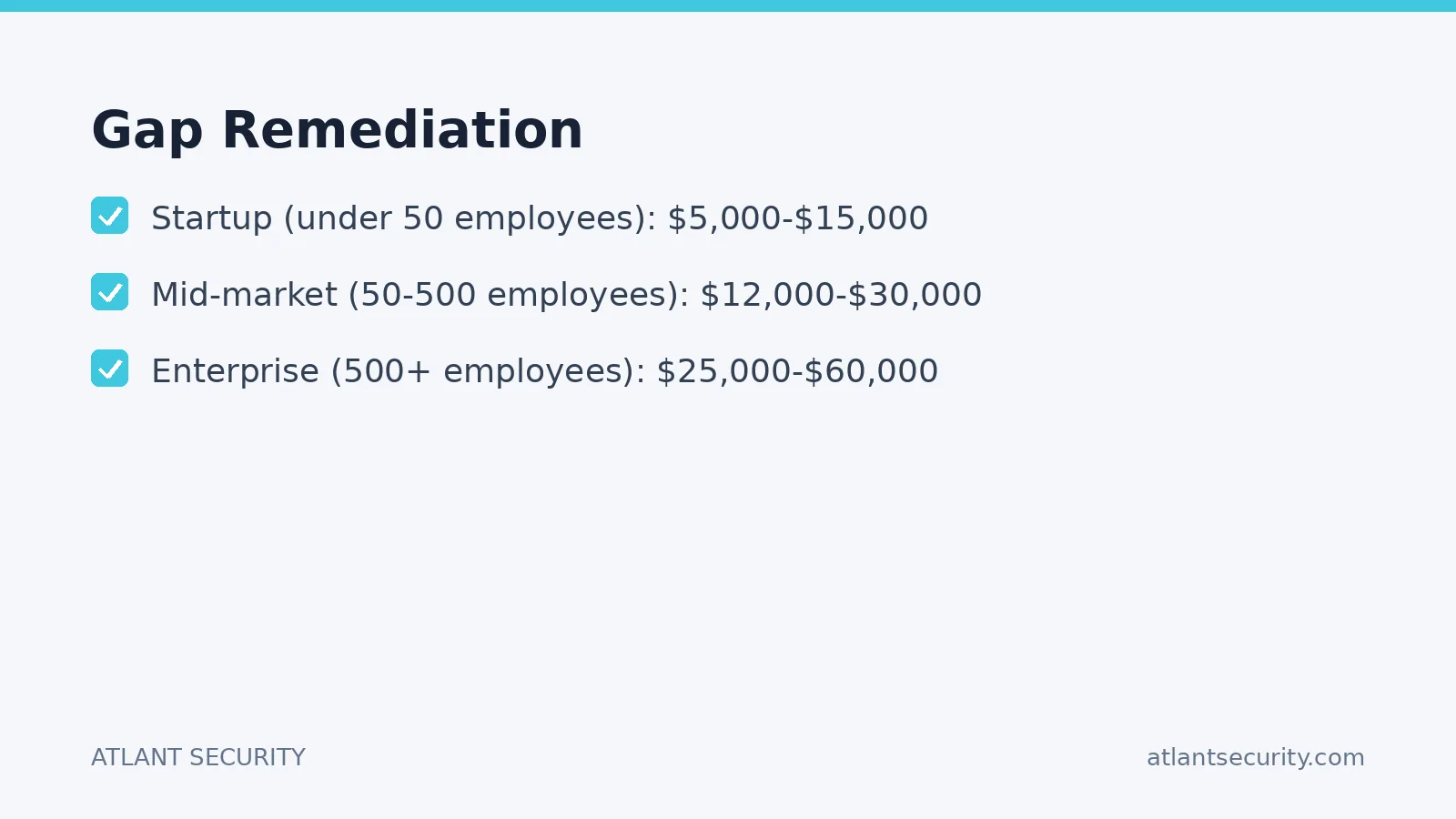
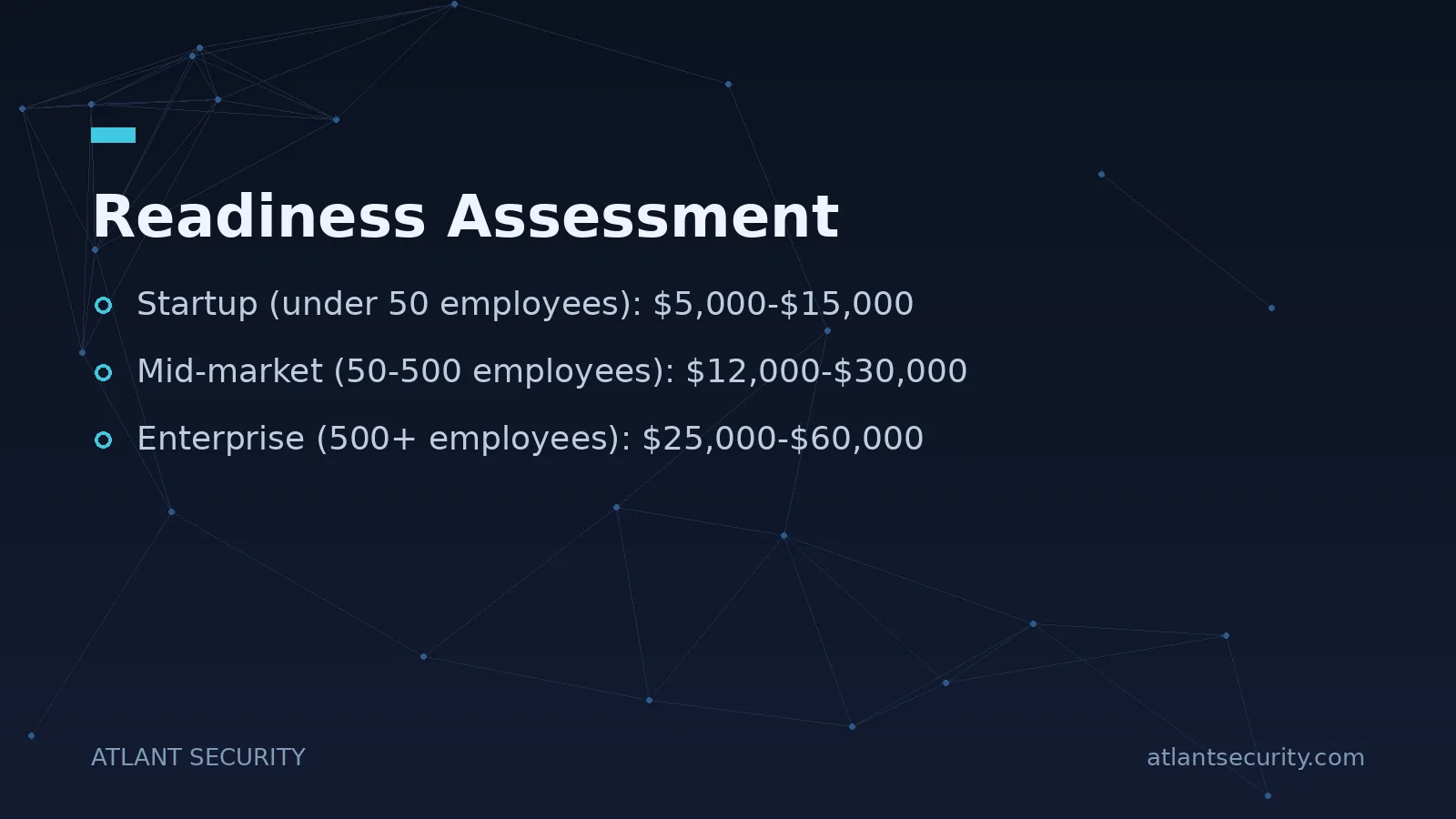
- Startup (under 50 employees): $5,000-$15,000
- Mid-market (50-500 employees): $12,000-$30,000
- Enterprise (500+ employees): $25,000-$60,000
The range depends on how many Trust Services Criteria you are pursuing (Security alone vs. Security + Availability + Confidentiality), how many systems are in scope, and whether your infrastructure is straightforward cloud or a hybrid mess of legacy systems and SaaS integrations.
Some firms bundle readiness into their consulting engagement. At Atlant Security, we typically deliver a readiness assessment within 2-4 weeks, producing a gap report, remediation roadmap, and realistic timeline. This alone can save you tens of thousands by preventing you from over-scoping the audit or buying tools you do not need.
Cost Component #2
Gap Remediation
This is where the real money goes. Readiness tells you what is broken; remediation is fixing it. For most companies, gap remediation represents 40-60% of total first-year SOC 2 cost.
Common remediation work includes:
- Writing policies and procedures: $3,000-$15,000 if outsourced (information security policy, acceptable use, incident response, change management, vendor management, etc.)
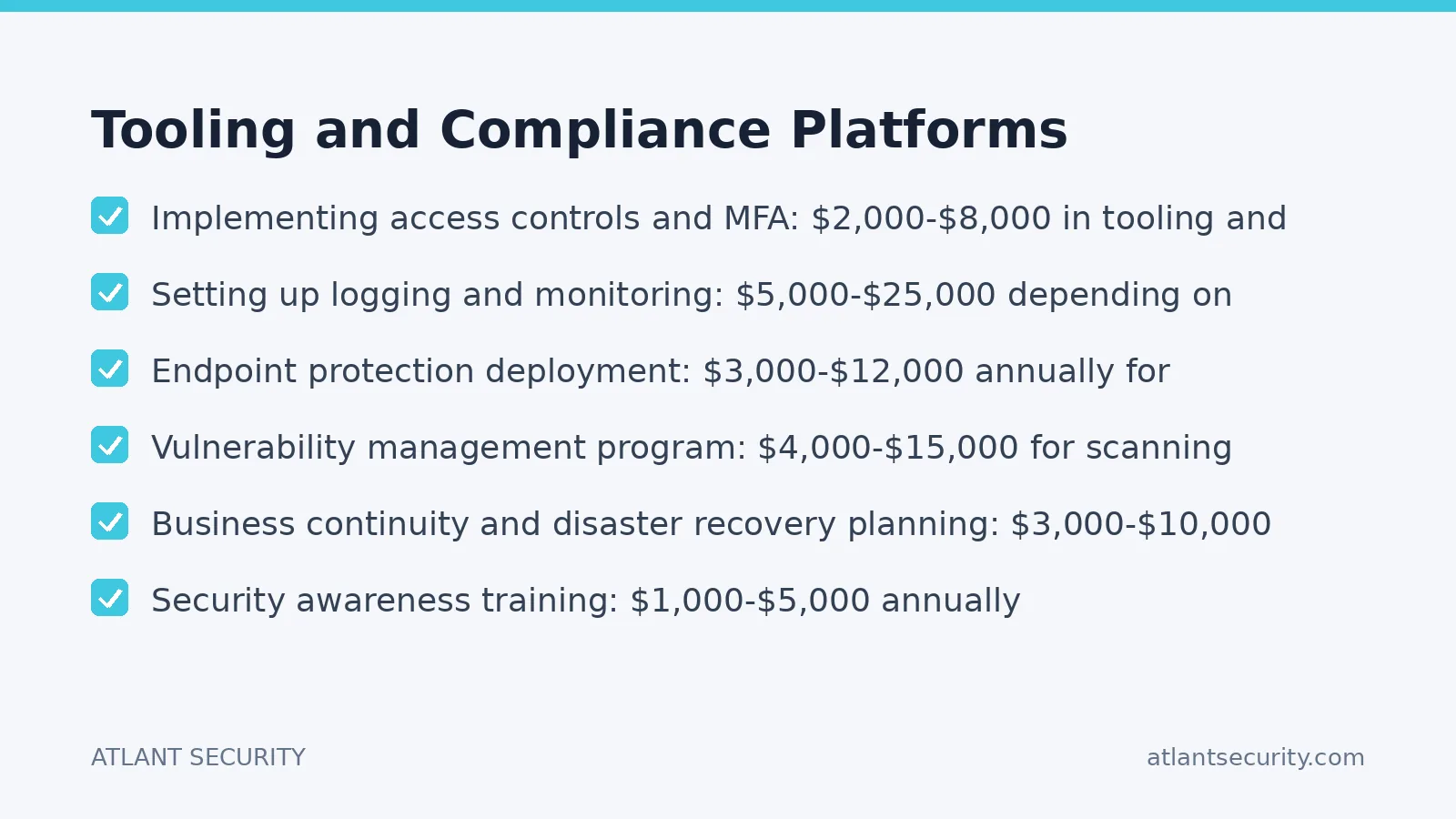
- Implementing access controls and MFA: $2,000-$8,000 in tooling and configuration time
- Setting up logging and monitoring: $5,000-$25,000 depending on whether you need a SIEM or can rely on native cloud logging
- Endpoint protection deployment: $3,000-$12,000 annually for EDR/MDR solutions
- Vulnerability management program: $4,000-$15,000 for scanning tools and processes
- Business continuity and disaster recovery planning: $3,000-$10,000
- Security awareness training: $1,000-$5,000 annually
- Vendor risk management program: $2,000-$8,000 to establish
Total remediation cost:
- Startup with decent security hygiene: $8,000-$30,000
- Mid-market with gaps: $25,000-$80,000
- Enterprise with legacy systems: $50,000-$200,000+
If you already have an IT security audit program and basic controls in place, remediation costs drop significantly. A company that has been doing security work but never formalized it for an auditor might spend $10,000-$20,000 on remediation. A company starting from scratch could spend ten times that.
Cost Component #3
Tooling and Compliance Platforms
SOC 2 requires evidence. Lots of it. You need tools that generate, collect, and organize that evidence. There are two approaches: stitch together individual tools, or use an integrated compliance platform.
Individual security tools (annual costs):
- MDM (mobile device management): $3-$12 per device/month
- EDR/antivirus: $5-$18 per endpoint/month
- SIEM or log management: $5,000-$40,000/year
- Vulnerability scanner: $3,000-$15,000/year
- Password manager (enterprise): $3-$8 per user/month
- Security awareness training platform: $1,000-$5,000/year
- Backup and DR tooling: $2,000-$15,000/year
Compliance automation platforms (Vanta, Drata, Secureframe, Sprinto, etc.):
- Startup tier: $10,000-$20,000/year
- Mid-market tier: $18,000-$35,000/year
- Enterprise tier: $30,000-$60,000+/year
These platforms automate evidence collection, policy management, and continuous monitoring. They can reduce consultant hours and make audits smoother. But they are not magic - you still need someone who understands the controls to configure them properly and interpret the results. A platform without expertise is like buying a treadmill and expecting it to run for you.
Watch Out: Platform Lock-In
Most compliance platforms require annual contracts. Before committing $15,000+/year, make sure the platform integrates with your actual tech stack. We have seen companies buy Vanta only to discover it does not support their self-hosted GitLab instance or custom cloud setup - then end up collecting evidence manually anyway.
Cost Component #4
Auditor Fees
The audit itself is performed by a licensed CPA firm. This is a non-negotiable cost - you cannot self-certify SOC 2. The auditor examines your controls, tests them, and issues the official SOC 2 report.
SOC 2 Type I audit cost (point-in-time):
- Simple scope (Security only, cloud-native): $10,000-$20,000
- Moderate scope (2-3 TSC, some complexity): $18,000-$35,000
- Complex scope (all 5 TSC, hybrid infrastructure): $30,000-$60,000
SOC 2 Type II audit cost (observation period, typically 6-12 months):
- Simple scope: $15,000-$30,000
- Moderate scope: $25,000-$50,000
- Complex scope: $40,000-$80,000+
Auditor fees vary based on the firm’s reputation, your industry, and how audit-ready your evidence is. A well-prepared company with organized evidence can shave 20-30% off auditor fees because the auditor spends less time requesting clarifications and re-testing controls.
Most enterprises skip Type I entirely and go straight to Type II, since that is what sophisticated buyers demand. A Type I report is useful mainly as a milestone for startups that need to show progress quickly while the observation period for Type II runs.
Cost Component #5
Ongoing Maintenance and Annual Renewal
SOC 2 is not a one-time expense. Type II reports expire every 12 months. You need to maintain controls continuously and get re-audited annually. Year-two costs are typically 40-60% lower than year one because the heavy lifting (policies, tooling, remediation) is already done.
Annual ongoing SOC 2 costs:
- Compliance platform renewal: $10,000-$35,000/year
- Auditor fees (Type II renewal): $12,000-$60,000/year
- Internal staff time for evidence collection: 100-400 hours/year (valued at $5,000-$40,000)
- Security tooling renewals: $5,000-$30,000/year
- Policy updates and training refreshes: $2,000-$8,000/year
- Consultant retainer (optional): $5,000-$20,000/year
Total annual maintenance: $18,000-$120,000 depending on company size and complexity. Having a virtual CISO manage your compliance program can actually reduce these costs by preventing scope creep and keeping your team focused on what the auditor actually needs.
By Company Size
Total SOC 2 Cost Breakdown
Here is what the full first-year SOC 2 cost looks like across different company sizes, assuming a Type II engagement with Security as the primary Trust Services Criteria:
| Cost Component | Startup (<50 emp) | Mid-Market (50-500) | Enterprise (500+) |
|---|---|---|---|
| Readiness Assessment | $5,000-$15,000 | $12,000-$30,000 | $25,000-$60,000 |
| Gap Remediation | $8,000-$30,000 | $25,000-$80,000 | $50,000-$200,000 |
| Tooling / Platform | $8,000-$20,000 | $15,000-$40,000 | $25,000-$60,000 |
| Auditor Fees (Type II) | $15,000-$30,000 | $25,000-$50,000 | $40,000-$80,000 |
| Internal Staff Time | $3,000-$10,000 | $10,000-$30,000 | $20,000-$60,000 |
| TOTAL (Year 1) | $39,000-$105,000 | $87,000-$230,000 | $160,000-$460,000 |
Note: Ranges reflect 2026 U.S. market pricing. Companies with existing security programs will fall toward the lower end. Companies starting from scratch with complex environments will be at the upper end.
Budget Killers
Hidden SOC 2 Costs People Forget
The line items above are the obvious ones. Here are the costs that blindside people:
1. Opportunity cost of staff time. Your engineers and IT team will spend 150-500 hours on SOC 2 in the first year. At a fully-loaded engineering cost of $100-$180/hour, that is $15,000-$90,000 of productivity diverted from product development. This is the single largest hidden SOC 2 cost, and almost nobody budgets for it.
2. Scope creep. You start with Security-only scope, then a prospect says they need Availability and Confidentiality too. Adding Trust Services Criteria mid-engagement can increase auditor fees by 30-50% and require additional controls you had not planned for.
3. Remediation surprises. The readiness assessment finds things you did not know about. It is common for an assessment to uncover an exposure such as cloud storage that has been publicly accessible. Fixing the misconfiguration itself is usually cheap; the incident investigation, customer notifications, and legal review are not. Budget $5,000-$15,000 as a contingency.
4. Legal review of policies. Your security policies may need legal review, especially if you handle PII, PHI, or operate in regulated industries. Legal counsel for policy review runs $3,000-$10,000.
5. Penetration testing. While not strictly required for SOC 2, most auditors expect it and most enterprise customers require it alongside your SOC 2 report. Annual penetration tests cost $8,000-$30,000 depending on scope.
6. Contract delays and penalties. If your SOC 2 timeline slips (and it often does), you may miss deadlines in customer contracts. Enterprise agreements sometimes include a compliance deadline, and missing it can give the buyer leverage to renegotiate terms or delay the deal.
7. Cyber insurance premium adjustments. Some insurers will reassess your premium once you get SOC 2 (usually downward), but the reassessment process itself can take time and administrative effort. Budget $1,000-$3,000 for broker time and paperwork.
Approach Comparison
DIY vs. Consultant vs. Platform: Which Path Costs What?
There are three basic approaches to SOC 2 compliance, each with different cost profiles, timelines, and risk levels:
| Factor | DIY (Internal Only) | Consultant-Led | Platform + Consultant |
|---|---|---|---|
| First-Year Cost | $20,000-$60,000 | $50,000-$180,000 | $60,000-$200,000 |
| Hidden Staff Cost | $30,000-$90,000 | $10,000-$30,000 | $8,000-$20,000 |
| Timeline to Type II | 12-18 months | 6-12 months | 4-9 months |
| Risk of Audit Failure | High | Low | Low |
| Annual Renewal Cost | $15,000-$45,000 | $20,000-$60,000 | $25,000-$70,000 |
| Best For | Teams with security expertise in-house | Companies needing guidance and speed | Fastest path with ongoing automation |
| True Total Cost (incl. staff time) | $50,000-$150,000 | $60,000-$210,000 | $68,000-$220,000 |
The DIY path looks cheapest on paper but almost always ends up costing more when you factor in staff time, rework, and the risk of audit exceptions. We have seen DIY attempts take 18+ months and still produce reports with qualified opinions - which is arguably worse than having no report at all.
The consultant-led approach is what we recommend for most companies. You get expert guidance, a clear timeline, and someone who has done this dozens of times managing the process. At Atlant Security, we typically pair our consulting with the client's choice of compliance platform, giving you the best of both worlds without double-paying for overlapping capabilities.
Pro Tip: Consultant + Platform Hybrid
The most cost-effective approach for mid-market companies is to hire a consultant for the readiness assessment and remediation phase, then use a compliance platform for ongoing evidence collection and monitoring. This front-loads expert guidance where it matters most and automates the repetitive maintenance work. First-year cost: $60,000-$120,000. Annual renewal: $25,000-$50,000.
The Business Case
ROI of SOC 2: Why the Cost Pays for Itself
SOC 2 is an expense. But it is also one of the few compliance investments with a measurable, often dramatic return. Here is how:
Deals won. This is the big one. Enterprise buyers increasingly require SOC 2 Type II as a condition of procurement. Compliance certifications are now a routine part of enterprise vendor selection. The average enterprise SaaS deal is $120,000-$500,000 annually. Winning even one deal that would have been lost without SOC 2 pays for the entire compliance program.
Shorter sales cycles. Companies with SOC 2 reports consistently report 30-40% shorter sales cycles for enterprise deals. Without a report, you spend weeks going back and forth with vendor security questionnaires. With one, you hand over the report and move to contract negotiation. That acceleration translates directly into revenue.
Cyber insurance savings. SOC 2 compliance can reduce cyber insurance premiums by 10-25%. For a company paying $30,000-$80,000 annually in cyber insurance, that is $3,000-$20,000 in annual savings. Over a five-year period, insurance savings alone can offset a significant portion of your SOC 2 cost.
Reduced breach risk. The controls you implement for SOC 2 actually make you more secure. The average cost of a data breach in 2025 was $4.88 million (IBM). Even a modest reduction in breach probability has an enormous expected value.
Competitive differentiation. In crowded SaaS markets, SOC 2 is a trust signal. When a prospect is choosing between you and a competitor, having a clean SOC 2 Type II report tips the scale. Several of our clients have told us their SOC 2 badge became the single most effective element on their security page.
Higher valuation at fundraising or exit. Investors and acquirers view SOC 2 as a sign of operational maturity. It reduces due diligence friction and can increase valuation multiples, especially for B2B SaaS companies, where a mature compliance program can be a meaningful factor during a funding round or acquisition.
Quick ROI Math
First-year SOC 2 cost (mid-market): ~$100,000
One enterprise deal unlocked: $150,000-$500,000/year
Insurance savings: $5,000-$15,000/year
Faster sales cycle value: $20,000-$80,000 in accelerated revenue
Payback period: 3-9 months for most B2B companies
Practical Advice
How to Reduce Your SOC 2 Cost Without Cutting Corners
1. Start with the minimum viable scope. Begin with Security (the only required TSC). Add Availability, Confidentiality, Processing Integrity, or Privacy only when customers specifically require them. Each additional criterion adds 15-25% to audit costs.
2. Get a readiness assessment before signing with an auditor. An auditor charges by the hour. Every gap they find during the audit is time (and money) you are paying them to document your failures. A readiness assessment with a qualified consultant ensures you fix issues before the meter starts running.
3. Negotiate auditor fees. CPA firms have different rate structures. Get quotes from at least three auditors. Smaller regional firms charge $12,000-$25,000 for a straightforward Type II; Big Four-adjacent firms may charge $40,000-$80,000 for the same scope.
4. Use a compliance platform strategically. Do not buy a platform just because a vendor gave a compelling demo. Evaluate whether your tech stack is fully supported. If you only have 20 employees and a simple AWS setup, you may not need a $15,000/year platform - spreadsheets and a good consultant might suffice.
5. Consolidate security tooling. Many companies buy overlapping tools. Audit your existing stack before adding new ones. You might already have logging, endpoint protection, and MFA built into your Microsoft 365 E5 or Google Workspace Enterprise license.
6. Invest in a vCISO. A virtual CISO costs $3,000-$12,000/month and can manage the entire SOC 2 program, saving you from hiring a full-time compliance manager at $130,000-$180,000/year. For most companies under 500 employees, a vCISO is the most cost-effective leadership layer for compliance.
Common Questions
SOC 2 Cost FAQ
How much does SOC 2 cost for a small startup?
For a startup with fewer than 50 employees and a cloud-native stack, expect $20,000-$60,000 in direct costs for a Type I report, or $40,000-$105,000 for Type II including tooling and remediation. Factor in another $15,000-$50,000 in staff time and opportunity cost.
Is SOC 2 Type I worth the money, or should I go straight to Type II?
Type I is a point-in-time snapshot and costs less ($10,000-$25,000 for the audit alone). It is useful as an interim deliverable to show prospects you are actively working toward compliance. However, most enterprise buyers require Type II, so budget for that as your end goal. Some companies skip Type I entirely and go direct to Type II to avoid paying for two audits.
Can I do SOC 2 without hiring a consultant?
Yes, but it is risky unless you have experienced compliance or security professionals on staff. The DIY path takes longer, has higher audit failure risk, and the hidden cost of staff time often exceeds what you would have paid a consultant. If your budget is truly constrained, a compliance platform plus a few hours of consulting for the readiness phase is a reasonable compromise.
How long does SOC 2 compliance take?
With a consultant, most companies achieve Type I readiness in 2-4 months. Type II requires a 6-12 month observation period after controls are in place. End to end, expect 8-15 months for a Type II report. DIY timelines are typically 12-18 months.
Do compliance platforms like Vanta or Drata replace consultants?
No. Platforms automate evidence collection and monitoring, but they do not tell you which controls to implement, how to scope your audit, or how to remediate gaps. Think of a platform as the operating system and a consultant as the pilot. You need both for complex environments, though very simple setups with knowledgeable teams can get by with a platform alone.
What is the ongoing annual cost of maintaining SOC 2?
$18,000-$120,000 per year, covering auditor fees for renewal, compliance platform subscriptions, security tool renewals, staff time, and periodic policy updates. Year-two costs are typically 40-60% lower than year one.
Does SOC 2 actually help win deals?
Absolutely. In our experience, B2B SaaS companies that achieve SOC 2 Type II see a measurable increase in enterprise pipeline conversion. Many of our clients point to specific deals - worth $100,000-$500,000+ annually - that would not have closed without a current SOC 2 report. It is one of the highest-ROI compliance investments available.
How does SOC 2 cost compare to ISO 27001?
ISO 27001 certification typically costs 20-40% more than SOC 2 in the first year due to more extensive documentation requirements and a formal certification body audit (vs. a CPA firm for SOC 2). However, ISO 27001 is more recognized internationally. Many companies that sell globally pursue both, often leveraging overlapping controls to reduce the combined cost by 30-40%.
The SOC 2 cost question does not have a single answer, but it does have a clear framework. Know your scope. Get a readiness assessment. Budget for remediation and staff time. Choose the right mix of consultant support and tooling. And keep your eye on the ROI - because for most B2B companies, SOC 2 pays for itself faster than almost any other compliance investment.
"SOC 2 is not a cost center. It is a revenue enabler disguised as a compliance project."
Published: March 2026 · Author: Alexander Sverdlov
This article is for informational purposes only and does not constitute legal or professional advice. Cost ranges reflect 2026 U.S. market estimates and may vary based on scope, geography, infrastructure complexity, and consultant or auditor selection. Organizations should evaluate providers based on their specific needs and circumstances.

Alexander Sverdlov
Founder of Atlant Security. Author of 2 information security books, cybersecurity speaker at the largest cybersecurity conferences in Asia and a United Nations conference panelist. Former Microsoft security consulting team member, external cybersecurity consultant at the Emirates Nuclear Energy Corporation.