

We have probably seen your problem before. Our smallest client had eight employees. Our largest secures the nuclear power plant of the United Arab Emirates. Whatever shape yours is, tell us about it and we will tell you how we would fix it.
RIA Compliance · Cybersecurity · May 2026
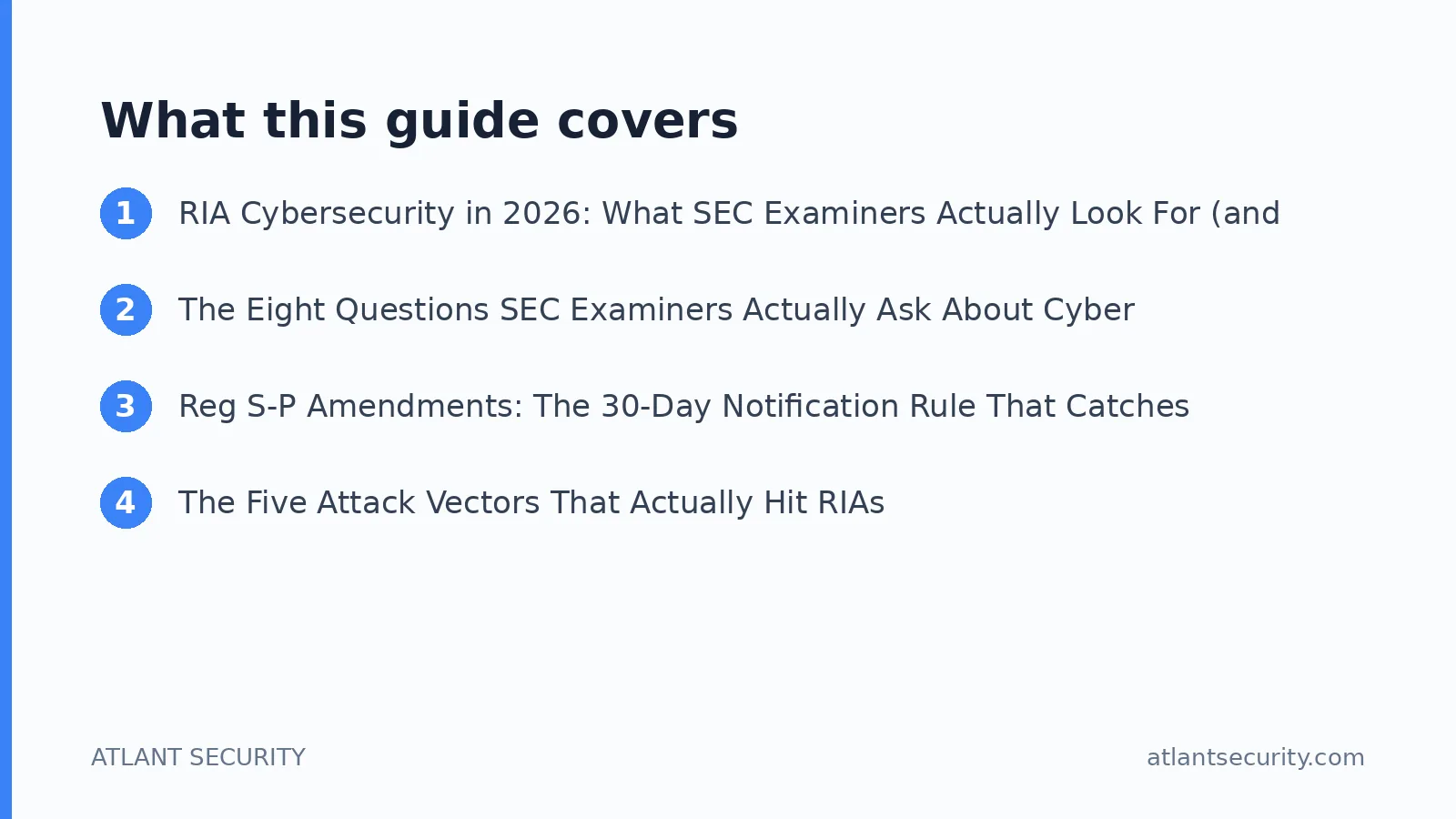
RIA Cybersecurity in 2026: What SEC Examiners Actually Look For (and How to Pass Without Drama)
A practical guide for Principals and Chief Compliance Officers at Registered Investment Advisers. What changed in Reg S-P, why your last cyber audit may have given you a false sense of security, and the 12-item checklist that decides whether the next SEC exam is a routine visit or a 90-day remediation order.
Key Takeaways
- Reg S-P amendments that took effect in 2024 require RIAs to notify affected individuals of a breach within 30 days, with documented incident response procedures and vendor oversight. Most RIAs we work with are not actually compliant; they just have not been examined yet.
- SEC examiners now ask the same eight cyber questions in nearly every exam. None of them are about firewalls or antivirus. They are about governance, vendor oversight, incident response, and the CCO's actual day-to-day program management.
- The $1.2M median wire fraud loss at RIAs in 2025 came from social engineering of client wire instructions, not from technical compromise. Your firewall did not let you down; your callback procedure did.
- Custodian relationships (Schwab, Fidelity, Pershing) carry contractual security obligations that flow down to you. If you have not read the latest version of your custodian's vendor security expectations recently, you are exposed.
- For a 25-person RIA, a genuinely defensible cybersecurity program costs $40K to $90K in year one and $24K to $48K per year ongoing. Less than that means you are buying compliance theater. More than that for a firm this size means you are being oversold.
- The 12-item CCO checklist at the end of this post is what we use when an RIA hires us before an SEC exam. Run through it before your next examination notice arrives.
Last quarter we got a call from the Chief Compliance Officer of a Greenwich, Connecticut RIA managing $640M for 180 households. Their SEC examination notice had arrived 96 hours earlier. The document request listed 47 items. Item 23 read: "Provide your cybersecurity policy, evidence of testing within the past 18 months, incident response procedures, and a summary of any reportable events under Reg S-P during the examination period."
They had a cybersecurity policy. They had paid for it in 2023. The policy was a 38-page document that read like it was written for a Fortune 500 bank. None of the procedures it described had actually been implemented. The Reg S-P language referred to the old version of the rule. There was no incident response test, no vendor risk register, and the CCO had never seen the policy until that morning.
We had nine business days. The exam concluded without findings. Below is the playbook we used, with the understanding that not every reader has nine days. Some have nine weeks. Some have nine months. The earlier you start, the smaller the panic.
Step One
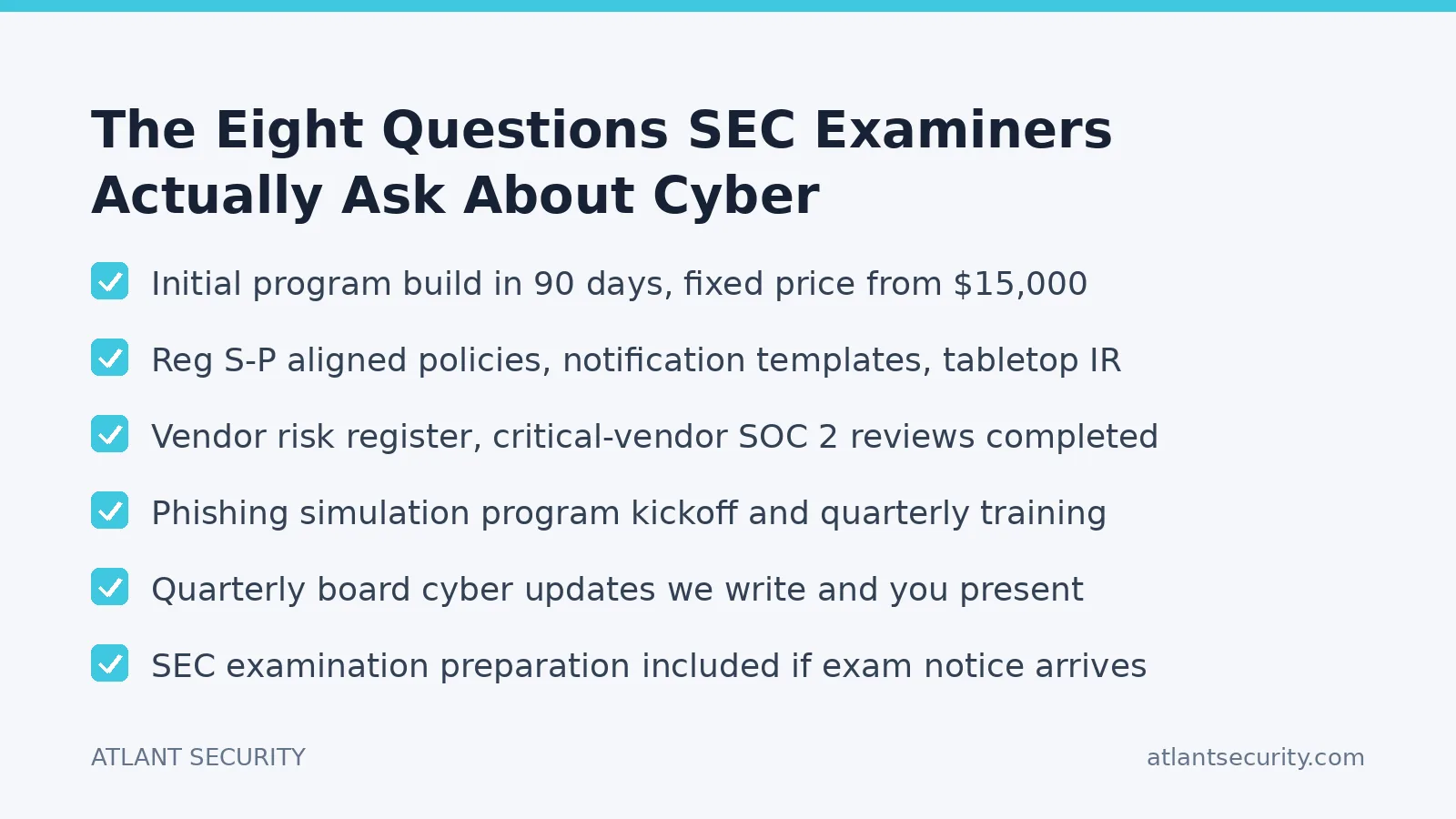
The Eight Questions SEC Examiners Actually Ask About Cyber
SEC examinations have evolved. A decade ago, the cyber portion was light, sometimes a single bullet on the document request. Today, examiners working under the Division of Examinations' annual priority statement walk in with a structured set of questions and they expect documented answers. The same eight questions show up in nearly every exam we have helped clients prepare for in the past 24 months.
If you read these eight questions and your honest internal answer to any of them is "I think we have that somewhere" or "our IT vendor handles it," your exam will not go well. Examiners are explicit and patient. They will ask the same question three different ways. They will check whether the document you produce was created before or after you received the exam notice (file metadata). They have seen every shortcut, including the policy that was downloaded yesterday from a compliance website.
Step Two
Reg S-P Amendments: The 30-Day Notification Rule That Catches Everyone
In May 2024 the SEC adopted amendments to Regulation S-P that materially changed what every RIA has to do when client data is exposed. Most firms we work with first hear about these amendments through us, not through their existing compliance vendor. The two material changes:
- Mandatory 30-day individual notification when sensitive customer information is reasonably believed to have been accessed or used without authorization. The 30-day clock starts when the firm has determined the incident occurred, not when investigation completes. Notification content has prescribed elements.
- Written incident response program with documented procedures for assessing the nature and scope of an incident, containing it, preventing further unauthorized access, and notifying affected individuals. The program must be approved by the board (or equivalent) and reviewed annually.
The practical implication is that you need three things ready before an incident occurs: an approved notification template with placeholder content (so you are filling in blanks, not drafting from scratch under pressure), a documented determination procedure that names who has authority to start the clock, and a relationship with outside counsel who can review notification language in 24 hours. If any of those three is missing, your real-world response to a breach will violate Reg S-P regardless of how well you contained the technical incident.
Step Three
The Five Attack Vectors That Actually Hit RIAs
Forget the news cycle about state-sponsored attackers and zero-day exploits. The actual attacks that have caused losses at RIA firms in the past 24 months are these five, in order of frequency:
Pattern recognition: four out of the five attacks above start with someone clicking, replying, or trusting an email. Technical controls matter, but the highest-leverage investment for an RIA is training plus procedural friction. Your callback procedure for wire changes is the difference between losing $850K and losing nothing.
Step Four
Custodian Security Expectations: The Quiet Contract You Already Signed
Your custodian (Schwab, Fidelity, Pershing, LPL, RBC, others) is not just a back office. They are a regulated counterparty whose own examiners require them to assess and manage the security of the RIA firms that custody assets with them. That requirement flows down to you through the master account agreement you signed and through periodic updates that arrive in your portal or as small-print policy notifications.
In practice, the major custodians now expect (or require) RIA firms to:
| Requirement | Typical timeline / format |
|---|---|
| MFA for all custodian portal logins | Already mandatory at all major custodians. Phishing-resistant MFA (FIDO2) increasingly required for high-volume firms. |
| Annual cybersecurity attestation | Self-attestation form covering policies, training, vendor management, incident response. Submitted via custodian portal annually. |
| Wire transfer procedural controls | Documented callback verification, dual approval thresholds, fraud monitoring integration with custodian alerts. |
| Incident notification within hours | If you suspect any compromise of credentials or systems that touch the custodian, notification is expected within 24 hours, in writing. |
| Vendor disclosure | Disclosure of third-party data processors that have access to client data or trading systems. Updated when material changes. |
| Employee offboarding within 24 hours | All access to custodian portals revoked within 24 hours of separation. Documented and auditable. |
The honest reality: most RIA firms we work with did not know all of these were already in their custodian contracts. The first time some of these get attention is when the custodian notifies the firm that a vendor audit will occur. By then the firm has 60 days to demonstrate compliance. With preparation, that is a routine exchange; without preparation, it can result in account-onboarding restrictions or worse.
Step Five
The 12-Item CCO Cybersecurity Checklist
This is the actual list we use when an RIA hires us to prepare for an SEC examination. It is also a defensible standing program when worked through deliberately over six months. Each item is a deliverable, not a goal. If you cannot produce the listed evidence within 30 minutes of a request, that item is not actually done.
Step Six
What a Defensible RIA Cyber Program Actually Costs
For a 25-person RIA managing $500M to $1.5B in AUM, our cost ranges are concrete and well-validated. Lower than this and you are paying for paperwork without controls. Higher than this for this size firm and someone is selling you enterprise tooling you do not need.
| Cost category | Year 1 (USD) | Year 2 onwards (USD) |
|---|---|---|
| Initial assessment and program build | $15,000 to $35,000 | N/A |
| Annual independent assessment | included above | $8,000 to $18,000 |
| Outsourced cyber program management (or fractional CISO) | $12,000 to $30,000 | $12,000 to $24,000 |
| Phishing training and simulation platform | $1,500 to $4,000 | $1,500 to $4,000 |
| EDR / endpoint protection | $2,500 to $6,000 | $2,500 to $6,000 |
| Email security (anti-phishing, BEC detection) | $2,000 to $4,500 | $2,000 to $4,500 |
| Backup and DR validation | $3,000 to $8,000 | $3,000 to $6,000 |
| Cyber insurance (commensurate, not catastrophic) | $5,000 to $12,000 | $5,000 to $12,000 |
| Total range | $41,000 to $99,500 | $34,000 to $74,500 |
Compare against the median wire-fraud loss alone ($850K) or the average ransomware recovery cost ($180K + downtime). The program is cheaper than a single incident, and most of these line items also lower your cyber insurance premium meaningfully.
How Atlant Security Helps RIAs
SEC-Ready Cyber Programs for RIAs in 90 Days
We build defensible cybersecurity programs for RIA firms managing $250M to $5B in AUM. Reg S-P aligned policies, the 12-item CCO checklist fully populated, tabletop incident response, custodian-attestation ready, and quarterly board reporting on autopilot. Fixed pricing from $15,000 for the initial program build, with ongoing fractional CISO support starting at $1,200 per month. You pay after we deliver the report and your principal reviews it.
- Initial program build in 90 days, fixed price from $15,000
- Reg S-P aligned policies, notification templates, tabletop IR
- Vendor risk register, critical-vendor SOC 2 reviews completed
- Phishing simulation program kickoff and quarterly training
- Quarterly board cyber updates we write and you present
- SEC examination preparation included if exam notice arrives
Frequently Asked
Questions RIA Principals Ask Us
We are a 12-person RIA. Do we really need all 12 checklist items?
Yes, in scope appropriate to your size. Items 1 through 10 are non-negotiable at any firm with discretionary authority over client funds. Items 11 (independent assessment) and 12 (board reporting) scale to your governance structure. A 12-person firm with a single managing principal still benefits from a quarterly written cyber summary to the principal; that becomes the "board" record for examination purposes.
Our IT vendor says they have us covered. Are they right?
Probably partially. IT vendors typically handle items 5 (MFA), 7 (some training tooling), and parts of items 4 (access control) and 8 (technical incident response). They do not write policies, do not perform independent assessments of their own work, do not maintain the vendor inventory of all your other vendors, do not draft Reg S-P notification templates, and do not produce board reporting. The CCO retains responsibility regardless of what the IT vendor does. Make sure the line is drawn in writing.
We just had an SEC exam. Can we relax for a few years?
No. Exam cycles are not fixed and a clean exam does not extend the next one. More importantly, the threat landscape and regulatory expectations move faster than exam cycles. Reg S-P amendments took effect between most firms' exam cycles, and the firms we worked with who did not update their programs were the ones who got findings on the next exam two to four years later.
Do we need a SOC 2 report ourselves, or just from our vendors?
RIAs generally do not need to produce their own SOC 2. SOC 2 is a vendor assurance framework used between service organizations and their customers. RIAs are typically customers in the SOC 2 universe, not service organizations. The exception is RIAs that themselves host technology used by other RIAs or institutional clients, in which case SOC 2 becomes relevant. For most RIAs, the right move is to collect SOC 2 reports from critical vendors and document review of them, not to pursue your own.
Cyber insurance: how much coverage is appropriate?
Common range for RIAs we work with is $1M to $5M in coverage, with $5M typical for firms managing $1B+ AUM. The more important variable than coverage amount is the policy's incident response retainer (which IR firm gets called and on what terms) and the exclusion list (especially social engineering and crypto-related exclusions). Read the policy with your security advisor, not just your insurance broker.
What is the first thing we should do this month?
Two things this month, in order. First, run a wire-fraud scenario through your team verbally: "A client emails to change wire instructions for a $500K outgoing transfer. Walk me through what happens next." If anyone in the room says anything other than "we call the client at the phone number we have on file, period," your firm is at risk. Second, locate your current cybersecurity policy, open it, and check the date. If it is more than 12 months old, you have a Reg S-P problem.
The RIAs that struggle in SEC examinations are not the ones with sophisticated attackers. They are the ones who treated cybersecurity as a compliance document rather than a program. The document has not been touched in two years. The procedure has not been tested. The vendor list has not been updated since three vendors ago. The training records do not exist for the three employees hired in the past 18 months.
If you are the CCO or the principal reading this and any of those sentences described your firm, you have a window. Most RIA examinations are scheduled 60 to 120 days in advance. That is enough time to operationalize the 12-item checklist if you start tomorrow. Less than 60 days is tight but workable. Less than 30 days, the right call is to bring in outside help and triage. We have done this enough times to know that nine days is doable in extremis. Sixty days is comfortable. Ninety days, with deliberate work, is the difference between an exam that lasts two weeks and one that drags into a 90-day remediation order.
Want a no-obligation review of where your firm sits against the 12-item checklist? Book a 30-minute consultation or email alexander@atlantsecurity.com directly.
Related services from Atlant Security: DFNS & Stablecoin Audit, FinTech vCISO, IT Security Audit. Book a discovery call to discuss your specific situation.
Selling into regulated financial buyers?
A named vCISO who has answered these questionnaires before takes your security programme, your evidence and your regulator-facing reporting, so due diligence stops being the thing that stalls the deal.
See fintech virtual CISO