

We have probably seen your problem before. Our smallest client had eight employees. Our largest secures the nuclear power plant of the United Arab Emirates. Whatever shape yours is, tell us about it and we will tell you how we would fix it.
Penetration Testing · Insights · October 2026
I’ve led over 500 penetration testing engagements across 14 countries. Most of what the industry sells as “penetration testing” is automated scanning with a fancy report cover. Here’s everything I wish someone had told me before my first engagement - and everything I tell our clients now.
Key Takeaways
- A real penetration tester thinks like an attacker and chains vulnerabilities together to demonstrate actual business impact - they do not just run scanners and hand you a PDF
- Most organizations overpay for vulnerability scanning disguised as penetration testing - learn the difference before signing a contract
- Penetration testing costs range from $4,000 to $100,000+ depending on scope, with most web application tests running $5,000-$12,000
- The 10-question framework in this guide will help you separate real penetration testers from scanner jockeys in under 30 minutes
- Certifications like OSCP matter, but references and sample reports tell you far more about what your engagement will actually look like
- A penetration test is only as valuable as its report - if your developers cannot reproduce and fix the findings, you wasted your money
The first real penetration test I ever ran was at a European bank. Not for Atlant Security - this was earlier in my career, back when I was still building the experience that would eventually lead me to start this firm. The engagement was supposed to take two weeks. It took four hours to get domain admin.
The password was Summer2019!
That was the domain administrator password for an organization managing billions in assets. I found it through a combination of LDAP enumeration, a Kerberoasting attack against a service account, and about 45 minutes of offline password cracking with Hashcat. From there, I had access to every account in the organization - every email, every file share, every database, every system that touched their Active Directory domain.
I will never forget the IT director’s face when I showed him the findings. He went through the five stages of grief in about 90 seconds. Denial: “That can’t be right.” Anger: “Who approved this test?” Bargaining: “Can we just mark this as a theoretical finding?” Depression: silence. Acceptance: “What do we fix first?”
That engagement taught me the most important lesson of my career: penetration testing is not about running tools. It is about thinking like someone who wants to destroy your business. The tools are just how you execute. The methodology is just how you organize. The real skill is the adversarial mindset - the ability to look at a system and instinctively understand how it can be abused.
That mindset is what separates real penetration testers from scanner jockeys. And after leading over 500 engagements across 14 countries, I can tell you: the difference between the two is the difference between a surgeon and someone who owns a scalpel.

Foundations
What Is a Penetration Tester? (And What Isn’t One)
A penetration tester (also called a pen tester or ethical hacker) is a security professional who simulates real-world cyberattacks against your systems, applications, and infrastructure to find exploitable vulnerabilities before criminals do. They do not just identify weaknesses - they exploit them, chain them together, and demonstrate the actual business impact of a successful attack.
The critical distinction is between finding a vulnerability and proving it can be exploited. A vulnerability scanner can tell you that your server is running an outdated version of OpenSSH. A penetration tester can tell you that the outdated OpenSSH, combined with a misconfigured sudo rule and a leaked SSH key in your public GitHub repository, gives an attacker root access to your production database server in under three minutes.
That difference - the ability to chain vulnerabilities, exploit business logic flaws, and demonstrate real impact - is what you are paying for when you hire a penetration tester. If you are not getting that, you are paying for a scanner subscription with a human-shaped invoice attached.
| Attribute | Penetration Tester | Vulnerability Scanner | Bug Bounty Hunter | Red Team Operator |
|---|---|---|---|---|
| Approach | Structured methodology with manual exploitation | Automated scanning against known CVEs | Freelance, targets specific bounties | Full adversary simulation over weeks/months |
| Scope | Defined targets, time-boxed | Broad surface, shallow depth | Narrow, single vulnerabilities | Entire organization, objectives-based |
| Finds Business Logic Flaws | Yes | No | Sometimes | Yes |
| Chains Vulnerabilities | Yes - core skill | No | Rarely | Yes - advanced |
| Deliverable | Detailed report with reproduction steps and remediation | Automated findings list with CVSS scores | Individual vulnerability reports | Full narrative with TTPs, detection gaps, strategic recommendations |
| Typical Cost | $4,000-$25,000 | $100-$500/month SaaS | Per-bug bounty ($100-$50,000) | $20,000-$100,000+ |
| Best For | Compliance, risk validation, pre-launch testing | Continuous monitoring, patch management | Supplementary testing on mature programs | Testing detection and response capabilities |
Service Types
The 7 Types of Penetration Testing
Not all penetration tests are created equal. Each type targets a different part of your attack surface and requires different expertise. Here is what each one actually involves, how long it takes, what it costs, and when you need it.
| Type | What It Tests | Duration | Cost Range | When You Need It |
|---|---|---|---|---|
| External Network | Internet-facing infrastructure: firewalls, VPNs, mail servers, DNS, cloud services | 3-7 days | $4,000-$15,000 | Annually; after infrastructure changes |
| Internal Network | Active Directory, lateral movement, privilege escalation, network segmentation | 5-10 days | $5,000-$20,000 | Annually; after mergers; post-breach validation |
| Web Application | OWASP Top 10, authentication, authorization, business logic, session management | 5-15 days | $5,000-$25,000 | Before launch; after major releases; for compliance |
| API | REST/GraphQL endpoints, authentication, rate limiting, BOLA/IDOR, data exposure | 3-10 days | $4,000-$15,000 | Before API goes public; when integrating partners |
| Mobile Application | iOS/Android: local storage, certificate pinning, binary protections, API communication | 5-10 days per platform | $6,000-$20,000 | Before app store submission; annually |
| Cloud Environment | AWS/Azure/GCP: IAM, storage, compute, networking, serverless, container security | 5-15 days | $5,000-$25,000 | After cloud migration; before compliance audit |
| Social Engineering / Physical | Phishing campaigns, phone pretexting, physical access, badge cloning, tailgating | 1-4 weeks | $3,000-$10,000 | To validate security awareness; before audits |
Most organizations need at least external network and web application testing annually. If you handle sensitive data, process payments, or operate in a regulated industry, you likely need three or more types. The key is matching the test type to your actual risk profile - not just checking a compliance box.
The most dangerous pen test is the one scoped to miss the thing that matters. I have seen companies test their marketing website while their production API - the one handling payment data - goes untouched for years.

Methodology Deep Dive
How Penetration Testers Actually Work: The Kill Chain
Every credible penetration testing methodology - whether based on PTES, OWASP Testing Guide, or NIST SP 800-115 - follows a similar kill chain. But the difference between a good pen tester and a bad one is not the methodology on paper. It is the thinking at each step.
Phase 1: Reconnaissance
Before a penetration tester touches your systems, they spend hours - sometimes days - gathering intelligence. OSINT (Open Source Intelligence) collection includes subdomain enumeration, employee harvesting from LinkedIn, technology fingerprinting from job postings and public source code, DNS record analysis, certificate transparency log mining, and internet archive research.
The goal is to build a map of the target’s attack surface before active scanning begins. A good pen tester often finds their most critical leads during recon - forgotten subdomains pointing to unpatched staging servers, open S3 buckets referenced in JavaScript files, API keys accidentally committed to public repositories.
From the field:
During an external pen test for a healthcare SaaS company, our recon phase uncovered a forgotten staging environment running on a subdomain that the client’s IT team did not know still existed. It was three major versions behind production. We had admin access within 20 minutes using a known exploit. The staging environment had a database connection to the production database. We could read every patient record. The “vulnerability” was a $50/month server that nobody remembered setting up two years earlier.
Phase 2: Scanning & Enumeration
Active scanning maps open ports, identifies running services, detects software versions, and fingerprints operating systems. But good penetration testers do not just run Nmap and call it done. They probe for default credentials on every discovered service, enumerate SMB shares, test SNMP community strings, check for anonymous FTP access, and map web application structures.
This phase is where the tester builds a prioritized list of attack vectors. The scanner finds 10,000 open ports. The human narrows it down to the five that actually matter.
From the field:
During an external pen test for a fintech company, we found a forgotten Jenkins server exposed on a non-standard port. The server had default credentials. From Jenkins, we had access to deployment pipelines that pushed code to production. We could have deployed a backdoor to their payment processing system. The “vulnerability” was a $200/month server that nobody remembered existed - running with the factory admin credentials it shipped with.
Phase 3: Vulnerability Analysis
This is where human expertise becomes indispensable. Automated scanners produce hundreds of findings, many of them false positives. A skilled penetration tester manually validates each potential vulnerability, eliminates false positives, and - crucially - maps out how individual weaknesses can be chained into attack paths.
A medium-severity IDOR vulnerability and a low-severity information disclosure finding might individually seem unremarkable. Chained together, they become a critical attack path that lets an unauthenticated attacker access any user’s account. Only a human tester sees that chain.
Phase 4: Exploitation
Exploitation is proof. Not theoretical risk - demonstrated impact. The penetration tester develops proof-of-concept exploits, gains initial access, and begins working toward the defined objectives. In an internal test, this might mean going from a standard user account to domain admin. In a web application test, it might mean extracting database contents or bypassing payment workflows.
Responsible testers always operate within the rules of engagement. If the engagement scope says “do not touch the production database,” they demonstrate they could access it without actually exfiltrating data. The proof is in the access, not the damage.
From the field:
During a web application pen test for an e-commerce platform, we discovered that changing a single parameter in the checkout API request allowed us to set our own price for any product. We bought a $3,000 laptop for $0.01. We immediately reported it as a critical finding and reversed the transaction. The client’s developers had validated prices on the frontend but not the backend API. An automated scanner would never have found this - it is a business logic flaw, not a CVE.
Phase 5: Post-Exploitation
After gaining initial access, the penetration tester demonstrates what an attacker could do with that foothold. Lateral movement across the network, privilege escalation to administrative access, accessing sensitive data, and demonstrating how far an attacker could go. This phase answers the question every executive cares about: “How bad could this actually get?”
From the field:
On an internal network pen test for a manufacturing company, we started with a standard employee workstation. Within six hours, we had domain admin rights through a Kerberoasting attack on a service account with a weak password. From domain admin, we accessed the SCADA network controlling their factory floor. We could have shut down production lines. The total investment to prevent this: a stronger service account password and network segmentation between IT and OT. Cost of a production shutdown: roughly $400,000 per day.
One practical note on frequency: the Pentestas AI pentesting platform makes it realistic to test on your release cadence rather than your budget cycle, because the AI does the exhaustive parameter work and retesting after remediation is included.
Phase 6: Reporting
The report is the deliverable. Everything else is methodology. A penetration test report must translate technical findings into business risk. Every vulnerability needs a CVSS score and a plain-English explanation of business impact. Every finding needs step-by-step reproduction instructions so your developers can verify and fix it. Every remediation recommendation needs an effort estimate so your team can prioritize.
We will cover what a good report looks like in detail below.

The Real Arsenal
Tools Real Penetration Testers Use
Tools do not make a penetration tester, but the right tools in skilled hands dramatically increase effectiveness. Here is an honest breakdown of what experienced pen testers actually use across each phase of an engagement.
| Category | Tools | What They Do |
|---|---|---|
| Reconnaissance | Amass, Subfinder, theHarvester, Shodan, Censys | Subdomain discovery, email harvesting, internet-wide scanning, attack surface mapping |
| Network Scanning | Nmap, Masscan, Rustscan | Port scanning, service fingerprinting, OS detection, script-based enumeration |
| Web Testing | Burp Suite Pro, OWASP ZAP, SQLMap, Nuclei | HTTP interception, injection testing, template-based vuln scanning, fuzzing |
| Exploitation | Metasploit, Cobalt Strike, Impacket, CrackMapExec | Exploit development/delivery, C2 frameworks, Windows/AD attack tooling |
| Post-Exploitation | BloodHound, Mimikatz, Rubeus, PowerView | AD path analysis, credential extraction, Kerberos attacks, domain enumeration |
| Cloud Security | Prowler, ScoutSuite, Pacu, CloudFox | Cloud misconfiguration scanning, AWS/Azure/GCP exploitation, privilege escalation |
| Password Attacks | Hashcat, John the Ripper, Hydra | Offline hash cracking (GPU-accelerated), online brute forcing, credential spraying |
| Wireless | Aircrack-ng, WiFi Pineapple, Bettercap | WPA/WPA2 cracking, evil twin attacks, network interception |
| Physical | Proxmark, Rubber Ducky, LAN Turtle, O.MG Cable | RFID/badge cloning, keystroke injection, covert network implants |
The Scanner Jockey Red Flag
If your pen tester’s “methodology” is “we run Nessus and give you the report,” you do not have a penetration tester. You have a subscription to a scanning tool with a human-shaped invoice attached. Real penetration testers use scanners as one input into a manual, human-driven testing process. The scanner finds candidates. The tester validates, exploits, and chains them into meaningful attack paths.
A note on Burp Suite specifically: it is the single most important tool in a web application pen tester’s arsenal. If you ask your pen tester what tools they use and they do not mention Burp Suite Pro for web testing, that is a concern. It is like a carpenter who does not own a hammer.
Pricing Guide
How Much Do Penetration Testers Cost?
Let me give you the real numbers. Not the “it depends” non-answer most firms give you, but actual price ranges based on what the market charges in 2026. These reflect what you should expect from qualified, experienced penetration testing firms - not offshore mills and not Big Four consultancies (which charge 3-5x for the same work).
| Test Type | Price Range | What Drives Pricing |
|---|---|---|
| External Network | $4,000-$15,000 | Number of IPs, services exposed, complexity |
| Internal Network | $5,000-$20,000 | Network size, AD complexity, segmentation |
| Web Application | $5,000-$25,000 | App complexity, number of roles, API endpoints, authentication flows |
| API | $4,000-$15,000 | Number of endpoints, documentation quality, authentication complexity |
| Mobile (Single Platform) | $6,000-$20,000 | iOS vs Android, native vs hybrid, backend API scope |
| Cloud Environment | $5,000-$25,000 | Number of accounts, services in use, IAM complexity |
| Red Team Engagement | $20,000-$100,000+ | Duration, objectives, social engineering scope, physical testing |
| Social Engineering | $3,000-$10,000 | Campaign complexity, number of targets, physical testing inclusion |
Atlant Security Pricing
At Atlant Security, penetration testing starts at $4,000 for a focused external assessment. Most web application tests run $5,000-$12,000. We provide fixed-price proposals within 24 hours - no hourly billing surprises, no scope creep charges. You know exactly what you are paying before we start. How an engagement runs from the first scoping call to the retest, and what the evidence in the report looks like, is laid out on our penetration testing services site.
What Drives Prices Up
Four factors consistently increase pen test pricing: (1) Scope expansion - more applications, more IPs, more environments; (2) Compliance requirements - PCI DSS and specific regulatory frameworks often dictate testing methodology and reporting format; (3) Retesting - always negotiate retesting into your original contract rather than paying separately; (4) Urgency - rush engagements (less than 2 weeks notice) typically carry a 25-50% premium.
Deliverables
What a Penetration Test Report Should Look Like
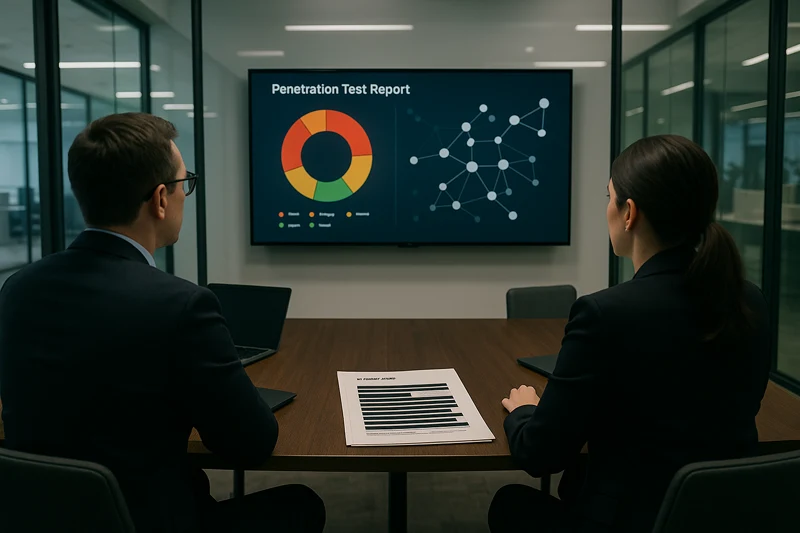
The report is the product. Everything else - the scanning, the exploitation, the late nights - exists to produce a document that helps your organization become more secure. A penetration test report that does not drive remediation is a waste of money.
Here is what a real pen test report must include:
The Six Components of a Quality Penetration Test Report
1. Executive Summary (1 page). Board-readable. No technical jargon. Summarizes the engagement scope, overall risk posture, critical findings, and business impact. If a non-technical executive cannot understand the risk after reading this page, the report has failed.
2. Findings with CVSS Scores AND Business Context. Every finding needs both a standardized severity rating and a plain-English explanation of what it means for the business. “CVSS 9.8 - Remote Code Execution” is meaningless to a CISO. “An attacker can execute commands on your payment processing server from the internet, potentially modifying transaction amounts or exfiltrating cardholder data” is actionable.
3. Step-by-Step Reproduction Instructions. Your developers need to verify the issue and test their fix. If the report says “SQL injection was found” but does not include the exact URL, parameter, payload, and expected response, your developers cannot reproduce it. And if they cannot reproduce it, they cannot fix it with confidence.
4. Proof of Concept Evidence. Screenshots, request/response captures, command outputs, video recordings where helpful. Evidence proves the finding is real, not theoretical.
5. Prioritized Remediation Plan with Effort Estimates. Not just “fix this” but “fix this first, and it will take your team approximately 4 hours of development work.” Remediation guidance should include specific technical steps, not vague recommendations.
6. Strategic Recommendations. Beyond individual fixes - systemic issues. If seven findings share a root cause of “no input validation,” the strategic recommendation is to implement a centralized input validation framework, not to patch seven individual endpoints.
The Useless Report
I once reviewed a pen test report from another firm - 47 pages, 200+ findings, not a single one had reproduction steps. The client’s developers could not fix anything because they could not reproduce the issues. We had to re-test everything. That is not a report - it is a list. If you have received a report like that, you did not get a penetration test. You got a scanner dump with formatting.
Evaluation Framework
How to Hire a Penetration Tester: The 10-Question Framework
These ten questions will separate competent penetration testers from firms that are merely good at sales. Ask every one of them. Pay close attention to the answers.
1. Who specifically will be testing my systems?
Good answer: “Your lead tester will be [Name], who holds OSCP and has 7 years of experience in web application testing. Here is their anonymized portfolio.”
Bad answer: “We assign testers based on availability. You will be notified closer to the engagement date.” (This means you might get a junior analyst running automated tools.)
2. What is your methodology beyond running automated tools?
Good answer: “We follow PTES with manual testing for business logic, authentication, and authorization flaws. Automated scanning is about 20% of our process - the rest is manual analysis and exploitation.”
Bad answer: “We use industry-leading tools like Nessus, Qualys, and Burp Suite to comprehensively scan your environment.” (If tools are the methodology, you are paying for a scanner.)
3. Can you show me a sample report?
Good answer: “Absolutely. Here is an anonymized sample. Note the reproduction steps, the business impact analysis, and the prioritized remediation guidance.”
Bad answer: “Our reports are confidential. We cannot share samples.” (Every serious firm has anonymized samples. If they will not share one, they are hiding something.)
4. How do you handle critical findings discovered mid-test?
Good answer: “Critical and high-severity findings are reported immediately via a secure channel - typically within 1 hour of validation. We do not wait for the final report.”
Bad answer: “All findings are included in the final report at the end of the engagement.” (If they find a critical RCE vulnerability on day 1 and do not tell you for two weeks, that is reckless.)
5. What happens if you accidentally cause an outage?
Good answer: “We have a documented escalation procedure. We immediately stop testing, notify your point of contact, and assist with recovery. Our insurance covers any damages.”
Bad answer: “That has never happened.” (It happens to every firm eventually. The question is whether they have a plan for it.)
6. Do you carry professional liability insurance?
Good answer: “Yes, we carry errors & omissions insurance and cyber liability insurance with $X million in coverage. We can provide a certificate of insurance.”
Bad answer: “We will get back to you on that.” (No insurance means you absorb all the risk.)
7. What certifications does your testing team hold?
Good answer: “Our testers hold OSCP, OSEP, GPEN, and CREST CRT. But more importantly, here is what they have found in engagements similar to yours.”
Bad answer: “Our team holds CEH, CompTIA Security+, and various vendor certifications.” (These are awareness-level certifications, not practitioner-level.)
8. How do you scope and price engagements?
Good answer: “We conduct a scoping call, review your architecture, and provide a fixed-price proposal with a clearly defined scope of work within 24-48 hours.”
Bad answer: “We charge $300/hour and estimate the engagement at 40-80 hours.” (Hourly billing with a 2x range means they do not know how long it will take, and you have no cost certainty.)
9. Do you provide retesting after remediation?
Good answer: “Yes, retesting of identified findings is included in the engagement price. We typically schedule it 4-8 weeks after report delivery.”
Bad answer: “Retesting is available as a separate engagement at our standard rates.” (Retesting should be included. If it is not, budget for it.)
10. Can you provide three recent client references?
Good answer: “Absolutely. I will connect you with a financial services client, a SaaS company, and a healthcare organization we tested in the last six months.”
Bad answer: “Due to confidentiality, we cannot share client names.” (Every firm can ask a few satisfied clients for permission to serve as references. If they cannot produce a single reference, they either have no clients or no satisfied ones.)

Credentials
Penetration Testing Certifications: What They Mean and What They Don’t
Certifications are a starting point for evaluation, not the finish line. Here is an honest assessment of the certifications that matter in penetration testing, what each one actually tells you, and which ones are marketing theater.
| Certification | Provider | What It Tells You | Honest Assessment |
|---|---|---|---|
| OSCP | Offensive Security | Can hack into machines in a grueling 24-hour hands-on exam | The gold standard. If your tester has this, they can hack. It is hard to pass, entirely practical, and highly respected. |
| OSEP | Offensive Security | Advanced post-exploitation, evasion techniques, Active Directory attacks | Next level. Demonstrates ability to bypass modern defenses. Excellent for internal network testing. |
| OSCE3 | Offensive Security | Expert-level web, exploit development, and evasion - the trifecta | Elite. Very few people hold this. It combines OSEP + OSWE + OSED. A tester with OSCE3 is among the best in the world. |
| GPEN | SANS / GIAC | Solid pen testing fundamentals, particularly network-focused | Good. SANS training is thorough. GPEN holders have solid methodology knowledge. Best for network-focused testing. |
| CREST CRT/CCT | CREST | UK/international standard for registered and certified testers | Respected internationally. Required for some regulated industries, especially UK financial services. CCT is particularly rigorous. |
| CEH | EC-Council | Person passed a multiple-choice exam about hacking concepts | The marketing certification. Having it means nothing. Not having it also means nothing. It is a multiple-choice test that does not require any practical hacking ability. Do not make hiring decisions based on CEH. |
Certifications tell you someone passed an exam. References tell you someone delivered results. Always check references. The best penetration tester I ever worked with had zero certifications and 15 years of experience breaking into banks for a living. The worst had four certifications and could not find a SQL injection without a scanner.
Timing
When to Schedule Penetration Testing
The most common question clients ask us is “how often should we test?” The answer depends on your risk profile, but here are the triggers that should prompt a penetration test:
- After major releases or infrastructure changes. New code means new attack surface. If you deployed a significant feature, migrated infrastructure, or changed your authentication system, you need a test.
- Before compliance audits. SOC 2, PCI DSS, ISO 27001, HIPAA - all either require or strongly benefit from recent penetration test results. Schedule tests 2-3 months before your audit window to allow time for remediation. See our IT security audit services.
- Annually at minimum. Quarterly for high-risk environments (financial services, healthcare, critical infrastructure). The threat landscape changes faster than most organizations update their defenses.
- After a breach or security incident. Validation testing confirms that remediation was effective and that no additional attack vectors remain. Our vulnerability assessments can supplement post-incident testing.
- Before M&A activity. Buyer-side due diligence should include penetration testing of the target’s systems. You do not want to acquire a company and inherit their vulnerabilities.
- When launching a new product or API. Before your SaaS product goes live, before your API opens to partners, before your mobile app hits the app store. Finding vulnerabilities before launch is orders of magnitude cheaper than finding them in production.
- When changing cloud providers or architectures. Migration introduces configuration errors. A cloud penetration test after migration catches misconfigurations that your team may have introduced during the transition.
FAQ
Frequently Asked Questions About Penetration Testers
What is the difference between penetration testing and vulnerability scanning?
Vulnerability scanning is automated - a tool checks your systems against a database of known vulnerabilities and produces a list. Penetration testing is manual - a human expert validates those findings, eliminates false positives, discovers vulnerabilities no scanner can find (business logic flaws, authentication bypasses, chained attacks), and demonstrates real-world exploitability. A vulnerability assessment tells you what might be wrong. A penetration test proves what is actually exploitable.
How long does a penetration test take?
Most engagements take 1-3 weeks of active testing, followed by 1 week for reporting. A focused external network test might take 3-5 days. A comprehensive web application test for a complex SaaS platform might take 2-3 weeks. Red team engagements can span 4-12 weeks. The timeline depends on scope, application complexity, and the number of user roles and authentication flows to test.
Can penetration testing break my systems?
Experienced penetration testers use techniques calibrated to minimize risk to production systems. That said, any testing that involves real exploitation carries inherent risk. Denial-of-service testing, for example, can cause outages if not carefully controlled. Reputable firms discuss risk mitigation before testing begins, define rules of engagement, carry insurance, and have escalation procedures for accidental disruptions. Testing against staging environments first is common practice for risk-sensitive systems.
Should I do black box, grey box, or white box testing?
Grey box testing provides the best value for most organizations. The tester gets limited information (standard user credentials, API documentation, network diagrams) which simulates a realistic attacker who has done initial reconnaissance. Black box wastes time on reconnaissance that could be spent finding deeper vulnerabilities. White box (full source code access) is best for critical applications where you want the deepest possible analysis. Our recommendation: grey box for most tests, white box for your most critical applications.
How often should we get pen tested?
At minimum, annually. If you process payments (PCI DSS), handle healthcare data (HIPAA), or operate in financial services, quarterly testing is advisable. You should also test after any significant application release, infrastructure change, or security incident. Many of our clients at Atlant Security operate on a quarterly testing cadence with different test types rotating each quarter.
What is the difference between a pen test and a red team engagement?
A penetration test finds as many vulnerabilities as possible within a defined scope and timeframe. A red team engagement simulates a real adversary trying to achieve specific objectives (access CEO email, exfiltrate customer data, disrupt operations) using any means necessary - technical exploitation, social engineering, physical access, the full spectrum. Red teams test your detection and response capabilities, not just your defenses. Pen tests are for finding holes. Red teams are for testing whether your security team can catch an attacker in the act.
Do penetration testers need access to our source code?
Not always, but source code access (white box testing) significantly increases the depth of testing. With source code, testers can identify vulnerabilities that are extremely difficult to find through black box testing alone - hard-coded credentials, insecure cryptographic implementations, race conditions, and subtle authorization flaws. For critical applications, we recommend providing source code access. For standard assessments, grey box with API documentation is sufficient.
Can we use internal staff for penetration testing?
Internal pen testing programs have value, but they should supplement - not replace - external testing. Internal testers carry inherent bias: they know the systems, they have relationships with developers, and they may unconsciously avoid testing areas they know are fragile. External testers bring fresh eyes, no political constraints, and experience across hundreds of different environments. Most compliance frameworks also require independent, third-party testing.
What compliance frameworks require penetration testing?
PCI DSS explicitly requires penetration testing at least annually and after significant changes. SOC 2 does not strictly require it but auditors strongly expect it as evidence of security testing controls. ISO 27001 requires regular security testing as part of the ISMS. HIPAA requires risk assessments that typically include penetration testing. GDPR requires “regular testing, assessing, and evaluating” of security measures. In practice, if you are pursuing any serious compliance certification, you need penetration testing. See our security audit services for compliance-driven testing.
How do we prepare for a penetration test?
Preparation makes a massive difference in test quality. Before your engagement: (1) Define clear scope and objectives. (2) Provide the tester with accounts for each user role (if grey/white box). (3) Share API documentation and architecture diagrams. (4) Whitelist the testing team’s IP addresses in your WAF and IDS so testing is not blocked. (5) Notify your hosting provider and cloud vendor (AWS, Azure, GCP all require penetration testing notification). (6) Designate a point of contact who can answer questions and authorize emergency escalation. (7) Sign the rules of engagement and statement of work before testing begins.
Ready to Find Out What a Real Penetration Tester Finds in Your Environment?
Not a scanner report - a human expert who thinks like an attacker and reports like a consultant. Senior practitioners, fixed pricing, retesting included. See why 200+ companies across 14 countries trust Atlant Security with their penetration testing.
Last Updated: October 2026 · Author: Alexander Sverdlov, Atlant Security
This article is for informational purposes only. Atlant Security provides penetration testing services and is referenced in this guide. All pricing reflects general market conditions as of October 2026. Organizations should conduct their own due diligence when selecting a penetration testing partner.
Comparing firms? Our ranking of the top 40 penetration testing companies covers boutiques, research-led consultancies, PTaaS and autonomous platforms, with each one's pricing model and the scopes it suits.
Related services from Atlant Security: Penetration Testing, IT Security Audit, Virtual CISO. Book a discovery call to discuss your specific situation.
Need an actual break-in attempt?
A penetration test is a person chaining weaknesses into real access, not a scanner report. Scoped to what matters, priced before we start, with the route that produced every finding written down.
See penetration testing