Cybersecurity Audit Services: What You're Really Paying For (And What You Should Demand)
Alexander Sverdlov
Security Analyst

💫 Key Takeaways
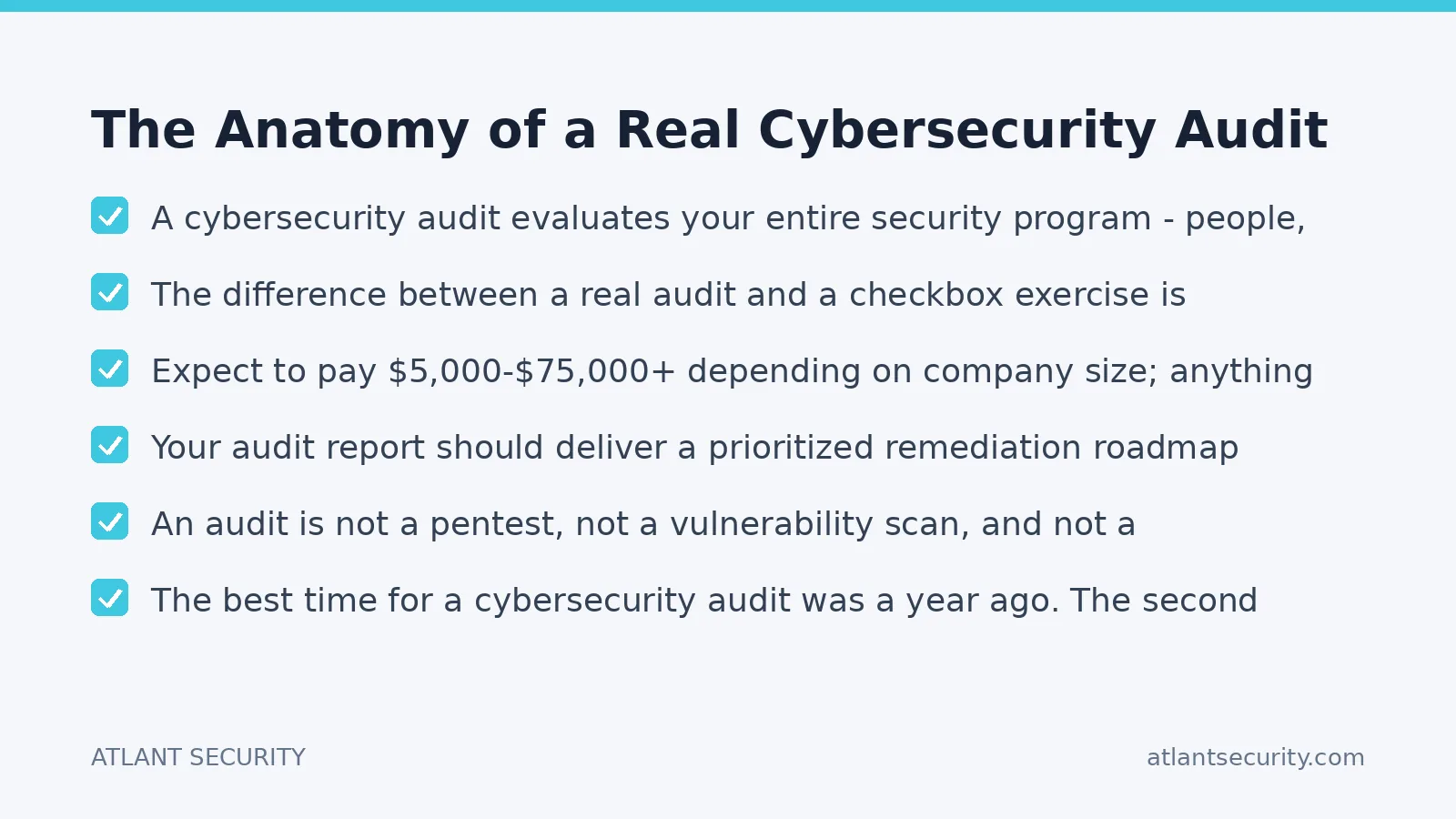
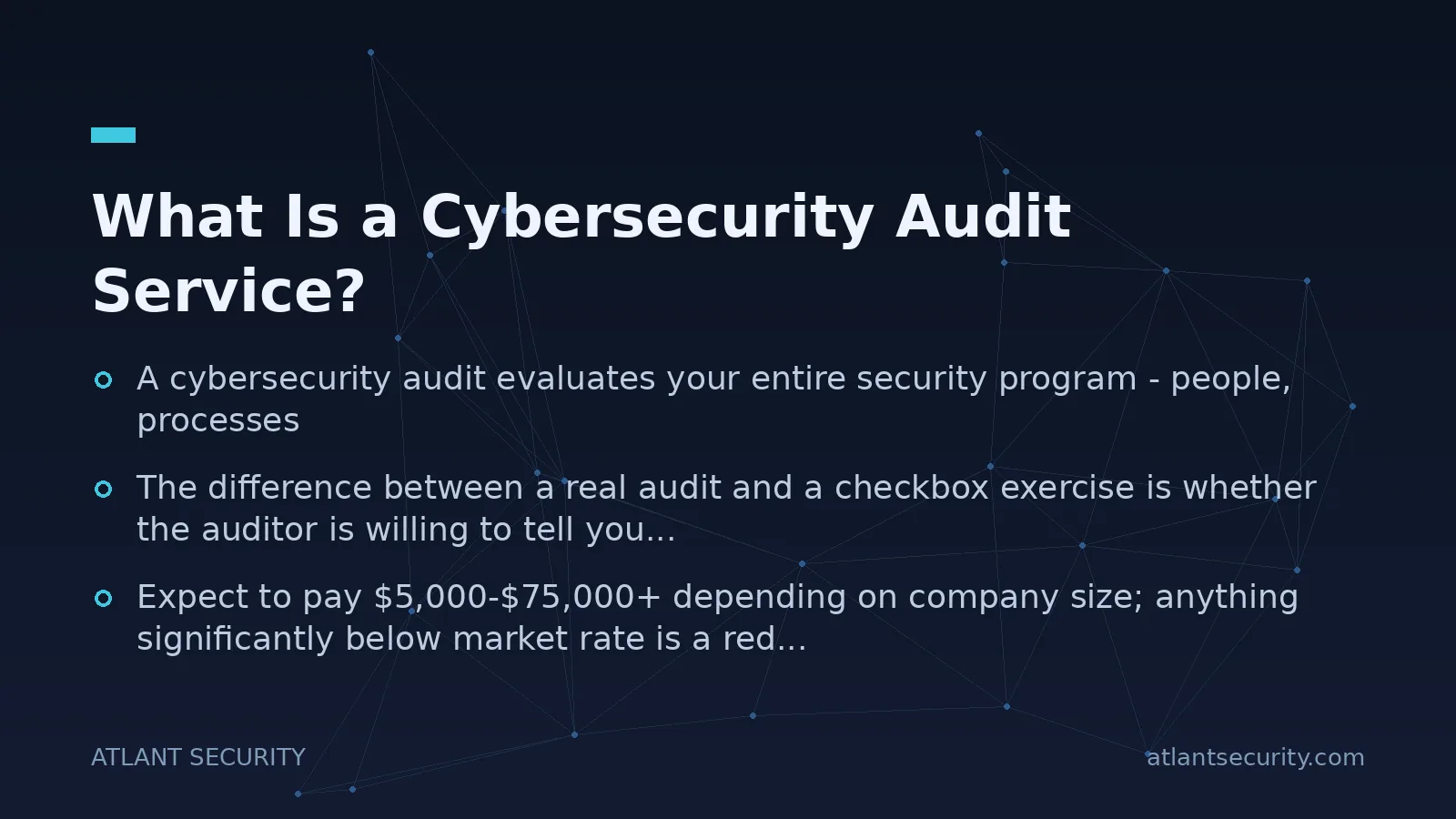
- A cybersecurity audit evaluates your entire security program - people, processes, and technology - not just your firewall rules or patch levels
- The difference between a real audit and a checkbox exercise is whether the auditor is willing to tell you things you do not want to hear
- Expect to pay $5,000-$75,000+ depending on company size; anything significantly below market rate is a red flag, not a bargain
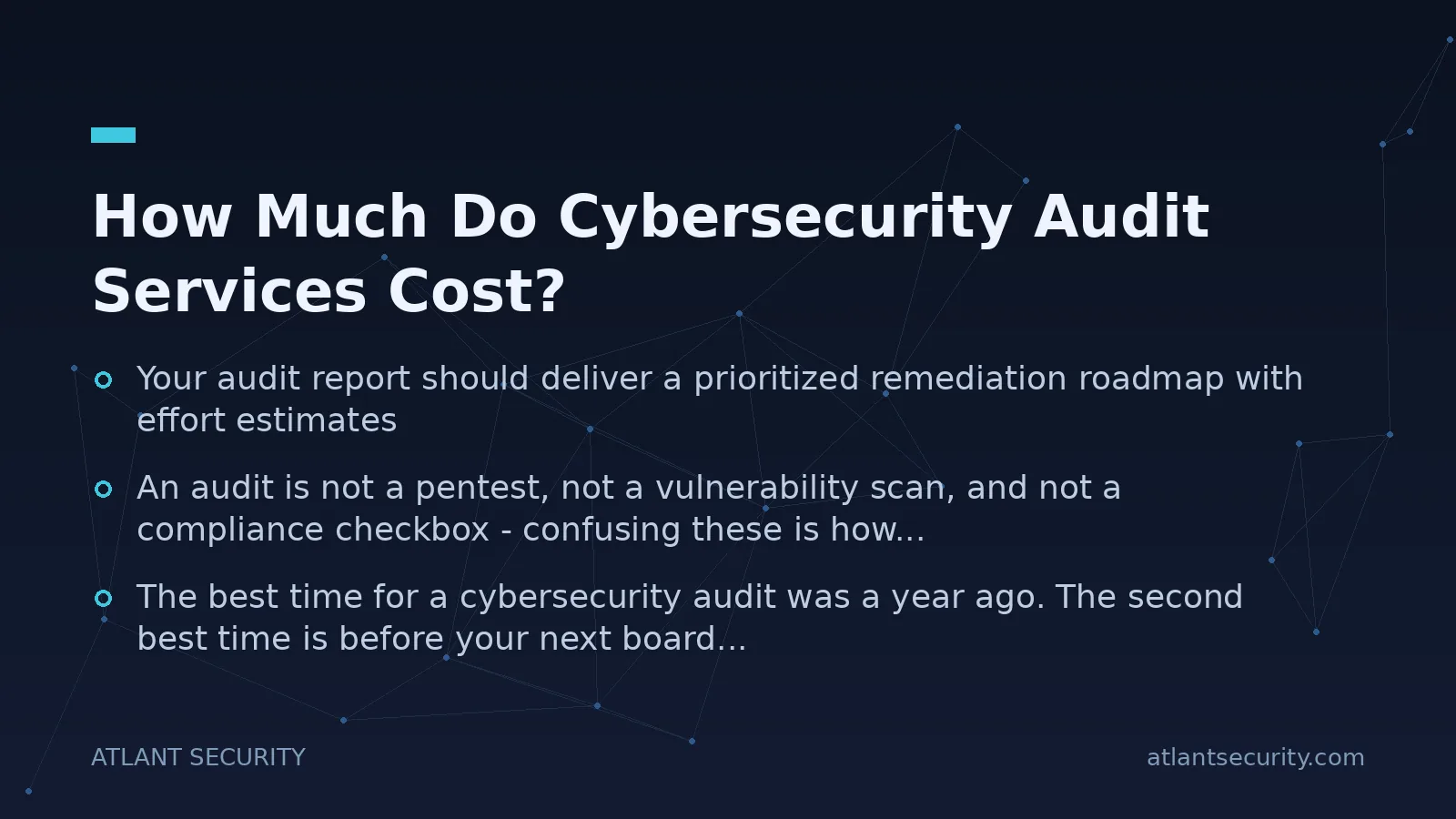
- Your audit report should deliver a prioritized remediation roadmap with effort estimates, not just a list of findings dumped in a PDF
- An audit is not a pentest, not a vulnerability scan, and not a compliance checkbox - confusing these is how companies end up with false confidence
- The best time for a cybersecurity audit was a year ago. The second best time is before your next board meeting, renewal, or acquisition
The CEO called me on a Tuesday afternoon. His voice was calm - the kind of forced calm that people use when they are trying very hard not to sound panicked. He told me his company, a logistics firm with about 300 employees and operations across three states, had just been hit with ransomware. Their entire ERP system was encrypted. Shipping schedules gone. Customer data locked. Invoices, payroll records, vendor contracts - all of it behind a ransom demand of 14 Bitcoin.
The operation was down for 11 days. Eleven days of lost revenue, emergency contractor fees, manual workarounds using spreadsheets and personal phones, and a PR crisis that cost them two of their largest accounts. The final damage, when we tallied it months later, exceeded $2.3 million.
Here is the part that still keeps me up at night: they had been audited six months earlier.
Their previous “auditor” - I use the word loosely - had conducted what amounted to a two-hour walkthrough with a checklist that hadn’t been updated since 2019. The report was 12 pages of boilerplate, including six pages of cover material and appendices. The findings section listed exactly three items: “consider implementing MFA for email,” “update password policy to require 12 characters,” and “review firewall rules annually.” The report concluded with a clean bill of health.
The attacker had used a default credential on their VPN appliance - a Fortinet unit with a well-known vulnerability that had a patch available for over a year. Any real auditor would have found it in the first hour. Not the first day. The first hour.
This is why the word “audit” means nothing without understanding what is behind it. And this is why I wrote this guide - so you can tell the difference between a cybersecurity audit that actually protects your company and one that just generates a PDF and a false sense of security.
Definitions Matter
What Is a Cybersecurity Audit Service?
Let me define this clearly, because the cybersecurity industry has done a remarkable job of making every term mean whatever the vendor selling it wants it to mean.
A cybersecurity audit is a systematic, evidence-based evaluation of your organization’s entire security program. Not just your technology. Not just your compliance status. Your entire program - the people who manage it, the processes they follow, the technology they use, and how all three interact under real-world conditions.
A proper cybersecurity audit answers three fundamental questions:
- What is your current security posture? - Not what you think it is. Not what your IT team tells you it is. What it actually is, verified through evidence and testing.
- Where are the gaps between your current state and where you need to be? - Measured against your specific risk profile, regulatory obligations, contractual requirements, and business objectives.
- What should you fix first, and how? - Prioritized by actual risk, not by whatever the auditor’s tool flagged as “critical” by default.
This is fundamentally different from several things that are often confused with - or sold as - a cybersecurity audit:
| Service | What It Does | What It Does NOT Do | Typical Duration |
|---|---|---|---|
| Cybersecurity Audit | Evaluates your entire security program - governance, controls, processes, technology, people | N/A (comprehensive by design) | 2-4 weeks |
| Vulnerability Assessment | Scans systems for known vulnerabilities using automated tools | Evaluate governance, processes, or human factors; validate exploitability | 1-3 days |
| Penetration Test | Simulates real attacks to exploit specific vulnerabilities and test defenses | Review policies, compliance posture, or overall program maturity | 1-3 weeks |
| Risk Assessment | Identifies and quantifies business risks from cyber threats | Test technical controls or verify implementation details | 1-2 weeks |
| Compliance Audit | Checks adherence to a specific framework (SOC 2, ISO 27001, HIPAA) | Assess risks outside the framework scope; test real-world attack resilience | 2-6 weeks |
The logistics company from my opening story? They had received a vulnerability scan disguised as an audit. A junior analyst ran Nessus, exported the default report, and someone at the firm wrote a cover letter. That is not an audit. That is a screenshot with a logo on it.
A real cybersecurity audit includes elements of all the above - but it is orchestrated by experienced professionals who understand how to connect technical findings to business risk and who can tell you not just what is wrong, but why it matters and what to do about it in an order that makes sense for your specific situation.
What Gets Examined
The Anatomy of a Real Cybersecurity Audit
When we conduct a cybersecurity audit at Atlant Security, we evaluate 20 distinct domains. Each domain has specific control objectives, evidence requirements, and testing procedures. Here is what a comprehensive audit should cover:
| # | Audit Domain | What the Auditor Should Examine | Common Failures |
|---|---|---|---|
| 1 | Security Governance | Security policies, organizational structure, board reporting, risk appetite definition | Policies exist on paper but are not enforced or known by staff |
| 2 | Risk Management | Risk register, risk assessment methodology, risk treatment plans, residual risk acceptance | Risk register has not been updated in 12+ months |
| 3 | Access Control | IAM policies, RBAC implementation, privileged access management, MFA coverage, deprovisioning | Former employees still have active accounts; service accounts with excessive privileges |
| 4 | Network Security | Firewall rules, network segmentation, IDS/IPS, VPN configurations, DNS security | Flat networks with no segmentation; overly permissive firewall rules |
| 5 | Endpoint Security | EDR deployment, device hardening, mobile device management, removable media controls | EDR installed but not monitored; BYOD devices unmanaged |
| 6 | Cloud Security | Cloud configuration, IAM roles, storage bucket policies, encryption at rest, network controls | Public S3 buckets; root account used for daily operations |
| 7 | Application Security | SDLC practices, code review processes, OWASP top 10 coverage, API security | No security review in CI/CD pipeline; APIs with broken authentication |
| 8 | Data Protection | Data classification, data flow mapping, DLP controls, data retention policies | No data inventory; sensitive data in unclassified locations |
| 9 | Encryption | Encryption standards (at rest, in transit), key management, certificate management | TLS 1.0/1.1 still enabled; encryption keys stored alongside data |
| 10 | Physical Security | Data center access controls, visitor management, clean desk policies, equipment disposal | Server closets unlocked; no visitor logs |
| 11 | Incident Response | IR plan, playbooks, communication procedures, tabletop exercise history, lessons learned | IR plan exists but has never been tested; no after-action reviews |
| 12 | Business Continuity | BCP/DR plans, RTO/RPO definitions, failover testing, crisis communication | RPOs defined but never validated against actual backup frequency |
| 13 | Vendor Management | Third-party risk assessments, vendor security requirements, contract security clauses | No inventory of vendors with access to sensitive data |
| 14 | Employee Awareness | Security training program, phishing simulation results, policy acknowledgment tracking | Annual training with no follow-up; phishing click rates above 20% |
| 15 | Change Management | Change approval workflows, rollback procedures, emergency change processes | Production changes deployed without approval or documentation |
| 16 | Logging & Monitoring | SIEM deployment, log retention, alert thresholds, log integrity, coverage gaps | Logs collected but no one reviews alerts; 30-day retention insufficient for forensics |
| 17 | Patch Management | Patching cadence, critical patch SLAs, patching coverage, legacy system exceptions | Critical patches applied 30+ days late; legacy systems completely unpatched |
| 18 | Backup & Recovery | Backup strategy (3-2-1 rule), restoration testing, immutable backups, offline copies | Backups run but never test-restored; ransomware can reach backup storage |
| 19 | Compliance Mapping | Gap analysis against applicable frameworks (SOC 2, ISO 27001, HIPAA, GDPR, PCI DSS, etc.) | Compliance treated as one-time project; no continuous monitoring |
| 20 | Executive Reporting | Board-ready security metrics, risk dashboards, trend analysis, benchmark comparisons | No security reporting to the board; metrics focused on activity not outcomes |
If your auditor is not covering the majority of these domains - with evidence collection, interviews, and technical validation for each - you are not getting an audit. You are getting a spot check with a nice cover page.
How Evidence-Based Auditing Works
A claim without evidence is just an opinion. Real auditors do not accept “yes, we do that” as an answer. They ask to see the policy, then the configuration that enforces it, then the logs that prove it has been working. If your auditor never asked to see a screen, a configuration file, or a log entry - they were not auditing. They were interviewing.
Honest Pricing
How Much Do Cybersecurity Audit Services Cost?
I am going to share the actual pricing ranges we see in the market as of early 2026 because most companies have no idea what a cybersecurity audit should cost, and that information asymmetry is exactly how bad actors - both the hackers and the fraudulent auditors - thrive.
| Company Size | Employees | Typical Scope | Price Range | Timeline |
|---|---|---|---|---|
| Small Business | Under 50 | Single location, simple infrastructure, 1-2 cloud providers | $5,000-$12,000 | 1-2 weeks |
| Mid-Market | 50-500 | Multiple offices, hybrid cloud, regulatory requirements, vendor ecosystem | $12,000-$30,000 | 2-3 weeks |
| Enterprise | 500+ | Multi-location, complex hybrid infrastructure, multiple compliance mandates, global operations | $25,000-$75,000+ | 3-6 weeks |
These prices reflect the cost of having senior security professionals - not junior analysts running automated scans - spend meaningful time understanding your environment, collecting evidence, testing controls, and writing a report that is actually useful. The largest variable is not your company size alone but the complexity of your environment: a 100-person fintech with three cloud providers and PCI DSS obligations costs more to audit than a 200-person professional services firm with a single office and Microsoft 365.
⚠️ The Cheap Audit Warning
If your cybersecurity audit costs less than your annual coffee budget, it is not an audit.
A $2,000 “audit” means one of three things: they are running an automated scan and calling it an audit, they are using junior staff who lack the experience to identify real risks, or they are producing a template report with your company name pasted in. In all three cases, you are paying for a false sense of security - which is worse than no audit at all, because it makes you believe you are protected when you are not.
To put this in perspective: the average cost of a data breach in 2025 was $4.88 million (IBM Cost of a Data Breach Report). A comprehensive cybersecurity audit is less than 1% of that figure for most organizations. The math is not complicated.
Red Flags
8 Signs Your Cybersecurity Auditor Is Wasting Your Money
After reviewing hundreds of audit reports produced by other firms - often brought to us by clients who want a second opinion - I have identified the most reliable indicators that an audit engagement is not delivering real value. If any of these describe your current auditor, it is time to have a difficult conversation.
1. They never asked to speak with anyone outside IT
Security is an organizational function, not a technology function. If your auditor only spoke with your IT team, they missed how HR handles onboarding and offboarding (access provisioning), how finance processes payments (fraud controls), how operations handles vendor relationships (third-party risk), and how leadership makes decisions about risk acceptance. A real audit interviews people across the organization - typically 8 to 15 stakeholders for a mid-sized company.
2. The engagement lasted less than a week
There is a minimum amount of time required to do a competent audit, and for any organization with more than 20 employees, that minimum is measured in weeks, not days. A two-day “audit” can at best perform a surface-level assessment. It cannot collect and verify evidence, interview stakeholders, review configurations, analyze logs, and produce a meaningful report. If your auditor finished in two days, they skipped most of the work.
3. The report is mostly automated scanner output
Open the report to the findings section. If the findings look like they came directly from Nessus, Qualys, or Rapid7 - complete with CVE numbers, CVSS scores, and generic remediation advice - your auditor ran a scan and exported the results. That is a vulnerability assessment, not an audit. A real audit report contextualizes findings: “This unpatched Exchange server is critical because it is internet-facing and handles email for your executive team, and the specific vulnerability (CVE-XXXX-XXXXX) has a known exploit being used in active ransomware campaigns targeting your industry.”
4. They did not ask for documentation
A serious auditor will request policies, procedures, network diagrams, asset inventories, previous audit reports, incident records, risk registers, and vendor agreements before setting foot in your environment. If your auditor showed up, asked a few questions, and left without requesting any artifacts - they were performing a courtesy visit, not an audit. The documentation review alone typically takes a senior auditor 1-2 full days.
5. Every finding is rated “Medium”
This is a tell-tale sign of a risk-averse auditor who does not want to alarm you (or a lazy one who used the default rating). In any real organization, an honest audit will produce a distribution: a few critical findings that need immediate attention, several high-priority items, a larger number of mediums, and many lows. If your report has 25 findings and they are all rated medium, the auditor homogenized the results to avoid difficult conversations. That defeats the entire purpose.
6. No remediation priorities or effort estimates
A list of findings without a prioritized remediation plan is like a diagnosis without a treatment plan. Your audit report should tell you: fix this first (week 1-2, estimated 8 hours of engineering time), then this (week 3-4, requires budget approval), then this (quarter 2, architectural change). If your auditor hands you a list of 50 findings and says “good luck,” they did half the job.
7. They are trying to sell you products
If your audit report concludes with a recommendation to purchase specific security products - especially products the audit firm sells or resells - you have a conflict of interest. A legitimate audit firm recommends control objectives and solution categories, not specific vendor products. The moment the auditor’s revenue depends on scaring you into buying something, the objectivity of the audit is compromised.
8. They gave you a clean bill of health
I have audited over 200 organizations in my career. Not one - not a single one - had zero findings. If your auditor concluded that everything is fine, one of two things happened: they did not look hard enough, or they are afraid to deliver bad news. Either way, you paid for nothing. A good auditor will always find something, because security is a moving target and perfection does not exist. The question is whether they found the things that matter.
Deliverables
What Your Audit Report Should Deliver
A cybersecurity audit report is not just a list of findings. It is a strategic document that serves multiple audiences and drives action. If your report does not contain the following components, you should ask your auditor why - and consider whether you are getting what you paid for.
✅ What a Good Audit Report Contains
1. Executive Summary (2-3 pages): Written for the board and C-suite. No jargon. Clear risk ratings. Business impact language. Overall maturity score with benchmark comparison. This is the document your CEO should be able to read in 10 minutes and understand exactly where the company stands.
2. Detailed Technical Findings (10-30 pages): Written for your IT and security team. Each finding includes: description, evidence, risk rating with justification, affected systems, exploitation scenario (how an attacker would use this), and specific remediation steps.
3. Prioritized Remediation Roadmap: Findings organized into immediate (0-30 days), short-term (30-90 days), and strategic (90-365 days) actions. Each item includes estimated effort, resource requirements, and dependencies.
4. Compliance Mapping Matrix: Your findings mapped against relevant frameworks (SOC 2, ISO 27001, NIST CSF, HIPAA, PCI DSS, GDPR, etc.) so you can understand compliance gaps alongside security gaps.
5. Security Maturity Assessment: A framework-based maturity score (typically 1-5) across each domain, showing where you are, where you should be for your risk profile, and what it takes to get there.
6. Follow-up Schedule: A defined timeline for reassessment, including which findings should be validated at 30, 60, and 90 days post-remediation. An audit without follow-up accountability is just a report that sits in a drawer.
One way to evaluate your audit report: imagine handing it to a new CISO on their first day. Could they use it, without any other context, to understand the company’s security posture, know what to fix first, and build a 12-month security plan? If the answer is no, the report is incomplete. If you do not have a CISO, a virtual CISO service can help you interpret and act on audit findings.
Our Process
The 14-Day Audit: How Atlant Security Does It Differently
Over the past decade, we have audited more than 200 organizations across financial services, healthcare, technology, logistics, and critical infrastructure. That experience has taught us something important: the value of an audit is not in finding problems. It is in giving you the clarity and the roadmap to fix them.
Here is how our cybersecurity audit service works, day by day:
| Phase | Days | Activities | Your Time Required |
|---|---|---|---|
| Scoping & Kickoff | Day 1 | Define scope, identify stakeholders, request documentation, set up secure communication channels | 2-3 hours |
| Document Review | Days 2-3 | Review all security policies, procedures, network diagrams, previous assessments, incident history, vendor agreements | Minimal (document sharing) |
| Stakeholder Interviews | Days 3-5 | Interview IT leadership, system administrators, HR, finance, operations, and executive team. 30-60 minutes each. | 30-60 min per interviewee |
| Technical Assessment | Days 4-9 | Configuration reviews, vulnerability scanning, access control validation, cloud security assessment, log analysis, backup verification | Provide access credentials; answer questions as they arise |
| Analysis & Reporting | Days 10-12 | Correlate findings, assess risk, build remediation roadmap, draft executive summary and technical report | None |
| Delivery & Debrief | Days 13-14 | Present findings in two sessions: executive briefing (30 min) and technical deep-dive (90 min). Answer questions. Finalize report. | 2 hours total |
What makes our approach different:
- Senior-led engagements. Every audit is led by a consultant with 10+ years of experience. We do not send junior analysts to do the fieldwork and have a senior partner “review” the output. The person who reviews your firewall rules is the same person who presents to your board.
- Business context first. We start by understanding your business - your revenue model, your regulatory environment, your risk appetite, your growth plans. Every finding is evaluated through the lens of what actually matters to your organization, not a generic severity scale.
- No product sales. We do not resell security products. Our revenue comes entirely from consulting services. This means our recommendations are objective. If you need a SIEM, we will tell you - but we will not care which one you buy.
- Remediation support. We do not just hand you a report and walk away. We offer optional remediation support where our team works alongside yours to fix the findings - or we provide detailed guidance so your team can do it independently. Either way, we follow up at 30, 60, and 90 days to verify progress.
- Framework-agnostic, compliance-aware. We audit against your actual risk profile, then map findings to whatever frameworks matter to you - SOC 2, ISO 27001, NIST CSF, HIPAA, PCI DSS, GDPR, DORA, or any combination. One audit, multiple compliance outputs.
Why 14 Days?
We have found that 14 business days is the optimal balance between thoroughness and efficiency for most mid-market organizations. Shorter engagements sacrifice depth. Longer ones often reflect scope creep or inefficient processes. Our methodology is designed to extract maximum insight in minimum time - we have done this enough times to know exactly where to look and what to ask.
FAQ
Frequently Asked Questions About Cybersecurity Audit Services
How often should we get a cybersecurity audit?
At minimum, annually. However, you should also conduct an audit after any major infrastructure change (cloud migration, merger or acquisition, new office), after a security incident, before pursuing a new compliance certification, or when you are preparing for due diligence from investors or acquirers. For organizations in regulated industries - financial services, healthcare, critical infrastructure - semi-annual audits with continuous monitoring between them is the standard we recommend.
What is the difference between a cybersecurity audit and a SOC 2 audit?
A SOC 2 audit evaluates your organization against the AICPA Trust Services Criteria (security, availability, processing integrity, confidentiality, privacy). It produces a formal attestation report from a licensed CPA firm. A cybersecurity audit is broader and more flexible - it evaluates your entire security program against your specific risk profile and can incorporate multiple frameworks. Think of SOC 2 as a standardized exam. A cybersecurity audit is a comprehensive health check. Many of our clients do both: the cybersecurity audit identifies and fixes gaps, and the SOC 2 audit provides the formal attestation their customers require.
Can we use our IT team to do the audit internally?
You can, and internal audits have value for ongoing monitoring between external assessments. However, an internal audit has a fundamental limitation: the people who built and maintain the systems are evaluating their own work. It is the same reason public companies cannot audit their own financial statements. Even with the best intentions, internal teams have blind spots, biases, and institutional knowledge that causes them to overlook assumptions they have baked into the environment. We recommend a hybrid approach: internal assessments quarterly, external audits annually.
How long does a typical cybersecurity audit take?
For most mid-market companies, expect 2-3 weeks from kickoff to final report delivery. Small businesses with simple environments can be completed in 1-2 weeks. Large enterprises with multiple locations, complex hybrid infrastructure, and extensive regulatory requirements may need 4-6 weeks. The most common bottleneck is not the auditor’s time but the client’s responsiveness - how quickly you can provide documentation, schedule interviews, and grant system access directly impacts the timeline.
What compliance frameworks does your audit cover?
Our audits are framework-agnostic at the core - we evaluate your actual security posture first, then map findings to whichever frameworks are relevant. We regularly map to SOC 2, ISO 27001, NIST CSF, NIST 800-53, HIPAA, PCI DSS, GDPR, DORA, CPS 234, MAS TRM, NIS2, and CCPA. If you are pursuing a specific certification, we structure the audit to double as your gap assessment, so you do not pay for the same work twice.
Do you provide remediation support or just the report?
Both. Every audit engagement includes a detailed report with specific remediation steps your team can follow independently. For clients who want hands-on support, we offer remediation services where our engineers work alongside your team to implement fixes, harden configurations, deploy missing controls, and validate that remediation was effective. We also offer ongoing security advisory through our virtual CISO service for organizations that need continuous guidance, not just a point-in-time assessment.
What access do auditors need to our systems?
The level of access depends on the audit scope, but typically we need: read-only access to cloud management consoles (AWS, Azure, GCP), firewall and network device configurations, endpoint management consoles, identity provider settings, email security configurations, and SIEM/log management platforms. We never need (or want) write access to production systems. All access is documented, time-limited, and revoked at the end of the engagement. We can also work through screen-sharing sessions with your team if direct access is not feasible due to policy or regulatory constraints.
How do we prepare for a cybersecurity audit?
The best preparation is gathering your documentation before the engagement starts. Collect your current security policies, network architecture diagrams, asset inventory, list of cloud services and SaaS applications, previous audit or assessment reports, incident records from the past 12 months, organizational chart showing IT and security team structure, and a list of key vendors with access to your data or systems. Do not “clean up” before the audit - we need to see your environment as it actually operates, not a staged version. The entire point is to find the gaps, and you cannot find them if you hide them first.
Published: April 2026 · Author: Alexander Sverdlov
This article is for informational purposes only and does not constitute legal or professional advice. Audit costs, timelines, and deliverables may vary based on organizational complexity, scope, and regulatory requirements. Contact us for a tailored assessment of your cybersecurity audit needs.
Related services from Atlant Security: Vulnerability Assessment, Cybersecurity Due Diligence, IT Security Audit. Book a discovery call to discuss your specific situation.

Alexander Sverdlov
Founder of Atlant Security. Author of 2 information security books, cybersecurity speaker at the largest cybersecurity conferences in Asia and a United Nations conference panelist. Former Microsoft security consulting team member, external cybersecurity consultant at the Emirates Nuclear Energy Corporation.