
We have probably seen your problem before. Our smallest client had eight employees. Our largest secures the nuclear power plant of the United Arab Emirates. Whatever shape yours is, tell us about it and we will tell you how we would fix it.
CSA STAR · Cloud Security · March 2026
CSA STAR Level 1 and Level 2 both demonstrate cloud security maturity, but the difference between a self-assessment and a third-party audit is enormous in the eyes of enterprise customers and EU procurement teams. Here is how to decide which level your organization actually needs.
Key Takeaways
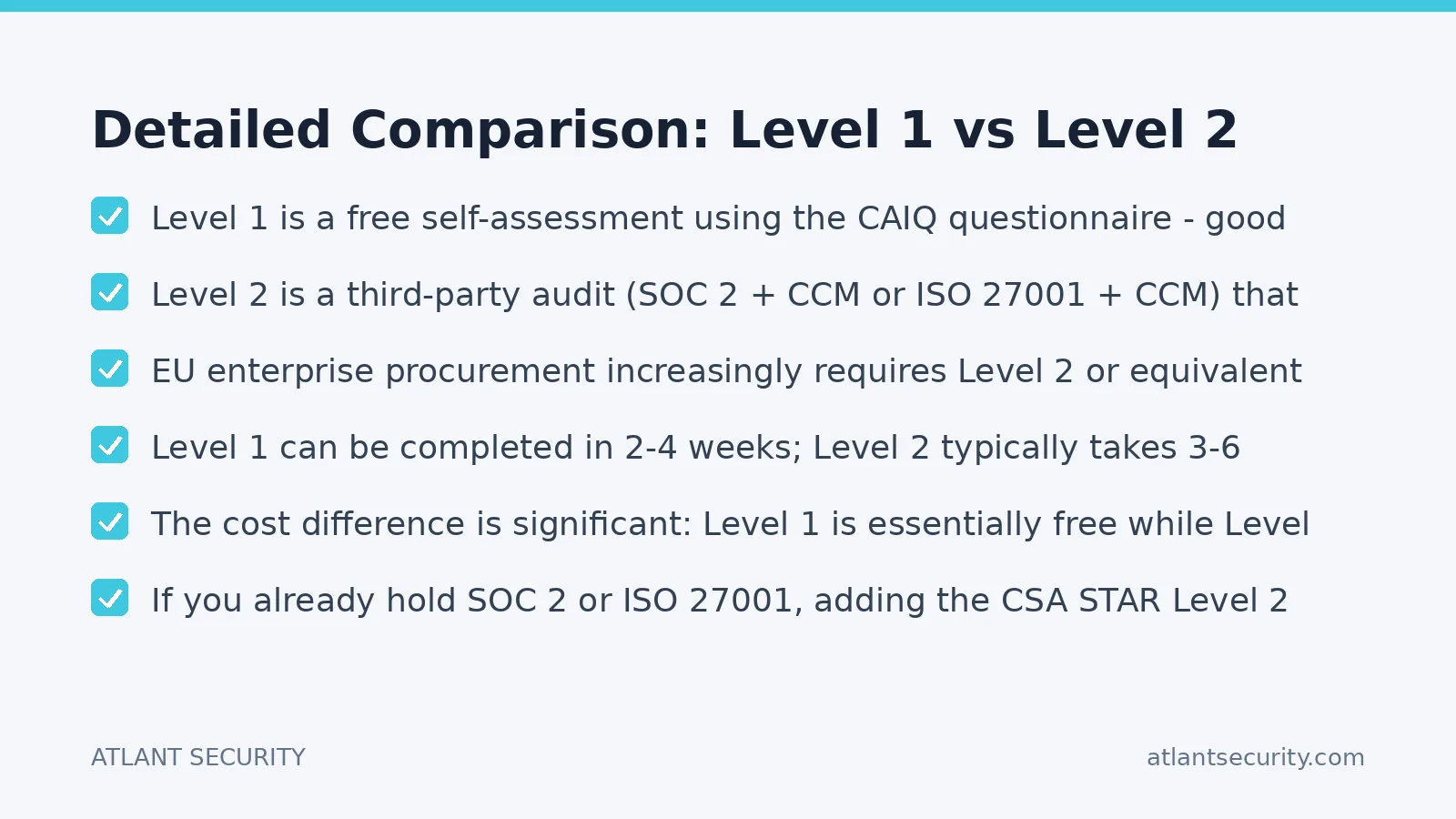
- Level 1 is a free self-assessment using the CAIQ questionnaire - good for transparency, not for trust
- Level 2 is a third-party audit (SOC 2 + CCM or ISO 27001 + CCM) that provides independent assurance
- EU enterprise procurement increasingly requires Level 2 or equivalent third-party attestation
- Level 1 can be completed in 2-4 weeks; Level 2 typically takes 3-6 months including preparation
- The cost difference is significant: Level 1 is essentially free while Level 2 runs €40,000-€120,000+ depending on scope
- If you already hold SOC 2 or ISO 27001, adding the CSA STAR Level 2 layer is far less effort than starting from scratch
One of the most common questions I get from cloud service providers across Europe is deceptively simple: “Do we need CSA STAR Level 1 or Level 2?”
The honest answer is: it depends entirely on who you are selling to, what regulatory environment you operate in, and how much competitive differentiation you need from your security posture. But the nuance matters, and I have seen too many companies either overspend on Level 2 when Level 1 would suffice, or underinvest with Level 1 when their enterprise prospects are quietly disqualifying them for lacking independent assurance.
Let me walk you through the actual differences - not the marketing versions, but what each level means in practice for your business, your budget, and your sales pipeline.
The Fundamentals
What Are CSA STAR Level 1 and Level 2?
CSA STAR (Security, Trust, Assurance, and Risk) is a program created by the Cloud Security Alliance to help cloud service providers demonstrate their security posture. It is built on top of the Cloud Controls Matrix (CCM), a comprehensive framework of cloud-specific security controls organized into 17 domains.
Level 1: Self-Assessment. You download the Consensus Assessments Initiative Questionnaire (CAIQ), answer the questions yourself based on the CCM controls, and submit the completed questionnaire to CSA for publication on the STAR Registry. There is no external validation. You are telling the market “here is how we believe we meet these controls.”
Level 2: Third-Party Audit. An independent auditor evaluates your controls against the CCM. This is done as an extension of either a SOC 2 audit (resulting in a CSA STAR Attestation) or an ISO 27001 audit (resulting in a CSA STAR Certification). The auditor issues a formal opinion. You are telling the market “an independent third party has verified that we meet these controls.”
The difference is the same as between a self-reported credit score and one pulled by a bank. Both reference the same underlying data, but only one carries independent weight.
Head-to-Head
Detailed Comparison: Level 1 vs Level 2
| Dimension | Level 1 (Self-Assessment) | Level 2 (Third-Party Audit) |
|---|---|---|
| Assessment Type | Self-reported CAIQ questionnaire | Independent audit by accredited third party |
| Underlying Standard | CCM v4 (CAIQ) | CCM v4 + SOC 2 or ISO 27001 |
| Cost | Free (internal effort only) | €40,000-€120,000+ (audit + preparation) |
| Timeline | 2-4 weeks | 3-6 months (including readiness) |
| Validation | None - CSA publishes your answers as-is | Auditor tests controls, reviews evidence, issues formal report |
| Maturity Model | Not scored | Capability Maturity Model scoring across all CCM domains |
| Market Recognition | Demonstrates awareness; limited competitive advantage | Strong signal of cloud security maturity; competitive differentiator |
| Registry Listing | Listed on CSA STAR Registry | Listed on CSA STAR Registry with audit badge |
| Renewal | Annual update recommended | Annual surveillance or re-certification |
| EU Procurement | May satisfy basic transparency requirements | Often required or strongly preferred in enterprise RFPs |
The Self-Assessment Path
When CSA STAR Level 1 Is Enough
Level 1 is not a lesser certification - it is a different tool for a different situation. Here are the scenarios where Level 1 genuinely makes sense:
You are an early-stage startup building your first cloud product and want to signal security awareness to initial customers without the budget for a full audit. Level 1 on the STAR Registry tells prospects “we take cloud security seriously enough to map our controls to an industry framework and publish the results.”
Your customers are primarily SMBs who do not run formal vendor security assessments. They may check the STAR Registry or ask for your CAIQ, but they are unlikely to require a third-party audit report.
You are using Level 1 as a stepping stone to Level 2. Completing the CAIQ forces you to systematically evaluate your controls against all 17 CCM domains, which is an excellent gap analysis exercise before committing to a full audit.
You already have SOC 2 or ISO 27001 and want additional cloud-specific visibility without a separate audit cycle. Publishing a CAIQ alongside your existing certifications adds a cloud-focused lens at minimal cost.
Practical Tip
Even if you only pursue Level 1, treat the CAIQ as a real security exercise - not a checkbox. I have reviewed CAIQ submissions from companies that clearly spent 30 minutes on it, marking everything as “Yes” without evidence. Savvy enterprise buyers will read your CAIQ. Vague or implausible answers erode trust faster than having honest gaps.
The Audit Path
When You Need CSA STAR Level 2
Level 2 becomes necessary - or strategically essential - in these scenarios:
You sell to European enterprises. EU procurement teams, particularly in financial services, healthcare, and public sector, increasingly require third-party attestations for cloud vendors. A self-assessment is viewed as marketing material; an audited certification is viewed as evidence.
You are responding to enterprise RFPs. If your sales team regularly encounters security questionnaires asking “Do you have an independent third-party cloud security assessment?” then Level 1 does not answer that question. Level 2 does.
Your competitors have Level 2. In a head-to-head comparison where your competitor can point to an audited STAR Certification and you can only offer a self-assessment, you are at a material disadvantage - even if your actual security posture is equivalent or better.
You need to demonstrate NIS2 alignment. The EU Network and Information Security Directive (NIS2) requires essential and important entities to implement appropriate security measures and demonstrate compliance. A CSA STAR Level 2 certification, especially when combined with ISO 27001, provides strong evidence of compliance with NIS2 supply chain security requirements.
You handle regulated data in the cloud. If you process financial data, health records, or personal data subject to GDPR at scale, the maturity scoring in Level 2 gives your customers and regulators a quantifiable measure of your cloud security maturity - something Level 1 simply cannot provide.
Maturity Scoring
The Capability Maturity Model Difference
One of the most important distinctions between Level 1 and Level 2 is the maturity model. Level 1 is binary: you either claim to meet a control or you do not. Level 2 introduces a Capability Maturity Model that scores each control domain on a scale, typically from 1 (ad hoc/reactive) to 5 (optimized/continuous improvement).
This matters because it gives your customers a nuanced view of your security program. A company that scores a 3 (defined and documented) across all domains is demonstrating a structured, repeatable security program. A company that scores a 5 is demonstrating continuous optimization with metrics-driven improvement.
| Maturity Level | Description | What It Signals |
|---|---|---|
| 1 - Reactive | Ad hoc processes, no formal documentation | Controls exist but are not managed |
| 2 - Repeatable | Basic processes established but not standardized | Some consistency, still person-dependent |
| 3 - Defined | Documented, standardized, communicated across org | Mature security program with governance |
| 4 - Managed | Measured, monitored, adjusted based on metrics | Quantitative process management |
| 5 - Optimized | Continuous improvement, innovation, automation | Industry-leading security operations |
Most organizations achieving Level 2 certification for the first time score in the 2-3 range across domains, which is perfectly respectable. The maturity model creates a roadmap for improvement and gives you concrete goals to work toward in subsequent audit cycles.
Budget Reality
Cost and Effort: What to Actually Expect
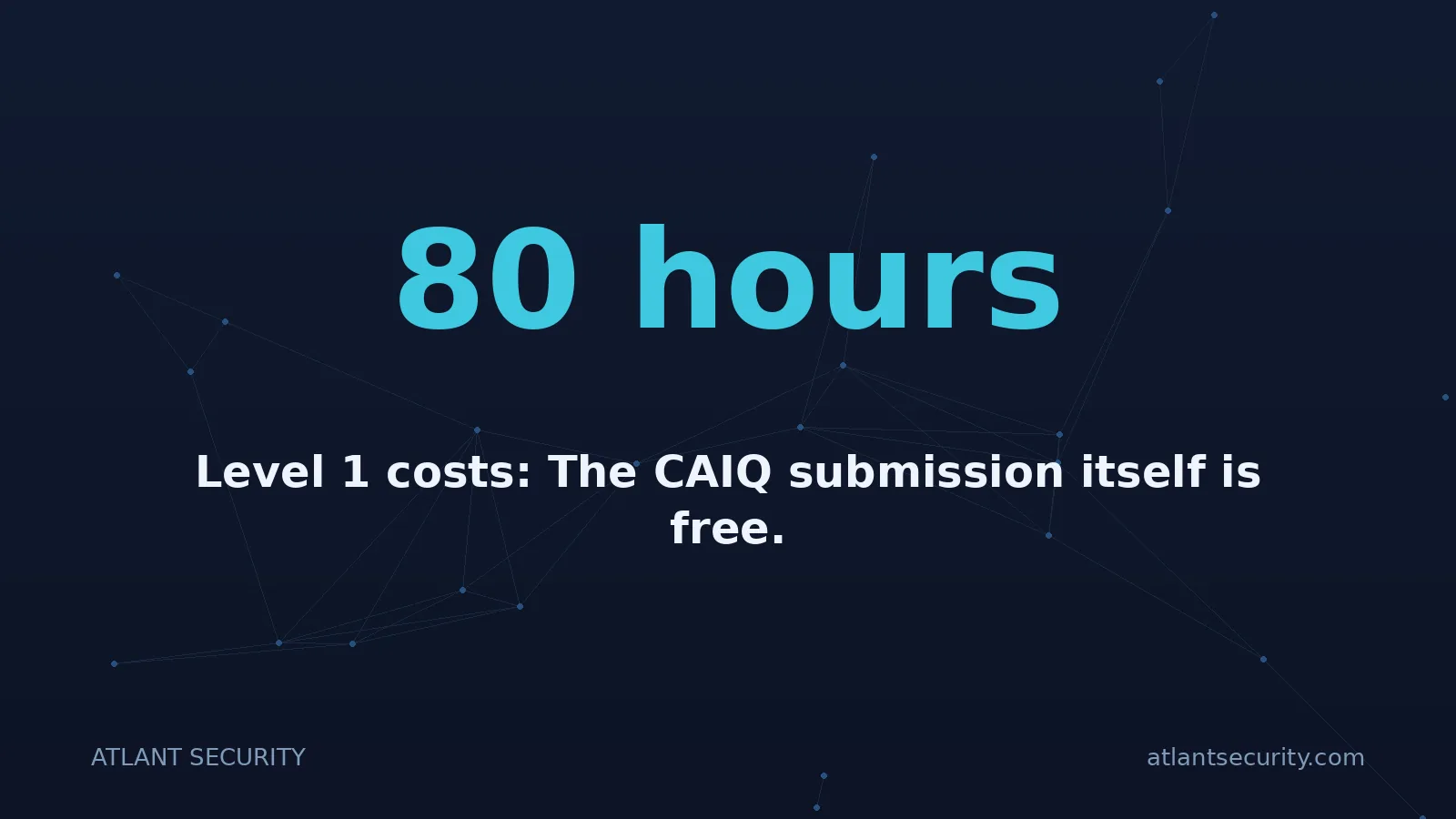
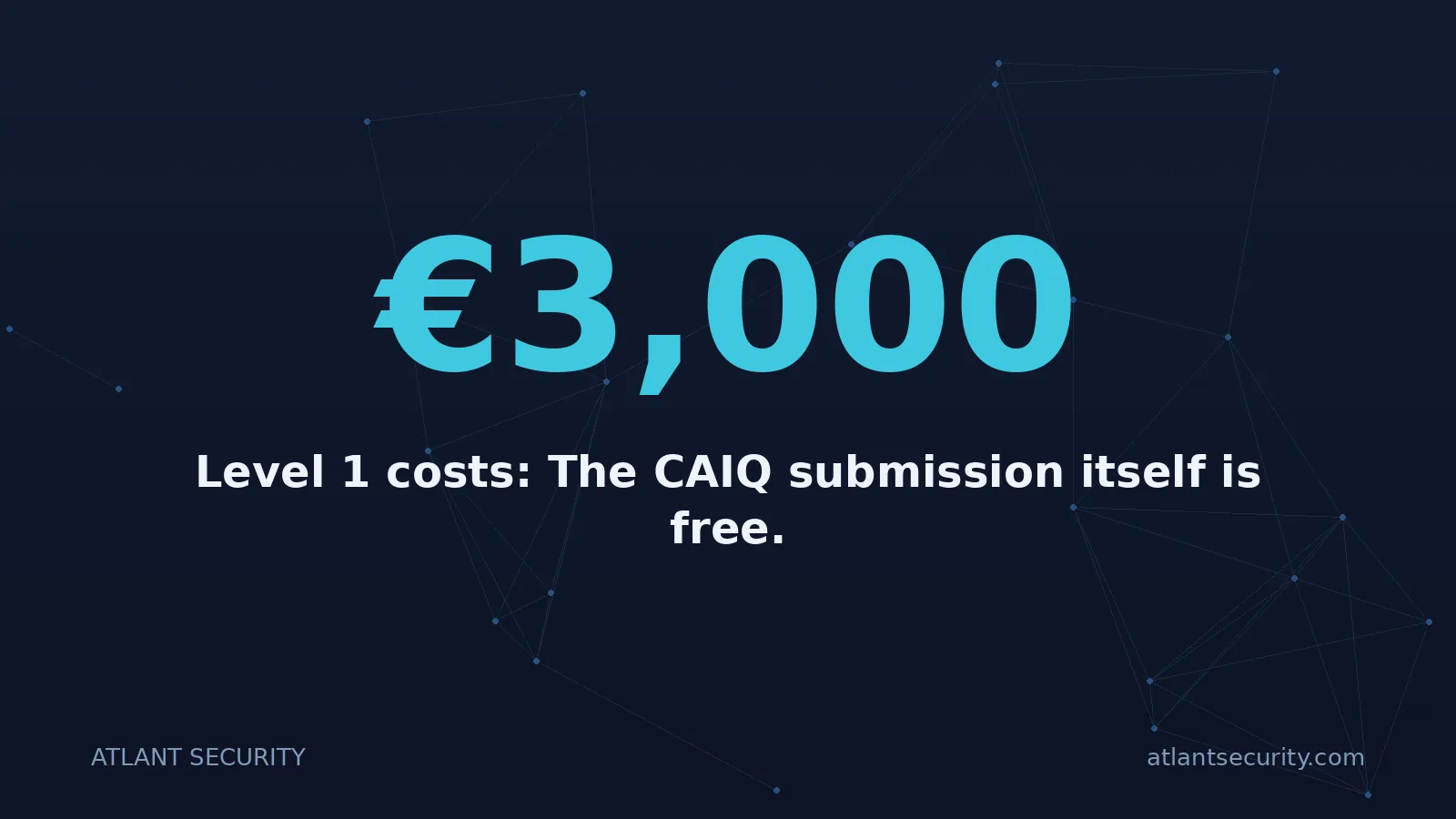
Level 1 costs: The CAIQ submission itself is free. Your real cost is the internal time required to thoughtfully complete the questionnaire. For a team with an existing security program, this is typically 40-80 hours of work spread across security, engineering, and operations stakeholders. If you engage a consultant to help, budget €3,000-€8,000.
Level 2 costs: This is where the investment gets real. The total cost depends heavily on your starting point:
| Scenario | Estimated Cost | Timeline |
|---|---|---|
| Starting from scratch (no SOC 2 or ISO 27001) | €80,000-€120,000+ | 6-12 months |
| Already have ISO 27001, adding CSA STAR | €40,000-€65,000 | 3-5 months |
| Already have SOC 2, adding CSA STAR Attestation | €40,000-€70,000 | 3-5 months |
| Have both ISO 27001 and SOC 2, adding STAR | €30,000-€50,000 | 2-4 months |
These figures include readiness consulting, audit fees, and internal effort. The largest variable is your current security maturity - organizations with well-documented policies, established access controls, and operational monitoring in place will spend far less on remediation than those building from the ground up.
Cost-Saving Insight
If you are planning to pursue both ISO 27001 and CSA STAR Level 2, do them together. Many audit firms can conduct both assessments in a single engagement, which significantly reduces duplicated effort and audit fees compared to running them sequentially. The CCM maps directly to ISO 27001 Annex A controls, so the evidence you prepare serves double duty.
Customer Trust
What Each Level Proves to Your Customers
Level 1 proves: You are aware of cloud security best practices. You have evaluated your controls against the CCM framework. You are willing to be transparent about your security posture. This is a statement of intent and awareness.
Level 2 proves: An independent third party has verified that your controls are designed effectively and operating as intended. Your security program has been scored on a maturity model. You have invested materially in cloud security. This is evidence of verified competence.
The gap between these two is enormous in enterprise sales. I have sat in procurement review meetings where a vendor with Level 1 was dismissed with “that is just self-reported” while a competitor with Level 2 sailed through security review. Right or wrong, this is the market reality.
Decision Framework
How to Decide: A Practical Framework
Here is the decision tree I walk clients through:
1. Who are your customers? If you sell primarily to SMBs or individual consumers, Level 1 is likely sufficient. If you sell to enterprises, government agencies, or regulated industries, you almost certainly need Level 2. If the evidence is the part that hurts, Venvera's ISO 27001 build keeps the Annex A controls, the statement of applicability and the proof for each in one place.
2. What does your sales team hear? Ask your account executives and solutions engineers: are prospects asking for third-party audit reports? Are you losing deals on security review? If the answer is yes, Level 2 pays for itself in closed revenue.
3. What is your competitive landscape? If your direct competitors have Level 2 and you do not, you are handing them a differentiation point on a silver platter.
4. What is your regulatory environment? Operating in the EU under NIS2, processing GDPR-regulated data, or serving financial services customers? Third-party attestation is rapidly becoming table stakes, not a differentiator.
5. What is your existing certification landscape? If you already have ISO 27001 or SOC 2, the incremental investment to add Level 2 is modest compared to the signal it sends. If you have neither, consider whether a combined ISO 27001 + CSA STAR engagement makes more sense than pursuing them separately.
EU Procurement Reality Check
In 2026, I am seeing a clear trend in European enterprise procurement: third-party cloud security attestation is moving from “nice to have” to “required.” The combination of NIS2 supply chain requirements, DORA for financial services, and increasing GDPR enforcement rigor means that self-assessments - regardless of how well done - are progressively less acceptable as sole evidence of cloud security due diligence. If your roadmap includes serving regulated European enterprises, plan for Level 2.
FAQ
Frequently Asked Questions
Can I skip Level 1 and go directly to Level 2?
Yes. There is no requirement to complete Level 1 before pursuing Level 2. Many organizations go directly to Level 2, especially if they already have ISO 27001 or SOC 2 in place. However, completing the CAIQ as a Level 1 exercise first can be a useful readiness assessment to identify gaps before engaging an auditor.
Is CSA STAR Level 2 the same as SOC 2 + CCM?
CSA STAR Attestation (one path to Level 2) is built on the SOC 2 framework with the CCM as additional criteria. A CPA firm conducts a SOC 2 examination and simultaneously evaluates your controls against the CCM. The result is a SOC 2 + CCM report. The other path, CSA STAR Certification, is built on ISO 27001 with CCM as additional criteria. Either path qualifies as Level 2.
How long is a CSA STAR Level 2 certification valid?
CSA STAR Certification (ISO 27001 path) follows the ISO 27001 three-year cycle with annual surveillance audits. CSA STAR Attestation (SOC 2 path) typically covers a 12-month reporting period with annual renewal. In both cases, you need to maintain the certification actively - it is not a one-time achievement.
Does Level 2 replace the need for SOC 2 or ISO 27001?
No - Level 2 is built on top of one of these standards. You will receive both: the underlying SOC 2 report or ISO 27001 certificate, plus the CSA STAR attestation or certification. Think of Level 2 as an additive layer that extends your existing certification with cloud-specific controls, not a replacement for it.
We are a small team with limited budget. Is there a middle ground?
Start with Level 1 as a structured gap analysis, then use the findings to build your remediation roadmap. Once you have the controls in place, pursue ISO 27001 + CSA STAR Level 2 as a combined engagement. This phased approach spreads the cost across 12-18 months while still getting you to Level 2. Many of our clients follow this exact path - it is the most cost-effective route for growing companies.
Is CSA STAR recognized by European regulators?
CSA STAR is widely recognized by European enterprises and increasingly referenced in EU cloud security discussions. While it is not a regulatory requirement in itself, the European Union Agency for Cybersecurity (ENISA) has recognized the CSA STAR program as a relevant cloud security assurance scheme. Combined with ISO 27001, CSA STAR Level 2 provides strong evidence of compliance with NIS2 supply chain security requirements and GDPR technical and organizational measures.
Not Sure Which Level You Need? Let’s Figure It Out Together.
We help cloud service providers across Europe navigate CSA STAR certification - from initial CAIQ gap analysis through full Level 2 audit preparation.
Book a Meeting With An Expert and we will assess your current posture, recommend the right level, and map out a realistic timeline and budget.
Published: March 2026 · Author: Alexander Sverdlov
This article is for informational purposes only and does not constitute legal or professional advice. CSA STAR requirements and pricing may vary based on scope, auditor, and organizational complexity. Contact us for a tailored assessment.
Related services from Atlant Security: SOC 2 Readiness, ISO 27001 Readiness, CSA STAR Readiness. Book a discovery call to discuss your specific situation.
Going for CSA STAR?
We assess you against the CCM, close the gaps with your team and prepare the evidence for Level 1 self-assessment or Level 2 certification, so the audit is a formality rather than a scramble.
See CSA STAR readiness