
We have probably seen your problem before. Our smallest client had eight employees. Our largest secures the nuclear power plant of the United Arab Emirates. Whatever shape yours is, tell us about it and we will tell you how we would fix it.
Security Warning · AI Threats · April 2026
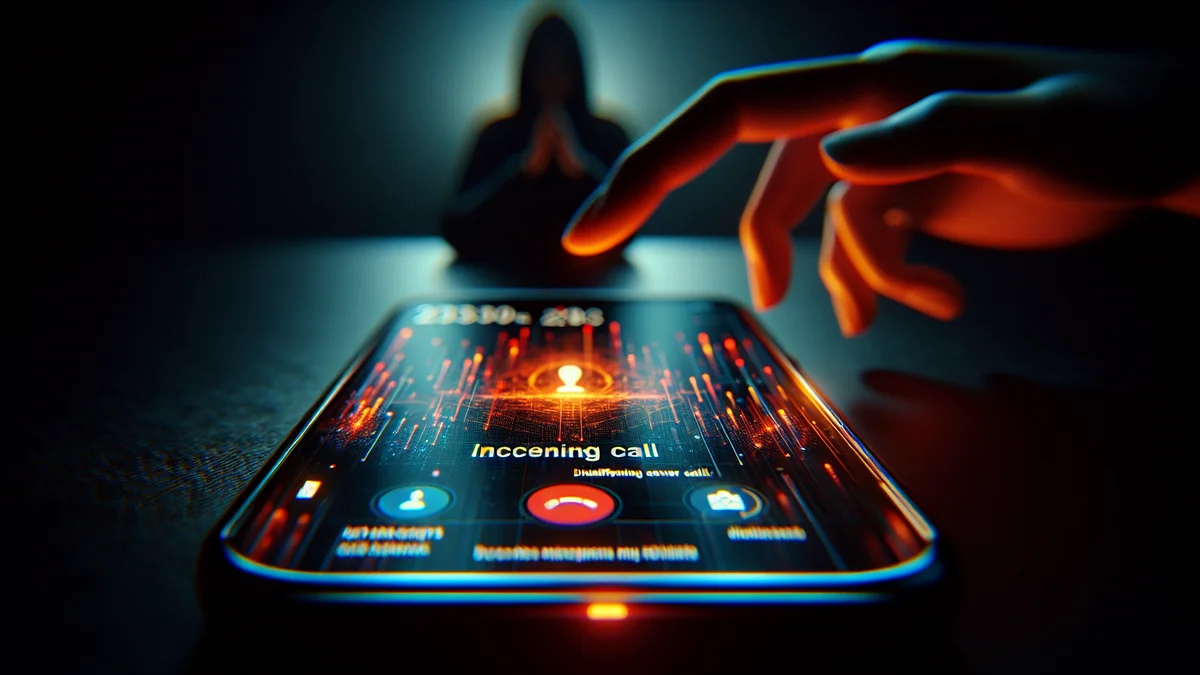
A real client case: an AI-generated voice impersonated their bank’s fraud department with terrifying accuracy. The attack combined a spoofed toll-free number, synthetic speech, and a live human closer to harvest banking credentials. This is the full breakdown - and your defense playbook.
Key Takeaways
- AI-generated voices are now indistinguishable from real human callers - your team cannot rely on “it sounds real” as verification
- Attackers use a hybrid model: AI voice for the initial contact, then transfer to a live human for complex social engineering
- Toll-free 888 numbers, bank names on caller ID, and insider-sounding terminology are all trivially spoofed
- The single most effective defense: never take security actions based on incoming calls - always hang up and call back on a verified number
- Credential harvesting sites hosted on web.app, netlify.app, and vercel.app are a major red flag - no legitimate bank uses these domains
- Businesses need simulated vishing exercises the same way they run phishing simulations - annual security awareness training alone is no longer sufficient
Three weeks ago, the CFO of one of our clients - a mid-sized logistics company with about 200 employees - received a phone call that nearly cost the company everything in its operating accounts.
The caller ID showed 888-488-8279. A toll-free number. The kind of number you expect from a bank. The first voice was female - professional, calm, slightly concerned. It identified itself as calling from the bank’s fraud prevention department.
“We’re calling to verify whether you authorized a wire transfer from your business accounts to a power company. Our system flagged the transaction because the originating IP address is located in Singapore.”
The CFO’s stomach dropped. They had not authorized any wire transfer. They had no business with any power company. And Singapore? Nobody on their team was in Singapore. The call already felt real. The urgency was immediate.
Then came the transfer. “I’m going to connect you with a specialist on our fraud investigation team.” A brief hold - muzak, the kind you hear on every real bank call - and then a male voice picked up. He had a slight accent, spoke quickly but clearly, and immediately began asking questions that sounded like they came from someone who had the company’s banking information in front of him.
The CFO asked the obvious first question: “Which account is this about? Can you give me the last few digits?”
The answer: “The transaction was attempted on all of them.”
That should have been the red flag that ended the call right there. A real bank fraud department would name the specific account. But the caller pivoted seamlessly. He said they were already returning the transactions unpaid. He asked the CFO to make sure they could still log into their online banking - “just to make sure the attackers haven’t locked you out.” The CFO checked. They could still log in. A small wave of relief.
Then the caller asked something that made him sound deeply legitimate: “Are you using version 22 or 23 of the business online banking platform?”
This is the kind of detail that only someone who works at the bank would know - or so it seemed. In reality, this information is available to anyone who has ever logged into the platform, or who has done basic reconnaissance on the bank’s publicly accessible login pages. But to the CFO, in the heat of the moment, it felt like proof that this caller was real.
The CFO’s instincts kicked in one more time. “Can I call you back to verify that this is really the bank?”
The response was practiced and smooth: “Of course, I understand your concern. But I want to reassure you - we haven’t asked you for any information. And if you call back, it will take quite a while to get routed back to this department. In the meantime, your ACH capability may be blocked as a security measure.”
Two techniques in a single sentence. First, a preemptive objection handler: “we haven’t asked for information” - designed to make the CFO feel safe because, technically, they hadn’t asked for a password yet. Second, manufactured urgency: if you hang up, your ACH transactions will be frozen. For a logistics company that processes dozens of ACH payments daily, that threat is existential.
Then came the kill shot. The caller said that to prevent the ACH block, the CFO needed to log into a specific portal so the fraud team could verify and unblock their ACH capability. The URL they provided was:
bmo-hubsupport.web.app
Not bmo.com. Not a subdomain of the real bank. A credential harvesting page hosted on Google’s Firebase platform - web.app - a free hosting service that anyone can sign up for in minutes.
This is where the story could have ended in catastrophe. But the CFO had been through our security awareness training six months earlier. One of the specific scenarios we had covered was URL verification - checking that any banking URL matches the exact domain of your actual bank. The moment the caller said “web.app,” alarm bells went off.
The CFO hung up. Called us. Called the bank on the verified number from their website. The bank confirmed: no wire transfers had been attempted, no fraud alerts had been issued, and they had not called. The entire thing - from the 888 number to the AI-generated female voice to the smooth-talking “specialist” - was a sophisticated social engineering attack. And if not for one URL that didn’t look right, it would have worked.
Understanding the Threat
Anatomy of an AI Vishing Attack
What happened to our client was not a random robocall. It was a carefully orchestrated, multi-stage social engineering operation that combined AI automation with human psychology. Here is how each stage works and why it is so effective.
| Stage | Tactic | Psychological Principle |
|---|---|---|
| 1. Phone Number Spoofing | Caller ID displays a legitimate-looking 888 toll-free number | Authority bias - toll-free numbers signal corporate legitimacy |
| 2. AI Voice Initial Contact | AI-generated female voice with natural cadence, emotional inflection, and scripted fraud alert | Fear activation - “wire fraud” triggers immediate emotional response |
| 3. Transfer to Live Human | Hold music, then a human “specialist” who can adapt to unexpected questions | Consistency bias - already invested time in the call, less likely to hang up |
| 4. Credibility Building | Insider-sounding questions (“version 22 or 23?”), references to specific banking features | Social proof - “they know things only a bank employee would know” |
| 5. Urgency Manufacturing | Threat of frozen ACH capability, active wire fraud, limited time to act | Scarcity/loss aversion - fear of losing access overrides caution |
| 6. Objection Handling | Pre-scripted responses to “can I call you back” and “how do I verify this” | Reciprocity - “we’re helping you, trust us” |
| 7. Credential Harvesting | Directing to a look-alike login page on a free hosting domain (web.app) | Compliance momentum - already followed 6 steps, one more feels natural |
Each step is designed to build on the one before it. By the time the victim reaches Stage 7, they have already emotionally committed to the narrative. They believe their money is at risk. They believe they are speaking to their bank. They believe the URL they are being directed to is a security tool that will help them. The credential harvesting page itself looks identical to the real banking login - because cloning a login page takes about ten minutes with freely available tools.
What makes this attack fundamentally different from the robocalls of five years ago is Stage 2. The AI voice. It does not sound like a robot. It does not have awkward pauses. It has natural rhythm, appropriate emotional undertones, and it responds to initial questions with pre-programmed branching logic. The victim’s first interaction is designed to feel exactly like a real bank representative - because modern text-to-speech with emotional synthesis is that good.
The Escalating Threat
Why AI Makes Voice Phishing Exponentially More Dangerous
Phone scams are not new. What is new is the technology that now powers them. Here is what has changed and why security leaders need to treat AI vishing as a categorically different threat from traditional phone fraud.
AI Voices Are Indistinguishable from Human Voices
In controlled studies, listeners can no longer reliably tell the difference between AI-generated speech and real human speech. The latest text-to-speech models produce voices with natural breathing patterns, micro-hesitations, and emotional inflection. They can convey concern, urgency, authority, and warmth. When the first voice our client heard said “We’re calling from the fraud prevention department,” there was nothing robotic about it. No uncanny valley. No synthetic artifacts. Just a professional woman’s voice delivering alarming news.
Voice Cloning from Seconds of Audio
Modern voice cloning requires as little as three seconds of sample audio to produce a convincing replica of a specific person’s voice. Think about what that means: a voicemail greeting, a conference presentation on YouTube, a podcast appearance, an earnings call recording - any of these provides enough material for an attacker to clone a CEO’s voice and use it to authorize fraudulent wire transfers. We have seen cases where attackers cloned a CFO’s voice from a LinkedIn video and used it to call the accounting department with “urgent” payment instructions.
Scalability: Hundreds of Simultaneous Calls
A human scammer can make one call at a time. An AI system can make hundreds. The economics have inverted: where phone fraud once required call centers full of social engineers, a single operator with an AI voice platform and a VoIP system can run hundreds of concurrent vishing calls across different targets. The AI handles the initial contact, qualifies the target, builds initial rapport, and only routes “promising” calls to the human closer. It is a funnel, exactly like a sales operation - except the product is fraud.
AI Does Not Get Nervous, Does Not Make Mistakes, and Does Not Have Mismatched Accents
One of the traditional tells for phone scams was the caller’s behavior under pressure: hesitation when asked unexpected questions, a thick foreign accent from someone claiming to be “John from the local branch,” background noise from a call center. AI eliminates all of these. The voice is perfectly calm, perfectly consistent, speaks with whatever regional accent is programmed, and has no background noise. It is, in some ways, more convincing than a real bank employee.
The Hybrid Model Is the Most Dangerous
What our client experienced - AI for the opener, human for the close - is the most effective vishing architecture currently in use. The AI voice is perfect for scripted, predictable interactions: delivering the initial fraud alert, creating urgency, and establishing the narrative. But when the target starts asking unexpected questions (“which account specifically?”), an AI can stumble. The transfer to a human “specialist” solves this problem. The human can improvise, handle objections, and adapt in real time. The combination of AI scale and human adaptability makes this model devastatingly effective.
The Numbers Are Alarming
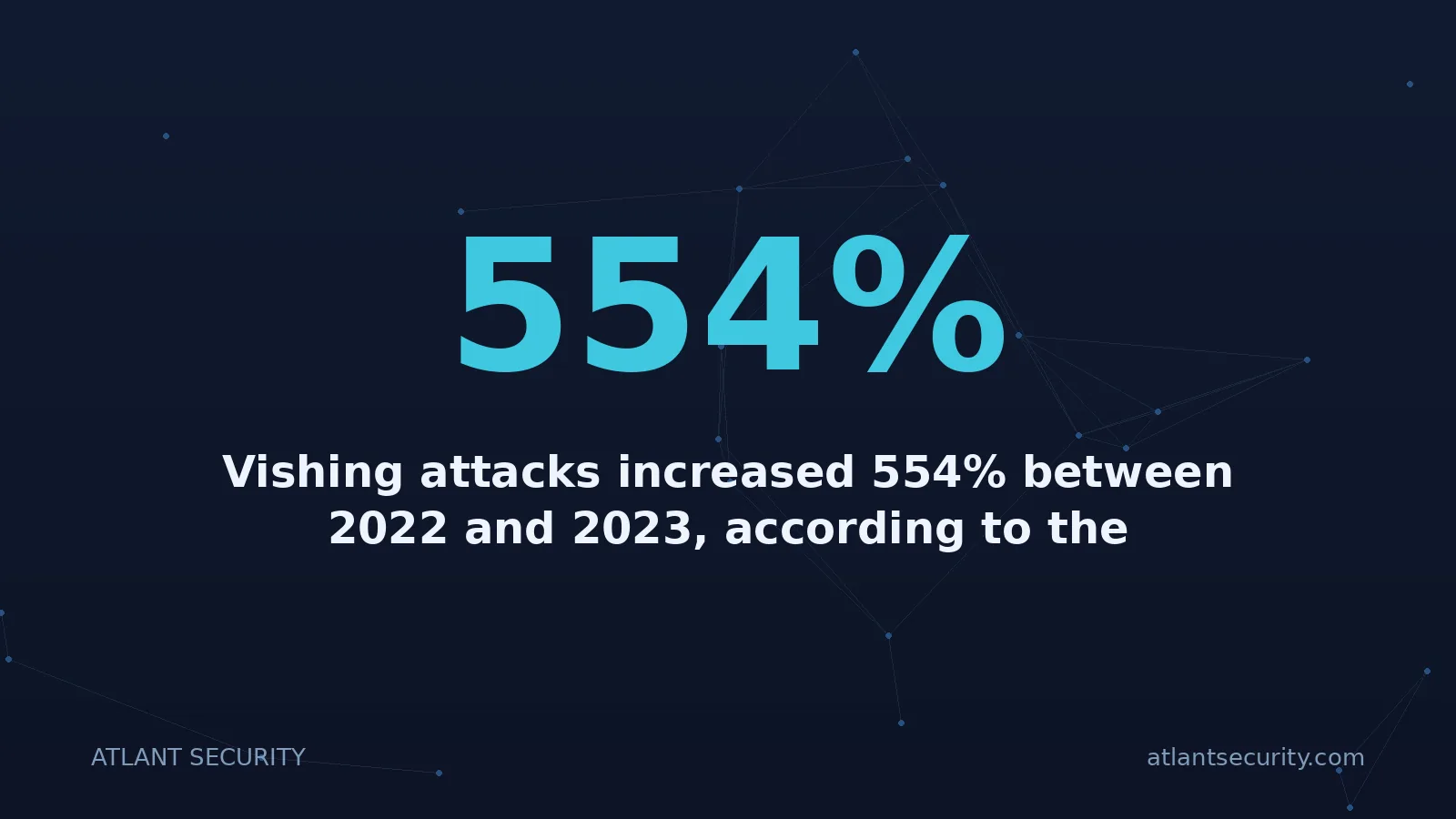
Vishing attacks increased 554% between 2022 and 2023, according to the CrowdStrike Global Threat Report. AI-powered social engineering - including vishing, deepfake video calls, and voice-cloned authorization fraud - is projected to cause over $25 billion in losses by 2026. The FBI’s IC3 reported that business email compromise and its voice-enabled variants accounted for $2.9 billion in losses in the United States alone in 2023. Voice-based attacks are now the fastest-growing category of social engineering.
Detection
The 9 Warning Signs This Client’s CFO Spotted (Eventually)
In our post-incident review with the CFO, we dissected the call moment by moment. Some of these red flags were only obvious in hindsight. Others were subtle enough that even experienced professionals would miss them. Here they are - and for each one, we have included what a legitimate bank fraud department would actually do instead.
| Warning Sign | Why It Matters | What a Real Bank Would Do |
|---|---|---|
| 1. The AI voice had a slightly too-perfect cadence | Real humans stumble, self-correct, and speak unevenly. AI speech is unnervingly smooth. | A real representative would sound like a real person - imperfect, sometimes distracted, occasionally saying “um.” |
| 2. “All of them” instead of a specific account | The attacker did not have real account numbers and could not bluff specific digits. | A real fraud alert references the specific account number and transaction amount. |
| 3. Discouraged calling back | A callback to the real bank number would expose the fraud immediately. | Real fraud departments encourage you to hang up and call the number on your card or statement. |
| 4. URL was bmo-hubsupport.web.app | web.app is Google Firebase free hosting. No bank uses it. | A real bank would direct you to their official domain only - never a third-party hosting platform. |
| 5. Asked the client to “verify login” | Banks never ask you to log in during an outbound call - this is always a credential harvesting setup. | A real bank would lock the account on their end and ask you to visit a branch or call in. |
| 6. Manufactured urgency about ACH being blocked | Creates time pressure so the victim acts before thinking critically. | A real bank would say “we’ve already secured your account” - not threaten consequences for inaction. |
| 7. Insider-sounding knowledge but no specifics | Knowing “version 22 vs 23” sounds impressive but is publicly researchable. The attacker could not produce account details. | A real bank representative would have your account details on screen and would verify you, not the other way around. |
| 8. The AI-to-human transfer felt slightly off | The transition from AI to human had a different audio quality and cadence shift that felt unnatural. | Real bank transfers happen within the same phone system and maintain consistent audio quality. |
| 9. They asked which “version” of online banking | A bank employee would already have this information tied to the customer’s profile. | A real bank representative would know which platform version you are using without asking. |
The most important takeaway from this table: no single red flag was definitive on its own. It was the accumulation of small inconsistencies that ultimately triggered the CFO’s suspicion. And even then, the call nearly succeeded. The attacker had an answer for almost every objection. That is what makes AI-powered vishing so dangerous - the attack is engineered to survive scrutiny, not just avoid it.
Actionable Defense
How to Protect Your Business from AI Vishing
Technical controls alone will not stop vishing. Unlike email phishing, which can be partially filtered by technology, vishing attacks happen on a communication channel - the telephone - where there are essentially no automated defenses. Protection comes down to policy, training, and verification procedures. Here are the eight defenses that actually work.
1. Policy: Never Act on Inbound Calls
This is the single most effective defense against every form of vishing, AI-powered or otherwise. Establish a company-wide policy: no financial actions, no credential entry, no account changes, and no sensitive information will ever be provided in response to an incoming call, regardless of who the caller claims to be. If someone calls claiming to be your bank, your vendor, the IRS, or your CEO - the response is always the same: “Thank you, I’ll call you back.” Then hang up and dial the known, verified number.
The Single Most Effective Defense
“We never take security actions based on incoming calls. We always call back on a verified number.” Print this on a card. Tape it next to every phone in your finance department. Make it the first slide in every security training session. This one rule, consistently followed, defeats 100% of vishing attacks - including AI-powered ones.
2. Verify Independently
Never use a callback number provided by the caller. Not even if they say “you can Google it.” Attackers have been known to manipulate Google Business listings and search ads to display fraudulent phone numbers. Always use the number printed on the back of your bank card, on your most recent paper statement, or on the institution’s official website that you navigate to directly (not via a link someone provides).
3. Establish Internal Code Words
For any internal financial verification request - wire transfers, account changes, vendor payment modifications - establish a rotating code word or passphrase known only to authorized personnel. When the “CEO” calls the accounting department to authorize an urgent wire transfer, the first response should be: “What is the code word?” An AI clone of your CEO’s voice cannot provide a code word it has never heard.
4. URL Verification Training
This is what saved our client. Train every employee who handles finances to recognize legitimate URLs versus imposters. The rule is simple: if the domain is not exactly yourbankname.com, it is fake. Domains ending in web.app, netlify.app, vercel.app, github.io, or pages.dev are free hosting platforms. They are commonly abused for credential harvesting because they are free, fast to set up, and come with HTTPS by default (so the padlock icon appears, which many people still incorrectly trust as a sign of legitimacy). See our guide to recognizing phishing with real examples for more on this.
5. Dual Authorization for Financial Transactions
No single person should have the authority to approve wire transfers, change vendor payment details, or modify banking credentials. Implement dual authorization where any financial action above a threshold (e.g., $5,000) requires approval from two authorized individuals using separate communication channels. Even if a vishing attack compromises one person, the second approver provides a critical verification checkpoint.
6. AI Voice Awareness Training
Most employees have never heard a high-quality AI-generated voice in a realistic scenario. They do not know what to listen for because they do not know the technology exists at this level of sophistication. Include AI voice demonstrations in your security training: play examples of AI-generated speech, voice clones, and real-versus-AI comparisons. The goal is not to teach employees to reliably detect AI voices - that is increasingly impossible - but to teach them that a voice sounding real is no longer proof that it is real.
7. Phone Number Spoofing Awareness
Many employees, including senior executives, still believe that caller ID is reliable. It is not. Phone number spoofing is trivially easy with SIP trunking and VoIP services. An attacker can make any number appear on your caller ID - your bank’s real number, an 888 toll-free number, even your own company’s main line. Teach your team: caller ID is cosmetic, not verified. Treat it like the “From” name on an email - it can be set to anything.
8. Simulated Vishing Exercises
You almost certainly run simulated phishing campaigns via email. It is time to do the same with phone calls. Hire a social engineering firm to conduct simulated vishing calls against your finance team, your reception desk, your C-suite, and your IT help desk. Measure who follows the callback policy, who provides information, and who gets redirected to a credential harvesting page. The results are always eye-opening - and they drive policy compliance far more effectively than another PowerPoint presentation.
Building Resilience
How to Train Your Team: A Practical Vishing Awareness Program
Security awareness training that consists of an annual webinar and a quiz is not effective against AI-powered social engineering. The attacks are too sophisticated, too personalized, and too psychologically manipulative to be countered by a once-a-year refresher. Here is what an effective vishing awareness program looks like.
Quarterly Vishing Awareness Sessions
Conduct focused 30-minute sessions every quarter, not annually. Each session should cover a real-world vishing incident (anonymized like the one in this article) and walk through the attack step by step: what the attacker did, what psychological principles they exploited, and where the victim either caught the fraud or did not. Real examples are dramatically more effective than theoretical warnings.
Role-Playing Exercises
Divide employees into pairs. One person plays the attacker, one plays the target. Give the “attacker” a script based on a real vishing scenario. Let the “target” practice responding: asking verification questions, refusing to provide information, hanging up and calling back. This builds muscle memory. When a real attack comes, the response should be automatic, not something the employee has to think through under pressure.
Reward Employees Who Report Suspicious Calls
Create a positive feedback loop. When an employee receives a suspicious call and reports it to IT or security, recognize them - publicly, in a team meeting, or with a small incentive. This accomplishes two things: it reinforces the reporting behavior, and it signals to the entire organization that suspicious call reporting is valued, not treated as paranoia. Never penalize employees who report calls that turn out to be legitimate. The cost of a false positive (investigating a real bank call) is infinitely less than the cost of a false negative (missing a vishing attack).
Post-Incident Reviews
After any vishing attempt - successful or not - conduct a formal review within 48 hours. What happened? How did the attacker get the target’s direct number? What social engineering techniques were used? At what point did the target become suspicious (or not)? What policies or training would have changed the outcome? Document the findings and use them in the next quarterly training session.
Create a Vishing Playbook for High-Risk Roles
Reception staff, finance teams, accounts payable, and executive assistants are the primary targets for vishing attacks. Create a one-page playbook specifically for these roles. It should include: (1) the callback policy, (2) verification questions to ask callers claiming to be from financial institutions, (3) the process for reporting suspicious calls, (4) the list of known legitimate phone numbers for your bank and key vendors, and (5) explicit permission to hang up on any caller who resists verification. Laminate it. Keep it next to every phone.
Incident Response
What to Do If You Suspect You’ve Been Vished
If you or an employee entered credentials, provided account information, or even just feel uncertain about a call you received, take these steps immediately. Speed matters - in credential harvesting attacks, attackers often use stolen credentials within minutes.
Immediate Response Checklist
- Change all potentially exposed credentials immediately. If you entered banking credentials on a suspicious site, change your online banking password right now. Do not wait. Change any other accounts that share the same password (which, ideally, should be none).
- Call your bank on their verified phone number. Not the number from the suspicious call. The number on the back of your bank card or on your paper statement. Alert them to the potential compromise. Request that they flag your accounts for suspicious activity, freeze outbound transfers if necessary, and issue new credentials.
- Alert your IT and security team. They need to assess whether any systems were compromised, whether the attacker may have gained access to email or other internal systems, and whether other employees were targeted simultaneously.
- Preserve all evidence. Save call logs showing the phone number and time. Screenshot any URLs you visited. Document everything you remember about the conversation - what was said, what was asked, what you provided. This evidence is critical for law enforcement and for your own incident investigation.
- File an IC3 report. The FBI’s Internet Crime Complaint Center (ic3.gov) accepts reports of internet-enabled financial crime, including vishing. Filing a report creates a record that helps law enforcement identify patterns, track criminal organizations, and in some cases recover stolen funds.
- Brief all staff who handle finances. If one person in your organization was targeted, others may be targeted too - either simultaneously or in the following days. Send an immediate alert to all finance, accounting, and executive team members describing the attack and reminding them of the callback verification policy.
Time Is Critical
In banking credential theft, attackers typically initiate unauthorized transactions within 5 to 15 minutes of obtaining credentials. The window between credential theft and fund transfer is extremely narrow. If you believe credentials were compromised, do not wait until morning, do not schedule a meeting, do not “think about it.” Act immediately.
Frequently Asked Questions
FAQ: AI Voice Phishing (Vishing)
How realistic are AI-generated voices now?
Extremely realistic. The latest text-to-speech models produce voices with natural breathing, emotional inflection, micro-pauses, and regional accents. In blind listening tests, participants correctly identify AI-generated speech at rates only marginally better than random chance. For practical purposes, you should assume that any voice on a phone call could be AI-generated and make verification decisions based on process, not on how the caller sounds.
Can attackers clone my CEO’s voice to authorize transfers?
Yes. Voice cloning technology requires as little as three seconds of audio to create a usable clone. Your CEO’s voice is likely available from earnings calls, conference presentations, podcast appearances, YouTube videos, or even voicemail greetings. This is exactly why internal code words and dual authorization policies exist - they provide verification that voice identity alone cannot.
How do attackers get our phone numbers and banking details?
From multiple sources: corporate websites list executive names and sometimes direct phone numbers, LinkedIn profiles reveal job titles and roles, data breaches expose email addresses and phone numbers, and public business filings contain banking relationships. Attackers also purchase targeted business data from data brokers. In our client’s case, the attacker knew they banked with a specific institution - this information is often visible in public SEC filings, procurement documents, or even job postings that mention specific banking platforms.
What is the difference between vishing and regular phone scams?
Traditional phone scams rely on volume and untargeted scripts - “this is the IRS, you owe back taxes.” Vishing (voice phishing) is targeted social engineering: the attacker has researched the specific victim, knows their bank, references real products and features, and has a multi-stage plan to extract specific credentials or authorize specific transactions. AI-powered vishing adds another layer: the ability to scale targeted attacks using synthetic voices that are indistinguishable from humans.
Should we stop answering calls from unknown numbers?
That is impractical for most businesses. A better approach is to answer all calls but never take security-sensitive actions during an incoming call. If someone claims to be from your bank, a vendor, or a government agency and asks you to verify information, change credentials, visit a URL, or authorize a transaction - tell them you will call back, hang up, and verify independently. You can answer unknown calls; you just cannot trust them.
How often should we train staff on vishing?
Quarterly, at minimum. Annual training is insufficient because the threat landscape changes too quickly and because security awareness fades over time without reinforcement. Combine quarterly awareness sessions with at least two simulated vishing exercises per year. Finance teams and executive assistants should receive additional, role-specific training given that they are the primary targets.
Are there technical defenses against caller ID spoofing?
STIR/SHAKEN is a framework adopted by US carriers to authenticate caller ID, but its adoption is incomplete and it has known limitations. It works best for calls between major carriers and does not cover international or VoIP-originated calls effectively. Some enterprise phone systems offer call authentication features, and some banks are implementing voice biometrics for customer verification. However, none of these technologies are reliable enough to be your sole defense. Policy-based controls (the callback rule) remain more effective than any current technical solution.
What should our phone call verification policy look like?
Your policy should state: (1) No employee will take security-sensitive actions based on an incoming phone call. (2) Any caller requesting financial actions, credential changes, or sensitive information will be told the company will call back on a verified number. (3) Verified numbers are maintained in an internal directory and are sourced from official documents, not from caller-provided numbers. (4) Wire transfers and payment changes above a defined threshold require dual authorization from two separate individuals via two separate communication channels. (5) All suspicious calls must be reported to IT/security within one hour. (6) No employee will be penalized for following this policy, even if the call turns out to be legitimate.
Would Your Team Fall for an AI Vishing Attack?
We run simulated social engineering assessments that include AI-powered vishing calls, phishing campaigns, and physical intrusion testing. Find out where your team’s real vulnerabilities are - before an attacker does.
Last Updated: April 2026 · Author: Alexander Sverdlov
This article is based on a real client incident. Company details have been anonymized to protect client confidentiality. The technical details and attack methodology are presented accurately for educational purposes. The phone number and URL referenced in this article were used in an actual vishing attack and are included to help organizations recognize similar threats. This content is for informational purposes only and does not constitute legal advice. Organizations should consult with legal counsel regarding their specific reporting obligations.
Related services from Atlant Security: FinTech vCISO, IT Security Audit, Virtual CISO. Book a discovery call to discuss your specific situation.
Smaller company, no security team?
Most small companies need six controls, not a fourteen-point programme. We tell you which six, fix them with you, and are straight about what you can safely skip.
See small business cybersecurity