

Virtual CISO · Small Business Security
Your business faces the same cyber threats as Fortune 500 companies. The difference is they have a $400K CISO and a security team. Here’s how small organizations get the same caliber of leadership at a fraction of the cost.
Here’s something that doesn’t get said often enough: small organizations are not too small for cybersecurity leadership. They’re too small to waste money on the wrong kind of it.
If you run a 20-person SaaS company, a 50-employee healthcare practice, or a growing fintech startup, you already know the pressure. Customers are asking about your SOC 2 report. Your cyber insurance application has questions you can’t answer. Your IT person is doing their best, but security strategy isn’t the same as managing laptops and email.
A Virtual CISO (vCISO) solves this problem. Not by adding another full-time executive to your payroll, but by giving you access to senior security leadership on terms that actually make sense for your size and budget. Let’s look at exactly what that means, what it costs, and how to know if it’s the right fit.
The Reality Check
The Small Organization Security Paradox
There’s a painful irony in cybersecurity: the organizations least equipped to handle a breach are the ones most likely to be targeted. Attackers don’t look for the most valuable target-they look for the easiest one. And small organizations, often running with minimal security controls and no dedicated security staff, are exactly that.
The Numbers Tell the Story
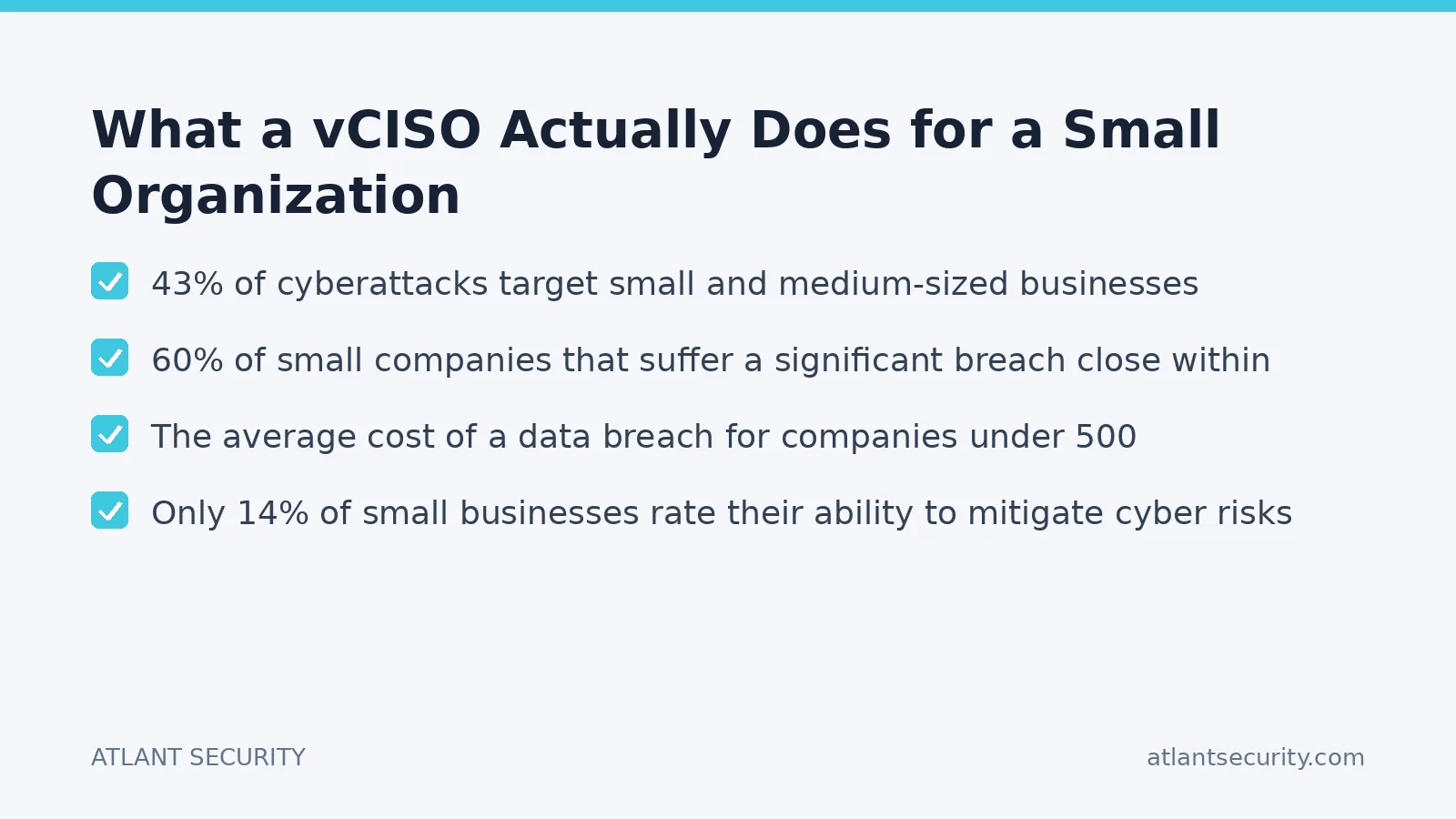
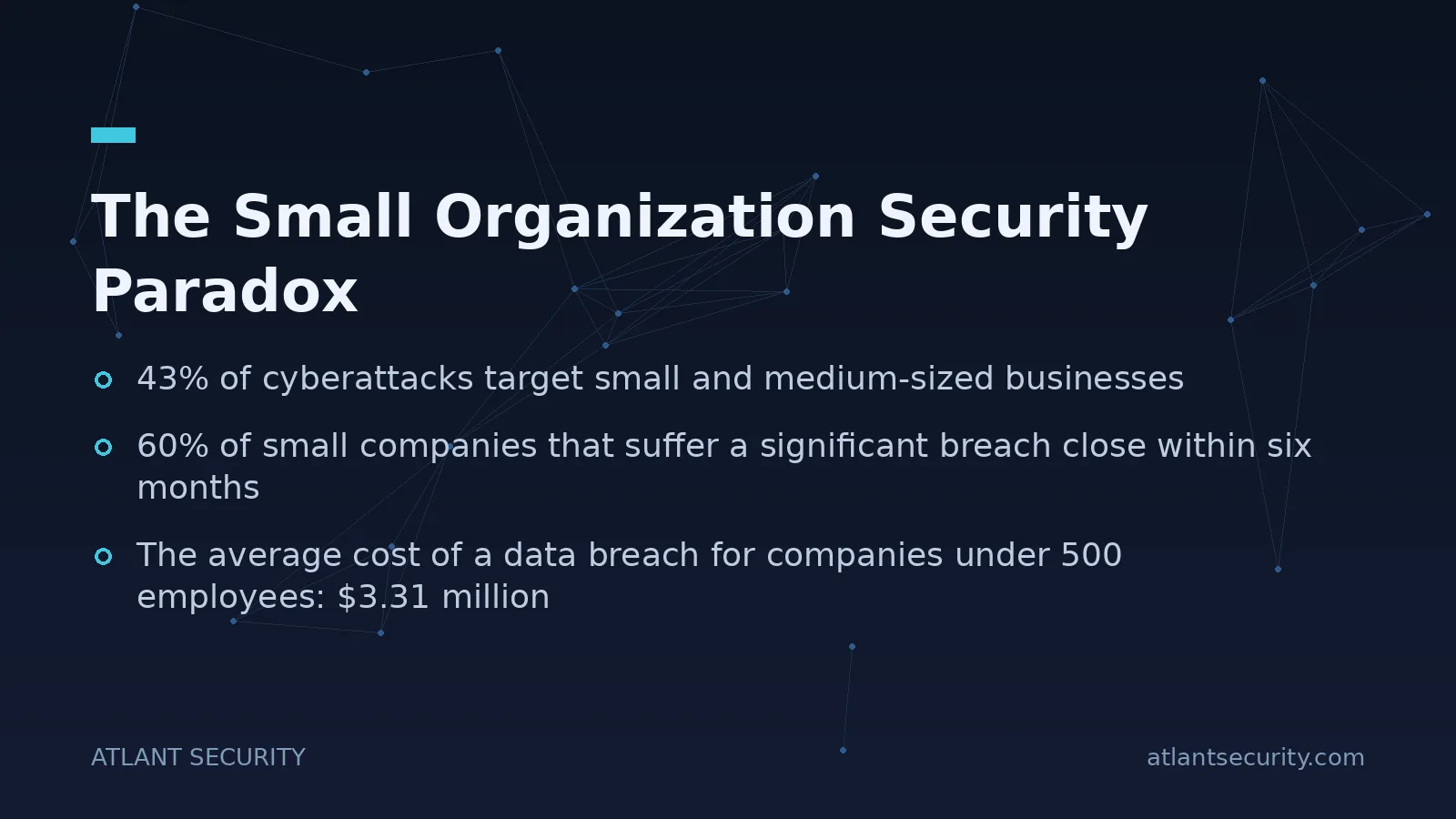
- 43% of cyberattacks target small and medium-sized businesses
- 60% of small companies that suffer a significant breach close within six months
- The average cost of a data breach for companies under 500 employees: $3.31 million
- Only 14% of small businesses rate their ability to mitigate cyber risks as highly effective
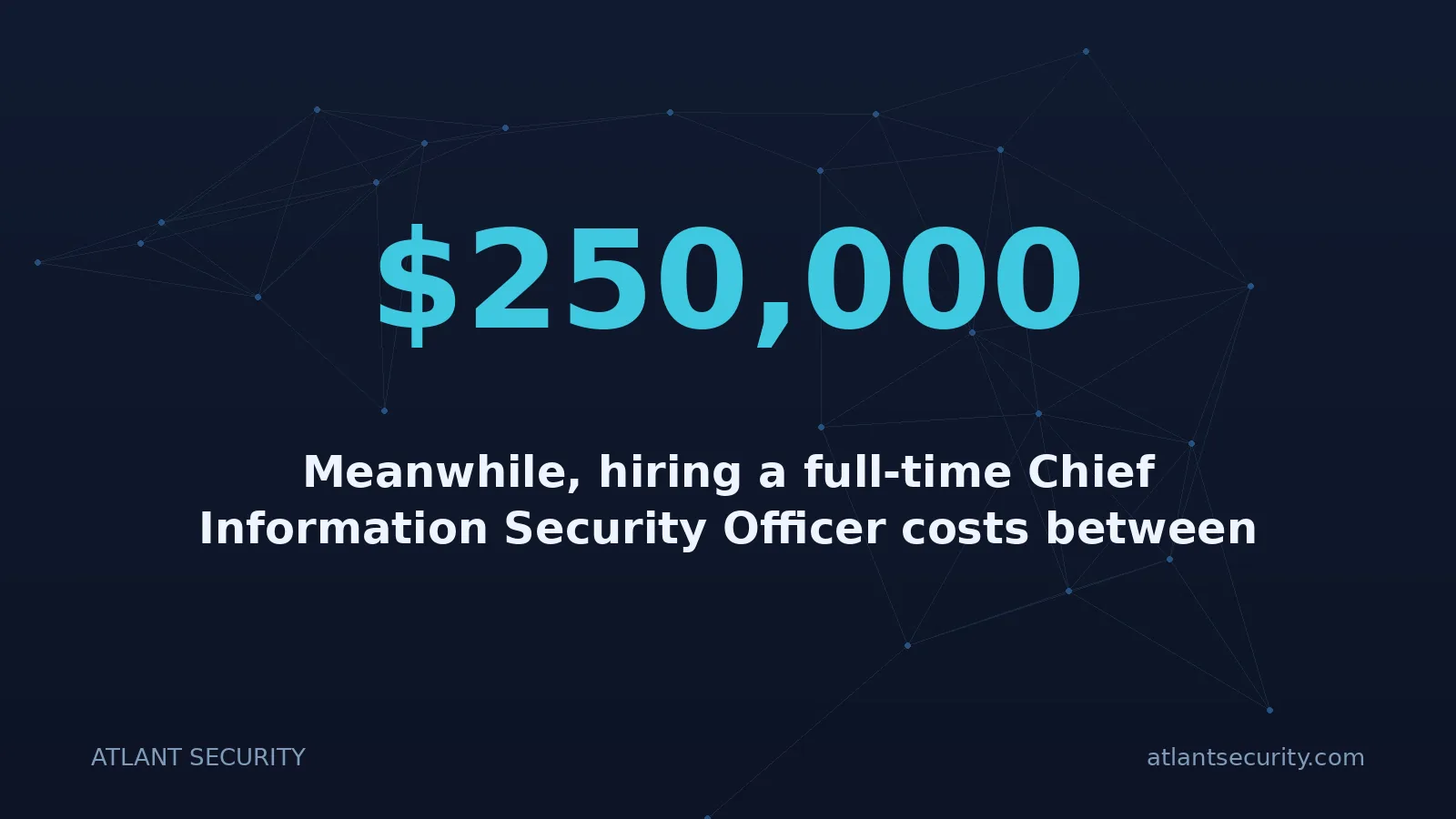
Meanwhile, hiring a full-time Chief Information Security Officer costs between $250,000 and $400,000 in base salary alone. Add benefits, bonuses, equity, and the recruiting cost to find someone willing to join a small company, and you’re looking at $350,000 to $550,000 per year-often more than the entire IT budget of a small organization. Below the size where a vCISO retainer makes sense, Atlant Security offers cybersecurity support for small businesses built around six controls and a tenant audit from $1,450.
This is the paradox: you need security leadership the most when you can least afford it. A vCISO breaks this deadlock.
Day-to-Day Reality
What a vCISO Actually Does for a Small Organization
Forget the buzzwords. Here’s what a Virtual CISO actually does for a company like yours, week by week:
Strategic Planning
Builds your security roadmap tied to business goals. Not a 200-page document nobody reads-a practical, prioritized plan that says “do this first, then this, then this” based on your specific risks and budget.
Policy & Compliance
Writes and maintains security policies that satisfy your compliance requirements (SOC 2, HIPAA, ISO 27001, PCI DSS). Handles the evidence collection process. Prepares you for audits. Responds to customer security questionnaires so your sales team doesn’t stall.
Risk Management
Identifies what could go wrong, how likely it is, and how much it would cost. Then prioritizes fixes based on impact, not fear. This is the difference between spending $5,000 on something that matters and $50,000 on something that sounds scary but isn’t relevant to your business.
Vendor & Team Management
Evaluates security tools before you buy them (so you don’t overspend). Manages your relationships with MSSPs, penetration testers, and other security vendors. Trains your team on security awareness. Sits in on vendor calls so you have someone technical on your side of the table.
Board & Executive Reporting
Translates security into business language for your board, investors, or leadership team. Produces quarterly security reports that show progress, risk posture, and ROI-without the jargon that makes executives’ eyes glaze over.
Incident Response
Builds your incident response plan before you need it. And when something does happen-a phishing compromise, a ransomware attempt, a data exposure-you have an experienced leader who has handled dozens of incidents before, guiding your response in real time.
Side by Side
Full-Time CISO vs. vCISO vs. No Security Leadership
The choice isn’t really between these three options. It’s between two of them-because “no security leadership” isn’t a strategy. It’s a gamble.
| Dimension | Full-Time CISO | vCISO | No CISO |
|---|---|---|---|
| Annual Cost | $350K-$550K+ | $36K-$180K | $0 (until a breach) |
| Time to Value | 3-6 months (recruiting + onboarding) | 1-2 weeks | N/A |
| Experience Level | Single person’s experience | Team with cross-industry experience | None |
| Compliance Support | Depends on individual’s expertise | Multi-framework coverage built-in | Ad-hoc, reactive |
| Board Reporting | ✓ | ✓ | ✗ |
| Incident Response | ✓ | ✓ | ✗ |
| Vendor Independence | May have vendor preferences | Vendor-neutral recommendations | Sold to by every vendor |
| Scalability | Fixed capacity | Scales up or down with need | N/A |
| Retention Risk | High (CISOs average 26 months tenure) | Low (firm relationship, not individual) | N/A |
The Hidden Costs
What It Actually Costs to NOT Have Security Leadership
The decision not to invest in security leadership isn’t free. It just moves the cost to a different line item-one that shows up at the worst possible time.
| Risk Scenario | Potential Cost Without vCISO | How a vCISO Prevents It |
|---|---|---|
| Ransomware attack | $100K-$1M+ (ransom, downtime, recovery) | Incident response plan, backup strategy, employee training |
| Lost enterprise deal (no SOC 2) | $50K-$500K+ in annual contract value | SOC 2 readiness program, audit management |
| Data breach notification | $150-$250 per record + legal fees | Data classification, access controls, DLP strategy |
| Regulatory fine (HIPAA, GDPR) | $10K-$2M+ depending on violation | Compliance program, gap analysis, ongoing monitoring |
| Cyber insurance denial | Full breach cost uninsured | Insurance application support, control implementation |
The question isn’t whether your organization can afford a vCISO. It’s whether it can afford the consequences of not having one. A single prevented incident pays for years of vCISO engagement.
The Complete Engagement
What You Get: The Complete vCISO Engagement for Small Organizations
When you engage a vCISO company like Atlant Security, this is the full scope of what’s included. Every item below is part of the engagement-not an add-on, not an upsell.
Everything Included in Your vCISO Engagement
✓ Security Risk Assessment
Complete evaluation of your current risk posture
✓ Security Roadmap
Prioritized 12-month plan aligned to your budget
✓ Policy Development
Complete policy library tailored to your org
✓ Compliance Management
SOC 2, ISO 27001, HIPAA, PCI, GDPR, NIST
✓ Vendor Risk Management
Third-party security assessments and oversight
✓ Incident Response Plan
Tested playbook + real-time incident support
✓ Security Awareness Training
Employee education + phishing simulations
✓ Executive Reporting
Quarterly board-ready security reports
✓ Pen Test Oversight
Scope, manage, and interpret penetration tests
✓ Cyber Insurance Support
Application assistance + premium optimization
All of this, starting from a fraction of what you’d pay for a single full-time security hire.
Self-Assessment
How to Know If Your Organization Is Ready for a vCISO
Not every organization needs a vCISO right now. But most that are asking the question probably do. Here’s a quick self-assessment. If you check three or more of these boxes, it’s time to have a conversation.
You’ve been asked for a SOC 2 report (or ISO 27001, HIPAA evidence, etc.) by a customer or partner and didn’t know where to start.
Your IT person handles security “on the side” because there’s nobody else to do it.
You’re applying for cyber insurance and the application asks questions about security controls you don’t have documented.
You handle sensitive data-customer PII, financial records, health information, intellectual property-and aren’t confident about your protections.
You’re growing rapidly and your security hasn’t kept pace with your headcount, customer base, or product complexity.
Your board or investors are asking about cybersecurity and you don’t have a clear answer about your posture or plan.
You’ve had a security incident (even a minor one) and realized you didn’t have a response plan.
If any of these resonate, you’re not behind-you’re at the exact right moment to get ahead of the problem. The organizations that struggle most with security are the ones that wait until after the incident, the failed audit, or the lost deal.
Making the Right Choice
Choosing the Right vCISO Partner for a Small Organization
Not all vCISO companies are built for small organizations. Some are enterprise-focused firms that “also serve” smaller clients as an afterthought. Others are solo consultants who may have deep expertise but limited bandwidth. Here’s what to look for:
What to Look For
1. Small-org experience, not just small-org pricing.
Your vCISO should understand that a 30-person company can’t implement the same controls as a 3,000-person company. The roadmap needs to be right-sized, not downsized. Ask them how their approach differs for organizations under 100 employees.
2. No vendor kickbacks.
Some security consultants earn commissions from recommending specific tools. Your vCISO should recommend what’s right for your business, not what earns them the highest referral fee. Ask directly: do you receive compensation from any vendors you recommend?
3. Compliance fluency across multiple frameworks.
If your vCISO only knows one framework, you’ll end up with siloed compliance. Look for experience across SOC 2, ISO 27001, HIPAA, PCI DSS, NIST CSF, and GDPR so they can help you map controls across frameworks and avoid duplicate work.
4. A team, not just a person.
Solo consultants create key-person risk. If they go on vacation, get sick, or take on too many clients, you lose coverage. Look for a firm where your primary vCISO is backed by a team-so there’s always someone available.
5. Flexible engagement terms.
Avoid long-term lock-ins. A confident provider doesn’t need a 24-month contract to keep you. Look for month-to-month or quarterly terms that let you scale up, scale down, or part ways if the fit isn’t right.
Red Flags to Watch For
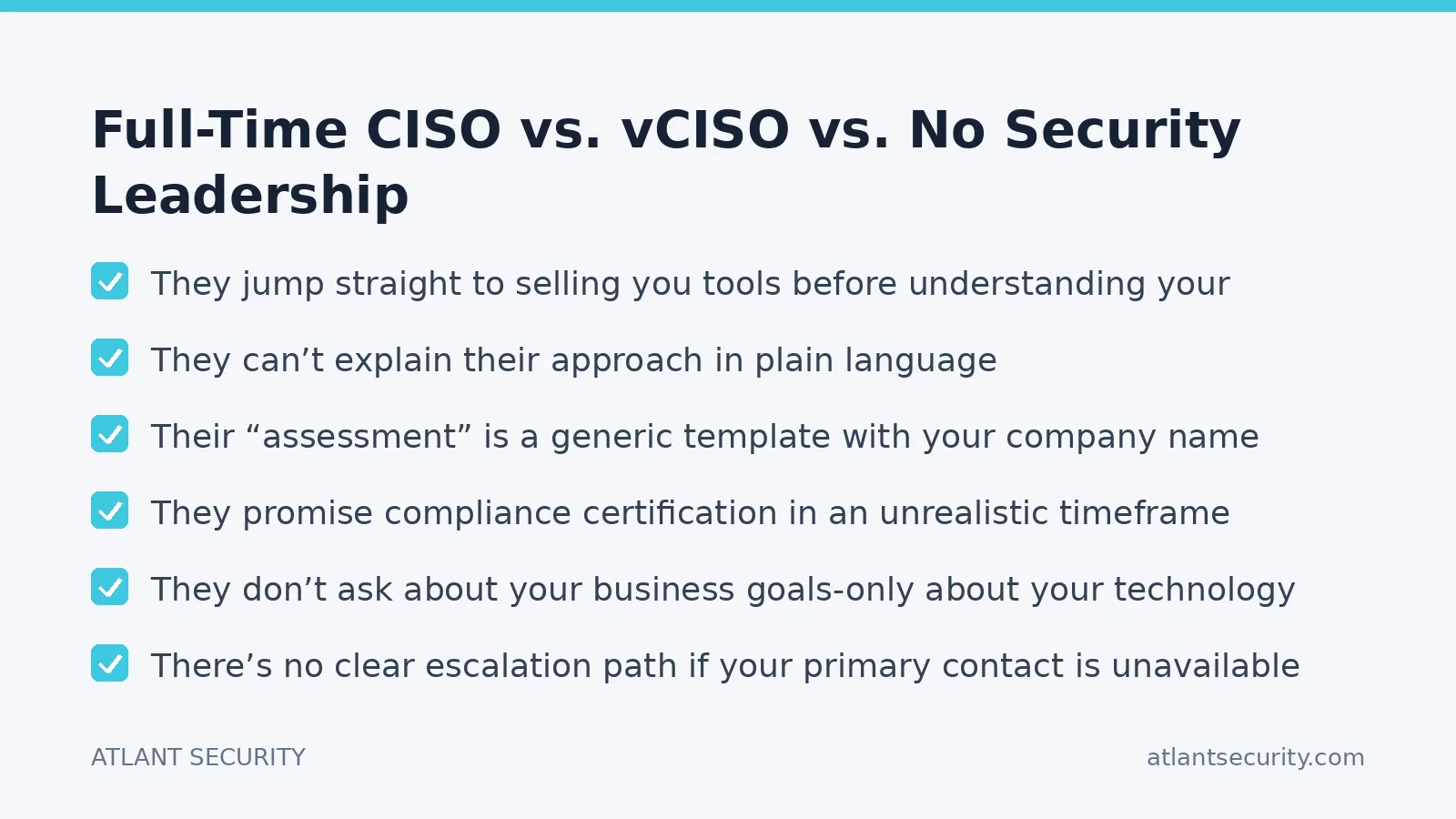
- They jump straight to selling you tools before understanding your business
- They can’t explain their approach in plain language
- Their “assessment” is a generic template with your company name pasted in
- They promise compliance certification in an unrealistic timeframe
- They don’t ask about your business goals-only about your technology
- There’s no clear escalation path if your primary contact is unavailable
Getting Started
What the First 90 Days Look Like
One of the biggest concerns small organizations have is the disruption factor: will bringing in a vCISO create months of chaos? It shouldn’t. Here’s what a well-run engagement looks like from day one:
Weeks 1-2: Discovery & Assessment
Your vCISO meets your team, reviews existing documentation, maps your technology environment, identifies compliance obligations, and assesses your current risk posture. This is a listening phase-no changes yet, just understanding.
Weeks 3-4: Risk Report & Roadmap
You receive a clear risk assessment and a prioritized security roadmap. Not a 100-page document-a practical plan that says “here are the 5 things that matter most, in order, and here’s what each one costs and achieves.” Quick wins get scheduled immediately.
Months 2-3: Implementation & Foundation
Core security policies get written. Critical gaps get addressed. Compliance evidence collection begins. Your incident response plan gets built. Regular cadence meetings start (typically biweekly). Your vCISO becomes a known presence in your organization.
Month 4 Onward: Ongoing Management & Maturity
The foundation is in place. Now it’s about continuous improvement: managing compliance audits, reviewing vendors, updating policies, running tabletop exercises, responding to security questionnaires, and reporting to leadership. The heavy lift is done-it shifts to steady-state governance.
Security Leadership That Fits Your Organization
Atlant Security provides Virtual CISO services built specifically for small and growing organizations. No bloated enterprise frameworks. No long-term lock-ins. Just experienced security leadership that meets you where you are.
Published: September 2026 · Author: Alexander Sverdlov, CISSP, Founder and Principal Security Consultant
This article is for informational purposes only and does not constitute professional security advice. Statistics cited reflect industry averages and may vary by sector, geography, and organization size. Contact a qualified security professional for guidance specific to your organization.
Ready to get started? Atlant Security helps companies close security gaps and pass compliance fast, led personally by a former Microsoft security consultant with 200+ assessments across 14 countries. Book a free strategy call and get a fixed-price proposal within 24 hours.
