

We have probably seen your problem before. Our smallest client had eight employees. Our largest secures the nuclear power plant of the United Arab Emirates. Whatever shape yours is, tell us about it and we will tell you how we would fix it.
Honest Pricing Guide · Updated September 2026
vCISO Cost in 2026: What You’ll Actually Pay
We break down what a virtual CISO actually costs across every engagement model, company size, and scope level-with real dollar amounts, hidden costs to watch for, and a full ROI calculation.
Key Takeaways
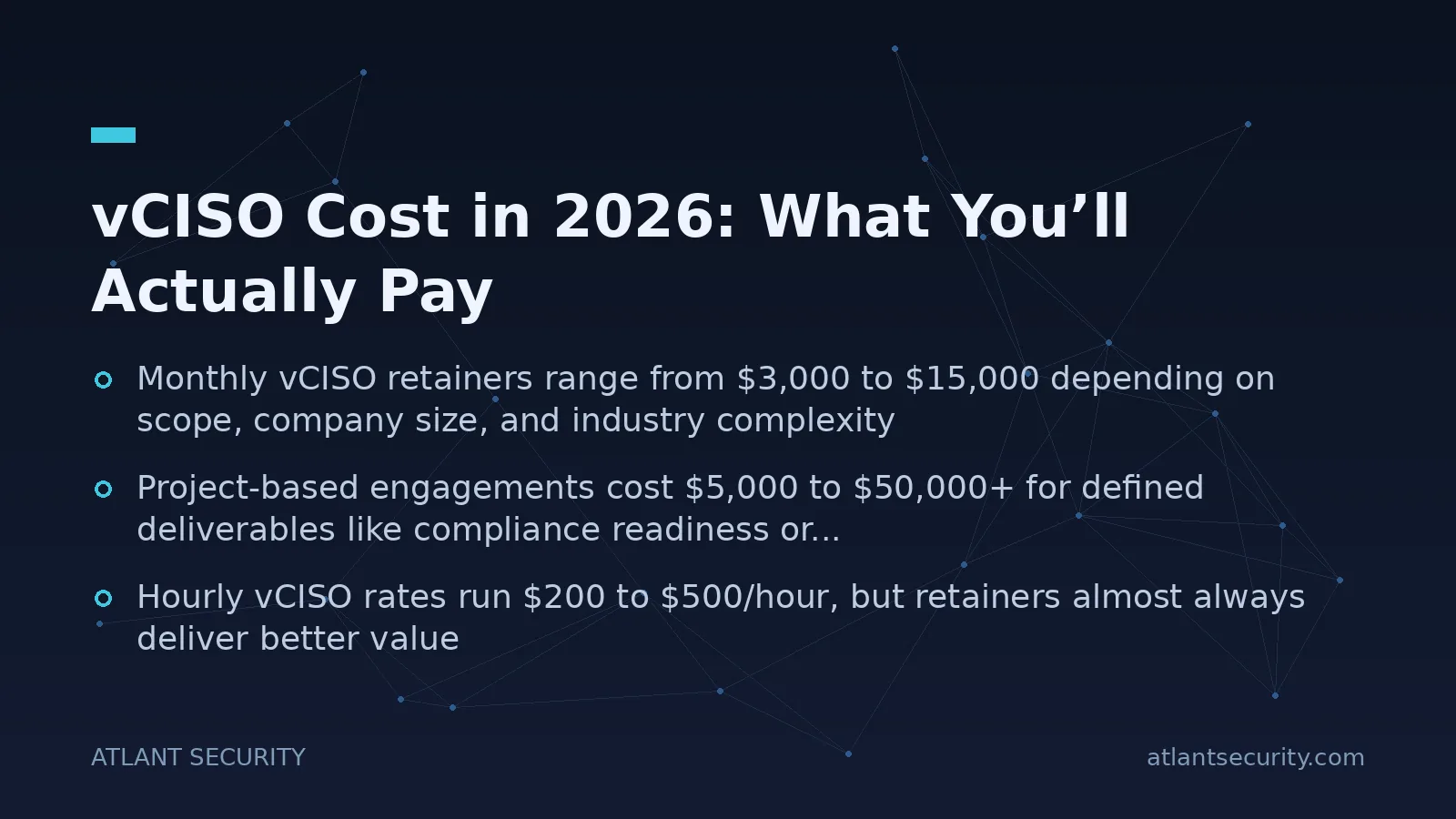
- Monthly vCISO retainers range from $3,000 to $15,000 depending on scope, company size, and industry complexity
- Project-based engagements cost $5,000 to $50,000+ for defined deliverables like compliance readiness or security program buildout
- Hourly vCISO rates run $200 to $500/hour, but retainers almost always deliver better value
- A full-time CISO costs $350,000-$600,000+ in total compensation-a vCISO delivers 80% of the value at 20-40% of the cost
- The ROI math is overwhelming: the average cost of a data breach is $4.88 million-a vCISO engagement pays for itself many times over
Table of Contents
From Experience
Why I Wrote This Guide
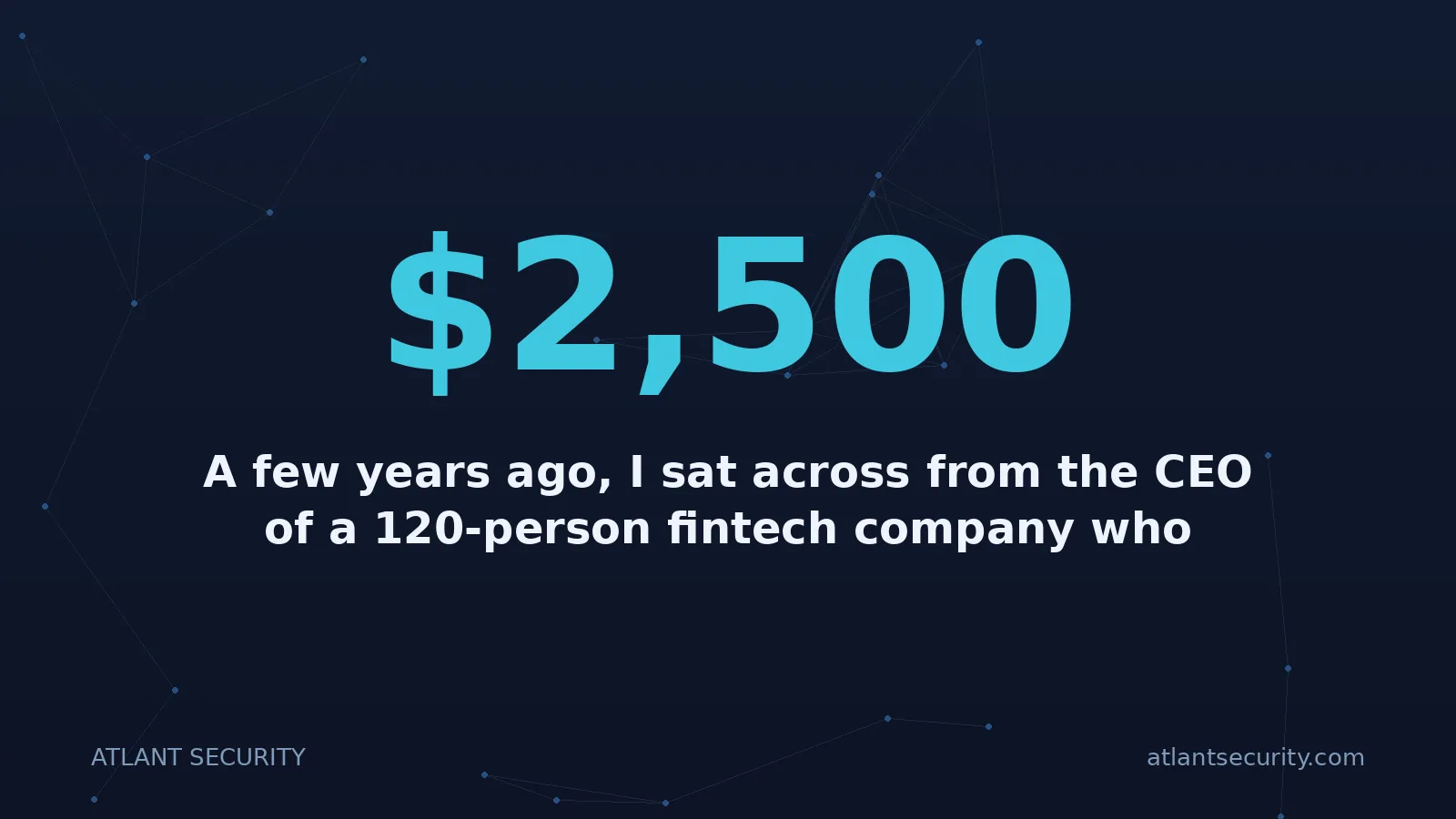
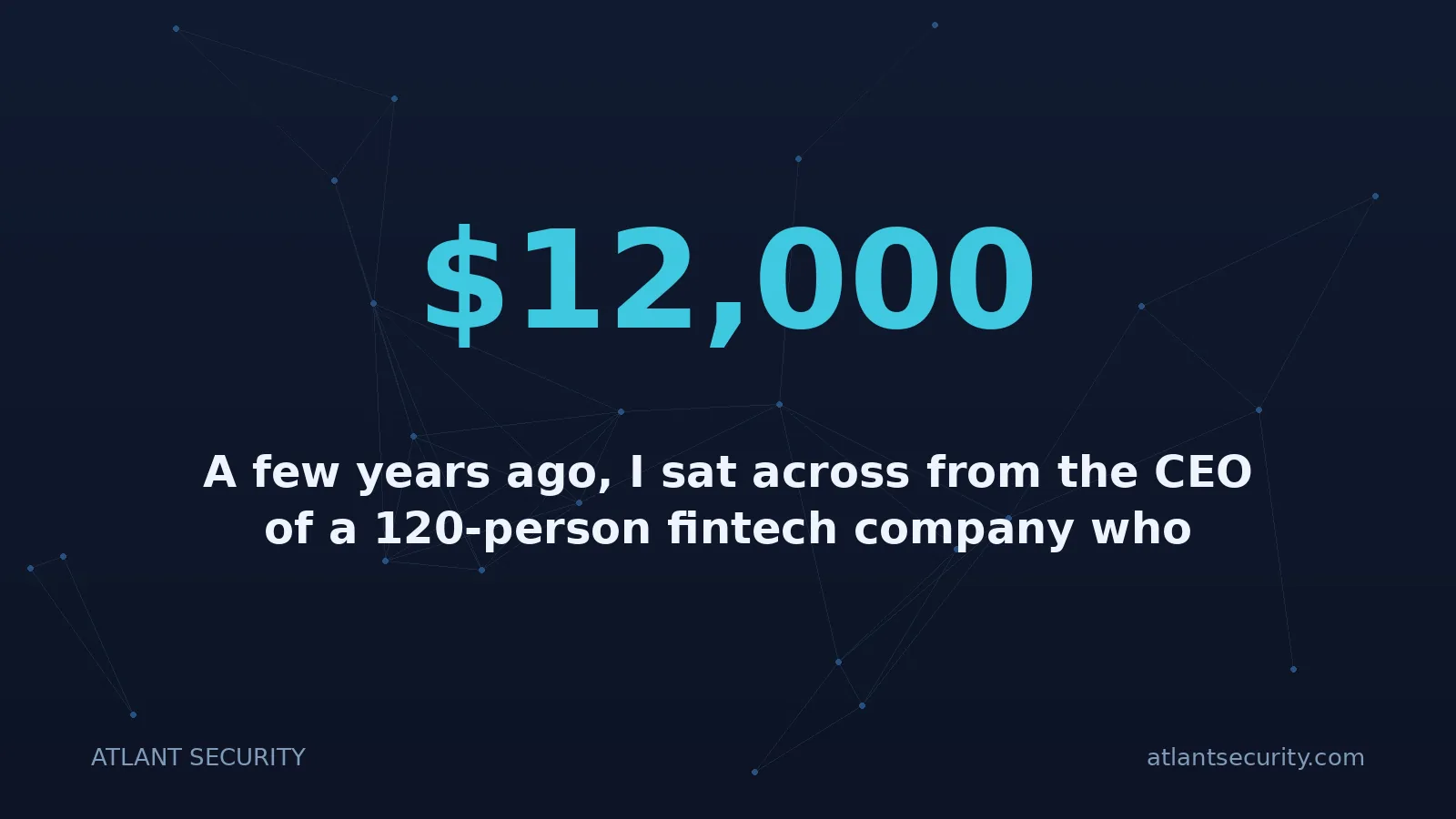
A few years ago, I sat across from the CEO of a 120-person fintech company who looked genuinely defeated. He had just received three proposals for virtual CISO services. One quoted $2,500 a month. Another came in at $12,000 a month. The third was a flat $75,000 for a “12-month security transformation.”
“How can the same service cost anywhere from $30,000 to $75,000 a year?” he asked me. “Are any of these even reasonable?”
It was a fair question-and one I’ve heard hundreds of times since. The truth is that vCISO cost varies enormously because the service itself varies enormously. A $3,000/month engagement and a $15,000/month engagement aren’t the same product with different margins. They’re fundamentally different levels of scope, expertise, and time commitment.
After years of running virtual CISO engagements and watching companies struggle to compare proposals that feel like apples-to-orangutans, I decided to write the pricing guide I wish every buyer had before their first call with a provider.
This article covers every pricing model, breaks down what you should expect to pay based on your company size and needs, reveals the hidden costs that catch people off guard, and provides a concrete ROI calculation you can bring to your CFO. No vague ranges. Real numbers.
Pricing Overview
The Quick Answer on vCISO Cost
If you’re in a hurry and just need the numbers, here they are:
| Engagement Model | Typical Range | Best For |
|---|---|---|
| Monthly Retainer | $3,000-$15,000/mo | Ongoing security leadership and program management |
| Project-Based | $5,000-$50,000+ | Defined outcomes like compliance readiness, policy buildout, or risk assessment |
| Hourly | $200-$500/hr | Ad-hoc advisory, board presentations, or incident support |
Those ranges are real, but they’re also wide enough to be unhelpful on their own. The rest of this guide explains exactly where you’ll land within them-and why.
Detailed Breakdown
vCISO Cost by Engagement Model
The engagement model you choose is the single biggest factor in what you’ll pay. Let’s break each one down with the specifics that matter.
Monthly Retainer: $3,000-$15,000/month
This is the most common and, in our experience, the most cost-effective model for organizations that need ongoing security leadership. You pay a fixed monthly fee and receive a defined number of hours and deliverables.
| Tier | Monthly Cost | Hours/Month | Typical Scope |
|---|---|---|---|
| Foundational | $3,000-$5,000 | 10-20 hours | Policy reviews, monthly check-ins, basic risk oversight, security questionnaire support |
| Growth | $5,000-$10,000 | 20-40 hours | Compliance program management, vendor risk assessments, security roadmap execution, team mentorship |
| Enterprise | $10,000-$15,000 | 40-60 hours | Full security program leadership, board reporting, multi-framework compliance, incident response planning, M&A security diligence |
Why retainers deliver the best value
Retainer-based engagements allow your vCISO to build deep institutional knowledge over time. They learn your tech stack, your team’s strengths and gaps, your regulatory landscape, and your business goals. This context makes every hour dramatically more productive than starting cold on a project basis. Most organizations that start hourly eventually switch to retainers for exactly this reason.
Project-Based: $5,000-$50,000+
Project-based pricing works well when you have a clearly defined objective with a beginning and an end. You pay a fixed price for a specific deliverable, which makes budgeting straightforward.
| Project Type | Typical Cost | What You Get |
|---|---|---|
| Security Risk Assessment | $5,000-$15,000 | Comprehensive risk identification, threat analysis, prioritized remediation roadmap |
| Policy & Procedure Development | $8,000-$20,000 | Full security policy suite, data handling procedures, incident response plan, acceptable use policies |
| SOC 2 Readiness Program | $15,000-$35,000 | Gap analysis, control implementation, evidence collection, auditor coordination |
| Security Program Buildout | $25,000-$50,000+ | Full security program from scratch: governance framework, technical controls, training program, vendor management, board reporting |
| Incident Response Planning | $5,000-$12,000 | IR playbooks, communication templates, tabletop exercise, team training |
Project-based engagements make sense when you know exactly what you need. The risk is that security isn’t a one-time event-organizations that complete a project and walk away often find themselves back at square one within 12-18 months because nobody maintained the program.
Hourly Advisory: $200-$500/hour
Hourly engagements give you maximum flexibility but minimum predictability. You call your vCISO when you need them and pay only for time used.
| Provider Type | Hourly Rate | Notes |
|---|---|---|
| Solo Practitioner | $200-$300/hr | Lower overhead, but single point of failure and limited bandwidth |
| Boutique vCISO Firm | $300-$400/hr | Team-backed, broader expertise, established methodology |
| Large Consulting Firm | $400-$500/hr | Brand name, deep bench, but may staff with junior consultants |
The hidden math on hourly billing
At $350/hour, just 10 hours of work per month costs $3,500-the same as a foundational retainer that typically includes 10-20 hours plus structured deliverables and accountability. Hourly engagements also create a psychological barrier: teams hesitate to call their vCISO because “the meter is running,” which means small problems don’t get addressed before they become expensive ones.
By Organization
vCISO Cost by Company Size
Your company size is one of the strongest predictors of what you’ll actually pay for a vCISO. Larger organizations have more systems, more users, more vendors, more regulatory obligations, and more attack surface-all of which increase the scope of work required.
| Company Size | Monthly Cost | Annual Cost | Typical Needs |
|---|---|---|---|
| Startup (1-50) | $3,000-$5,000 | $36K-$60K | Foundational policies, single compliance framework (SOC 2), basic risk management, security questionnaire support |
| Small Business (50-200) | $5,000-$8,000 | $60K-$96K | Multi-framework compliance, vendor management, security awareness training, incident response planning |
| Mid-Market (200-500) | $8,000-$12,000 | $96K-$144K | Full program management, board reporting, M&A due diligence, regulatory exam preparation, team building |
| Upper Mid-Market (500-1,000) | $12,000-$15,000 | $144K-$180K | Enterprise-grade security strategy, complex regulatory landscape, international operations, executive team integration |
| Enterprise (1,000+) | $15,000+ or full-time CISO | $180K+ | At this size, most organizations need a dedicated full-time CISO or a very senior part-time CISO arrangement |
What Drives the Price Higher Within Each Range?
- Multiple compliance frameworks (SOC 2 + HIPAA + ISO 27001 simultaneously)
- Highly regulated industries (healthcare, financial services, government contractors)
- Board-level reporting requirements and executive committee participation
- Hands-on implementation work versus advisory-only guidance
- Incident response on-call availability (24/7 vs. business hours)
- International operations with cross-border data requirements
Scope Details
What’s Included at Each vCISO Tier
Not all vCISO engagements are created equal. Here’s what you should expect to receive at each price point from a reputable provider. If a proposal is missing items from the tier that matches its price, ask questions.
Foundational Tier ($3,000-$5,000/month)
Best for: Startups and early-stage companies building their first security program
- Initial security risk assessment and gap analysis
- Core security policy development (5-10 essential policies)
- Monthly strategic check-in calls (1-2 hours)
- Security questionnaire review and completion support
- Basic compliance guidance for one framework
- Vendor security review support (ad hoc)
- Email and Slack availability for security questions
Growth Tier ($5,000-$10,000/month)
Best for: Scaling companies with active compliance needs and growing attack surface
- Everything in Foundational, plus:
- Full compliance program management (SOC 2, ISO 27001, HIPAA, etc.)
- Bi-weekly or weekly strategic calls
- Vendor risk management program design and oversight
- Security awareness training program coordination
- Incident response plan development and tabletop exercises
- Security metrics dashboard and quarterly reporting
- Technology stack evaluation and vendor-neutral recommendations
- Internal team mentorship and skill development
Enterprise Tier ($10,000-$15,000/month)
Best for: Complex organizations with board-level security requirements and multi-framework compliance
- Everything in Growth, plus:
- Board of directors security presentations and reporting
- Multi-framework compliance management (parallel programs)
- M&A cybersecurity due diligence support
- Regulatory exam preparation and liaison
- Security budget planning and tool procurement guidance
- Cyber insurance policy review and application support
- Executive team integration (participate in leadership meetings)
- Security team hiring strategy and interview support
- On-call availability for security incidents
The Business Case
ROI Calculation: Cost of a Breach vs. Cost of a vCISO
Let’s talk about the number that makes vCISO cost look trivial: the cost of not having one.
According to IBM’s 2025 Cost of a Data Breach Report, the global average cost of a data breach is $4.88 million. For companies under 500 employees-exactly the segment most likely to use a vCISO-the average breach cost is $3.31 million. In the United States specifically, the average climbs to $9.36 million.
Now let’s do the math for a mid-market company:
| Cost Category | Amount |
|---|---|
| Annual vCISO cost (Growth tier) | $96,000 |
| Security tools and implementation (estimated) | $30,000 |
| Annual security audit | $20,000 |
| Total Annual Security Investment | $146,000 |
| Average breach cost (sub-500 employees) | $3,310,000 |
| Regulatory fines (potential) | $100,000-$500,000+ |
| Customer churn and revenue loss (estimated) | $500,000-$2,000,000 |
| Total Breach Impact (conservative) | $3,910,000+ |
The ROI Math
Investment: $146,000/year for a vCISO-led security program
Risk avoided: $3.9M+ in potential breach costs
ROI ratio: Every $1 invested protects against $26.70 in potential losses
Even if you assume a breach probability of just 10% per year, the expected value of loss prevented ($390,000) still exceeds the total investment ($146,000) by a factor of 2.67x.
And that calculation doesn’t even factor in the revenue-enabling benefits: faster sales cycles when you can prove SOC 2 compliance, lower cyber insurance premiums (typically 15-30% savings with a documented security program), and the ability to win enterprise deals that require evidence of formal security leadership.
Organizations with a vCISO-led security program also experience breaches that cost 38% less on average because they catch incidents earlier, respond faster, and have containment procedures in place. So even if a breach does occur, the financial damage is dramatically reduced.
Comparison
vCISO Cost vs. Full-Time CISO Total Compensation
This is the comparison that makes the business case for a vCISO almost impossible to argue against. Let’s look at what a full-time CISO actually costs when you account for everything-not just base salary.
| Cost Component | Full-Time CISO | vCISO (Growth Tier) |
|---|---|---|
| Base Salary | $220,000-$350,000 | - |
| Annual Bonus (15-25%) | $33,000-$87,500 | - |
| Equity / Stock Options | $50,000-$150,000 | - |
| Benefits (health, 401k, PTO) | $30,000-$50,000 | - |
| Recruiting Fees (20-25%) | $44,000-$87,500 (one-time) | - |
| Conferences & Training | $10,000-$20,000 | - |
| Monthly / Annual Retainer | - | $60,000-$96,000/yr |
| Total Year-1 Cost | $387,000-$745,000 | $60,000-$96,000 |
| Savings with vCISO | $291,000-$685,000 in Year 1 | |
There’s an even more important dimension beyond cost: time to value. Recruiting a full-time CISO takes 4-6 months on average. During that time, you have no security leadership. A vCISO engagement can begin within 1-2 weeks, and most providers deliver meaningful initial assessments within the first 30 days.
There are also structural advantages. A vCISO from a reputable firm like Atlant Security brings a team behind them-not just one person. If your full-time CISO goes on vacation, gets sick, or quits (the average CISO tenure is just 18-26 months), you’re exposed. A team-backed vCISO has built-in redundancy.
When a full-time CISO makes more sense
A full-time CISO is the right choice when your organization exceeds 1,000 employees, operates in a heavily regulated industry requiring daily security leadership presence, has a mature security team that needs an on-site executive leader, or faces security challenges that require more than 60 hours/month of dedicated executive attention. Many organizations use a part-time CISO as a bridge while they build the case and budget for a full-time hire.
Practical Advice
How to Budget for a vCISO Engagement
Understanding the cost ranges is one thing. Building a realistic budget is another. Here are the steps I recommend to every organization evaluating vCISO cost for the first time.
Step 1: Define Your Actual Needs
Before you talk to a single provider, answer these questions honestly:
- What compliance frameworks are you required to meet (or are customers asking for)?
- Do you have any internal security staff, or will the vCISO be your entire security function?
- Are there any upcoming events that create urgency (fundraising, enterprise deals, audits)?
- What level of involvement do you need: advisory only, or advisory plus hands-on implementation?
- Is there a board or investor requiring security reporting?
Step 2: Budget for the Full Picture
When building your budget, account for:
- vCISO retainer: Your primary ongoing cost ($3K-$15K/month)
- Tool licensing: GRC platform, security tools ($200-$3,000/month)
- Compliance audit fees: SOC 2 audit ($15K-$30K), ISO 27001 certification ($10K-$25K)
- Penetration testing: Annual or semi-annual ($10K-$30K)
- Security awareness training: Platform and content ($2K-$8K/year)
- Implementation labor: Internal time or external contractors for remediation work
Step 3: Get Multiple Proposals and Compare Correctly
Request proposals from 3-4 providers and compare them on scope, not just price. A $5,000/month proposal that includes 15 hours and no compliance management is not cheaper than an $8,000/month proposal that includes 30 hours, full compliance program management, and vendor risk assessments. Build a comparison spreadsheet that normalizes scope, deliverables, hours, and expertise level across all proposals.
Common Questions
Frequently Asked Questions About vCISO Cost
How much does a vCISO cost per month?
A vCISO typically costs between $3,000 and $15,000 per month on a retainer basis. The exact price depends on your company size, industry, compliance requirements, and the scope of services included. Startups and small businesses usually fall in the $3,000-$5,000 range, while mid-market companies with complex compliance needs typically pay $8,000-$12,000 per month.
Is a vCISO cheaper than a full-time CISO?
Yes, significantly. A full-time CISO costs $350,000-$600,000+ annually when you include salary, bonus, equity, benefits, and recruiting fees. A vCISO engagement typically runs $36,000-$180,000 per year depending on scope-saving organizations $200,000-$500,000+ annually. For companies under 500-1,000 employees, a vCISO is almost always the better financial decision.
What’s the hourly rate for a virtual CISO?
Hourly rates for virtual CISO services range from $200 to $500 per hour depending on the provider type and experience level. Solo practitioners charge $200-$300/hour, boutique vCISO firms like ours charge $300-$400/hour, and large consulting firms charge $400-$500/hour. However, monthly retainers almost always provide better value than hourly billing for ongoing engagements.
What is included in a vCISO retainer?
A typical vCISO retainer includes security risk assessments, policy development and maintenance, compliance program management, vendor risk oversight, incident response planning, regular strategic meetings, security metrics reporting, and ongoing advisory support. The specific deliverables vary by tier-foundational retainers ($3K-$5K/mo) cover basics, while enterprise retainers ($10K-$15K/mo) include board reporting, multi-framework compliance, and M&A security diligence.
Are there hidden costs with a vCISO engagement?
The most common hidden costs include: required security tool purchases ($500-$5,000/month), overage charges for exceeding monthly hour allotments, separate fees for penetration testing and formal audits ($10K-$50K+), implementation labor if you lack internal resources ($2K-$10K/month), and early termination fees on long-term contracts. Always ask about these costs during the proposal process to avoid surprises.
The economics of this changed recently. AI-driven pentesting runs the same OWASP Top 10, API, cloud and network checks a human tester works through, chains the findings into proof-of-concept evidence, and returns results in five to ten days with retesting included once you have fixed things. That turns testing after every release from an aspiration into a line item.
How do I know if my company needs a vCISO?
Your company likely needs a vCISO if: customers are asking for SOC 2 or ISO 27001 compliance, you’re handling sensitive data without formal security governance, you’re preparing for a fundraise or acquisition, your board or investors are asking about cybersecurity risk, or you’ve been relying on your IT team to manage security strategy alongside their day jobs. If any of these apply, a virtual CISO service can provide the leadership you need at a fraction of the cost of a full-time hire.
Can I start with a small vCISO engagement and scale up?
Absolutely, and this is actually the approach we recommend. Start with a foundational retainer ($3,000-$5,000/month) to get your baseline security posture assessed and core policies in place. As your needs grow-whether that’s pursuing additional compliance frameworks, preparing for board-level reporting, or managing a growing vendor ecosystem-you can scale up to a Growth or Enterprise tier. Good vCISO providers build their engagements to accommodate this natural progression.
What’s the ROI of hiring a vCISO?
The ROI is substantial. With an average data breach costing $4.88 million globally (and $9.36 million in the US), a vCISO engagement at $60K-$180K/year represents a fraction of potential losses. Beyond breach prevention, vCISOs deliver ROI through faster sales cycles (compliance certifications), lower cyber insurance premiums (15-30% savings), enterprise deal enablement, and reduced regulatory fine risk. Most organizations see a positive ROI within the first year through compliance-enabled revenue alone.
Ready to Talk About What a vCISO Would Cost for Your Organization?
Every organization’s security needs are different. Atlant Security provides team-backed virtual CISO services with transparent pricing, vendor-neutral recommendations, and flexible engagement terms. No long-term lock-in. No required tool purchases.
Last Updated: September 2026 · Author: Alexander Sverdlov
This article is for informational purposes only and should not be considered financial or legal advice. Pricing data reflects market research and our experience working with organizations across industries and sizes as of the publication date. Actual costs may vary based on provider, geography, scope, and specific requirements. Organizations should obtain multiple proposals and conduct their own evaluation when selecting a vCISO provider.
