Top Cybersecurity Companies in Dubai: A 2026 Guide for SaaS and Enterprise
Alexander Sverdlov
Security Analyst

💫 Key Takeaways
- Dubai’s cybersecurity market is driven by cloud-first government policy, booming fintech, and strict regulatory frameworks including NESA, DFSA, and DIFC-DP Law
- Not all providers are equal - some are security architects, others are glorified tool resellers. Know the difference before signing a contract
- The best cybersecurity partner offers architectural hardening first, not a sales pitch for software licenses
- UAE-specific regulations (NESA IAS, DFSA GEN 3.4, DIFC Data Protection Law) impose mandatory security controls that generic global consultancies often overlook
- A vendor-neutral partner with vCISO capability gives startups and mid-market companies enterprise-grade security leadership without the $250K+ salary
- This guide includes a side-by-side comparison table of Dubai’s top providers across 7 critical dimensions
When you are sitting on a gold mine, security is not optional - it is survival.
That is the reality of Dubai’s tech-driven economy. With data-rich industries like fintech, logistics, government services, and healthcare all booming at once, the city has become a prime target for cybercrime. The UAE’s ambition to lead the world in digital transformation is genuinely impressive, but it comes with an equally large attack surface.
If you are running a SaaS, enterprise, or startup in Dubai, you have likely asked:
- “How do I know if our current security provider is good enough?”
- “Who are the top cybersecurity companies in Dubai, and how do they compare?”
- “Can we secure our systems without spending a fortune on tools we don’t need?”
You are in the right place. This is the definitive guide to choosing a cybersecurity partner in Dubai. Whether you are a CTO, CEO, or investor, this post will help you understand the landscape, compare the top players, spot the red flags, and ultimately choose the right partner.
Market Context
Need hands-on NESA / UAE IA compliance help?
Atlant Security provides NESA / UAE IA compliance consulting: fixed price, led by a former Microsoft security consultant, and you review the readiness report before you pay. See the service and book a strategy call →
Why Cybersecurity in Dubai Is Booming

Dubai is not just trying to become a global tech hub - it is executing the playbook. Here is what is fueling cybersecurity demand in 2026:
| Trend | Impact on Cybersecurity |
|---|---|
| UAE Cloud-First Policy | Massive migration to AWS, Azure, Huawei Cloud increases attack surface |
| Fintech & Digital Payments Growth | PSPs and neobanks are prime targets for fraud and data breaches |
| Healthcare & Healthtech | Patient data is heavily regulated but often poorly protected |
| Logistics & Smart Cities | IoT and OT systems open backdoors for attackers |
| Remote Work & SaaS Adoption | Misconfigured endpoints and cloud mismanagement are rampant |
What This Means for You
Companies in Dubai are under pressure from investors, regulators, and customers to show they are not just secure - but resilient. It is no longer enough to tick the ISO 27001 or SOC 2 checkbox. You need a partner who can harden your architecture, not just sell you tools.
Selection Framework
How to Choose a Cybersecurity Company in Dubai

Not all cybersecurity companies are created equal. Some are security architects. Others are glorified tool resellers. Here is a checklist to help you separate the pros from the pretenders - and red flags you should never ignore.
| Criteria | What to Look For | Why It Matters |
|---|---|---|
| Industry Specialization | Do they specialize in SaaS, fintech, or healthcare? | You do not want a generalist if you are protecting high-risk data |
| Strategic Architecture vs. Tools | Do they offer architectural hardening before pitching tools? | Tools do not fix broken processes. You need principles first |
| Audit and Hardening Experience | Do they run real audits (SOC 2, NIST, AD)? | Compliance is not just paperwork - it is real security validation |
| Cloud & Endpoint Security | Do they offer deep hardening for AWS, Azure, and endpoints? | Most breaches start with cloud misconfig or weak endpoints |
| Virtual CISO Capability | Can they act as your CISO or advise one? | Essential for startups and scaling companies who need top-tier guidance |
| No Vendor Lock-In | Are they independent of tool vendors? | Avoid biased advice from someone who earns commissions on licenses |
| Documented Outcomes | Do they deliver repeatable, documented results? | Professionals work with playbooks. Amateurs wing it |
🚨 Red Flags to Avoid
- Tool-Centric Sales: “You need to buy X, Y, Z software” on day one - tools without context equal wasted budget
- No Clear Framework: No NIST, no CIS, no ESA - just “we will handle it”
- Lack of Transparency: Cannot show you their playbook or pricing upfront
- One-Person Agencies: One person doing everything creates a bottleneck and a single point of failure
- No Experience with Sensitive Data: They have never worked with payment data, medical records, or investor-sensitive IP
Pro Tip from Atlant Security’s Founder
“Security is a system, not a product. You cannot just buy one tool and call yourself protected. You need principles, not just platforms.” - Alexander, ex-Microsoft, Founder of Atlant Security
The Rankings
Top 15 Cybersecurity Companies in Dubai (2026)

Whether you are a Series A SaaS startup or a government-adjacent enterprise, this is the most current and strategic list of cybersecurity providers in Dubai. We evaluated these companies across cloud and endpoint hardening expertise, audit capability (SOC 2, NIST, ISO), experience with sensitive data environments, independence from tool vendors, quality of ongoing advisory (vCISO and strategy), and technical depth.
| Rank | Company | Best For | Key Strengths | Founded | Local Presence |
|---|---|---|---|---|---|
| 1 | Atlant Security | SaaS, fintech, healthcare, UHNWIs | Security architecture, hardening, virtual CISO, no vendor lock-in | 2013 | Remote HQ, ex-Microsoft UAE |
| 2 | Help AG | Government, large enterprises | Strong vendor partnerships, managed services | 2004 | Dubai |
| 3 | DarkMatter | National infrastructure, advanced threat defense | Government backing, advanced cyber capability | 2015 | Abu Dhabi & Dubai |
| 4 | Paladion (now Atos) | MSSP clients | SOC services, SIEM | 2000 | Dubai |
| 5 | DTS Solution | ISO/NIST consulting, compliance-heavy orgs | Policy writing, compliance audits | 2011 | Dubai |
| 6 | Paramount | Banking & telcos | GRC, compliance, integration | 1992 | Dubai |
| 7 | SecurView | Cloud & identity management | Technical cloud security focus | 2007 | Dubai |
| 8 | IBM Security (Middle East) | Fortune 500 enterprises | Full-stack solutions, AI-powered threat defense | N/A | Dubai |
| 9 | KPMG Cybersecurity | Enterprise audits | Compliance, risk management, hybrid cloud | N/A | Dubai |
| 10 | EY Cybersecurity | Regulatory-heavy industries | SOC 2, ISO 27001, consulting | N/A | Dubai |
| 11 | CyberGate | Pen testing, training | Red teaming, awareness training | 2014 | Dubai |
| 12 | Digital14 (part of e& Group) | Infrastructure, telco | National scale defense | 2020 | Abu Dhabi & Dubai |
| 13 | Systech Middle East | SMBs and healthcare | Compliance and risk analysis | 2003 | Dubai |
| 14 | Palindrome Technologies | Telecom and network defense | Packet-level security | 2005 | Dubai |
| 15 | Vision Valley | Telecom, infrastructure | Integration and perimeter security | 2002 | Dubai |
Head-to-Head
Comparison Table: Dubai’s Top Cybersecurity Providers by Critical Criteria
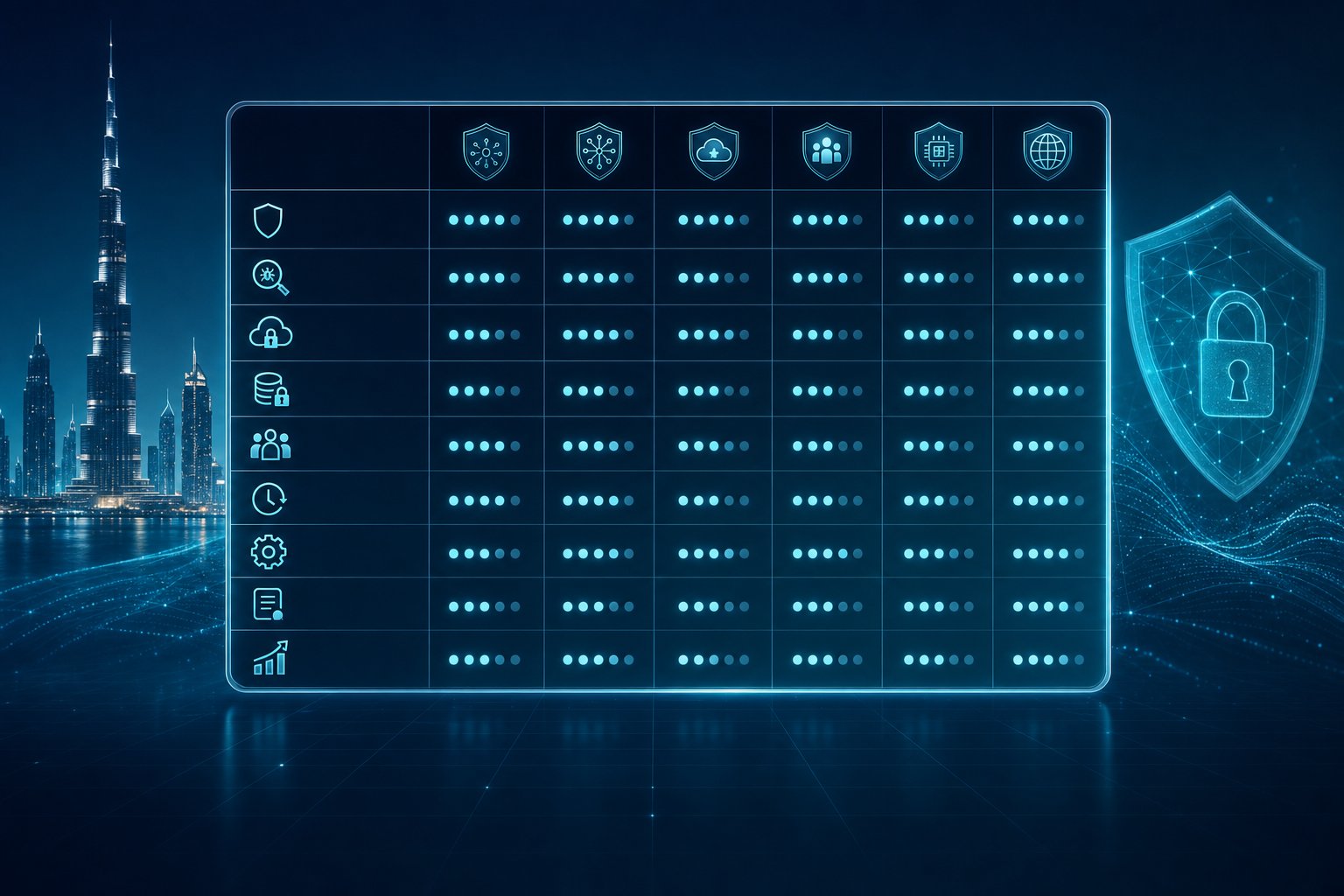
When evaluating cybersecurity partners, CEOs and tech leaders often ask: “How do these companies actually differ? Who is overcharging for fluff? Who is technically elite?” This comparison matrix breaks down the top 10 players by what truly matters:
| Company | Security Architecture | SOC 2 / NIST Audit | Vendor-Neutral | Cloud Security | Endpoint Hardening | vCISO | Pricing |
|---|---|---|---|---|---|---|---|
| Atlant Security | Full-stack, ESA/NIST | Deep audit + implementation | 100% independent | AWS, Azure, GCP | Elite AD & laptop | Included | Fixed-scope |
| Help AG | Tool-heavy | SOC & MDR focus | Strong vendor ties | Depends on vendor | Basic AV/SIEM | Not offered | Custom only |
| DarkMatter | Strong defense ops | Less enterprise audit focus | Government-aligned | Full cloud SOC | Not primary focus | Gov-only | NDA required |
| DTS Solution | GRC-focused | Strong compliance | Neutral | Basic cloud policies | No hardening | Available | Custom |
| KPMG | Policy-first | Strong compliance staff | Neutral | Partner-dependent | Not their domain | Strategy only | Very high |
| IBM Security | Full-stack (IBM ecosystem) | Enterprise-grade | IBM-first | Watson XDR | IBM EDR/AV | Strategic only | High custom |
Regulatory Landscape
UAE Cybersecurity Regulations: NESA, DFSA, and DIFC

One of the most overlooked factors when choosing a cybersecurity partner in Dubai is whether they understand the local regulatory landscape. The UAE has developed a sophisticated set of cybersecurity regulations that go beyond generic ISO or SOC 2 requirements. A provider who only knows NIST and ISO but cannot navigate NESA, DFSA, and DIFC requirements will leave gaps in your compliance posture.
NESA - National Electronic Security Authority (now part of the Cyber Security Council)

NESA’s Information Assurance Standards (IAS) are the UAE’s national cybersecurity framework. They apply to all government entities and critical infrastructure operators, and increasingly to private sector companies in regulated industries. The framework mandates specific controls across asset management, access control, cryptography, physical security, incident management, and business continuity. Companies operating in sectors like energy, finance, healthcare, and telecommunications must demonstrate NESA compliance or face regulatory consequences.
NESA IAS is structured into priority levels (P1, P2, P3) based on the criticality of the entity. A P1 entity (critical national infrastructure) faces the most stringent requirements, while P3 entities have a reduced but still substantial control set.
DFSA - Dubai Financial Services Authority
If your company operates in the Dubai International Financial Centre (DIFC), you fall under the regulatory oversight of the DFSA. The DFSA’s General Module (GEN) Rule 3.4 requires authorized firms to have adequate systems, controls, and procedures to manage technology risk, including cybersecurity. This includes requirements for information security governance, regular vulnerability assessments, penetration testing, incident response capabilities, and business continuity planning.
In practice, the DFSA expects firms to demonstrate alignment with internationally recognized standards such as ISO 27001 or NIST CSF, supplemented by controls specific to financial services. Firms that cannot demonstrate robust cyber defenses risk regulatory action, reputational damage, and loss of their DIFC license.
DIFC Data Protection Law
The DIFC Data Protection Law (DIFC Law No. 5 of 2020) is often described as the GDPR of the Middle East. It establishes comprehensive data protection requirements for organizations processing personal data within the DIFC, including mandatory breach notification within 72 hours, data protection impact assessments, appointment of Data Protection Officers for certain entities, and strict rules on cross-border data transfers.
| Regulation | Applies To | Key Requirements | Consequence of Non-Compliance |
|---|---|---|---|
| NESA IAS | Government entities, critical infrastructure, regulated private sector | 188+ controls across asset management, access control, cryptography, incident response | Regulatory penalties, loss of government contracts, mandatory remediation |
| DFSA GEN 3.4 | DIFC-licensed financial services firms | Technology risk management, vulnerability assessments, pen testing, incident response | Regulatory action, fines, potential loss of DIFC license |
| DIFC Data Protection Law | Any entity processing personal data within the DIFC | 72-hour breach notification, DPIAs, DPO appointment, cross-border transfer controls | Fines up to $100,000 per violation, enforcement orders, reputational damage |
Why This Matters for Your Provider Selection
A cybersecurity partner who only understands ISO 27001 but cannot map controls to NESA IAS priority levels, cannot advise on DFSA technology risk requirements, or does not know the DIFC breach notification timeline is going to leave dangerous gaps in your compliance program. Ask specifically about UAE regulatory experience during your evaluation.
The Recommendation
Why Atlant Security Is the #1 Cybersecurity Company in Dubai
Atlant Security was built from the ground up to maximize value and minimize friction for clients. Here is why it leads this ranking:
| Feature | What It Does | Value to Client |
|---|---|---|
| NIST, SOC 2, ISO-Aligned Audit | Maps current state to global and UAE standards | Saves you from audit failure or delays |
| Hardening Scripts for AWS, Azure, AD | Closes security gaps fast | Reduces attack surface instantly |
| Executive-Level Reporting | Shows board and investors you are serious | Builds trust and closes funding faster |
| Ongoing vCISO Advisory | Strategic guidance, part-time | No need to hire a $250K/year CISO |
| Zero Vendor Lock-In | Only recommends tools if truly needed | No upsell, no fluff, no bias |
| UHNW Client Confidentiality | Secure comms, anonymous setups | VIP-grade discretion |
Who should choose Atlant Security: SaaS founders with compliance gaps and no in-house CISO, enterprises with missing NIST controls or failing audits, UHNW families and executives needing discreet digital security, and CTOs tired of tool-first vendors who cannot harden anything.
Audit plus hardening, not just PowerPoint. Cloud plus endpoint mastery on AWS, Azure, and Active Directory. Ex-Microsoft, UAE-based founder. No vendor commissions. Transparent pricing, documented outcomes, and a partner mindset.
Common Questions
Frequently Asked Questions
How much does it cost to hire a cybersecurity company in Dubai?
Costs vary widely depending on scope. A focused security audit and hardening engagement can range from $10,000 to $50,000. Ongoing vCISO advisory retainers typically fall between $3,000 and $15,000 per month. Enterprise-grade managed security services from large providers like IBM or KPMG can run into six figures annually. The key is to match the investment to your actual risk profile and business stage - a Series A startup does not need the same scope as a Fortune 500 bank.
Do I need a Dubai-based cybersecurity company, or can I work with a global provider?
Both can work, but a provider with UAE regulatory expertise is essential if you operate in regulated industries. Global firms like IBM and EY have Dubai offices but may route work through global teams unfamiliar with NESA, DFSA, and DIFC-specific requirements. A provider with direct UAE experience understands the local regulatory nuances that matter for compliance.
What is the difference between a cybersecurity audit and a penetration test?
A penetration test simulates an attacker trying to exploit specific vulnerabilities in your systems. A cybersecurity audit evaluates your entire security posture against a framework (NIST, ISO 27001, SOC 2) including policies, access controls, configurations, incident response, and governance. You need both, but the audit should come first - it identifies the systemic weaknesses that pen tests alone cannot reveal.
Is NESA compliance mandatory for private companies in Dubai?
NESA IAS compliance is mandatory for government entities and critical infrastructure operators. Private companies in regulated sectors (finance, energy, healthcare, telecommunications) are increasingly expected to demonstrate alignment. Even if your company is not directly mandated, government clients and large enterprises in Dubai will often require NESA alignment from their vendors as a procurement condition.
What should I prioritize first: SOC 2, ISO 27001, or NESA?
It depends on your market and customer base. If you are a SaaS company selling to US or global enterprise clients, SOC 2 is typically the first priority. If you are targeting European or Middle Eastern enterprise clients, ISO 27001 carries more weight. If you do business with UAE government entities or critical infrastructure, NESA alignment is essential. A good cybersecurity partner will help you build a unified control framework that satisfies multiple standards simultaneously rather than treating each one as a separate project.
Can a cybersecurity company in Dubai also handle incident response?
Some can, but many cannot. Audit and compliance firms are not necessarily equipped for live incident response, which requires a different skill set - forensics, real-time containment, evidence preservation, and crisis communication. When evaluating providers, ask specifically about their incident response capability, response time SLA, and whether they have handled real breaches in production environments. A provider like Atlant Security that offers both proactive security architecture and reactive incident response gives you the full spectrum of coverage.
Published: June 2026 · Author: Alexander Sverdlov
This guide is based on market research, direct industry experience, and evaluation of publicly available information about each provider. Rankings reflect the author’s professional assessment. Atlant Security is the author’s firm. Readers are encouraged to conduct their own due diligence when selecting a cybersecurity partner.

Alexander Sverdlov
Founder of Atlant Security. Author of 2 information security books, cybersecurity speaker at the largest cybersecurity conferences in Asia and a United Nations conference panelist. Former Microsoft security consulting team member, external cybersecurity consultant at the Emirates Nuclear Energy Corporation.