

Legal Industry Security Guide · March 2026
Law firms hold the most sensitive data in business: M&A intelligence, litigation strategy, client financials, and attorney-client privileged communications. Here’s how to protect all of it-and why your ethical obligations demand that you do.
Key Takeaways
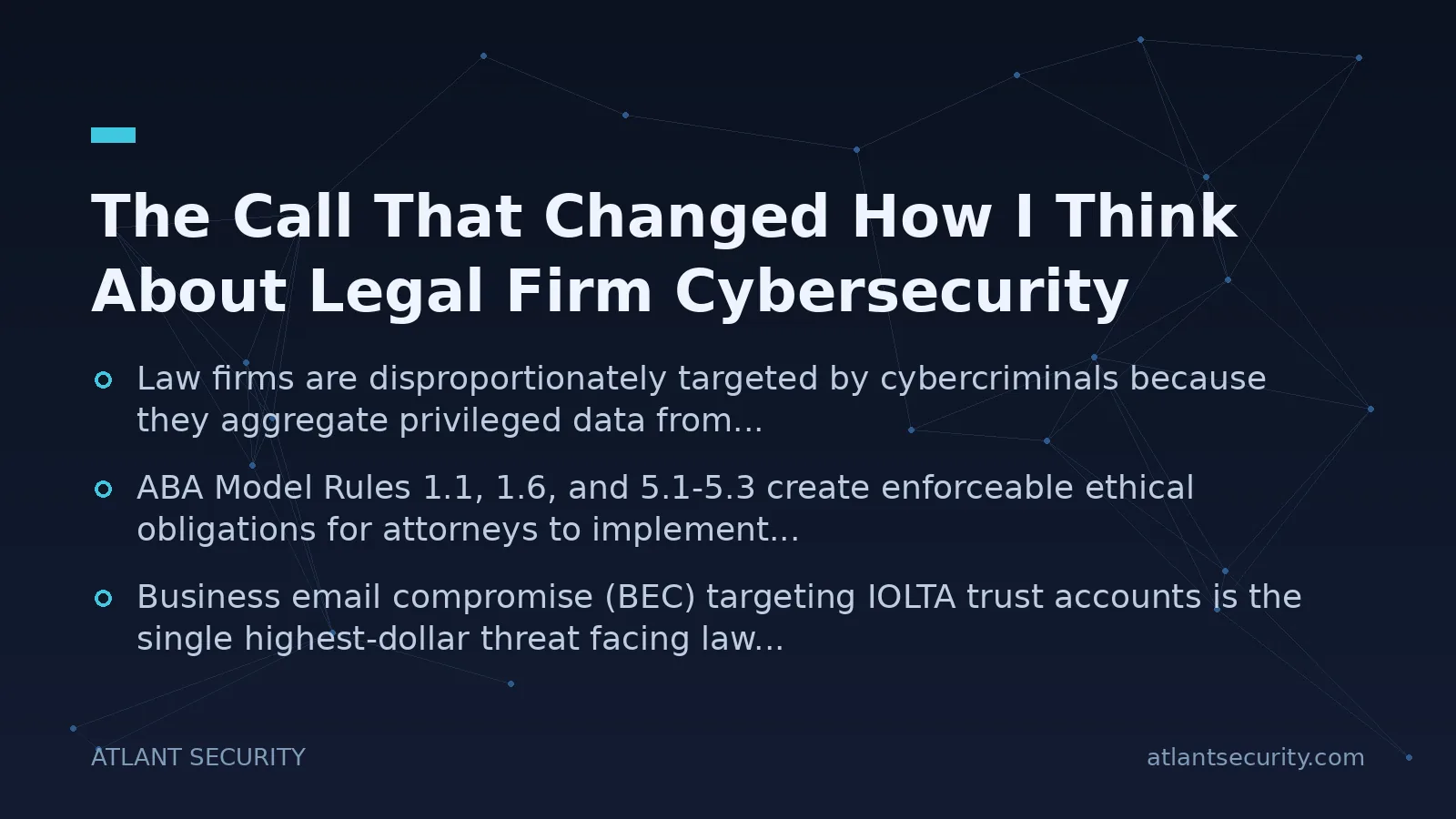
- Law firms are disproportionately targeted by cybercriminals because they aggregate privileged data from dozens or hundreds of clients into a single network
- ABA Model Rules 1.1, 1.6, and 5.1-5.3 create enforceable ethical obligations for attorneys to implement reasonable cybersecurity measures
- Business email compromise (BEC) targeting IOLTA trust accounts is the single highest-dollar threat facing law firms today
- A law firm security program must address matter-level access controls, client portal security, document management systems, and mobile device management
- State bar associations are increasingly issuing ethics opinions requiring specific security measures, and disciplinary actions for cybersecurity failures are on the rise
- Cyber liability insurance underwriters now require minimum security controls before issuing or renewing policies for law firms
From Experience
The Call That Changed How I Think About Legal Firm Cybersecurity
Three years ago, I received a call from the managing partner of a mid-sized litigation firm in the Northeast. His voice was calm-the kind of forced calm you hear from someone who has been awake for 36 hours and has moved past panic into grim acceptance. “We have a problem,” he said. “A significant one.”
The problem was this: an attacker had compromised the email account of a senior associate who was handling the closing on a $14 million commercial real estate transaction. The attacker monitored the email thread for eleven days-learning the names, the deal terms, the timeline, the tone of communication-and then, forty minutes before the scheduled wire transfer, sent forged closing instructions from what appeared to be the associate’s email address. The buyer’s CFO wired $2.6 million to an account controlled by the attacker. The money was in Eastern Europe within hours.
The financial loss was devastating. But what followed was worse. The firm faced a malpractice claim from the buyer, a bar complaint from the seller’s counsel alleging incompetence, a mandatory breach notification to every client whose data resided on the compromised email account, and a deeply uncomfortable conversation with their professional liability insurer-who pointed out that the policy’s cyber exclusion had been in the renewal paperwork the firm never read.
That firm had revenue north of $20 million. They had sophisticated attorneys who could dissect a contract down to the semicolon. But their legal firm cybersecurity program consisted of antivirus software on laptops and an IT manager who also handled the phone system. They had no multi-factor authentication, no email authentication protocols, no wire transfer verification procedures, and no incident response plan.
Since that engagement, I’ve worked with dozens of law firms-from solo practitioners to AmLaw 200 shops-and the pattern repeats. Attorneys understand risk in the abstract. They manage it for clients every day. But the risk sitting inside their own networks is something most firms have never seriously confronted.
This guide is what I wish that managing partner had read twelve months before he called me.
Threat Landscape
Why Law Firms Are Cybercriminals’ Favorite Targets
Cybercriminals are rational economic actors. They go where the return on effort is highest. And law firms represent one of the most attractive targets in the entire economy. Here’s why.
What Makes Law Firms Uniquely Vulnerable
- Privileged data concentration - A single mid-sized law firm may hold confidential data for hundreds of clients across industries. Breaching one firm gives attackers access to trade secrets, financial records, and strategic plans from dozens of companies simultaneously.
- M&A intelligence - Firms handling mergers and acquisitions possess material non-public information worth millions on the open market. The SEC has prosecuted cases where hackers breached law firm networks specifically to conduct insider trading.
- Client funds in trust accounts - IOLTA and client trust accounts hold real money-sometimes tens of millions of dollars. Unlike corporate bank accounts with sophisticated fraud controls, trust accounts are often managed with minimal transaction safeguards.
- Attorney-client privilege as leverage - Ransomware operators know that law firms face catastrophic consequences if privileged communications are leaked. The privilege itself-once breached-may be permanently waived. This makes firms more likely to pay ransoms.
- Weaker security than corporate targets - Most law firms invest a fraction of what their corporate clients spend on cybersecurity. Attackers know this. Breaching a law firm is often easier than breaching the client directly-and yields the same data.
Law Firms vs. Other Industries: Why Attackers Prefer Legal Targets
| Factor | Law Firms | Corporate Targets |
| Data value | Multi-client privileged data | Single-company data |
| Security budget | Typically 1-3% of revenue | 5-15% of IT budget |
| Dedicated security staff | Rare below AmLaw 200 | Common in mid-market+ |
| Ransom payment likelihood | High (privilege waiver risk) | Moderate |
| Liquid funds on hand | Trust accounts with millions | Operating accounts |
A law firm is a one-stop shop for an attacker. Instead of breaching ten companies individually, you breach one law firm and get the crown jewels from all ten.
Ethical Obligations
ABA Model Rules on Cybersecurity: Your Ethical Duty to Protect Data
Legal firm cybersecurity is not merely a best practice-it is an ethical obligation. The American Bar Association has made clear through amendments to the Model Rules and formal opinions that attorneys who fail to implement reasonable cybersecurity measures are violating their professional duties. Here are the three pillars.
Model Rule 1.1: Duty of Competence
Comment 8 to Rule 1.1 was amended in 2012 to explicitly state that competent representation requires an attorney to “keep abreast of the benefits and risks associated with relevant technology.” This means ignorance of cybersecurity threats is not an excuse. An attorney who fails to understand basic security risks to client data is, by definition, not providing competent representation.
In practice, this means attorneys must understand-at least at a functional level-how email encryption works, what multi-factor authentication does, how cloud storage protects (or fails to protect) documents, and what risks emerge from using personal devices for client work.
Model Rule 1.6: Duty of Confidentiality
Rule 1.6(c) requires attorneys to “make reasonable efforts to prevent the inadvertent or unauthorized disclosure of, or unauthorized access to, information relating to the representation of a client.” The word “reasonable” is doing significant work here. What constitutes reasonable effort evolves with the threat landscape.
ABA Formal Opinion 477R (2017) provides guidance: the analysis is risk-based and considers the sensitivity of the information, the likelihood of disclosure if additional safeguards are not employed, the cost of additional safeguards, the difficulty of implementing the safeguards, and the extent to which safeguards adversely affect the lawyer’s ability to represent clients. In 2026, transmitting sensitive client data via unencrypted email almost certainly fails this standard.
Model Rules 5.1 & 5.3: Duty to Supervise
Partners and supervising attorneys have an obligation to ensure that lawyers and non-lawyer staff under their supervision comply with ethics rules-including cybersecurity obligations. This extends to third-party vendors: if your firm uses a cloud-based document management system, you have a duty to evaluate whether that vendor has appropriate security measures in place.
ABA Formal Opinion 483 (2018) further clarified that when a data breach occurs, attorneys have an obligation to monitor for breaches, stop them when detected, take steps to restore security, and determine whether notice to clients is required. “We didn’t know” is not a viable defense when you had a duty to monitor.
Regulatory Landscape
State Bar Requirements and Ethics Opinions
While the ABA Model Rules set the baseline, individual state bars have gone further with specific ethics opinions and requirements. The trend is unmistakable: the standard of care for legal firm cybersecurity is rising every year, and firms that fail to keep pace face increasing disciplinary risk.
Notable State Bar Cybersecurity Opinions
- California (Formal Opinion 2010-179) - An attorney’s duty of confidentiality applies to electronic communications. Attorneys must use “reasonably secure” methods and may need to avoid email entirely for highly sensitive matters.
- New York (Ethics Opinion 1019) - Attorneys must use reasonable care to prevent unauthorized access to client data stored or transmitted electronically. This includes understanding how their technology works and what risks it presents.
- Florida (Ethics Opinion 12-3) - Cloud computing is permissible, but attorneys must take reasonable precautions to protect confidentiality-including due diligence on the cloud provider and appropriate backup procedures.
- Texas (Ethics Opinion 648) - Attorneys must ensure that client information stored electronically is reasonably safe from unauthorized access, including through encryption and access controls.
- New Jersey (Advisory Committee on Professional Ethics Opinion 701) - Attorneys using cloud storage must undertake to stay abreast of technological advances and best practices that affect the security of data.
Beyond ethics opinions, some states now impose affirmative requirements. Several jurisdictions mandate cybersecurity CLE credits. Others require firms above a certain size to designate a technology officer or conduct annual security assessments. The direction of travel is clear: what was “best practice” five years ago is becoming “minimum requirement” today.
Firms operating across state lines face the added complexity of complying with the most stringent applicable standard. A firm with offices in New York and California must meet both bars’ expectations-and should generally build their program to the higher standard rather than trying to maintain jurisdiction-specific minimum thresholds.
Threat Intelligence
Threats Specific to Law Firms: What Attackers Actually Do
Generic cybersecurity advice misses the mark for law firms because the threats facing legal practices are qualitatively different from those facing most businesses. Attackers tailor their techniques to exploit the specific workflows, financial structures, and trust relationships that define legal practice.
BEC Targeting Trust Accounts
Business email compromise targeting IOLTA and client trust accounts is the single most financially devastating attack against law firms. Attackers compromise an email account in the transaction chain-often a paralegal or associate rather than a partner-and monitor communications until a large wire transfer is imminent. They then intercept or forge wire instructions, redirecting funds to accounts they control.
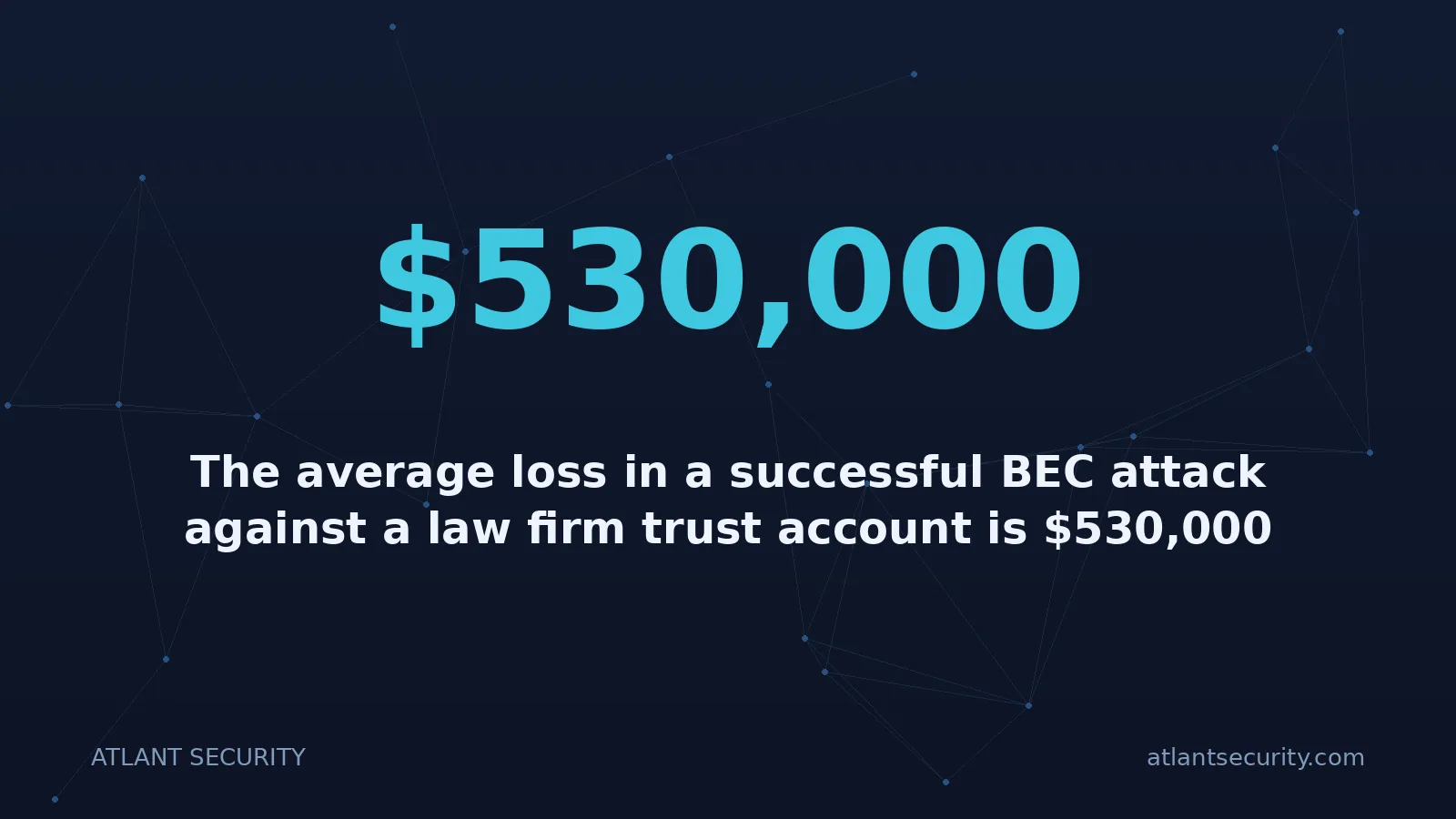
The average loss in a successful BEC attack against a law firm trust account is $530,000 to $2.1 million, according to FBI IC3 data. Recovery rates are below 30% when the fraud isn’t detected within 24 hours. Real estate closings, corporate transactions, estate distributions, and settlement disbursements are the most common targets.
What makes this attack devastating for law firms specifically is the fiduciary obligation. The firm is custodian of client funds. A successful BEC attack against trust accounts can trigger malpractice liability, bar disciplinary proceedings, and personal liability for the responsible attorney.
Client Impersonation Attacks
Attackers create convincing impersonations of existing clients to request document production, payment disbursements, or changes to account instructions. They research client names, matter numbers, and communication styles using data from prior breaches, social media, and public filings.
In a particularly insidious variant, attackers compromise a client’s email and communicate with the firm as the client. From the attorney’s perspective, they’re responding to a legitimate request from a real client, sent from the client’s actual email address. Without out-of-band verification procedures, these attacks are nearly impossible to detect.
Lateral Movement Through Matter Databases
Once inside a law firm’s network, attackers exploit the interconnected nature of matter management systems. A single compromised credential can provide access to thousands of client matters if the firm hasn’t implemented matter-level access controls. Practice management systems, document management repositories, and billing databases each contain rich client data organized in ways that make it easy for an attacker to identify and extract the most valuable information.
Nation-state actors have been documented specifically targeting law firms handling matters related to trade disputes, sanctions, government contracts, and cross-border M&A. The APT10 group, linked to China’s intelligence services, conducted a sustained campaign against major law firms to obtain M&A intelligence and litigation strategy documents.
Ransomware with Double-Extortion
Standard ransomware encrypts files and demands payment. Double-extortion ransomware-now the norm-also exfiltrates data and threatens to publish it. For law firms, this creates an excruciating dilemma: if privileged communications are published, the attorney-client privilege may be deemed waived for every affected matter. Clients may suffer immeasurable harm from the disclosure of litigation strategy, settlement positions, or regulatory investigation responses.
Ransomware groups including ALPHV/BlackCat and LockBit have specifically listed law firms on their leak sites, knowing that the threat of publishing privileged data creates maximum pressure to pay. The average ransom demand against law firms has risen to $1.2 million to $5.4 million, with the largest AmLaw firms facing demands exceeding $30 million.
Security Program
Building a Cybersecurity Program for Your Law Firm
A law firm cybersecurity program must be tailored to how legal work actually gets done. Generic corporate security templates miss critical areas like matter-level access controls, trust account protections, and the unique challenge of attorneys who insist on using their personal iPads. Here is a framework organized around the specific systems and workflows that define legal practice.
Email Security: Your First Line of Defense
Email is where the majority of law firm attacks begin and where the highest-dollar losses occur. A robust email security program includes:
- Multi-factor authentication on every account. No exceptions for senior partners. Hardware security keys (YubiKey) for anyone handling trust account transactions or sensitive client matters.
- DMARC, DKIM, and SPF configured and enforced. These email authentication protocols prevent attackers from sending emails that appear to come from your firm’s domain. Enforcement should be set to “reject,” not “quarantine” or “none.”
- Advanced threat protection with AI-based analysis that detects business email compromise attempts, display name spoofing, and lookalike domains.
- Email encryption for all communications containing sensitive client information. Consider making TLS 1.2+ a baseline requirement for all firm communications.
- External email banners that clearly mark messages originating outside the firm, reducing the success rate of impersonation attacks.
Document Management System (DMS) Security
Your DMS-whether iManage, NetDocuments, Worldox, or another platform-is the repository for your firm’s most sensitive work product. Securing it requires:
- Matter-level access controls. Not everyone in the firm should be able to access every matter. Implement ethical walls for conflicted matters and restrict access to sensitive client work to the assigned team.
- Audit logging. Every document access, download, and modification should be logged. These logs serve both security monitoring and client audit response purposes.
- Encryption at rest and in transit. Documents should be encrypted in storage and during transmission-especially for cloud-hosted DMS platforms.
- Data loss prevention (DLP) rules that detect and block unusual bulk downloads, external sharing of privileged documents, or transfers to personal email accounts or cloud storage.
Client Portal Security
Client portals are increasingly replacing email for document exchange and case updates. Securing them protects both the firm and its clients:
- Require MFA for client portal access. Clients may push back initially, but the alternative-exchanging sensitive documents over unencrypted email-is indefensible.
- Session timeouts and IP logging. Automatic session expiration after 15-30 minutes of inactivity, with logging of all access by IP address and device.
- Granular permissions. Clients should only see documents and communications related to their own matters. Cross-client data leakage is both a security failure and an ethics violation.
- Secure file sharing with expiring links, download limits, and watermarking for sensitive documents.
Mobile Device Management (MDM)
Attorneys are mobile professionals. They review documents in court, respond to emails from airports, and take calls from home offices. This creates enormous security surface area that MDM must address:
- Mandatory device enrollment for any personal or firm-issued device accessing firm email, DMS, or client data. No unenrolled devices, no exceptions.
- Remote wipe capability. When a device is lost, stolen, or when an attorney departs the firm, you must be able to remove firm data without affecting personal information.
- Containerization. Firm data should live in a managed container (Microsoft Intune, VMware Workspace ONE) that separates it from personal apps and data.
- Minimum device security requirements: current OS version, device encryption enabled, screen lock configured, no jailbroken/rooted devices.
- VPN or zero-trust network access for connections to firm resources from outside the office network.
Law Firm Security Program: Priority Matrix
| Priority | Control | Timeline | Cost Range |
| Immediate | MFA on all accounts | 1-2 weeks | $5-$15/user/mo |
| Immediate | Email authentication (DMARC/DKIM/SPF) | 1-3 weeks | $0-$500/yr |
| Month 1 | Wire transfer verification procedures | 1 week | $0 (policy only) |
| Month 1 | Security awareness training | 2-4 weeks | $20-$50/user/yr |
| Quarter 1 | DMS access controls & audit logging | 4-8 weeks | $5K-$25K |
| Quarter 1 | MDM deployment | 4-6 weeks | $8-$15/device/mo |
| Quarter 2 | Incident response plan | 3-5 weeks | $5K-$15K |
| Quarter 2 | Full security audit | 4-8 weeks | $15K-$75K |
Risk Transfer
Insurance and Regulatory Requirements for Law Firms
Cyber liability insurance has become essential for law firms-but obtaining and maintaining coverage increasingly requires demonstrating that reasonable security controls are in place. The insurance market has hardened significantly, and underwriters are asking detailed security questions that many firms cannot answer favorably.
What Cyber Insurance Underwriters Require
As of 2026, most cyber liability insurers require law firms to attest to or demonstrate the following controls as conditions of coverage:
- Multi-factor authentication on all remote access, email, and privileged accounts
- Endpoint detection and response (EDR) on all workstations and servers
- Regular patching cadence-critical vulnerabilities remediated within 14 days
- Offline or immutable backups tested at least quarterly
- Security awareness training for all employees at least annually
- Incident response plan that has been reviewed and tested
- Written information security policy approved by firm leadership
Firms that cannot meet these requirements face three possible outcomes: policy denial, policy exclusions that render coverage effectively useless, or premiums two to five times higher than firms with mature security programs. We have seen malpractice insurers refuse renewal for firms that experienced a breach and could not demonstrate basic security hygiene.
Regulatory Requirements Beyond Bar Rules
Law firms are also subject to regulatory requirements that extend beyond bar ethics rules:
- State data breach notification laws - All 50 states require notification when personal information is compromised. Law firms holding client PII (Social Security numbers, financial account data) must comply.
- HIPAA - Firms handling protected health information (medical malpractice, personal injury, healthcare transactions) may be considered business associates and subject to HIPAA Security Rule requirements.
- SEC and FINRA requirements - Firms representing SEC-registered entities or handling securities matters may face additional data protection obligations.
- GDPR and international data protection - Firms with clients or matters involving EU citizens must comply with GDPR requirements for data protection, processing records, and breach notification within 72 hours.
- Client-imposed requirements - Corporate clients increasingly mandate specific security controls as conditions of engagement. Failure to meet them means losing the client.
The intersection of ethical obligations, regulatory requirements, and insurance conditions creates a compelling case for a structured security audit as the foundation for any law firm cybersecurity program. An audit identifies gaps, prioritizes remediation, and produces documentation that satisfies multiple stakeholders simultaneously.
Personal Security
Partner-Level Personal Cybersecurity
Law firm partners present a unique risk. They have the highest levels of system access, handle the most sensitive client relationships, and-bluntly-are often the most resistant to security controls. They also have significant personal digital footprints: property records, bar association profiles, court filings, and media appearances make them easy to research and target.
Attackers know that compromising a named partner’s account provides maximum leverage-both for financial fraud and for social engineering other firm members and clients. A request from the managing partner’s email address is rarely questioned.
Recommended Partner Security Measures
- Separate personal and professional digital lives. Different email providers, different password managers, different devices where feasible.
- Hardware security keys for all critical accounts. Not just firm accounts-personal email, banking, and cloud storage too.
- SIM swap protection. Contact your carrier to set a transfer PIN and enable port-out protection. Partners are prime SIM swap targets.
- Personal data broker removal. Services that remove your home address, phone number, and family information from data broker sites reduce the information available to attackers.
- Dark web monitoring for personal credentials, firm credentials, and family members’ information.
- Consider a personal cybersecurity assessment that evaluates your entire digital exposure-not just what the firm provides, but your home network, personal devices, and family security posture.
Common Questions
Frequently Asked Questions About Law Firm Cybersecurity
What are the biggest cybersecurity threats facing law firms?
The three most significant threats are business email compromise targeting trust accounts and wire transfers, ransomware with double-extortion (where attackers threaten to publish privileged client data), and unauthorized access to matter management systems containing confidential client information. BEC remains the highest-dollar threat, while ransomware poses the greatest existential risk due to the potential waiver of attorney-client privilege.
Do the ABA Model Rules require specific cybersecurity measures?
The Model Rules do not prescribe specific technologies, but they establish a “reasonableness” standard that evolves with the threat landscape. Rule 1.1 (competence) requires attorneys to understand technology risks. Rule 1.6(c) requires “reasonable efforts” to prevent unauthorized access to client data. ABA Formal Opinions 477R and 483 provide further guidance. In practice, measures like multi-factor authentication, email encryption for sensitive communications, and regular security assessments are increasingly considered baseline “reasonable” measures.
How much should a law firm spend on cybersecurity?
Industry benchmarks suggest that law firms should allocate 6-10% of their IT budget to security, or approximately 0.5-1.5% of gross revenue. For a 50-attorney firm with $15 million in revenue, this translates to roughly $75,000-$225,000 annually. However, the appropriate amount depends on the firm’s practice areas (M&A and litigation firms face higher risk), client requirements, and regulatory obligations. Starting with a security audit helps prioritize spending where it matters most.
Can an attorney be disciplined for a cybersecurity breach?
Yes. While a breach alone may not result in discipline, an attorney’s failure to implement reasonable security measures before the breach-or failure to respond appropriately after discovery-can constitute a violation of Rules 1.1, 1.6, or 5.1/5.3. Several state bars have issued public reprimands and imposed sanctions on attorneys who failed to safeguard client data. The trend is toward increased enforcement as cybersecurity standards become more clearly defined in ethics opinions.
Does our law firm need a dedicated CISO or security officer?
Firms with more than 50 attorneys or those handling highly sensitive matters (M&A, government investigations, national security) should have dedicated security leadership. For firms below that threshold, a virtual CISO provides strategic security leadership at a fraction of the cost of a full-time hire. A vCISO can develop your security program, manage vendor relationships, oversee incident response, and represent the firm in client security audits-typically for $3,000-$10,000 per month.
What should a law firm do immediately after discovering a breach?
Activate your incident response plan (or engage an incident response firm immediately if you don’t have one). Contain the breach by isolating affected systems. Engage legal counsel experienced in data breach response-even law firms need outside counsel for this. Determine whether notification obligations exist under state law, HIPAA, or contractual requirements. Notify your cyber insurance carrier. Assess whether attorney-client privilege has been compromised and determine client notification obligations under ABA Formal Opinion 483. Document everything.
How do we protect against wire transfer fraud targeting our trust accounts?
Implement a mandatory callback verification procedure for all wire instructions-no exceptions. The callback must use a phone number obtained independently (from the client file or a trusted directory), never from the email containing the wire instructions. Require dual authorization for any wire transfer above a threshold amount (we recommend $10,000). Include explicit warnings in all client engagement letters about wire fraud. Consider using a secure client portal rather than email for transmitting financial instructions.
What cybersecurity training should law firm staff receive?
All firm personnel-attorneys, paralegals, administrative staff, and IT-should receive annual security awareness training covering phishing identification, social engineering tactics, safe handling of client data, password hygiene, and incident reporting procedures. Additionally, conduct monthly simulated phishing exercises and provide role-specific training: attorneys handling financial transactions need wire fraud awareness, staff with DMS access need data handling training, and anyone with administrative privileges needs advanced security training. Several states now require cybersecurity CLE credits, making this dual-purpose.
Ready to Secure Your Law Firm?
Atlant Security works with law firms across the Am Law 200 and the mid-market to build cybersecurity programs that meet ethical obligations, satisfy client requirements, and actually stop attacks. We understand legal workflows, matter-level confidentiality, and the trust account protections your firm needs. Start with a security audit to understand where you stand today.
Last Updated: March 2026 · Author: Alexander Sverdlov
This article is for informational purposes only and does not constitute legal advice. Cybersecurity requirements vary by jurisdiction, practice area, and firm size. Law firms should consult with cybersecurity professionals and their own ethics counsel when developing security programs. Specific ABA Model Rules and ethics opinions cited should be verified against current versions, as rules and interpretations evolve.
