

Compliance · March 2026
A practical, phase-by-phase ISO 27001 implementation guide built from real project experience. Covers gap assessment through certification-with timelines, deliverables, resource requirements, and the pitfalls that derail most organizations.
Key Takeaways
- ISO 27001 implementation typically takes 12-18 months across six phases: gap assessment, risk assessment, policy development, control implementation, internal audit, and certification audit
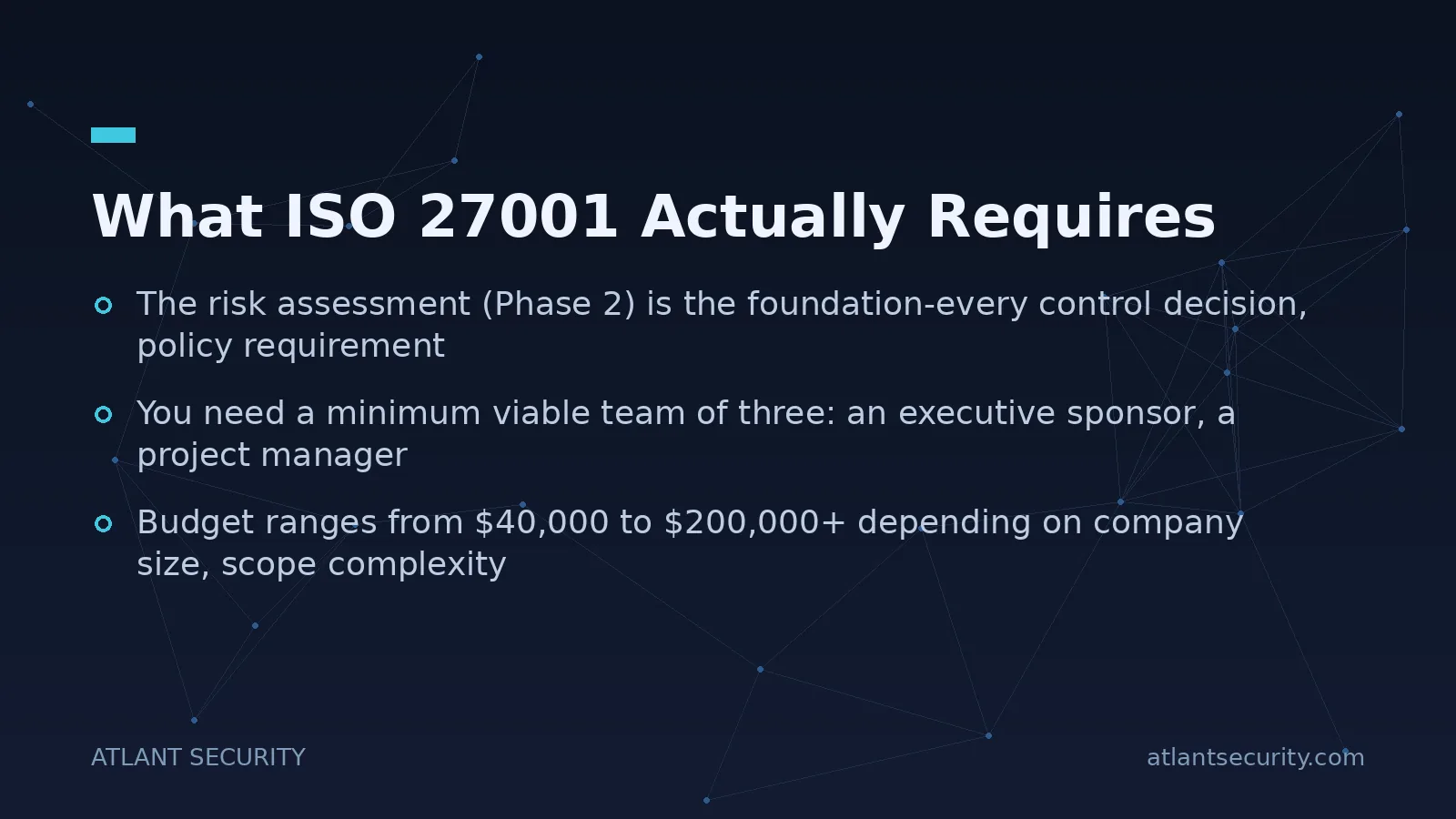
- The risk assessment (Phase 2) is the foundation-every control decision, policy requirement, and audit finding traces back to it
- You need a minimum viable team of three: an executive sponsor, a project manager, and an information security lead (or virtual CISO)
- Budget ranges from $40,000 to $200,000+ depending on company size, scope complexity, and how much external help you need
- The most common reason projects fail: treating ISO 27001 as an IT project rather than a business-wide management system
Three years ago, I sat across the table from a visibly frustrated CTO at a Series B fintech company. His largest prospective customer-a European bank-had just told him the deal was on hold until his company could demonstrate ISO 27001 certification. “We have great security,” he said. “We encrypt everything, we do pen tests, we have MFA everywhere. Why isn’t that enough?”
I explained what took me years of consulting engagements to fully internalize: ISO 27001 is not a technology checklist. It is a management system. The standard doesn’t care whether you use CrowdStrike or SentinelOne for endpoint protection. It cares whether you have a systematic process for identifying risks, selecting proportionate controls, monitoring their effectiveness, and continuously improving. The technology is just one layer. The governance, the documentation, the human processes-those are what auditors actually evaluate.
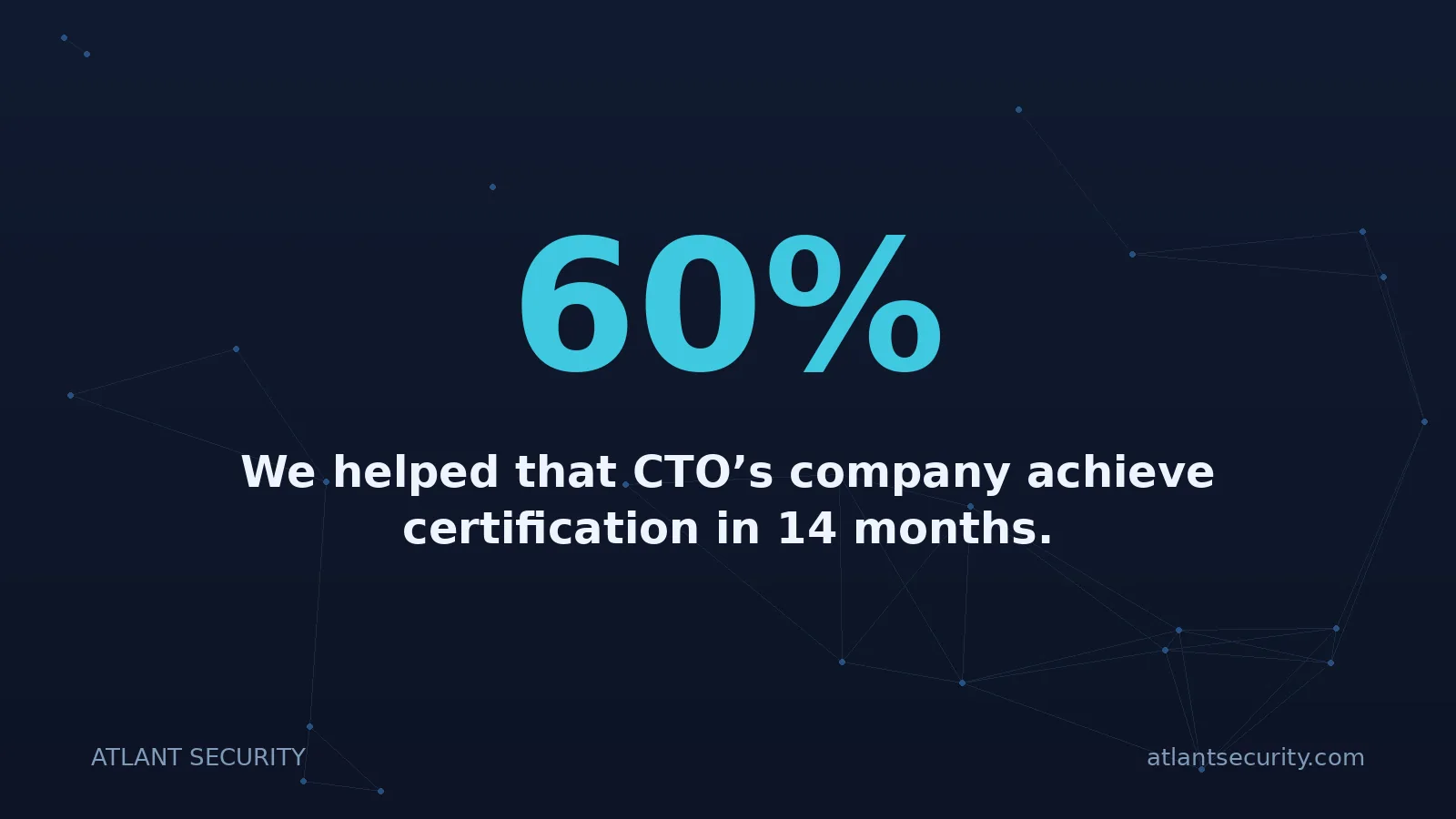
We helped that CTO’s company achieve certification in 14 months. Along the way, they discovered three critical access control gaps that their pen tests had never flagged, reduced their vendor risk exposure by 60%, and-most importantly-closed that European bank deal within two months of receiving their certificate.
This guide distills everything I’ve learned from guiding organizations through ISO 27001 implementation into a practical, phase-by-phase roadmap. Whether you’re a startup preparing for your first certification or an established enterprise modernizing an aging ISMS, the structure below will show you exactly what to do, when to do it, and what pitfalls to avoid.
Foundation
What ISO 27001 Actually Requires
ISO/IEC 27001 is the international standard for Information Security Management Systems (ISMS). Published by the International Organization for Standardization and the International Electrotechnical Commission, the current version (ISO 27001:2022) specifies requirements for establishing, implementing, maintaining, and continually improving an ISMS within the context of your organization.
The standard has two main components. Clauses 4-10 define the mandatory management system requirements: context of the organization, leadership commitment, planning, support, operation, performance evaluation, and improvement. Annex A provides a reference set of 93 information security controls (reorganized from 114 in the 2013 version) across four categories: organizational, people, physical, and technological.
A critical misconception: you do not need to implement every Annex A control. You need to implement controls that are justified by your risk assessment. The Statement of Applicability (SoA) documents which controls you selected, which you excluded, and the rationale for each decision. This risk-based approach is the heart of ISO 27001.
ISO 27001:2022 Structure at a Glance
- Clauses 4-10: Mandatory management system requirements (context, leadership, planning, support, operation, performance evaluation, improvement)
- Annex A: 93 reference controls in 4 categories - 37 organizational, 8 people, 14 physical, 34 technological
- ISO 27002:2022: Companion guidance document with implementation advice for each Annex A control
- Risk-based approach: You select controls based on your risk assessment, not by checking every box
Planning
Timeline & Resource Requirements
Before diving into the phases, let’s set realistic expectations. ISO 27001 implementation is a significant undertaking, but it is entirely manageable with proper planning and the right resources.
| Phase | Duration | Key Effort |
|---|---|---|
| Phase 1: Gap Assessment | 4-6 weeks | Understand current state vs. requirements |
| Phase 2: Risk Assessment | 6-8 weeks | Identify, analyze, and evaluate information security risks |
| Phase 3: Policy Development | 6-10 weeks | Draft, review, and approve ISMS documentation |
| Phase 4: Control Implementation | 12-20 weeks | Deploy controls, train staff, collect evidence |
| Phase 5: Internal Audit | 4-6 weeks | Validate ISMS effectiveness before external audit |
| Phase 6: Certification Audit | 4-8 weeks | Stage 1 (documentation) + Stage 2 (implementation) |
Total Timeline: 12-18 Months
Organizations with mature security practices and dedicated resources can compress this to 9-12 months. Companies starting from scratch or with limited internal bandwidth should plan for 15-18 months. Rushing the process almost always results in nonconformities during the certification audit.
Minimum viable team: Executive sponsor (5 hrs/week), Project manager / ISMS coordinator (20-30 hrs/week), Information security lead or vCISO (15-25 hrs/week), plus department representatives contributing 3-5 hrs/week each during relevant phases.
The organizations that achieve certification fastest aren’t the ones with the biggest budgets. They’re the ones where leadership treats the ISMS as a business priority, not an IT side project.
Phase 1
Gap Assessment
The gap assessment is your starting point. It compares your organization’s current information security posture against ISO 27001 requirements and Annex A controls to produce a clear picture of what exists, what’s missing, and what needs improvement. Without this baseline, you’re building a project plan in the dark.
A thorough security audit at this stage saves months later. One of the most expensive mistakes I see is organizations skipping the gap assessment and jumping straight into policy writing-only to discover halfway through that their policies don’t align with their actual risk landscape.
Phase 1 Activities
- Define ISMS scope: Determine which parts of the organization, which locations, which systems, and which processes will be covered. Scope directly affects cost and timeline.
- Review existing documentation: Catalog current policies, procedures, risk registers, asset inventories, and any prior audit reports.
- Interview key stakeholders: Speak with department heads, IT staff, legal/compliance, and HR to understand current security practices-both documented and informal.
- Assess against Annex A controls: Walk through all 93 controls and rate each as fully implemented, partially implemented, or not implemented.
- Identify interested parties: Map stakeholders (customers, regulators, partners, employees) and their information security expectations per Clause 4.2.
Phase 1 Deliverables
- ISMS scope document (Clause 4.3)
- Gap assessment report with maturity ratings per control
- Interested parties register and requirements matrix
- Prioritized remediation roadmap with effort estimates
- Implementation project plan (phases, milestones, resource allocation)
Common Pitfall
Defining scope too broadly. Including every system, location, and process sounds thorough, but it multiplies cost and complexity. Start with a focused scope covering your core business operations and customer-facing systems. You can expand scope in subsequent surveillance audit cycles.
Phase 2
Risk Assessment
If the gap assessment tells you where you stand, the risk assessment tells you where to focus. ISO 27001 Clause 6.1.2 requires a formal risk assessment process that identifies information security risks, analyzes their likelihood and impact, and evaluates them against defined criteria. This is not optional, and it is not a one-time exercise-the standard requires regular reassessment.
The risk assessment directly drives your Statement of Applicability and your risk treatment plan. Every control you implement should trace back to a specific risk. Every control you exclude from Annex A should have a documented justification. Auditors will test this traceability. If your controls don’t align with identified risks, you will receive nonconformities.
Phase 2 Activities
- Define risk assessment methodology: Choose and document your approach (qualitative, semi-quantitative, or quantitative). Include criteria for likelihood, impact, and risk acceptance thresholds.
- Build asset inventory: Catalog information assets (data, systems, people, facilities) that fall within ISMS scope. Each asset needs an owner.
- Identify threats and vulnerabilities: For each asset, identify plausible threats (ransomware, insider misuse, natural disaster, vendor compromise) and existing vulnerabilities.
- Analyze and evaluate risks: Rate each risk for likelihood and impact. Compare against acceptance criteria to determine which risks require treatment.
- Develop risk treatment plan: For each unacceptable risk, decide on treatment: mitigate (apply controls), transfer (insurance/outsourcing), avoid (eliminate the activity), or accept (with documented justification from a risk owner).
- Create Statement of Applicability: Map selected controls from Annex A to identified risks. Document excluded controls with rationale.
Phase 2 Deliverables
- Risk assessment methodology document (Clause 6.1.2)
- Information asset inventory with assigned owners
- Risk register (threats, vulnerabilities, likelihood, impact, risk level, treatment decision)
- Risk treatment plan with assigned owners and target dates
- Statement of Applicability (SoA) mapping controls to risks
- Risk acceptance records signed by appropriate management
Common Pitfall
Using an overly complex risk methodology. I’ve seen companies adopt elaborate 10-point scales, weighted formulas, and Monte Carlo simulations for their first implementation. The result: nobody understands it, nobody maintains it, and auditors question whether the methodology is “consistently applied.” Start with a simple 3x3 or 5x5 likelihood-impact matrix. You can refine it in future cycles.
Phase 3
Policy Development
Documentation is where ISO 27001 implementation becomes tangible. The standard requires a hierarchy of documented information: a top-level information security policy, supporting topic-specific policies, procedures that describe how policies are executed, and records that prove execution.
The goal is not to produce volumes of documentation that nobody reads. The goal is to create practical, proportionate documentation that reflects how your organization actually operates. The best ISMS documentation I’ve reviewed is concise, written in plain language, and clearly connected to real workflows. The worst reads like it was copied from a template library and never adapted.
Core Documentation Set
| Document | ISO Clause | Purpose |
|---|---|---|
| Information Security Policy | 5.2 | Top-level direction and commitment from management |
| Risk Assessment Methodology | 6.1.2 | Defines how risks are identified, analyzed, evaluated |
| Statement of Applicability | 6.1.3 d) | Maps controls to risks; justifies inclusions/exclusions |
| Risk Treatment Plan | 6.1.3 e) | Action plan for addressing identified risks |
| Access Control Policy | A.5.15-5.18 | Rules for granting, reviewing, revoking access |
| Incident Response Procedure | A.5.24-5.28 | Steps for detecting, reporting, responding to incidents |
| Business Continuity Plan | A.5.29-5.30 | Ensures information security during disruptions |
| Internal Audit Procedure | 9.2 | Defines audit planning, execution, and reporting |
Phase 3 Deliverables
- Information security policy approved by top management
- Topic-specific policies (access control, acceptable use, data classification, supplier security, cryptography, etc.)
- Operational procedures (incident response, change management, backup, user provisioning/deprovisioning)
- Document control framework (version control, approval workflow, distribution, review schedules)
- ISMS roles and responsibilities matrix (Clause 5.3)
Common Pitfall
Buying a “complete template pack” and submitting it with only your company name swapped in. Auditors see this constantly, and it is one of the fastest paths to nonconformity findings. Templates are useful as starting points, but every document must reflect your actual organization-your real processes, your real technology stack, your real risk appetite. If staff cannot explain a policy because they’ve never seen it before the audit, that is a major red flag.
Phase 4
Control Implementation
This is the longest and most resource-intensive phase. You are taking the controls identified in your Statement of Applicability and actually deploying them-configuring systems, changing processes, training people, and building the evidence trail that proves each control is operating as intended.
The key principle here: evidence, evidence, evidence. ISO 27001 auditors evaluate not just whether a control exists, but whether it operates effectively and consistently. A firewall rule set is not evidence of a functioning access control program. The combination of a documented access control policy, an approval workflow for firewall changes, change management records, and periodic review logs-that is evidence.
Phase 4 Activities by Control Category
Organizational Controls (A.5)
- Establish information security roles and responsibilities across the organization
- Implement supplier security assessment and monitoring processes
- Set up threat intelligence gathering and analysis workflows
- Deploy project security integration procedures
People Controls (A.6)
- Conduct security awareness training program (all staff, role-based for technical teams)
- Implement background screening procedures for new hires
- Establish disciplinary process for security policy violations
- Create onboarding/offboarding checklists with security requirements
Physical Controls (A.7)
- Define secure areas and implement physical access controls
- Establish clean desk and clear screen policies
- Implement equipment security and secure disposal procedures
Technological Controls (A.8)
- Deploy endpoint protection, network security, and logging/monitoring solutions
- Configure MFA for all critical systems and privileged accounts
- Implement encryption for data at rest and in transit
- Establish vulnerability management and patch management cycles
- Set up backup and recovery procedures with regular testing
Phase 4 Deliverables
- Implemented controls with evidence packages for each Annex A control in your SoA
- Security awareness training completion records (all staff)
- Completed risk treatment actions with residual risk re-evaluation
- Management review meeting minutes (Clause 9.3) - at least one before internal audit
- Operational logs and records (access reviews, change logs, incident records, backup test results)
- Updated risk register reflecting current residual risk levels
Common Pitfall
Implementing controls without collecting evidence from day one. The certification audit requires evidence that controls have been operating effectively over a period of time-typically three months minimum. If you implement a quarterly access review process in Month 11 and your Stage 2 audit is in Month 14, you’ll only have one review cycle to show. Plan your evidence collection timeline backward from your target audit date.
Phase 5
Internal Audit
The internal audit (Clause 9.2) is your dress rehearsal. It evaluates whether the ISMS conforms to ISO 27001 requirements and your own documented policies, and whether it is effectively implemented and maintained. The internal audit must be completed before the certification audit, and its findings must be addressed through corrective actions.
A critical requirement: the internal auditor must be independent of the areas being audited. The person who designed your access control policy cannot audit it. Many organizations engage an external firm for internal audit services-this satisfies the independence requirement and brings a fresh perspective that catches issues your team has become blind to. Our IT security audit services are frequently used for exactly this purpose.
Phase 5 Activities
- Develop audit program: Create an audit plan covering all ISMS clauses (4-10) and all applicable Annex A controls. Ensure auditor independence.
- Execute audit: Review documentation, interview process owners, examine evidence, observe operational practices. Document findings as conformities, observations, minor nonconformities, or major nonconformities.
- Report findings: Produce an internal audit report with categorized findings, root cause analysis for nonconformities, and recommended corrective actions.
- Implement corrective actions: Address nonconformities with root-cause-driven fixes. Track corrective actions to completion.
- Conduct management review: Present internal audit results to top management (Clause 9.3). Document decisions on ISMS changes, resource allocation, and improvement opportunities.
Phase 5 Deliverables
- Internal audit program and plan
- Internal audit report with categorized findings
- Corrective action log with root causes, actions, owners, and completion dates
- Evidence of corrective action effectiveness verification
- Management review meeting minutes (Clause 9.3)
- Updated ISMS documentation reflecting corrective actions
Common Pitfall
Running a superficial internal audit that finds zero nonconformities. Auditors at the certification body know this is unrealistic-every first-implementation ISMS has issues. A “clean” internal audit raises suspicion about the audit’s rigor. A strong internal audit that finds and addresses real issues actually builds auditor confidence in your ISMS maturity.
Phase 6
Certification Audit
The certification audit is conducted by an accredited certification body (CB) and happens in two stages. Selecting your CB early-ideally during Phase 4-ensures availability and allows you to book audit dates that align with your implementation timeline.
Stage 1: Documentation Review
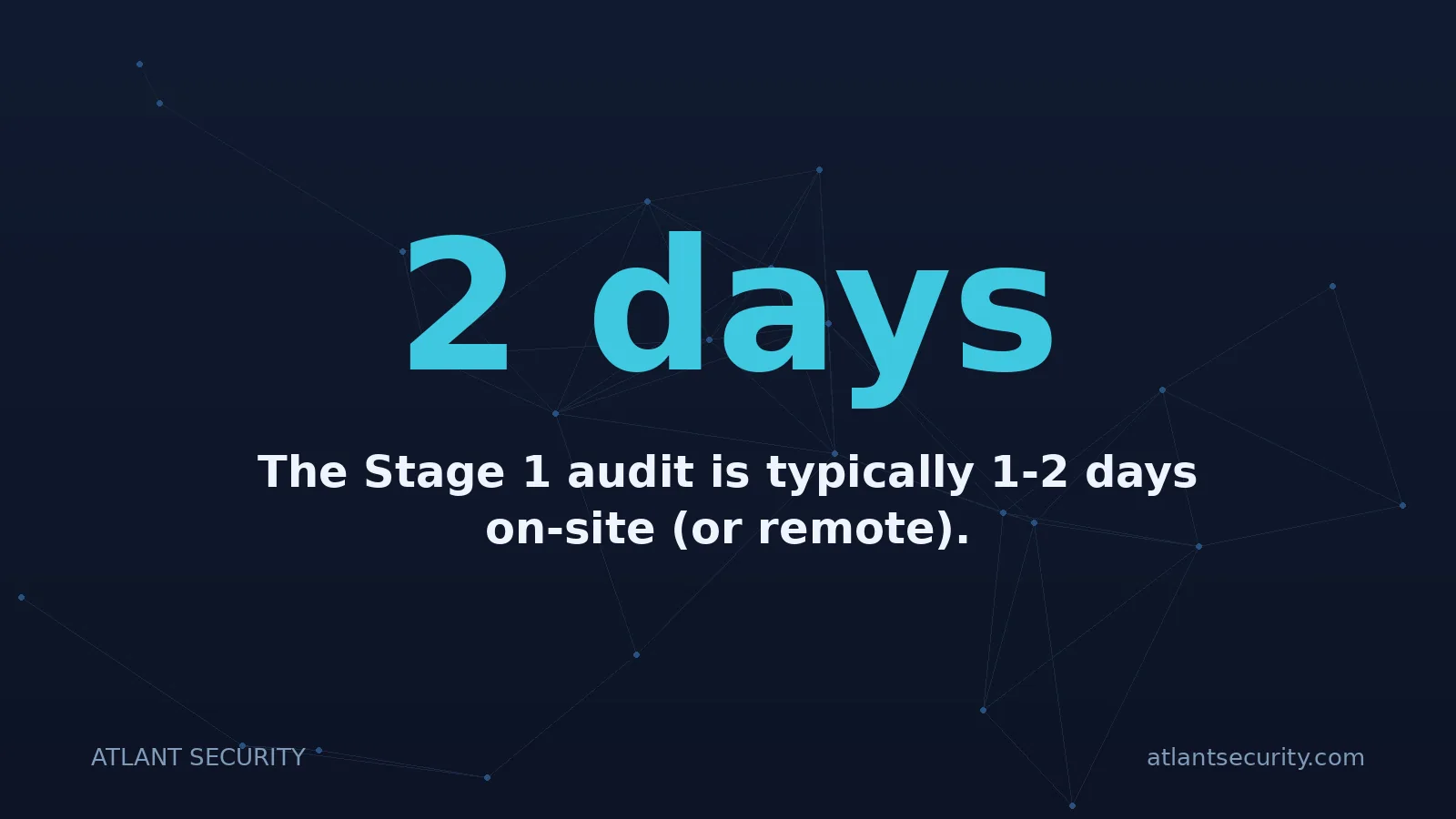
The Stage 1 audit is typically 1-2 days on-site (or remote). The auditor reviews your ISMS documentation to confirm it meets ISO 27001 requirements and that your organization is ready for the Stage 2 audit.
What auditors evaluate:
- ISMS scope and applicability statement
- Risk assessment methodology and results
- Information security policy and objectives
- Internal audit and management review completion
- Overall readiness for Stage 2
Stage 2: Implementation Audit
The Stage 2 audit (typically 3-8 days depending on scope and company size) evaluates whether your ISMS is effectively implemented. Auditors interview staff, examine evidence, observe processes, and test controls.
What auditors do:
- Interview process owners and staff at all levels
- Sample evidence records (access reviews, incident logs, change records)
- Test control effectiveness through observation and walkthrough
- Verify risk treatment actions are implemented and effective
- Confirm management commitment and ISMS integration into business processes
Phase 6 Deliverables
- Certification body selection and contract
- Stage 1 audit report and resolution of any findings
- Stage 2 audit report
- Corrective actions for any Stage 2 nonconformities (typically within 90 days)
- ISO 27001 certificate (valid for 3 years, with annual surveillance audits)
- Surveillance and recertification audit schedule
Certification is not the finish line-it’s the starting line. The real value of ISO 27001 comes from maintaining and improving the ISMS year after year, audit cycle after audit cycle.
Investment
Budget & Resource Breakdown
ISO 27001 implementation costs vary significantly based on organization size, scope complexity, current security maturity, and how much you do internally versus with external support. Below are realistic ranges based on our experience across dozens of implementations.
| Cost Category | Small Org (20-50 staff) | Mid-size (50-250 staff) | Enterprise (250+) |
|---|---|---|---|
| External consulting | $15K-$40K | $40K-$90K | $80K-$200K+ |
| Technology / tooling | $5K-$15K | $15K-$40K | $30K-$80K |
| Internal staff time | $10K-$25K | $25K-$60K | $50K-$120K |
| Certification audit fees | $8K-$15K | $15K-$30K | $25K-$50K |
| Estimated Total | $38K-$95K | $95K-$220K | $185K-$450K+ |
Organizations with an existing virtual CISO engagement can significantly reduce consulting costs, since ongoing security governance work overlaps heavily with ISO 27001 requirements. Many of our vCISO clients find that 40-60% of the ISMS documentation and controls are already in place from their existing security program.
Watch Out
The 8 Most Common ISO 27001 Implementation Pitfalls
After guiding dozens of organizations through certification, these are the failure patterns I see repeated most often. Each one has cost companies months of delay and tens of thousands in rework.
- Treating it as an IT project. ISO 27001 is a management system that spans the entire organization. HR, legal, facilities, procurement, and executive leadership all have mandatory roles. When IT owns it alone, critical gaps in people and physical controls go unaddressed.
- Skipping the gap assessment. Organizations that jump straight into policy writing or tool procurement invariably discover misalignment between their ISMS and their actual risk landscape-usually during the internal audit or, worse, during Stage 2.
- Overcomplicated risk methodology. A risk assessment framework that requires a PhD to operate will not be consistently applied or maintained. Start simple. Mature over time.
- Copy-paste documentation. Template-based policies that don’t reflect reality fail every time. Auditors will ask staff to explain policies-if they can’t, it’s a nonconformity.
- Underestimating evidence requirements. Controls need evidence of consistent operation over time. Start collecting evidence the day you implement a control, not the week before the audit.
- No management engagement. Clause 5 requires demonstrated leadership commitment. If your CEO or board can’t articulate the ISMS objectives during the Stage 2 audit, that’s a finding.
- Scope creep mid-project. Expanding ISMS scope after the risk assessment is done forces you to redo major work. Define scope clearly in Phase 1 and resist changes unless absolutely necessary.
- Choosing the wrong certification body. Not all CBs are equal. Look for UKAS, ANAB, or JAS-ANZ accreditation. Avoid CBs that also sell consulting services for the same standard-this creates a conflict of interest that accreditation bodies prohibit.
Common Questions
ISO 27001 Implementation FAQs
1. How long does ISO 27001 certification take?
Most organizations achieve certification in 12-18 months from project kickoff. Companies with mature security programs and dedicated resources can compress this to 9-12 months. The main variables are organization size, scope complexity, existing security maturity, and internal resource availability.
2. Do we need to implement all 93 Annex A controls?
No. ISO 27001 uses a risk-based approach. You implement controls that address identified risks. Controls that aren’t applicable to your context can be excluded-but each exclusion must be documented with a clear justification in your Statement of Applicability. In practice, most organizations implement 70-85 of the 93 controls.
3. Can a small company (under 50 employees) realistically achieve ISO 27001?
Absolutely. ISO 27001 is designed to be scalable. Smaller organizations often have simpler scope, fewer systems, and shorter communication lines-which can actually make implementation faster. The key is proportionality: your ISMS documentation and controls should match your organization’s size and complexity, not mimic an enterprise approach.
4. What is the difference between ISO 27001 and SOC 2?
ISO 27001 is an international standard resulting in a certificate valid for three years. SOC 2 is a North American reporting framework that produces an attestation report. ISO 27001 is prescriptive about the management system structure; SOC 2 is more flexible about implementation. Many organizations pursue both-there is roughly 60-70% overlap in control requirements. Your vCISO can help build a unified control framework that satisfies both.
5. What happens after certification?
ISO 27001 certification is valid for three years, but it requires annual surveillance audits (shorter audits that sample specific areas) to maintain. At the end of the three-year cycle, a full recertification audit is required. Between audits, you must continue operating the ISMS: conducting risk reviews, running internal audits, holding management reviews, managing incidents, and driving continual improvement.
6. Can we use a virtual CISO to lead ISO 27001 implementation?
Yes-and many organizations do. A virtual CISO with ISO 27001 Lead Implementer or Lead Auditor experience can serve as your ISMS manager, lead the implementation project, develop documentation, and prepare your team for audit. This is often more cost-effective than hiring a full-time security executive for what is fundamentally a 12-18 month project with ongoing but reduced maintenance thereafter.
7. What are the biggest risks to our certification timeline?
The three most common timeline killers are: (1) loss of executive sponsorship mid-project, (2) scope changes after the risk assessment, and (3) insufficient evidence collection time before the certification audit. Plan for at least three months of control operation before Stage 2 to build an adequate evidence base.
The Bottom Line
ISO 27001 Is a Business Investment, Not a Compliance Tax
The organizations that get the most from ISO 27001 are the ones that see it not as a certificate to hang on the wall, but as a framework for building a genuinely better security program. The discipline of risk-based thinking, documented processes, evidence-driven controls, and continuous improvement transforms how organizations manage information security-and that transformation delivers value far beyond the certificate itself.
Doors open. Enterprise contracts that require ISO 27001 move from “we can’t bid” to “we’re already certified.” Regulatory conversations shift from reactive firefighting to proactive compliance. Insurance premiums decrease. Investor due diligence becomes a non-event. And your team gains a structured way to manage security that scales with your business.
The path from gap assessment to certification is long but well-defined. Follow the six phases, invest in the right resources, avoid the common pitfalls, and you will get there. Thousands of organizations certify every year-including many that started with less security maturity than you likely have right now.
The best time to start ISO 27001 was when your first enterprise prospect asked for it. The second best time is today.
Ready to Start Your ISO 27001 Journey?
Atlant Security provides end-to-end ISO 27001 implementation support through our Virtual CISO services and security audit engagements.
From initial gap assessment through certification audit preparation, we work as an embedded extension of your team. Our consultations are free, candid, and zero-pressure.
Published: March 2026 · Author: Alexander Sverdlov, Atlant Security
This article is for informational purposes only and does not constitute legal or professional advice. ISO 27001 implementation timelines, costs, and requirements vary based on organization size, scope, and existing security maturity. Organizations should consult with a qualified information security professional before making implementation decisions. Cost estimates reflect 2026 market ranges.
