

Why Your Cyber-Insurance Premium Keeps Rising - and How to Fight Back
Feeling squeezed by ever-higher cyber-insurance quotes? You're not alone. As breach costs climb and attackers get savvier, insurers tighten underwriting - and pass the increases on to you. Let's unpack what's driving premiums up, then map out how you can push them back down without sacrificing coverage.
Premiums on the Rise
-
Claim Severity
The global average cost of a data breach soared to US $4.88 million in 2023 - up from US $4.35 million just two years earlier (source: Insurance Agents & Brokers Council). -
Frequency of Attacks
Ransomware surged +18 % in early 2024, and phishing remains the #1 breach vector - insurers are paying out more often and for bigger sums. -
Tighter Underwriting
Insurers now demand proof of critical controls - if you can't demonstrate MFA, EDR, and tested incident-response plans, expect rate hikes or even declinations. -
Market Correction
After pandemic-era spikes, some insurers began trimming rates (US premium growth eased to +11 % in Q1 2023 vs. +28 % prior) thanks to competition - but only for organizations with mature security programs.
How This Guide Helps You
| Part | What You'll Learn |
|---|---|
| 1 | Why premiums are climbing - and the opportunity to reverse course |
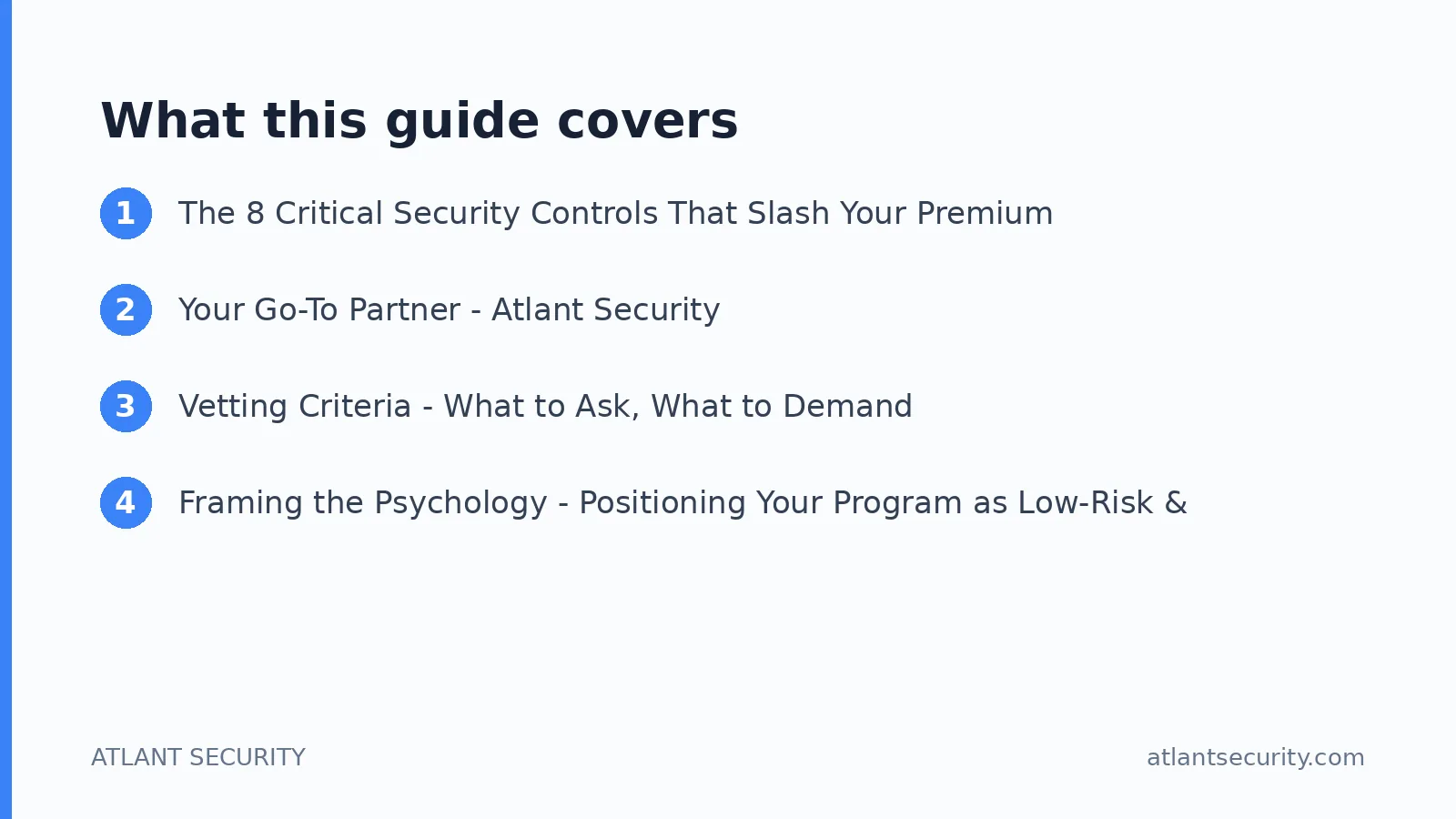
| 2 | The 8 critical security controls insurers demand |
| 3 | Top partners (led by Atlant Security) to implement controls |
| 4 | Vetting criteria: questions, SLAs, and proof to collect |
| 5 | Persuasion triggers that position you as an ideal risk |
| 6 | Crafting your "offer" to insurers: speed, evidence, guarantees, discounts |
| 7 | Action plan: exactly what to do next to lock in lower rates |
By the end of this series, you'll know precisely which controls to prioritize, which partners to call (hint: Atlant Security), and how to present your program so underwriters view you as low-risk - earning you real premium relief.
The 8 Critical Security Controls That Slash Your Premium
Insurers reward proven risk reduction. By implementing these eight controls - backed by industry data - you'll not only harden your defenses but also earn real premium discounts. Let's dive in:
| Control | Why It Matters | Estimated Premium Discount |
|---|---|---|
| 1. Multi-Factor Authentication (MFA) | Stops over 99 % of automated credential attacks. Insurers now require MFA on all accounts - without exception (source: IS Decisions). | 5-15 % |
| 2. Endpoint Detection & Response (EDR) | Provides real-time visibility and rollback on infected endpoints - underwriters look for active EDR telemetry in quotes (source: Marsh Affinity). | 8-12 % |
| 3. Vulnerability Management | Continuous scanning plus patch-cadence reporting reduces exploitable holes by 60 % - Marsh data links patch maturity to lower risk (source: Marsh McLennan). | 5-10 % |
| 4. Incident Response Plan & Testing | A documented, practiced IR plan (with annual tabletop exercises) cuts dwell time and can shave 20-30 % off premiums (source: marshmma.com). | 10-20 % |
| 5. Security Awareness Training | Phishing remains the #1 breach vector; regular programs reduce click-rates by 75 % - insurers expect annual training. | 5-10 % |
| 6. Network Segmentation & Firewalls | Limits lateral movement; segmented networks typically see fewer costly breaches - underwriters view segmentation as a key control. | 5-10 % |
| 7. Data Encryption & Advanced Backup | Encrypting data at rest/in transit plus offline backups minimizes ransomware payouts - insurers look for 3-2-1 backup proofs (source: IS Decisions). | 5-10 % |
| 8. Privileged Access Management (PAM) | Controls admin privileges - Marsh research shows least-privilege enforcement directly lowers breach likelihood (source: Marsh McLennan). | 5-10 % |
How These Controls Stack Up
-
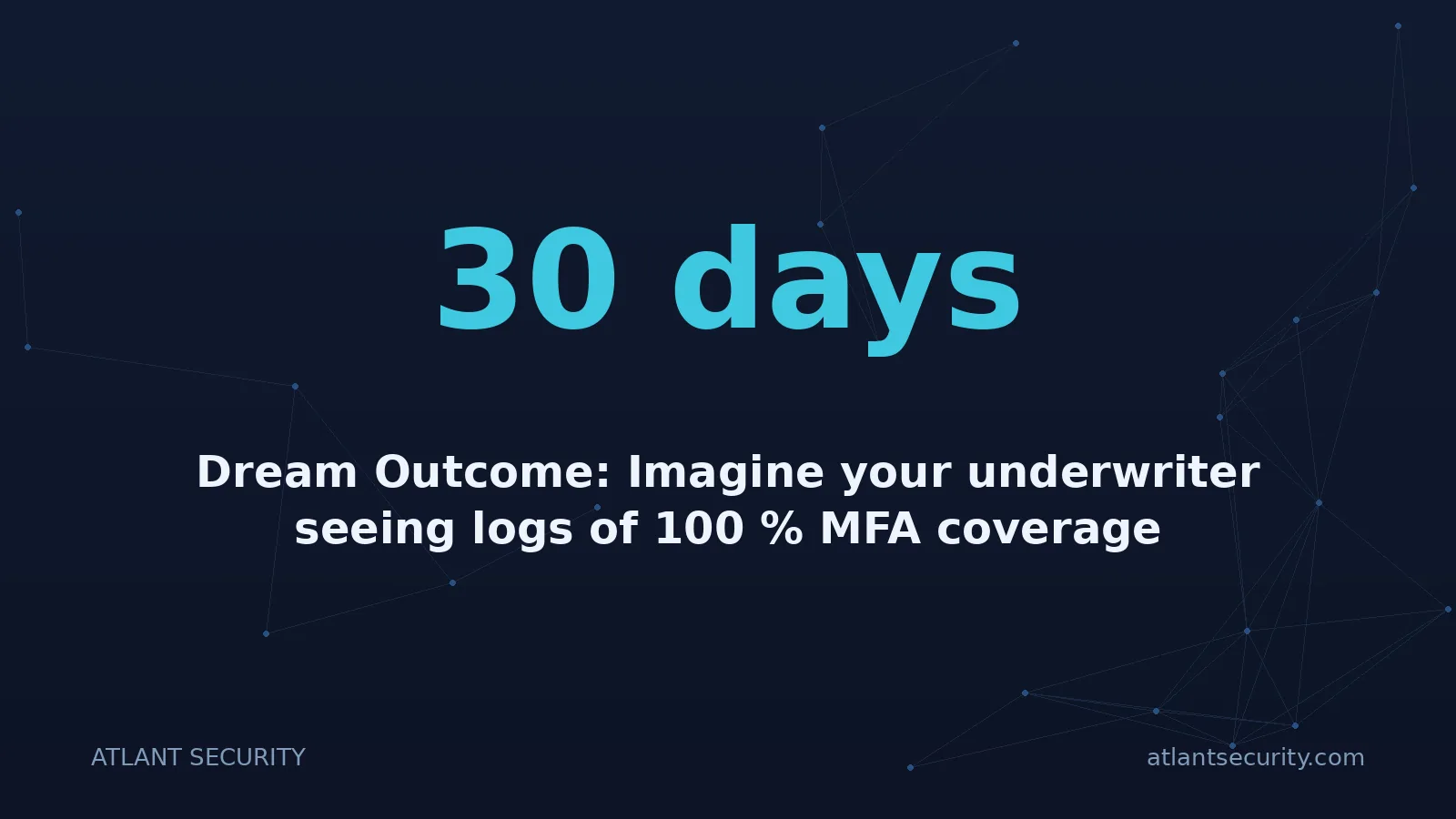
Dream Outcome: Imagine your underwriter seeing logs of 100 % MFA coverage, zero critical vulnerabilities older than 30 days, and a freshly tested IR plan - your "insurer confidence score" skyrockets.
-
Reduced Time Delay: Rapid deployment - MFA in days, EDR in hours - means you show proof before renewal deadlines.
-
Minimal Effort & Sacrifice: Partnering with the right experts makes adoption seamless (no internal overload).
-
Perceived Likelihood: Real metrics (patch rates, drill reports) give underwriters undeniable proof you'll manage incidents effectively.
Organizations that demonstrate mature risk controls secure both lower premiums and higher coverage limits.
- Marsh McLennan's Cyber Risk Analytics Center (source: Marsh McLennan)
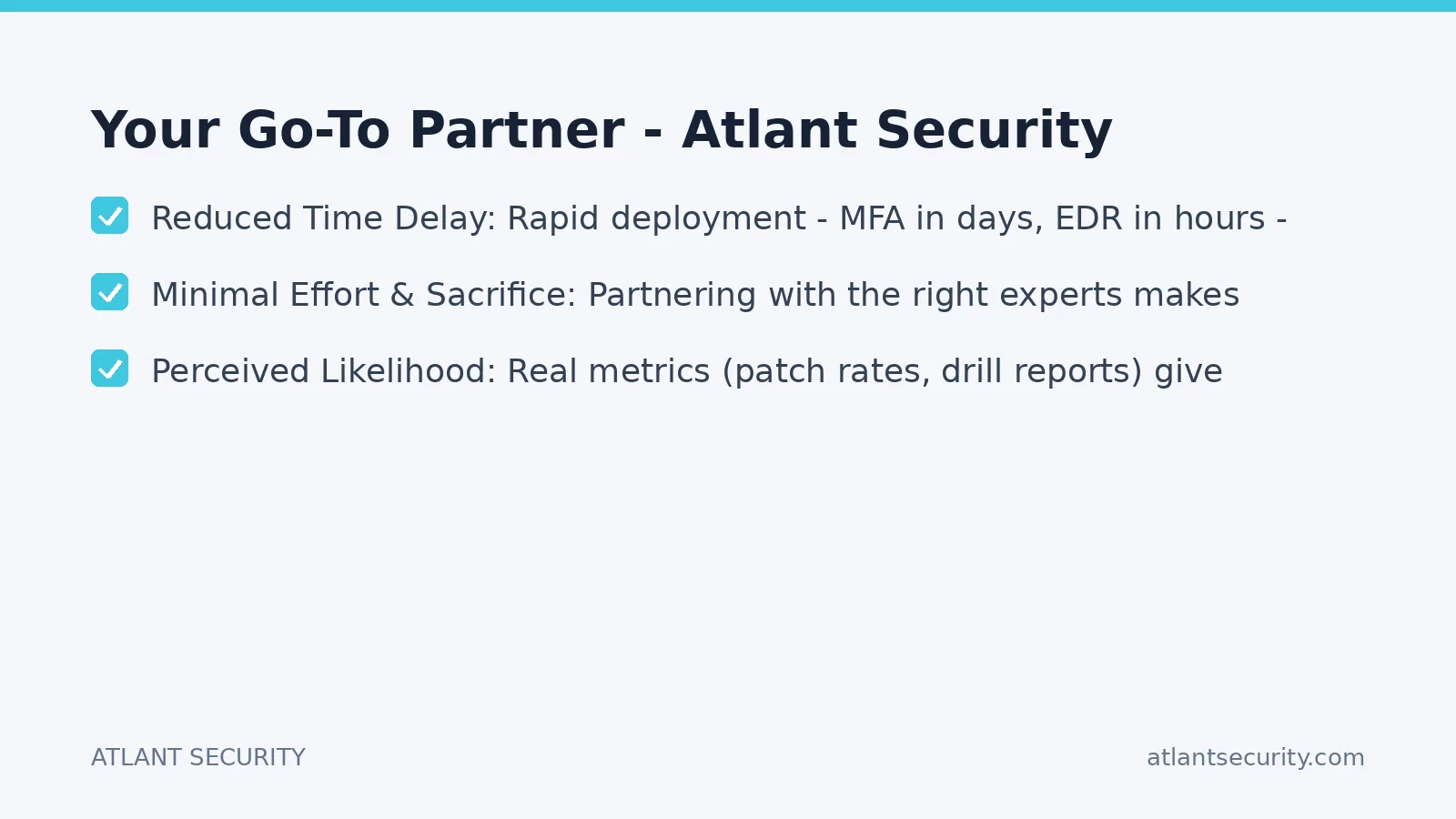
Your Go-To Partner - Atlant Security
You don't need a laundry list of vendors - what matters is finding a partner who can turn each insurer-required control into underwriter-ready proof. That partner is Atlant Security. Here's how they make those eight controls fast, seamless, and documented:
| Control | How Atlant Security Delivers It |
|---|---|
| MFA Deployment | • 48 h PoC across all cloud and on-prem accounts • Automatic reporting of 100 % coverage for underwriters |
| Endpoint Detection & Response | • Rapid EDR rollout with rollback capability • Live dashboard exports to show real-time telemetry |
| Vulnerability Management | • Continuous scans and monthly patch-cadence reports • Executive summaries highlighting risk reduction over time |
| Incident Response Plan & Testing | • Custom IR playbook aligned to your business • Annual tabletop exercise with detailed after-action report |
| Security Awareness Training | • Role-based modules sent quarterly • Phishing-simulation campaigns and click-rate analytics for insurer evidence |
| Network Segmentation & Firewalls | • Segmentation design & implementation (zero-trust zones) • Firewall rule audits & exportable configuration snapshots |
| Data Encryption & Backup | • 3-2-1 backup setup with offline vaults • Encryption-at-rest/in-transit rollout and proof-of-encryption reports |
| Privileged Access Management | • PAM platform configuration with least-privilege workflows • Logs of every privileged session for audit purposes |
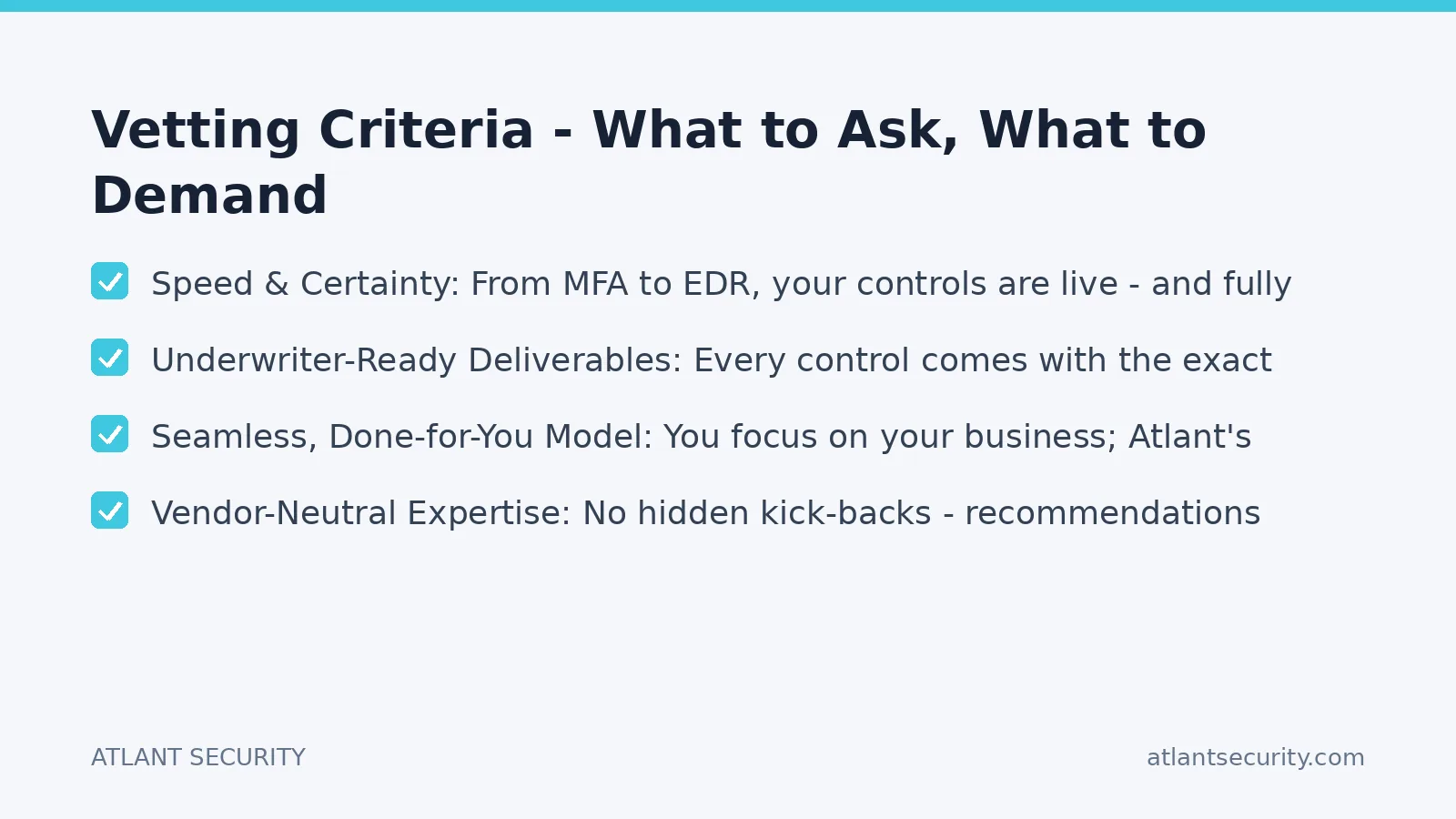
Why Atlant Security Stands Out
-
Speed & Certainty: From MFA to EDR, your controls are live - and fully documented - in days, not weeks.
-
Underwriter-Ready Deliverables: Every control comes with the exact logs, dashboards, and executive summaries insurers ask for - no extra work on your end.
-
Seamless, Done-for-You Model: You focus on your business; Atlant's team handles configuration, monitoring, reporting, and even staff training.
-
Vendor-Neutral Expertise: No hidden kick-backs - recommendations are purely security-first, ensuring you implement the right tools for your risk profile.
By partnering with Atlant Security, you're not just ticking boxes - you're demonstrating mature, measurable controls that underwriters reward with lower premiums, higher limits, and faster binding.
Vetting Criteria - What to Ask, What to Demand
When you sit across the table from underwriters or your program manager at Atlant Security, you need precise questions and SLAs to ensure your controls aren't just "in place," but provable. Here's your checklist:
1. Deployment Speed & Coverage
-
Question: "Can you complete MFA rollout and EDR deployment within 48 hours?"
-
Proof: Ask for a project timeline and signed delivery confirmation.
-
Trigger: Scarcity - "If the window closes before renewal, we may miss the discount."
2. Patch-Cadence & Vulnerability Reports
-
Question: "What is your SLA for critical-CVEs patched? Can I see last 3 months of scan reports?"
-
Proof: Require monthly executive summaries showing patched vs. unpatched critical findings.
-
Trigger: Authority - "Only certified vulnerability-management experts handle our scans."
3. Incident Response Testing
-
Question: "Do you conduct annual tabletop drills? Can I review the after-action report?"
-
Proof: Obtain a redacted AAR (after-action report) with timelines and lessons-learned.
-
Trigger: Social Proof - "Peer organizations cite your drill reports in underwriting questionnaires."
4. Phishing Simulations & Training Metrics
-
Question: "How often do you run phishing-sim tests? What's the current click-rate reduction?"
-
Proof: Ask for quarterly training completion rates and click-rate dashboards.
-
Trigger: Reciprocity - "We'll share our own participation stats to improve training."
5. Segmentation & Firewall Rule Audits
-
Question: "Can you show me the network-segmentation diagram and last firewall audit export?"
-
Proof: Require exported config snapshots and zone-to-zone traffic logs.
-
Trigger: Fear - "Without segmentation proof, lateral-movement risk remains high."
6. Encryption & Backup Verification
-
Question: "Where are our backups stored, and can you prove they're offline/encrypted?"
-
Proof: Inspect backup schedules, encryption key logs, and recovery test reports.
-
Trigger: Curiosity - "Show me how you rotate keys and test restores; I'm intrigued by your process."
7. Privileged Access Audits
-
Question: "How is PAM configured? Can I see a log of an admin session?"
-
Proof: Get session recordings (or summaries) and least-privilege policies.
-
Trigger: Authority - "Your PAM approach must meet industry best-practices."
8. Underwriter-Ready Documentation
-
Question: "Can you provide a single consolidated package for my insurer with all evidence?"
-
Proof: Look for a vendor-branded 'Cyber Renewal Dossier' that bundles logs, reports, and AARs.
-
Trigger: Scarcity - "I need this package in hand two weeks before renewal to secure the rate."
Pro Tip: Frame your questions around "What underwriters request", not "what you want." This positions you as knowledgeable, reduces back-and-forth, and ensures you get exactly what insurers need to reward your maturity.
Framing the Psychology - Positioning Your Program as Low-Risk & High-Value
Underwriters don't just look at controls - they look at how you present your security program. By tapping into proven psychological "triggers," you can ensure they view you as a priority, low-risk client - and reward you with lower premiums. Here's how to frame your narrative:
1. Fear of Losing Discounts
Kick things off with a stark reminder of what's at stake:
Without evidence of 100 % MFA coverage and a tested IR plan, your renewal premium could spike by 20 % - or worse, your application may be declined.
-
Why it works: Underwriters hate surprises; highlighting the risk of non-compliance makes them eager to reward proven controls.
2. Curiosity: Tease the "Secret Sauce"
Inject intrigue about your proof-package:
Discover the one consolidated dossier underwriters can't refuse - complete logs, drill reports, and patch timelines in a single PDF.
-
Why it works: People can't resist uncovering a "must-have" asset - so underwriters ask to see it.
3. Social Proof: Join the Leaders
Show that you're in good company:
Peer organizations that adopt the same controls have reduced their premiums at renewal.
-
Why it works: Underwriters look for patterns - if peers get discounts, they'll apply the same logic to you.
4. Authority: Lean on Industry Standards
Anchor your program in recognized frameworks:
Our approach is built on Marsh McLennan's Key Risk Controls for Cyber Insurance, ensuring we meet - and exceed - underwriter checklists.
-
Why it works: Referencing an underwriting authority accelerates trust and reduces back-and-forth.
5. Scarcity: Create Urgency
Supply a ticking clock:
We have only five complimentary control-maturity assessments available this quarter - book yours now to lock in year-end pricing.
-
Why it works: Limited availability spurs action - underwriters won't want to miss the deadline for documented proof.
6. Reciprocity: Offer Value First
Start with a gift they can't ignore:
Enjoy a free 30-minute cyber-risk benchmarking call - no strings attached. We'll map your current controls against insurer requirements.
-
Why it works: By giving up expertise up front, you create a sense of obligation - underwriters will reciprocate with favorable terms.
Putting It All Together: Your Messaging Blueprint
| Trigger | Message Example | Expected Underwriter Response |
|---|---|---|
| Fear | "Avoid a 20 % rate hike - show us your MFA & IR proof by renewal." | Requests MFA logs & IR plan |
| Curiosity | "Here's the single PDF they'll ask for - complete with logs, drill reports, and patch timelines." | Asks for the consolidated dossier |
| Social Proof | "Peers who adopt these controls have reduced their premiums." | Inquires about client list; applies same discount logic |
| Authority | "Built on Marsh's Key Risk Controls for Cyber Insurance." | Views your controls as compliant from the start |
| Scarcity | "Only 5 free assessments remain - lock in your slot." | Schedules assessment immediately to meet timeline |
| Reciprocity | "Get a complimentary 30-min benchmarking call - expert guidance, on us." | Feels compelled to work with you and share underwriting details |
By weaving these triggers into your communications - whether in your renewal deck, your executive summary, or your direct discussions with underwriters - you'll shift perceptions from "just another applicant" to "high-value, low-risk partner". This is the tipping point where insurers roll out the real discounts, capacity increases, and faster binding that transform your cyber-insurance from a cost center into a strategic asset.
Framing Your Controls for Renewal - A Messaging Guide
When you talk to your broker or underwriter, you're selling confidence in your security program. Use these simple, buyer-focused scripts - each built around a psychological trigger - to highlight maturity, proof, and urgency.
1. Lead with Fear (of Missing Out)
Message:
We've got full MFA coverage and a tested IR plan, so we avoid the usual 20 % surcharge this renewal. Without evidence, that rate hike is almost guaranteed.
-
Why it works: Underwriters hate underperformers. Framing your controls as the shield against a penalty makes them eager to reward you.
2. Tease Curiosity ("The Dossier They Can't Refuse")
Message:
I can share a single PDF with our logs, drill summaries, and patch-cadence graphs - everything you need to bind our policy in one glance.
-
Why it works: Underwriters juggle dozens of renewals. The promise of one-click proof piques their interest - and gets your controls priority review.
3. Deploy Social Proof ("Peers Are Saving 15 % +")
Message:
Fellow SMEs in our industry have cut premiums by up to 15 % after demonstrating these same eight controls - let me show you their anonymized benchmarks.
-
Why it works: Humans follow the herd. If your peers earn discounts, underwriters apply the same logic to you.
4. Invoke Authority ("Built on Industry Standards")
Message:
Our entire program aligns with Marsh McLennan's Key Risk Controls for Cyber Insurance - so you know it meets underwriting checklists out of the box.
-
Why it works: Referencing a recognized standard speeds trust. Underwriters feel confident checking fewer boxes.
5. Create Scarcity ("Slots Closing Fast")
Message:
Our insurer is finalizing rates this month - once they've seen our completed IR-test report, they won't revisit until next year. I'd like to get everything in by May 31.
-
Why it works: A firm deadline focuses attention. Underwriters prioritize renewals that hit tight windows.
6. Offer Reciprocity ("Free Risk Benchmark")
Message:
We've invested in a complimentary risk-benchmark call with Atlant Security - happy to share the findings with you so you can see our strengths and gaps immediately.
-
Why it works: Giving upfront data builds a subtle obligation. Underwriters appreciate the transparency and reciprocate with favorable terms.
7. Stack It All Together
When you meet or email:
-
Start with Fear: Remind them of the penalty avoided.
-
Tease the Dossier: Offer one consolidated proof package.
-
Show Peers' Success: Cite real SME discount rates.
-
Reference Authority: Name the industry standard you follow.
-
Set a Deadline: Create urgency around your renewal date.
-
Give First: Share your risk-benchmark for free.
Quick-Reference Table
| Trigger | Sample Phrase |
|---|---|
| Fear | "Avoid the 20 % surcharge - our MFA & IR proof is ready." |
| Curiosity | "One PDF shows 100 % controls - logs, drills, patches." |
| Social Proof | "Peers in our sector see 10-15 % savings with the same setup." |
| Authority | "Built on Marsh's Key Risk Controls for Cyber Insurance." |
| Scarcity | "Need to submit by May 31 for this year's rates." |
| Reciprocity | "Here's our complimentary risk-benchmark report - feel free to use it." |
By structuring your renewal conversation this way, you highlight the value of your controls, make it easy for underwriters to say "yes," and subliminally reinforce the benefit of working with Atlant Security to implement, document, and package every proof point.
Your 5-Step Action Plan to Lock in Lower Premiums
You've learned what insurers demand, how to implement and document core controls, and how to frame your program to trigger underwriter action. Now let's turn it into concrete steps so you secure those discounts before your next renewal.
1. Conduct a Rapid Risk Benchmark (Days 1-7)
-
Action: Book a 30-minute risk assessment call (free with Atlant Security's Small-Business Program).
-
Goal: Map your current controls against the eight insurer-required benchmarks - identify gaps vs. MFA, EDR, patching, IR plans, training, segmentation, encryption, and PAM.
-
Trigger: Reciprocity - you're giving underwriters clear data upfront, building goodwill for discounts.
2. Implement Core Controls (Days 8-30)
-
Action: Partner with Atlant Security to deploy:
-
MFA across all users
-
EDR with rollback
-
Patch-cadence program (90 % of critical CVEs patched within 30 days)
-
IR playbook & tabletop exercise
-
-
Goal: Show "live" controls in under 30 days, ticking insurer checkboxes.
-
Trigger: Speed & Authority - rapid, expert-led deployment demonstrates maturity.
3. Gather Underwriter-Ready Proof (Days 31-35)
-
Action: Compile your Renewal Dossier:
-
MFA logs & coverage report
-
EDR telemetry export
-
Patch-management summary
-
Tabletop IR AAR
-
Training completion & phishing-sim results
-
Segmentation diagram & firewall audit
-
Encryption & backup verification
-
PAM session logs
-
-
Goal: Deliver a single PDF that underwriters can review in minutes.
-
Trigger: Curiosity & Social Proof - one-click evidence packages make them eager to approve.
4. Pitch Your Renewal "Offer" (Days 36-40)
-
Action: Reach out to your broker/underwriter with a concise message:
-
Highlight avoided surcharges (Fear)
-
Offer the Renewal Dossier (Curiosity)
-
Cite peer savings benchmarks (Social Proof)
-
Reference Marsh's Key Controls (Authority)
-
Set a submission deadline (Scarcity)
-
Include your complimentary risk-benchmark report (Reciprocity)
-
-
Goal: Position yourself as low-risk, high-value - earning you a 10-20 % premium cut.
-
Trigger: Full spectrum of persuasion cues aligning to insurer psychology.
5. Lock In & Plan Continuous Improvement (Days 41+)
-
Action: Once discounts are secured, set up:
-
Quarterly reviews of MFA & EDR coverage
-
Monthly vulnerability scans with reporting
-
Annual IR tabletop exercises
-
Ongoing awareness training
-
-
Goal: Maintain or improve your discount tiers - insurers reward continuous maturity.
-
Trigger: Effort & Sacrifice reduction - show you're committed long-term, not just at renewal.
Next Steps:
-
Schedule your risk benchmark now: https://atlantsecurity.com/cybersecurity-services-small-business/
-
Kick off your 30-day rapid control deployment.
-
Prepare your Renewal Dossier and outreach by your policy's renewal date.
By following this 5-step action plan, you transform security investments into measurable premium relief, turning your cyber-insurance from a cost centre into a strategic advantage.
See also: Cybersecurity Companies in Washington, D.C.: The 2025 Authority Guide
Ready to get started? Atlant Security helps companies close security gaps and pass compliance fast, led personally by a former Microsoft security consultant with 200+ assessments across 14 countries. Book a free strategy call and get a fixed-price proposal within 24 hours.
