
A MAS Technology Risk Management assessment is not a form you fill in. It is the exercise that decides whether the Monetary Authority of Singapore, your board, and your customers can trust that your technology will keep running and keep their data safe. I have run technology risk assessments for financial institutions across multiple jurisdictions, and the firms that struggle in Singapore almost always make the same mistake: they treat the TRM Guidelines as a compliance checklist rather than as a genuine risk process. This guide shows how to conduct a MAS TRM risk assessment properly, from scoping to reporting, without the fluff.
Need hands-on MAS TRM compliance help?
Atlant Security provides MAS TRM compliance consulting: fixed price, led by a former Microsoft security consultant, and you review the readiness report before you pay. See the service and book a strategy call.
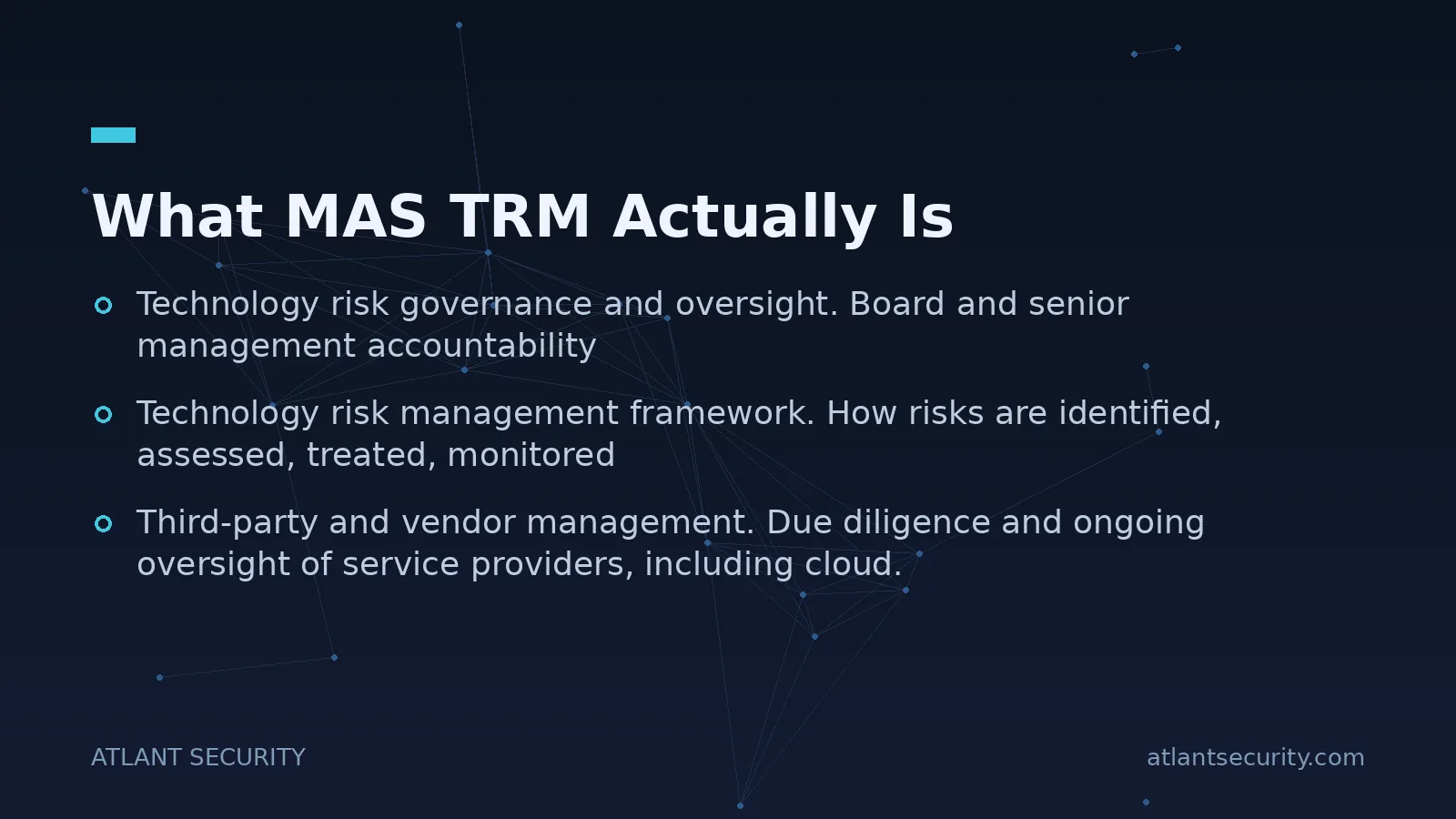
What MAS TRM Actually Is
The MAS Technology Risk Management Guidelines, most recently revised in January 2021, set out MAS's expectations for how financial institutions manage technology and cyber risk. They apply broadly to the financial institutions MAS regulates, from banks and insurers to payment firms and capital markets players. Fintech attack surface is API-first, and so is fintechpentest.com: payment logic, BOLA and mass-assignment in the API, and multi-tenant boundaries.
An important nuance often missed by newcomers: the TRM Guidelines themselves are guidance, not black-letter law. But MAS considers the degree to which an institution observes them when assessing its risk profile, and that assessment has real supervisory consequences. Sitting alongside the Guidelines are two instruments that are legally binding: the Notice on Technology Risk Management and the Notice on Cyber Hygiene. The Notices set mandatory requirements, including incident notification timelines and a baseline set of cyber hygiene measures. When you conduct a TRM risk assessment, you are effectively measuring yourself against the Guidelines while ensuring the mandatory Notice requirements are met without exception.
The Areas a TRM Assessment Must Cover
The TRM Guidelines are organised around a set of domains. A credible risk assessment touches all of them rather than cherry-picking the easy ones:
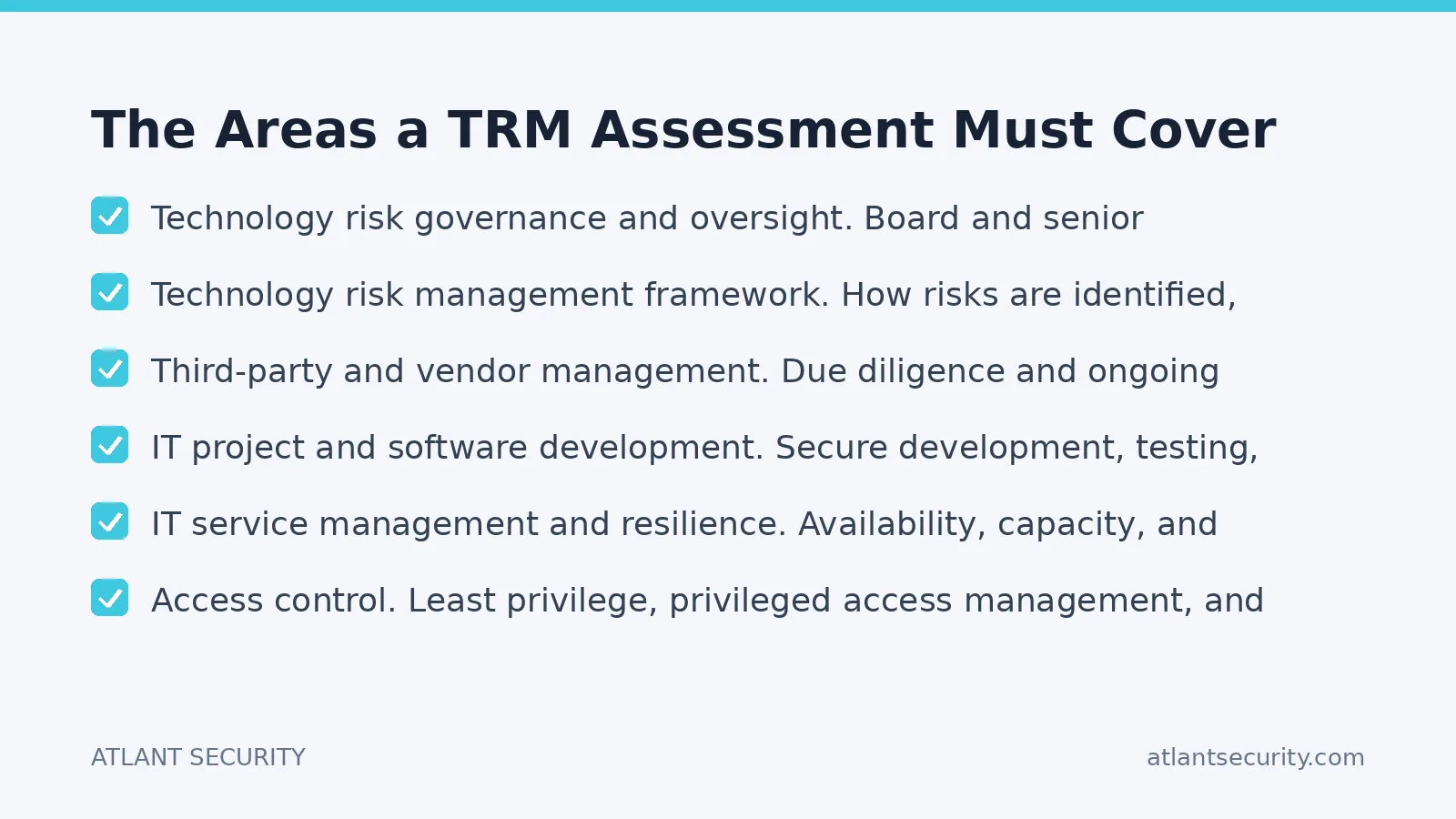
- Technology risk governance and oversight. Board and senior management accountability, a defined risk appetite, and a technology risk management framework.
- Technology risk management framework. How risks are identified, assessed, treated, monitored, and reported on an ongoing basis.
- Third-party and vendor management. Due diligence and ongoing oversight of service providers, including cloud.
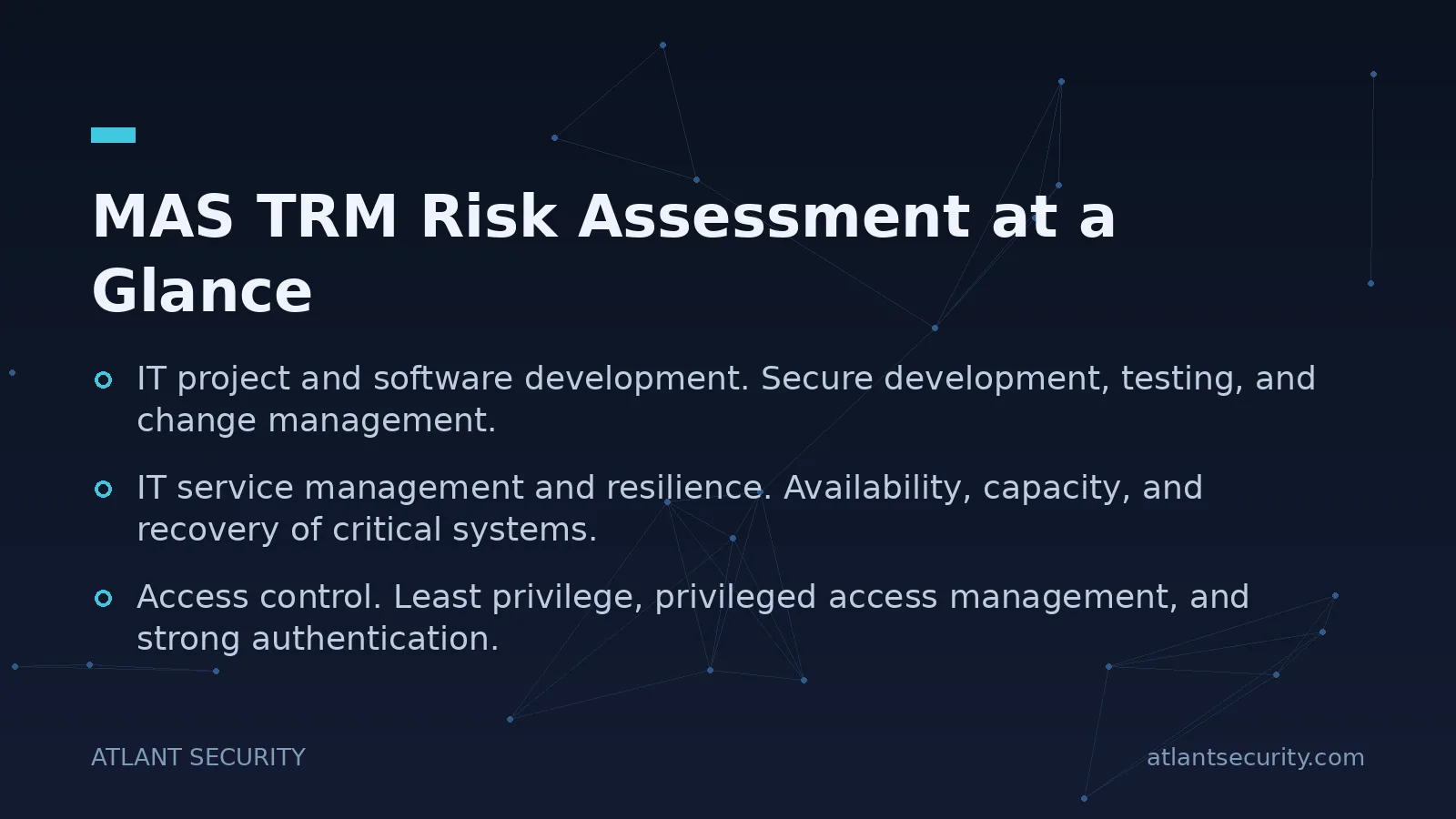
- IT project and software development. Secure development, testing, and change management.
- IT service management and resilience. Availability, capacity, and recovery of critical systems.
- Access control. Least privilege, privileged access management, and strong authentication.
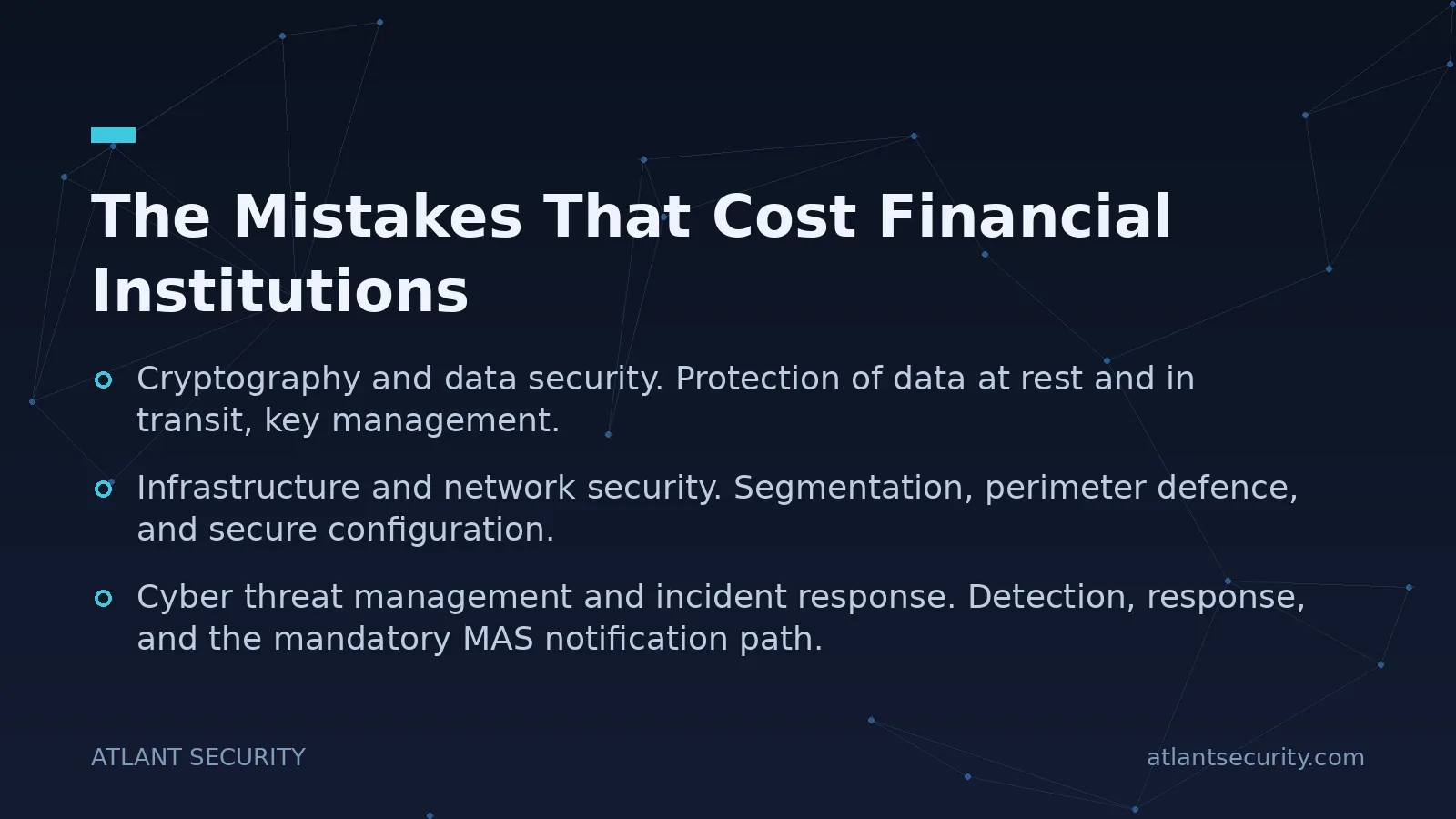
- Cryptography and data security. Protection of data at rest and in transit, key management.
- Infrastructure and network security. Segmentation, perimeter defence, and secure configuration.
- Cyber threat management and incident response. Detection, response, and the mandatory MAS notification path.
How to Conduct the Assessment, Step by Step
Here is the sequence I use to run a MAS TRM risk assessment that stands up to both internal audit and supervisory scrutiny.
Step 1: Define the Scope and Asset Inventory
You cannot assess risk against an unknown estate. Start by inventorying every information asset and system in scope: on-premise servers, cloud workloads, applications, databases, and the third-party services that process or store your data. For each, record the business criticality, the sensitivity of the data it handles, and the owner accountable for it.
Pay particular attention to cloud. Financial institutions in Singapore run heavily on major cloud platforms, and the shared responsibility model means the controls you configure are yours to assess, not the provider's. A vague scope is the single most common reason an assessment misses material risk. Get the boundary right before anything else.
Step 2: Identify Threats and Vulnerabilities
With scope defined, identify what could go wrong. Combine a threat view - ransomware, phishing, insider misuse, third-party compromise, denial of service - with a vulnerability view drawn from technical testing. Run authenticated vulnerability scans across the estate, review cloud configurations against hardening benchmarks, and look specifically for the issues that recur in financial environments: exposed management interfaces, weak or missing multi-factor authentication, unpatched internet-facing systems, and over-permissive cloud storage and identity policies.
This is where independent technical work earns its place. A vulnerability assessment and targeted penetration testing give you evidence of real weaknesses rather than assumptions, and MAS expects institutions to test the effectiveness of their controls, not merely assert them.
Step 3: Assess Impact and Likelihood
For each identified risk, evaluate two dimensions: how severe the consequence would be if it materialised, and how likely it is given your current controls. Severity should account for financial loss, operational disruption, customer harm, regulatory exposure, and reputational damage. Likelihood should draw on threat intelligence, past incidents, and the strength of existing controls.
Plot the results on a risk matrix so priorities are unambiguous. The output of this step is a ranked list: the high-impact, high-likelihood risks that demand urgent treatment, distinguished clearly from the low-priority items you can accept or monitor. This ranking is what turns a pile of findings into a defensible remediation plan.
Step 4: Implement and Verify Mitigation Controls
Treat the prioritised risks with controls proportionate to their severity. In financial environments the recurring, expected controls are consistent:
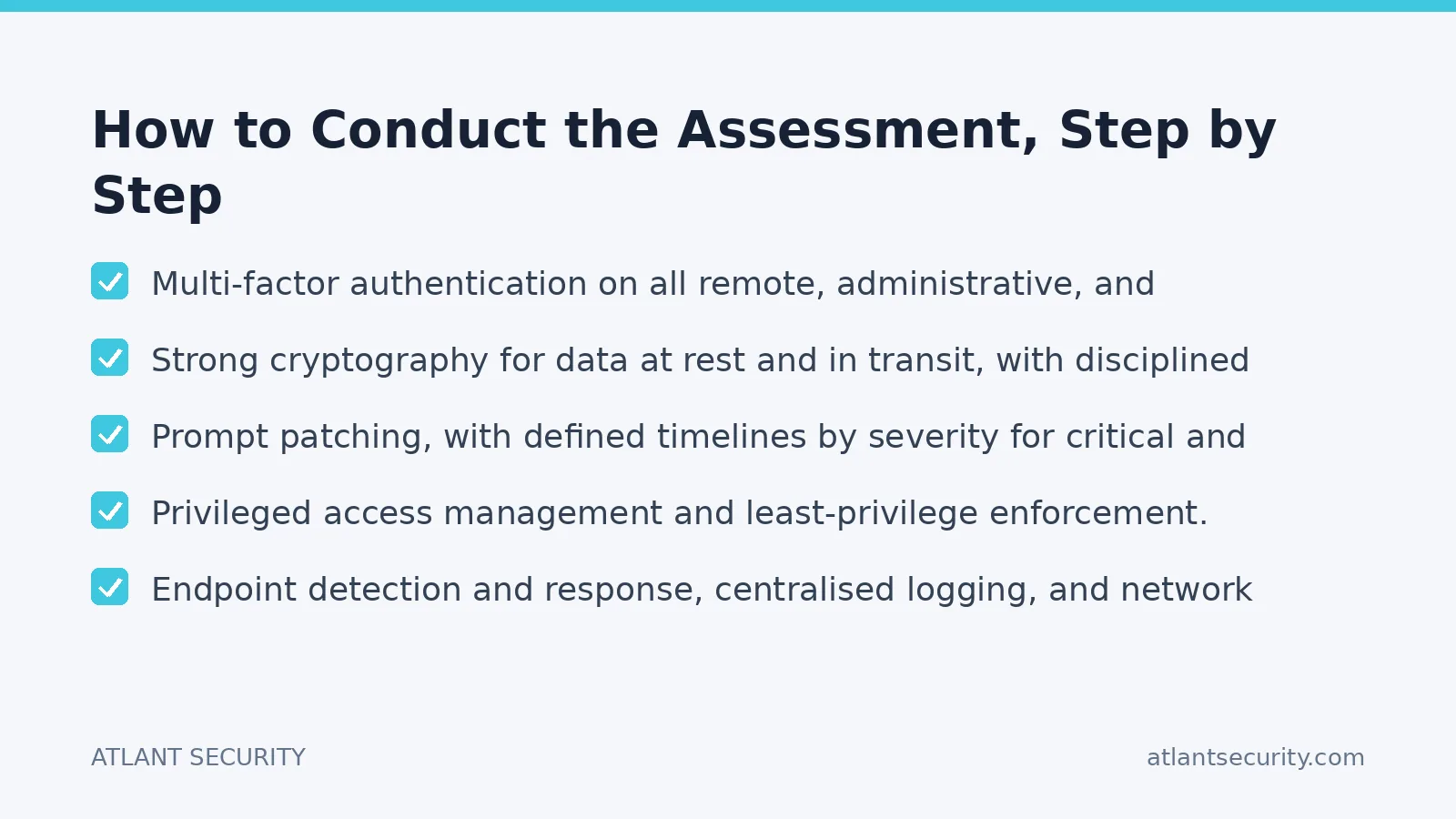
- Multi-factor authentication on all remote, administrative, and privileged access.
- Strong cryptography for data at rest and in transit, with disciplined key management.
- Prompt patching, with defined timelines by severity for critical and high-risk vulnerabilities.
- Privileged access management and least-privilege enforcement.
- Endpoint detection and response, centralised logging, and network segmentation.
- The baseline measures mandated by the Cyber Hygiene Notice, including securing administrative accounts, applying security patches, network perimeter defence, and malware protection.
Do not stop at deployment. Verify that each control actually works and record the evidence. A control you cannot demonstrate is, from a supervisory perspective, a control you do not have. If you are running significant cloud infrastructure, a dedicated review of that environment through cloud security consulting closes the gaps generic assessments tend to miss.
Step 5: Document, Report, and Monitor Continuously
Document the whole assessment: scope, methodology, risks identified, ratings, treatment decisions, and residual risk accepted by named owners. This documentation is what auditors and MAS supervisors will ask to see. Then establish continuous monitoring so the picture stays current between formal assessments - centralised logging and security monitoring to detect issues quickly, scheduled control testing, and periodic reassessment as the environment and threat landscape change.
Critically, wire in the mandatory incident path. Under the Notice on Technology Risk Management, a financial institution must notify MAS within one hour of discovering a relevant incident that has a severe and widespread impact or is suspected to be the result of malicious activity, followed by a root cause and impact analysis report within fourteen days. Your incident response plan must make the materiality decision explicit and rehearse the one-hour notification so it is not being worked out for the first time during a live crisis.
MAS TRM Risk Assessment at a Glance
| Stage | Objective | Common pitfall |
|---|---|---|
| Scope and inventory | Know every in-scope asset and owner | Cloud workloads left out of scope |
| Threats and vulnerabilities | Evidence-based view of weaknesses | Assuming controls work without testing |
| Impact and likelihood | Ranked, defensible priorities | Treating every finding as equal |
| Mitigation and verification | Proportionate, evidenced controls | Deploying controls but not proving them |
| Documentation and monitoring | Audit-ready records, live monitoring | Point-in-time report that goes stale |
The Mistakes That Cost Financial Institutions
Across the assessments I have seen, a handful of failure patterns recur in Singapore:
- Scope that quietly excludes cloud. The shared responsibility model is misunderstood and the institution's own configuration goes unassessed.
- Thin third-party oversight. Vendors are onboarded with due diligence and then never reviewed again, even as their access and role grows.
- Controls without evidence. Policies state that MFA and patching are enforced, but there is no configuration export or log to prove it.
- An untested incident path. The one-hour MAS notification requirement is documented but never rehearsed, so nobody knows who decides materiality under pressure.
- A one-off assessment. The exercise is done once for an audit and then left to drift, so the risk picture is out of date within months.
None of these are exotic. They are ordinary discipline gaps, and every one of them is cheaper to fix before a supervisor or an incident finds it for you.
How We Help
We run MAS TRM risk assessments and remediation programmes for financial institutions and fintechs operating in Singapore. Engagements are led by senior practitioners, priced up front, and structured so you review the readiness report before you commit further. If you need ongoing security leadership rather than a one-off review, we hold the role on a fractional basis through our fintech virtual CISO service, and we provide independent IT security audits to establish your baseline. For hands-on help, see our MAS TRM compliance service or simply get in touch to scope your situation.
Frequently Asked Questions
Are the MAS TRM Guidelines legally mandatory?
The TRM Guidelines themselves are guidance rather than binding law, but MAS considers how well an institution observes them when assessing its risk profile, which carries real supervisory weight. Separately, the Notice on Technology Risk Management and the Notice on Cyber Hygiene are legally binding and set mandatory requirements, including incident notification and baseline cyber hygiene measures. Digital banking, payment workflows, internal networks and privileged access each fail differently, which is why pentesting for digital banking is scoped around them rather than around a generic web test.
How quickly must we notify MAS of a technology incident?
Under the Notice on Technology Risk Management, a financial institution must notify MAS within one hour of discovering a relevant incident that has a severe and widespread impact or is suspected to result from malicious activity. A root cause and impact analysis report is then required within fourteen days. Your incident response plan should rehearse this so the one-hour clock is never a surprise.
Does MAS TRM cover cloud services?
Yes. Cloud is firmly in scope, and it is one of the areas MAS pays close attention to. Under the shared responsibility model, the configuration and controls you manage in the cloud are yours to assess and evidence. Excluding cloud workloads from scope is one of the most common and most serious mistakes in a TRM assessment.
How often should a TRM risk assessment be conducted?
Risk assessment should be an ongoing process rather than a single annual event. A full formal assessment is typically performed at least annually and after significant changes to systems or the threat environment, supported by continuous monitoring, scheduled control testing, and reassessment whenever the estate changes materially.
Who is accountable for technology risk under the Guidelines?
The board and senior management are accountable for technology risk oversight, including setting the risk appetite and ensuring an effective technology risk management framework is in place. Operational responsibility sits with security and technology leadership, but accountability cannot be delegated away from the top of the institution.
What is the difference between the TRM Guidelines and the Cyber Hygiene Notice?
The TRM Guidelines are a broad set of expectations covering governance, resilience, access control, cryptography, third parties, and more. The Cyber Hygiene Notice is a narrow, legally binding set of baseline measures such as securing administrative accounts, applying security patches, network perimeter defence, malware protection, and multi-factor authentication. A TRM assessment should confirm the mandatory Notice measures are met while evaluating the wider Guidelines.
