

Advisory · March 2026
Not every company needs a full-time CISO-but every company needs security leadership. Here are the 10 signs it’s time to bring in a virtual CISO, a decision framework to evaluate your options, and the real cost of doing nothing.
I’ll never forget the call. It was a Tuesday at 6:47 AM, and the CEO of a 200-person SaaS company was on the other end of the line, panic audible in his voice. “Alex, we just lost a $3 million deal. The prospect’s security team asked for our SOC 2 report, and we didn’t have one. We didn’t even know what it was.”
That company had 14 engineers, a solid product, paying customers, and zero security leadership. No one owned security. No one was thinking about it strategically. They had antivirus software on their laptops and assumed that was enough.
Sound familiar? If you’re reading this article, something probably triggered the question: Do I actually need a vCISO? Maybe a client asked about your security posture. Maybe your board started asking uncomfortable questions. Maybe you read about another breach and thought, “Could that be us?”
Here’s the short answer: if you’re asking the question, you probably need one. But “probably” isn’t good enough when you’re making a business decision. So let’s walk through this properly-with a checklist, a decision framework, real numbers, and complete honesty about when you don’t need a virtual CISO.
I’ve been in cybersecurity for over 15 years. I’ve served as a virtual CISO for companies ranging from 30-person startups to 2,000-employee enterprises. And the pattern I see over and over is the same: companies wait too long to get security leadership. They wait until the breach happens, the deal is lost, or the regulator comes knocking. This guide exists so you don’t have to learn that lesson the hard way.
Key Takeaways
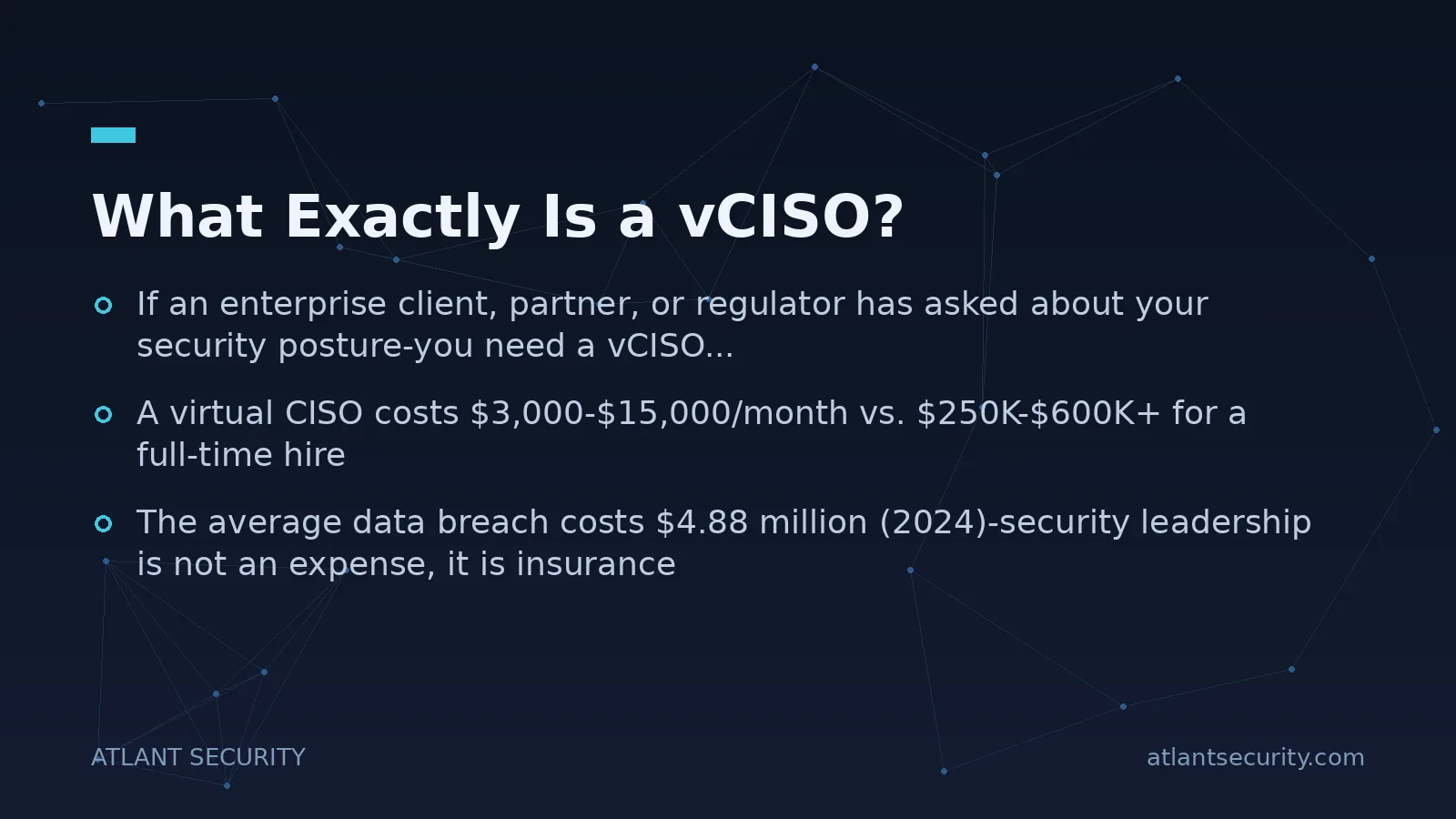
- If an enterprise client, partner, or regulator has asked about your security posture-you need a vCISO yesterday
- A virtual CISO costs $3,000-$15,000/month vs. $250K-$600K+ for a full-time hire, delivering 70-90% of the value at a fraction of the cost
- The average data breach costs $4.88 million (2024)-security leadership is not an expense, it is insurance
- Not every company needs a vCISO-but every company past 50 employees or handling sensitive data needs someone owning security strategy
- This article includes a 10-sign checklist, a decision framework, and honest guidance on when you do not need one
Quick Primer
What Exactly Is a vCISO?
A virtual CISO (vCISO) is an outsourced security executive who provides strategic cybersecurity leadership to your organization on a fractional or part-time basis. They do everything a full-time Chief Information Security Officer does-build your security program, manage compliance, advise the board, handle incident response planning, evaluate vendors-without the $300K+ salary, benefits, equity, and recruiting timeline.
Think of it this way: you probably don’t have a full-time CFO if you’re a 100-person company. You have a fractional CFO or an outsourced accounting firm. A vCISO is the security equivalent. You get the strategic brain without the full-time overhead.
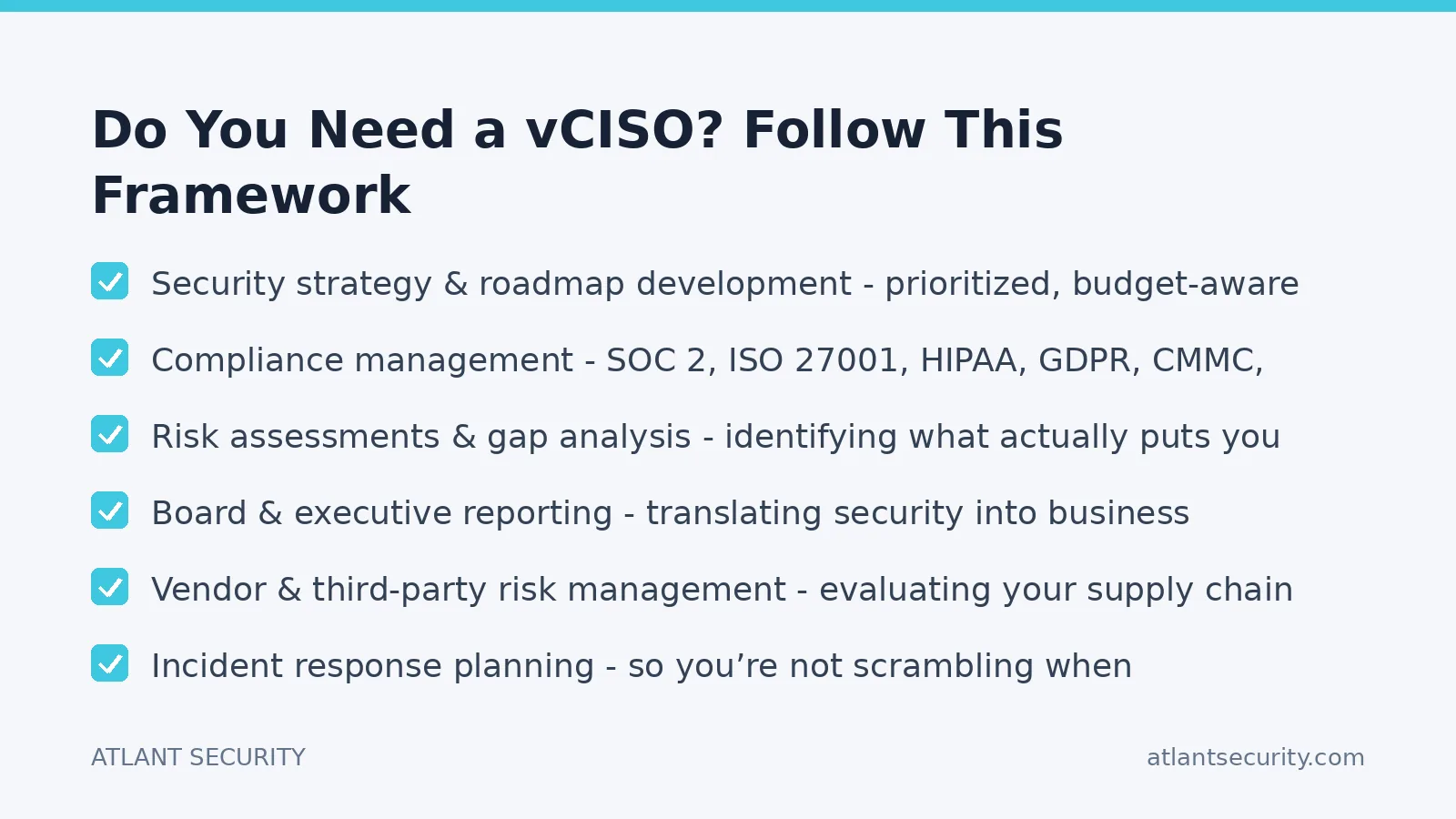
A quality virtual CISO service typically includes:
- Security strategy & roadmap development - prioritized, budget-aware plans
- Compliance management - SOC 2, ISO 27001, HIPAA, GDPR, CMMC, and more
- Risk assessments & gap analysis - identifying what actually puts you at risk
- Board & executive reporting - translating security into business language
- Vendor & third-party risk management - evaluating your supply chain
- Incident response planning - so you’re not scrambling when something goes wrong
- Security awareness & culture building - making security everyone’s job
The Checklist
10 Signs You Need a vCISO
If three or more of these apply to your organization, you almost certainly need a virtual CISO. Even one or two should trigger a serious conversation.
1. An enterprise client asked for your SOC 2 report (and you don’t have one)
This is the number-one trigger we see. A big prospect or existing customer sends over a security questionnaire or asks for SOC 2 certification, and your team freezes. If deals are stalling or dying because you cannot demonstrate security maturity, a vCISO can build the program and get you certified-typically in 3-6 months.
2. Your board or investors are asking security questions you cannot answer
Boards are increasingly asking about cyber risk, and “we have a firewall” is no longer an acceptable answer. If your leadership team is struggling to articulate your security posture, risk tolerance, or incident response capabilities, you need someone who speaks both security and business. That is a vCISO’s core skill.
3. Nobody in your organization “owns” security
Security is everyone’s responsibility-but if it is nobody’s job, it is nobody’s priority. When the IT manager, CTO, and COO all think someone else is handling security, critical gaps form. A vCISO provides a single point of accountability for your entire security program.
4. You’re entering a regulated industry or new market
Moving into healthcare (HIPAA), financial services (SOX, GLBA, NY-DFS), government contracting (CMMC, FedRAMP), or the EU market (GDPR, NIS2)? Each comes with specific security and compliance requirements. A vCISO who has navigated these frameworks dozens of times will save you months of false starts and costly mistakes.
5. You had a security incident and realized you had no plan
A phishing attack succeeded. An employee laptop was stolen. A vendor was breached. Whatever it was, the response was chaotic, and you realized there was no incident response plan, no communication protocol, and no one steering the ship. A vCISO builds these plans before the next incident.
6. You’re growing fast and security is falling behind
Rapid growth is exciting-but it creates security debt. New employees, new tools, new cloud environments, new integrations. Every one of these expands your attack surface. When your company doubles in size but your security stays the same, you are accumulating risk that compounds daily. A vCISO ensures security scales with your business.
7. Your cyber insurance application was denied or your premiums skyrocketed
Cyber insurers are getting stricter. If your application was denied, your premiums spiked, or you were asked to implement controls you don’t understand (MFA, EDR, network segmentation), a vCISO can close those gaps and work directly with your insurer to demonstrate compliance. Many organizations save more on insurance premiums than the cost of vCISO services.
8. You have security tools but no strategy
You bought the firewall. You have endpoint protection. Maybe someone set up a SIEM. But none of it is integrated, policies are outdated or nonexistent, and nobody is reviewing logs or measuring effectiveness. Tools without strategy is like buying a gym membership and never going. A vCISO turns your tool investments into an actual security program.
9. You’re preparing for M&A activity (buyer or seller)
Security due diligence is now a standard part of every M&A transaction. Acquirers want to know what they are inheriting. Sellers need to demonstrate a mature security posture to maximize valuation. On both sides, a vCISO can run the security audit, identify gaps, and present findings that withstand scrutiny.
10. You cannot afford a full-time CISO (but you need one)
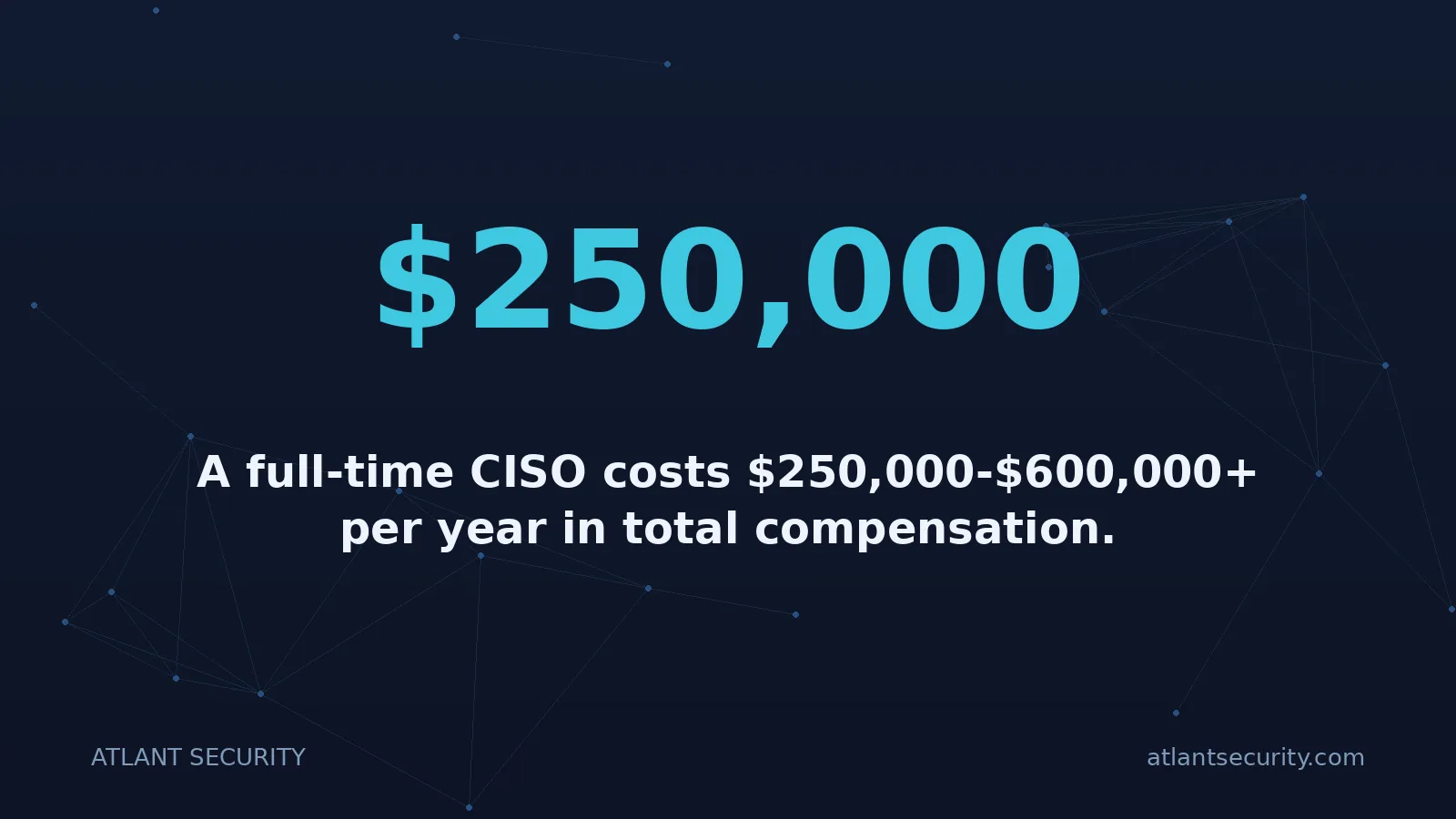
A full-time CISO costs $250,000-$600,000+ per year in total compensation. For most companies under 1,000 employees, that is not justifiable. But the security leadership gap is real and dangerous. A vCISO at $3,000-$15,000/month gives you executive-level security guidance at a fraction of the cost-and you can scale up or down as your needs evolve.
Quick Score
1-2 signs: Start planning. You have time, but the clock is ticking. 3-5 signs: You need a vCISO within the next quarter. 6+ signs: You need a vCISO now. Talk to us today →
Decision Framework
Do You Need a vCISO? Follow This Framework
Not every decision is black and white. This flowchart-style framework helps you determine not just whether you need a vCISO, but what type of security leadership fits your current stage.
Step 1: Do you handle sensitive data?
Customer PII, financial data, health records, intellectual property, or payment information. If yes, you have a legal and ethical obligation to protect it-and you need someone with the expertise to do that properly.
YES → Continue to Step 2 | NO → You may not need a vCISO yet (see “When You Don’t Need One” below)
Step 2: Do you have someone who owns security full-time?
Not the IT manager who “also does security.” A dedicated person whose primary job is security strategy, compliance, and risk management.
YES → You may need a consultant or audit instead. Consider an IT security audit. | NO → Continue to Step 3
Step 3: Can you afford $250K-$600K+ per year for a full-time CISO?
That is the total compensation range (salary, benefits, bonuses, equity) for a qualified full-time CISO in the United States. If this fits comfortably in your budget and your needs justify full-time, dedicated leadership, hire one.
YES → Hire a full-time CISO | NO → Continue to Step 4
Step 4: Do you face compliance requirements or enterprise sales pressure?
If customers, regulators, or partners require evidence of security controls (SOC 2, ISO 27001, HIPAA, CMMC, etc.), you need someone who can build and manage a compliance program end to end.
YES → You need a vCISO | NO → Continue to Step 5
Step 5: Is your company growing more than 30% year-over-year?
Rapid growth without security governance creates compounding risk. New employees, tools, cloud services, and integrations all expand your attack surface. Security debt grows faster than technical debt.
YES → You need a vCISO | NO → Consider starting with a one-time security audit and revisiting in 6 months
Framework Summary
If you handle sensitive data, lack a dedicated security leader, cannot afford a full-time CISO, and face compliance pressure or rapid growth-a virtual CISO is the most cost-effective and practical path to security leadership. For most mid-sized companies (50-1,000 employees), this is the answer.
Comparison
vCISO vs. Full-Time CISO: Side-by-Side
Understanding the tradeoffs helps you make the right investment. Here is how the two models compare across the dimensions that matter most.
| Dimension | Virtual CISO | Full-Time CISO |
|---|---|---|
| Annual Cost | $36K-$180K | $250K-$600K+ |
| Time to Deploy | 1-2 weeks | 3-6 months |
| Industry Experience | Multi-industry (dozens of clients) | Deep single-industry focus |
| Availability | Scheduled hours + on-call | Full-time, dedicated |
| Scalability | Scale up/down monthly | Fixed commitment |
| Institutional Knowledge | Builds over time; documented | Deep internal context |
| Team Backing | Firm’s full team behind them | Individual contributor |
| Best For | 50-1,000 employees | 1,000+ employees |
Honest Assessment
When You Do NOT Need a vCISO
We are a company that provides virtual CISO services, and we are going to tell you when not to buy them. Why? Because selling you something you do not need is bad business. Trust is built on honesty, and here is ours:
You probably do NOT need a vCISO if:
- You are a very small company (under 20 employees) with no sensitive data and no compliance requirements. At this stage, basic security hygiene-strong passwords, MFA, updated software, encrypted backups-is sufficient. A vCISO would be overkill.
- You already have a competent, full-time CISO. If you have a dedicated security leader who is effective, adding a vCISO creates confusion. Instead, consider an external security audit for an independent second opinion.
- You only need a one-time project, not ongoing leadership. If you need a single penetration test, a compliance gap assessment, or a security architecture review, hire a consultant for that specific project. A vCISO is an ongoing relationship.
- You are not willing to act on recommendations. A vCISO generates strategy, identifies risks, and recommends controls. If leadership has no intention of funding or implementing security improvements, hiring a vCISO is wasting money on a report that collects dust.
- Your security needs are purely operational. If you need someone to manage firewalls, monitor alerts, and patch servers-that is an MSSP (Managed Security Service Provider) or an IT operations role, not a vCISO. A vCISO is a strategic role.
Being honest about fit is important. If you fall into any of these categories and are unsure, we are happy to tell you so during a free consultation. We would rather point you to the right solution-even if it is not us-than sell you something you do not need.
The Real Numbers
The Cost of Not Having Security Leadership
The most expensive security decision is doing nothing. Here are the numbers that should keep every CEO and IT director up at night.
| Cost Category | Average Cost | Source |
|---|---|---|
| Average data breach (global) | $4.88 million | IBM, 2024 |
| Average breach for companies <500 employees | $3.31 million | IBM, 2024 |
| Average ransomware payment | $1.54 million | Sophos, 2024 |
| Cost of compliance violations (GDPR) | Up to €20M or 4% of revenue | EU GDPR |
| HIPAA violation penalties | $50K-$1.5M per violation | HHS OCR |
| Lost business due to breach | $1.47 million (avg.) | IBM, 2024 |
| Average breach detection time | 194 days | IBM, 2024 |
Let that last number sink in. 194 days. That is over six months where attackers are inside your systems, exfiltrating data, and you do not even know. Organizations with a security leader-including those with a vCISO-detect and contain breaches an average of 100 days faster than those without one (IBM Cost of a Data Breach Report, 2024).
Now compare the cost of a breach to the cost of prevention:
The Math Is Simple
- vCISO cost (annual): $36,000-$180,000 depending on scope
- Average breach cost for SMBs: $3,310,000
- ROI calculation: Even at the high end ($180K/year), a vCISO costs 5% of what a single breach would cost
- Additionally: Reduced insurance premiums, faster sales cycles (with SOC 2), and avoided regulatory fines
Beyond direct financial impact, there are costs that are harder to quantify but equally devastating:
- Reputation damage - 65% of consumers lose trust in a company after a breach (Ponemon Institute)
- Customer churn - breached companies see 3-5% higher customer attrition for 2+ years
- Executive liability - SEC rules now require board-level cybersecurity oversight; personal liability is increasing
- Talent loss - security incidents damage employer brand, making it harder to recruit
- Operational downtime - average ransomware recovery takes 24 days; some organizations never fully recover
Evaluation Criteria
What to Look For When Hiring a vCISO
Not all vCISO providers are equal. Some are solo practitioners with a slide deck. Others are full firms with deep benches. Here is what separates the ones that deliver from the ones that disappoint.
Multi-framework compliance experience
Your vCISO should have hands-on experience with the specific frameworks you need: SOC 2, ISO 27001, HIPAA, CMMC, GDPR, or industry-specific standards. Ask for references from clients who achieved certification under their guidance.
Team depth, not just an individual
A solo vCISO gets sick, goes on vacation, or gets overwhelmed. The best providers have a team behind the primary vCISO-specialists in penetration testing, compliance, cloud security, and incident response who can be called in when needed.
Vendor-neutral recommendations
If your vCISO pushes specific products or earns commissions from vendors, their advice is compromised. Look for providers who recommend the best tool for your situation, not the one that pays them the highest referral fee.
Board-level communication skills
Technical brilliance is useless if your vCISO cannot explain risk to the board in business terms. The best vCISOs translate “we found an unpatched CVE with a CVSS of 9.8” into “we have a vulnerability that could result in a $2M breach, and it will cost $15K to fix this week.”
Documented processes and knowledge transfer
A good vCISO documents everything: policies, procedures, risk registers, compliance evidence, architecture decisions. When the engagement evolves or transitions to an internal hire, nothing is lost. If your vCISO keeps everything in their head, that is a red flag.
Frequently Asked Questions
FAQ: Do I Need a vCISO?
How quickly can a vCISO start making an impact?
Most quality vCISO engagements show tangible results within 30 days. In the first two weeks, a vCISO typically completes a high-level risk assessment and identifies quick wins. By day 30, you should have a prioritized security roadmap, initial policy drafts, and a clear compliance path. Full SOC 2 readiness usually takes 3-6 months.
What is the difference between a vCISO and a security consultant?
A security consultant is typically engaged for a specific project-a penetration test, a compliance audit, or a risk assessment. A vCISO is an ongoing strategic relationship. They own your security program, attend your leadership meetings, report to your board, and evolve your security posture over time. Think of it as the difference between seeing a specialist once and having a primary care physician.
Can a vCISO help us get SOC 2 certified?
Absolutely. This is one of the most common reasons companies engage a vCISO. They will assess your current state, identify gaps, build the required policies and controls, coordinate with your auditor, and manage the process from start to certification. Our SOC 2 readiness program has helped companies achieve certification in as little as 12 weeks.
Will a vCISO replace our IT team?
No. A vCISO works with your existing IT team, not instead of them. They provide the strategic layer-risk management, compliance, policy, executive reporting-while your IT team handles day-to-day operations. In fact, most IT teams welcome a vCISO because it gives them clear direction and a security-aware executive who understands their challenges and advocates for proper resources.
How many hours per month does a vCISO typically work?
It varies by scope and company size. Most engagements range from 10 to 40 hours per month. Early-stage engagements (first 2-3 months) are usually more intensive as the vCISO builds your program. Ongoing maintenance typically requires fewer hours. Some providers offer tiered packages that scale with your needs.
What happens if we eventually hire a full-time CISO?
A good vCISO plans for this. They document everything, build repeatable processes, and can help you write the job description, interview candidates, and transition responsibilities smoothly. Many companies keep a vCISO on a reduced retainer even after hiring internally, as a sounding board and for specialized expertise the internal CISO may not have.
Do I need a vCISO if I already have cyber insurance?
Cyber insurance and a vCISO serve different purposes. Insurance helps you recover after an incident; a vCISO helps you prevent incidents and reduce their impact. In fact, many insurers now require specific security controls as a condition of coverage-a vCISO helps you meet those requirements and can reduce your premiums. Think of it this way: you would not skip a fire extinguisher just because you have fire insurance.
Still Not Sure If You Need a vCISO?
Let’s figure it out together. Our initial consultation is free, and we will give you an honest assessment-even if the answer is “you don’t need one yet.”
30-minute call. No sales pressure. Just a straightforward conversation about your security posture and whether a virtual CISO makes sense for your stage and goals.
Published: March 2026 · Author: Alexander Sverdlov, Atlant Security
This article is for informational purposes only and does not constitute legal or professional advice. Atlant Security provides virtual CISO services and has an interest in this topic. Cost and breach statistics reference publicly available reports from IBM, Sophos, and Ponemon Institute. Organizations should evaluate their specific needs and circumstances when making security leadership decisions.
