

SaaS Security · March 2026
Why SaaS companies face fundamentally different security challenges-and how specialized cybersecurity consulting helps you navigate multi-tenancy risks, enterprise buyer demands, SOC 2, ISO 27001, and DevSecOps without slowing down your ship cycle.
Three years ago, I sat across the table from the co-founders of a Series B SaaS company that had just lost their largest enterprise deal-a contract worth $1.2 million in annual recurring revenue. The prospect’s security team had sent over a 400-question vendor security assessment. The founders stared at it for two days, answered maybe 60 questions with confidence, and left the rest blank or vague. The prospect walked.
What stuck with me was what the CTO said afterward: “We spent two years building an incredible product, but we never thought about security as something we had to sell, too.”
That moment crystallized something I’d been seeing across dozens of SaaS engagements. SaaS security is not just an engineering problem-it is a business survival problem. Your customers are trusting you with their data, their workflows, and often their regulatory compliance. If you cannot demonstrate that you take that trust seriously, you will lose deals to competitors who can.
After working with that company for six months-helping them build a security program, achieve SOC 2 Type II, and develop a repeatable process for handling security questionnaires-they went back to the same prospect and won the deal. Their ARR doubled within a year, and the CEO credited security readiness as the single biggest unlock for moving upmarket.
This guide is everything I wish I could hand to every SaaS founder, CTO, and VP of Engineering before they hit that wall. It covers why SaaS companies need specialized cybersecurity consulting, what that consulting actually looks like across different growth stages, and how to invest strategically so security becomes a revenue enabler rather than a cost center.
Key Takeaways
- SaaS companies face unique security challenges-multi-tenancy, CI/CD pipelines, shared responsibility models, and enterprise buyer scrutiny-that generic cybersecurity consulting does not adequately address
- Specialized cybersecurity consulting for SaaS typically covers four pillars: product security, infrastructure security, corporate security, and compliance
- SOC 2 Type II and ISO 27001 have become table stakes for selling to enterprise customers; a structured roadmap can get you audit-ready in 3-6 months
- DevSecOps integration shifts security left without slowing down engineering velocity-this is where SaaS-savvy consultants deliver outsized value
- Security questionnaire readiness can directly accelerate deal cycles by 30-50% and unlock six- and seven-figure contracts
- Consulting costs range from $5,000-$15,000/month for early-stage startups to $20,000-$50,000+/month for growth-stage companies with complex compliance needs
The SaaS Difference
Why SaaS Companies Need Specialized Security Consulting
SaaS is not just “software on the internet.” It is a fundamentally different delivery model that creates security challenges traditional on-premise software companies never faced. A consultant who has spent their career securing banks and hospitals will miss critical SaaS-specific attack surfaces. Here is why specialization matters.
Multi-Tenancy: One Vulnerability, Every Customer Exposed
In a multi-tenant architecture, a single authorization flaw does not compromise one customer-it compromises all of them. Tenant isolation failures, cross-tenant data leakage, and noisy neighbor resource exhaustion are SaaS-specific risks that require consultants who understand how to test for and prevent them. We have seen companies with solid perimeter security but gaping holes in their tenant isolation logic, where Customer A could access Customer B’s data by manipulating API parameters.
CI/CD Pipeline Security: Your Deployment Pipeline Is an Attack Surface
SaaS companies deploy code daily-sometimes dozens of times a day. Every deployment is a potential injection point. Compromised build environments, poisoned dependencies, leaked secrets in CI/CD configurations, and insufficient code signing are all risks that traditional consultants rarely assess. A SaaS security audit must include your entire software supply chain, not just the running application.
The Shared Responsibility Model: Cloud Does Not Mean Secure
AWS, Azure, and GCP secure the infrastructure beneath your application. Everything above that-your configurations, your IAM policies, your encryption at rest and in transit, your container security-is on you. The shared responsibility model is well-documented but widely misunderstood. We routinely find SaaS companies that assume their cloud provider handles encryption key management or network segmentation when, in fact, those are the customer’s responsibility.
Enterprise Buyer Requirements: Security as a Sales Prerequisite
The moment you sell to a company with more than 500 employees, security becomes a purchasing requirement, not a nice-to-have. Enterprise procurement teams now routinely require SOC 2 Type II reports, penetration test results, security architecture documentation, incident response plans, and completed vendor security assessments before signing. Without a structured security program, you are locked out of the enterprise market entirely.
If you want this more often than once a year without a retainer, Pentestas is the route: AI-driven testing across web, API, cloud, network and mobile, with results back in five to ten days.
The Real Cost of Ignoring SaaS Security
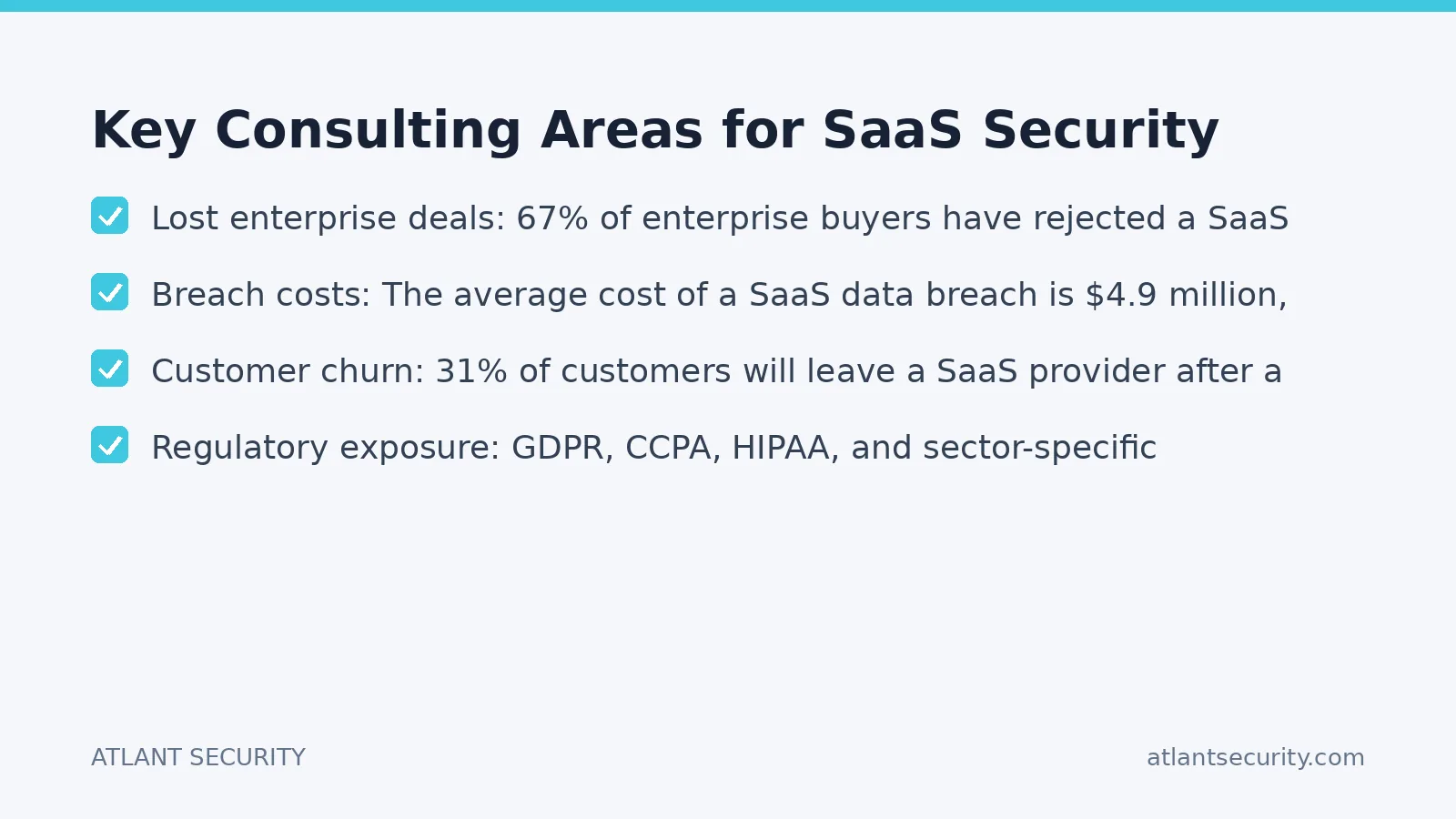
- Lost enterprise deals: 67% of enterprise buyers have rejected a SaaS vendor due to inadequate security documentation (Cloud Security Alliance, 2025)
- Breach costs: The average cost of a SaaS data breach is $4.9 million, 11% higher than the cross-industry average (IBM Cost of a Data Breach Report, 2025)
- Customer churn: 31% of customers will leave a SaaS provider after a security incident, even if their data was not directly affected
- Regulatory exposure: GDPR, CCPA, HIPAA, and sector-specific regulations create compounding liability when multi-tenant environments are breached
Maturity Framework
The SaaS Security Maturity Model: 5 Stages
One of the first things a qualified cybersecurity consultant will do is assess where your SaaS company sits on the security maturity curve. This matters because the right investments at Stage 1 are completely different from the right investments at Stage 4. Over-investing too early wastes money; under-investing too late loses deals and creates breach risk.
Here is the five-stage maturity model we use with our SaaS CISO services clients. It is informed by hundreds of SaaS engagements and maps directly to what enterprise buyers expect at each stage.
| Stage | Name | Characteristics | Consulting Focus |
|---|---|---|---|
| 1 - Ad Hoc | Reactive | No formal security policies, developers handle security informally, no compliance certifications | Gap assessment, foundational policy creation, quick-win hardening |
| 2 - Developing | Aware | Basic policies exist, some security tooling in place, beginning compliance journey (SOC 2 Type I) | SOC 2 readiness, initial pen testing, security architecture review |
| 3 - Defined | Structured | Documented security program, SOC 2 Type II certified, regular vulnerability scanning, incident response plan | DevSecOps integration, ISO 27001 preparation, vendor assessment automation |
| 4 - Managed | Proactive | Metrics-driven security program, automated compliance monitoring, threat modeling integrated into SDLC | Advanced threat modeling, red team exercises, security program optimization |
| 5 - Optimized | Leading | Security is a competitive advantage, continuous improvement culture, industry-leading practices, security team in place | Board-level advisory, M&A security due diligence, zero-trust architecture refinement |
Where Most SaaS Companies Sit
In our experience, the majority of SaaS companies between Series A and Series C are at Stage 1 or Stage 2. They have talented engineering teams but no formal security program. The good news is that moving from Stage 1 to Stage 3 typically takes 4-8 months with the right consulting partner-and that is exactly the range where enterprise deals start closing.
The Four Pillars
Key Consulting Areas for SaaS Security
Cybersecurity consulting for SaaS is not a single service-it is an umbrella that covers four distinct but interconnected domains. A comprehensive security program addresses all four. Here is what each one involves, why it matters, and what good consulting looks like in each area.
1. Product Security
This is where SaaS security consulting diverges most sharply from traditional consulting. Your product is the attack surface. It includes:
- Application penetration testing - Not just OWASP Top 10 scans, but deep-dive testing of business logic, tenant isolation, API authorization, and webhook security
- Secure SDLC design - Integrating threat modeling, code review processes, and security gates into your existing development workflow
- API security assessment - Evaluating authentication, rate limiting, input validation, and data exposure across all API endpoints
- Authentication and authorization architecture - Reviewing SSO integration, RBAC/ABAC implementation, session management, and multi-tenancy access controls
- Dependency and supply chain analysis - Auditing third-party libraries, container base images, and build pipeline integrity
2. Infrastructure Security
Your cloud infrastructure is the foundation everything runs on. SaaS-specific infrastructure consulting covers:
- Cloud configuration review - AWS, Azure, or GCP environment hardening, IAM policy audit, network segmentation verification
- Container and Kubernetes security - Image scanning, runtime protection, cluster hardening, secrets management
- Infrastructure as Code (IaC) review - Terraform, CloudFormation, or Pulumi templates reviewed for security misconfigurations before deployment
- Data encryption architecture - Encryption at rest and in transit, key management strategy, customer-managed encryption key (CMEK) implementation
- Logging, monitoring, and alerting - SIEM configuration, anomaly detection, and incident detection pipeline design
3. Corporate Security
Even with a perfectly secured product, your corporate environment can be the weakest link. SaaS companies often overlook corporate security because they are cloud-native and assume they have no “network” to protect. Consulting here includes:
- Endpoint security - MDM deployment, EDR tooling, device encryption enforcement across remote teams
- Identity and access management - SSO for all SaaS tools, MFA enforcement, privileged access management, access reviews
- Security awareness training - Phishing simulations, secure coding training for developers, social engineering defense
- Incident response planning - Playbooks, communication templates, tabletop exercises, and breach notification procedures
4. Compliance
Compliance is not security, but security without compliance is a dealbreaker for enterprise SaaS sales. Key compliance consulting areas include:
- SOC 2 Type I & Type II readiness - Gap assessment, control implementation, auditor coordination, evidence collection automation
- ISO 27001 certification - ISMS design, risk assessment methodology, Statement of Applicability, internal audit preparation
- GDPR and CCPA compliance - Data processing agreements, privacy impact assessments, data subject request workflows
- HIPAA compliance - For SaaS companies handling protected health information, including BAA frameworks and technical safeguards
- Industry-specific frameworks - PCI DSS for payment processing, FedRAMP for government, HITRUST for healthcare
Compliance Roadmap
SOC 2 + ISO 27001 Roadmap for SaaS Companies
The two certifications that unlock the most enterprise revenue for SaaS companies are SOC 2 Type II and ISO 27001. SOC 2 is the standard in the U.S. market; ISO 27001 is preferred by European and global enterprise buyers. If you are selling internationally, you will eventually need both.
The good news: there is significant overlap between the two frameworks. A well-structured consulting engagement builds both simultaneously rather than treating them as separate projects. Here is a realistic roadmap that our team has refined across dozens of SaaS engagements.
| Phase | Timeline | Activities | Deliverables |
|---|---|---|---|
| 1. Assessment | Weeks 1-3 | Current-state gap analysis against SOC 2 TSC and ISO 27001 Annex A, risk register creation, scope definition | Gap report, risk register, project plan with effort estimates |
| 2. Foundation | Weeks 3-8 | Core policy creation (Information Security, Acceptable Use, Access Control, Incident Response, etc.), ISMS establishment for ISO 27001 | 15-25 policies and procedures, ISMS documentation, Statement of Applicability |
| 3. Implementation | Weeks 6-16 | Technical control deployment, evidence collection setup, security tooling configuration, employee training | Configured controls, automated evidence collection, training records |
| 4. Internal Audit | Weeks 14-18 | Internal audit (required for ISO 27001), management review, SOC 2 readiness assessment, remediation of findings | Internal audit report, remediation tracker, audit-readiness confirmation |
| 5. External Audit | Weeks 16-24 | SOC 2 Type I audit (or begin Type II observation window), ISO 27001 Stage 1 and Stage 2 certification audit | SOC 2 Type I report, ISO 27001 certificate, corrective action plans for any findings |
Pro Tip: Run Both in Parallel, Not Sequentially
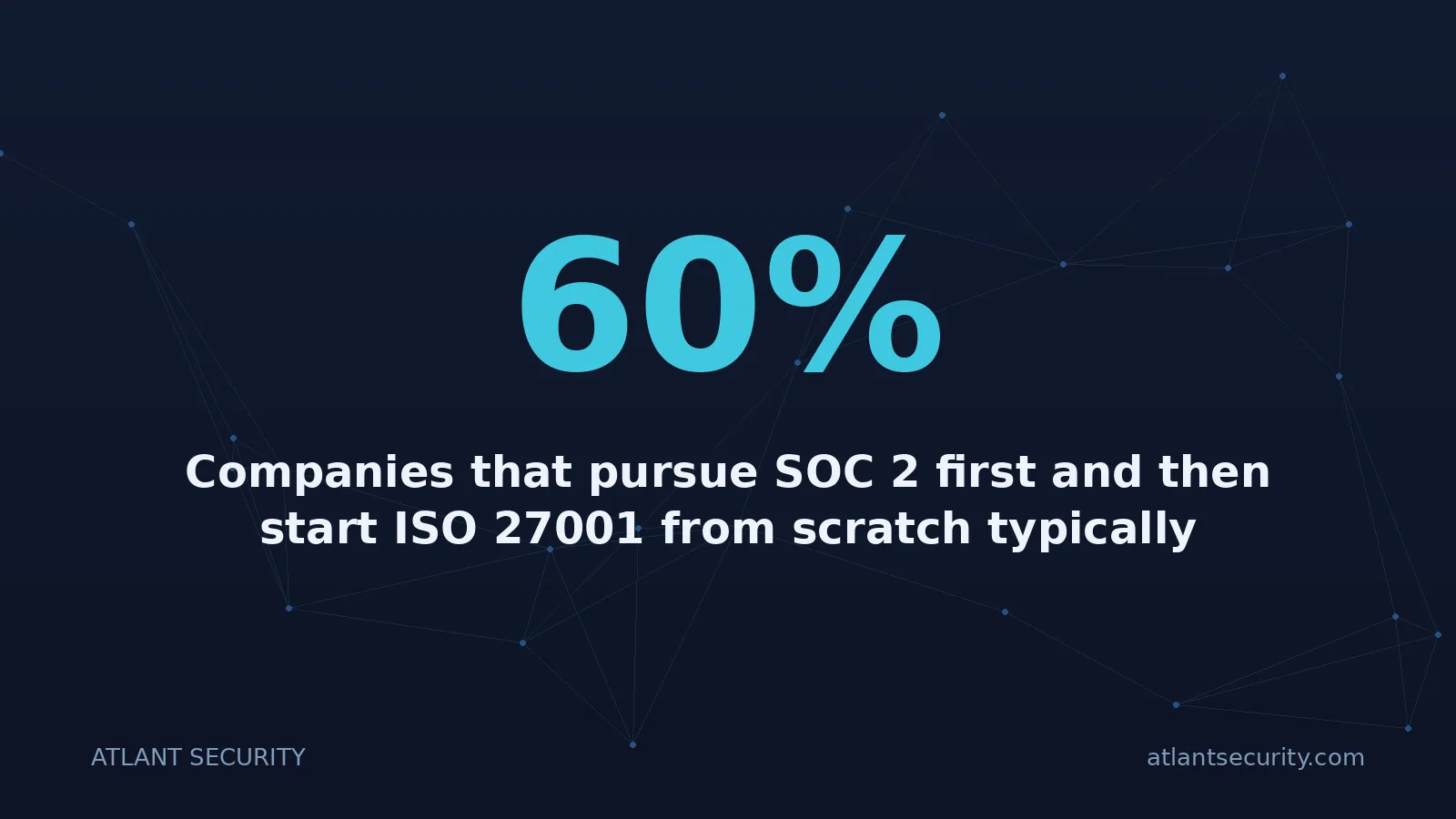
Companies that pursue SOC 2 first and then start ISO 27001 from scratch typically spend 40-60% more and take twice as long as companies that build a unified control framework from the beginning. A consultant experienced in both frameworks will design your policies and controls to satisfy both standards simultaneously, with framework-specific documentation layered on top. Ask any consultant you evaluate whether they have experience delivering both certifications in a single engagement.
Engineering Integration
DevSecOps Integration: Security Without Slowing Shipping
The number one objection I hear from SaaS CTOs is: “We cannot slow down our release cadence.” It is a legitimate concern. If security consulting results in a gate that adds three days to every deployment, you have solved a security problem and created a business problem.
DevSecOps done right does the opposite. It shifts security left into the development process so issues are caught early-when they are cheapest and fastest to fix. A SaaS-experienced security consultant will help you build a DevSecOps pipeline that integrates seamlessly into your existing CI/CD workflow.
Here is what a mature DevSecOps implementation looks like for a SaaS company, and what a good consulting engagement delivers at each layer:
The SaaS DevSecOps Stack
- Pre-commit: Secret scanning (preventing API keys, tokens, and credentials from entering the repository), pre-commit hooks for security linting
- Build phase: Static Application Security Testing (SAST) integrated into pull requests, Software Composition Analysis (SCA) for dependency vulnerabilities, container image scanning
- Test phase: Dynamic Application Security Testing (DAST) in staging environments, API fuzzing, integration security tests
- Deploy phase: Infrastructure as Code scanning, deployment policy enforcement, canary deployment security validation
- Runtime: Runtime Application Self-Protection (RASP), anomaly detection, automated incident alerting
- Feedback loop: Security findings fed back to developers with context and remediation guidance, mean-time-to-remediate tracking, security champion program
A consultant who understands SaaS will not hand you a 50-page PDF and walk away. They will sit with your engineering team, review your GitHub Actions or GitLab CI configuration, and help you implement tooling that runs in your existing pipeline. The goal is a setup where 90% of security checks are automated and invisible to developers, with manual review reserved for high-risk changes only.
The best security is invisible security. If your developers have to think about it, you have already lost. The pipeline should catch 90% of issues automatically, and developers should only be interrupted for the things that truly require human judgment.
Sales Enablement
Security Questionnaire Readiness: Turn Compliance Into Revenue
If you sell B2B SaaS, you will face security questionnaires. There is no avoiding them. Enterprise procurement teams send them as a standard part of vendor evaluation, and they range from 50-question Google Forms to 800-question CAIQ spreadsheets. How quickly and confidently you respond directly impacts your win rate and deal velocity.
A specialized cybersecurity consultant helps you build a security questionnaire response engine that turns a days-long scramble into a same-day turnaround. Here is what that looks like in practice:
Building Your Response Engine
- Master response library: 300-500 pre-approved answers covering the most common questions across SIG Lite, CAIQ, VSA, CIS, and custom questionnaires
- Security documentation package: Architecture diagrams, data flow maps, encryption specifications, BCP/DR documentation-all formatted for external consumption
- Trust center or security page: A public-facing page that proactively answers the top 50 questions, reducing inbound questionnaire volume by 20-30%
- Response workflow: Clear ownership, SLA targets (24-48 hours for standard questionnaires), escalation paths for novel questions
- Continuous improvement process: Every new question that is not in your library gets added. After 6 months, you are answering 90%+ of questions from the library
The ROI here is straightforward and measurable. One of our clients reduced their average questionnaire response time from 11 business days to 2 business days. Their sales team reported that faster security responses shortened the overall deal cycle by 35%, directly accelerating revenue recognition.
Both Sides of the Table
Vendor Security Assessment Handling
SaaS companies sit on both sides of the vendor assessment equation. Your enterprise customers assess you, and you need to assess your vendors and subprocessors. Both directions require consulting expertise, and failing at either one creates risk.
Being Assessed: Passing Your Customers' Security Reviews
Enterprise customers do not just send questionnaires. Larger deals often involve live security review calls, architecture walkthroughs, and on-site assessments. A consultant helps you prepare by:
- Conducting mock security reviews that simulate enterprise buyer scrutiny
- Preparing your team to present your security architecture confidently and concisely
- Identifying and remediating gaps that commonly trigger rejections
- Creating a security evidence package that can be shared under NDA to preempt detailed questioning
Assessing Your Vendors: Third-Party Risk Management for SaaS
Your security posture is only as strong as your weakest vendor. If you use Stripe for payments, Twilio for communications, and a dozen other SaaS tools in your stack, each one is a potential supply chain risk. Your customers know this, and they will ask about your vendor management program. Consulting here involves:
- Building a vendor inventory with risk tiering (critical, high, medium, low)
- Establishing assessment criteria and review cadences based on risk tier
- Creating contractual security requirements (DPA templates, security addenda)
- Implementing ongoing monitoring for vendor security incidents and changes
Quick Win
Even before engaging a consultant, start collecting SOC 2 reports from all your critical vendors. This single action demonstrates vendor risk awareness to your customers and gives your future consultant a head start on assessing your supply chain.
Investment Guide
Cost of Cybersecurity Consulting by SaaS Company Stage
Cybersecurity consulting for SaaS is not one-size-fits-all, and pricing varies dramatically based on your company stage, complexity, and goals. Here is a realistic breakdown based on what we see across hundreds of engagements. These are U.S. market rates for 2026 and reflect the cost of working with experienced, SaaS-specialized firms-not generalist IT shops.
| Company Stage | Typical Size | Monthly Retainer | Common Projects | Total Annual Investment |
|---|---|---|---|---|
| Pre-Seed / Seed | 5-20 people | $3,000-$7,000 | Foundational policies, basic hardening, SOC 2 Type I prep | $40K-$90K |
| Series A | 20-80 people | $7,000-$15,000 | SOC 2 Type II, pen testing, DevSecOps setup, questionnaire engine | $90K-$200K |
| Series B | 80-250 people | $15,000-$30,000 | ISO 27001, advanced pen testing, TPRM program, SaaS CISO services | $200K-$400K |
| Series C+ | 250-1,000+ people | $25,000-$50,000+ | FedRAMP, HITRUST, red teaming, M&A due diligence, board advisory | $350K-$650K+ |
| Public / Late Stage | 1,000+ people | $40,000-$80,000+ | Zero-trust architecture, regulatory programs, global compliance, GRC platform implementation | $500K-$1M+ |
How to Think About Security Consulting ROI
Security consulting for SaaS should be measured against revenue, not just risk. If your average enterprise deal is $200K ARR and you are losing 3-5 deals per year due to security gaps, that is $600K-$1M in lost revenue. A $150K annual consulting investment that closes even two of those deals delivers a 2-3x return in year one, compounding as those customers renew and expand.
This is why we recommend that SaaS companies track security-influenced pipeline-deals where security readiness was a factor in the buying decision. Most of our clients find this number is 40-70% of their enterprise pipeline.
One additional consideration: a virtual CISO engagement often serves as the anchor for your consulting relationship, providing strategic continuity while project-based consultants handle specific initiatives like pen testing or compliance audits. This hybrid model is the most cost-effective approach for Series A through Series C SaaS companies.
Frequently Asked Questions
FAQ: Cybersecurity Consulting for SaaS
How is cybersecurity consulting for SaaS different from general cybersecurity consulting?
General cybersecurity consulting focuses on network security, endpoint protection, and traditional IT infrastructure. SaaS-specific consulting addresses multi-tenant application security, CI/CD pipeline risks, cloud-native architecture, API security, and the unique compliance requirements that enterprise SaaS buyers demand. A SaaS-specialized consultant understands how to secure a product that is both the business and the attack surface, and how security directly impacts your ability to sell to enterprise customers.
When should a SaaS startup start investing in security consulting?
The ideal time is right after your seed round or when you sign your first paying customer-whichever comes first. At this stage, investing in foundational security architecture is 10x cheaper than retrofitting later. At minimum, every SaaS company should engage a security consultant before pursuing their first enterprise customer, before beginning SOC 2 preparation, or before processing any sensitive customer data. The longer you wait, the more technical debt accumulates and the more expensive remediation becomes.
How long does it take to get SOC 2 Type II certified with consulting help?
With an experienced consultant, the readiness phase typically takes 3-5 months from a standing start. After readiness, the Type II observation window requires a minimum of 3 months (6 or 12 months is more common for first-time audits). So from zero to SOC 2 Type II report in hand, expect 6-12 months total. The consultant accelerates this by building the right controls from the start, avoiding rework, and coordinating with your auditor to ensure there are no surprises. Visit our SOC 2 readiness page for a detailed breakdown.
Can we handle security in-house instead of hiring a consultant?
You can, but consider the economics. A full-time security engineer costs $150K-$250K annually (salary, benefits, tools). A CISO costs $250K-$500K+. For most SaaS companies under 200 employees, hiring a full internal security team does not make financial sense. Consulting gives you access to a team of specialists-penetration testers, compliance experts, cloud security architects-for a fraction of the cost of one full-time hire. The ideal model for most SaaS companies is a virtual CISO providing strategic leadership supplemented by project-based consulting for specific initiatives.
What should I look for when evaluating a cybersecurity consultant for my SaaS company?
Five things to prioritize: (1) SaaS-specific experience-ask how many SaaS companies they have worked with and in what capacity; (2) Technical depth-can they review your Terraform modules, your Kubernetes configs, your CI/CD pipelines? Or do they only do policy documents? (3) Compliance track record-how many SOC 2 and ISO 27001 certifications have they guided companies through, and what was the pass rate? (4) Engineering empathy-do they understand that shipping speed matters, or will they recommend changes that grind development to a halt? (5) References from similar companies-ask to speak with SaaS CTOs they have worked with at your stage and size.
How does security consulting integrate with our existing engineering workflow?
A good SaaS security consultant will not impose a separate workflow. They integrate into your existing processes: joining sprint planning to flag security considerations, reviewing pull requests for high-risk changes, configuring automated security scanning in your CI/CD pipeline, and training your developers to be security-aware. The goal is to embed security into how your team already works, not to create a parallel process that engineers will resist and eventually ignore.
Do I need both SOC 2 and ISO 27001, or can I start with one?
Start with whichever your customers are asking for. If you sell primarily in the U.S., start with SOC 2 Type II-it is the most commonly requested certification. If you sell internationally or to European enterprises, ISO 27001 may be the priority. That said, there is roughly 70% overlap between the two frameworks. A smart consultant will build your controls to satisfy both from day one, even if you only pursue one certification initially. This saves significant time and money when you pursue the second one later. See our ISO 27001 readiness page for more details.
What is the biggest mistake SaaS companies make with security consulting?
Treating it as a one-time checkbox exercise. Companies that engage a consultant for a single SOC 2 audit and then disengage find themselves scrambling again the next year. Security is a continuous program, not a project. The most successful SaaS companies maintain an ongoing consulting relationship-typically through a SaaS CISO retainer-that provides strategic continuity, keeps their compliance current, and ensures they are always ready for the next enterprise security review.
Ready to Secure Your SaaS Platform?
Whether you need SOC 2 readiness, a full security program, or a SaaS CISO to lead your security strategy-we have helped hundreds of SaaS companies get there.
Our free initial consultation includes: a 30-minute deep dive into your security challenges, a high-level maturity assessment, and actionable next steps tailored to your stage and goals. No obligation, no sales pressure.
Published: March 2026 · Author: Alexander Sverdlov, Atlant Security
This article is for informational purposes only and does not constitute legal or professional advice. Atlant Security provides SaaS CISO services, SaaS security audits, and virtual CISO services. Cost estimates reflect 2026 U.S. market rates and may vary based on scope, geography, and consultant experience. Organizations should evaluate their specific needs and circumstances when making security consulting decisions.
