
We have probably seen your problem before. Our smallest client had eight employees. Our largest secures the nuclear power plant of the United Arab Emirates. Whatever shape yours is, tell us about it and we will tell you how we would fix it.
Luxembourg is a small country with an outsized regulated sector, and that shapes its cybersecurity market completely. Most serious security spending here is driven by financial sector supervision rather than by general risk management, and the provider landscape is correspondingly concentrated: a few large national players and a small number of independent consultancies. This guide compares four with a genuine local presence.
Disclosure: this guide is published by Atlant Security, which appears at number 4 of 4 below. We are not a reseller or partner of any firm listed, none paid for placement, and none saw this before publication. Every company here was checked against its own live website on 14 September 2026. Strengths and weaknesses are our editorial judgement; each quoted line is taken verbatim from the firm’s own site.
What changed in this edition: This edition was rebuilt. The previous version named no companies at all. Two names that appear on most older Luxembourg shortlists have changed and are worth flagging: Excellium Services, long a leading Luxembourg security firm, now redirects to the Thales group cybersecurity pages, indicating the brand has been absorbed; and Telindus Luxembourg now operates as Proximus NXT, with telindus.lu redirecting accordingly. We list four firms rather than padding the count, because Luxembourg genuinely is a small market.
Start Here: the 30 Second Version
If you read nothing else on this page, read the row that describes you. Every provider is compared in detail further down, but choosing the right category of firm matters far more than choosing between two firms in the same category.
| If this is you | Buy this first | Because |
|---|---|---|
| A regulated financial entity | A DORA gap assessment and a named ICT risk management function | DORA has applied since January 2025. The question is no longer whether, it is who holds the function. |
| You have a register of information that nobody maintains | A register reconciliation against contracts | It has to be current and produced on request. A stale spreadsheet is a finding waiting to happen. |
| A Luxembourg entity wanting an independent view | A small independent consultancy | Only one firm below is genuinely independent and locally headquartered. That is the whole market. |
| You already buy connectivity and hosting locally | Consolidating security with the same supplier | Two firms below are exactly this. Data stays in-country, which is a live consideration here. |
| You do not know which of these you are | A scoped, fixed-price audit | Luxembourg has very few independent options. Knowing what you need protects you from the catalogue. |
Atlant Security editorial assessment, September 2026. This is our reading of the market, not a figure taken from any published source.
Does a Luxembourg Cybersecurity Company Need to Be in Luxembourg?
In Luxembourg, yes, more than in most European markets. Financial sector supervision here is detailed and locally interpreted, and providers who work with supervised entities routinely know what evidence satisfies the regulator in a way that reading the circulars will not teach you.
Data residency is also a live commercial question rather than a theoretical one. Luxembourg’s fund and banking sectors frequently prefer or require that data stay in-country, which favours providers with local infrastructure over remote specialists regardless of technical merit.
The country is small enough that on-site presence is trivial, and multilingual working across French, German, English and Luxembourgish is normal. That combination means the usual argument for hiring remotely carries less weight here than almost anywhere else in this series.
What Drives Security Spending in Luxembourg
Financial sector supervision, overwhelmingly. Luxembourg is one of the largest investment fund domiciles in the world, and entities supervised by the financial regulator operate under detailed expectations covering IT risk, outsourcing and cloud use. For a supervised entity, those expectations rather than a general standard define the security programme, and demonstrating compliance to the regulator is a substantial share of the work.
Outsourcing rules deserve particular attention because they catch people out. A supervised Luxembourg entity generally cannot simply hand a function to a cloud provider or an offshore supplier and consider the risk transferred; notification, due diligence and ongoing oversight obligations typically remain. That is why local providers who understand the outsourcing regime are valued here beyond their technical capability.
European directives add a second layer. The EU’s network and information security regime extends obligations to a wider set of sectors than its predecessor, and financial entities face a further operational resilience regulation with its own testing and third-party requirements. We cover the latter on our DORA compliance page, which is directly relevant to a great many Luxembourg firms.
Because all of this is revised regularly and interpreted through supervisory practice, treat the regulator’s own circulars and the national cybersecurity portal as authoritative rather than any vendor summary, including this one. Confirm your specific obligations with counsel before scoping a programme.
Work out which one you are
Which rulebook binds you in Luxembourg?
Luxembourg is a fund and banking centre inside the EU, which means the binding rules arrive from Brussels and are supervised locally. For most organisations here that means DORA.
You are a regulated financial entity
DORA, Regulation (EU) 2022/2554, which has applied since 17 January 2025 and covers roughly 22,000 financial entities across 20 categories, plus the ICT providers that serve them
Enforced by your competent authority, in Luxembourg the financial supervisor
You are any entity under DORA, of any size
The register of information: every contractual arrangement with an ICT third-party provider, kept current and produced to the supervisor on request
Enforced by your competent authority
You handle personal data of people in the EU
GDPR, and Article 32 on security of processing
Enforced by the Commission nationale pour la protection des donnees (CNPD)
The three most common situations. The full table below adds a fourth and gives the sourcing for each row.
| Your situation | What applies | Who enforces it | What it changes when you buy |
|---|---|---|---|
| You are a regulated financial entity | DORA, Regulation (EU) 2022/2554, which has applied since 17 January 2025 and covers roughly 22,000 financial entities across 20 categories, plus the ICT providers that serve them | Your competent authority, in Luxembourg the financial supervisor | Article 6(4) requires an ICT risk management control function independent enough to challenge the business. A named person, not a readiness deck. See DORA readiness. |
| You are any entity under DORA, of any size | The register of information: every contractual arrangement with an ICT third-party provider, kept current and produced to the supervisor on request | Your competent authority | Most mid-size entities have it half-built in a spreadsheet nobody has updated since first submission. |
| You handle personal data of people in the EU | GDPR, and Article 32 on security of processing | The Commission nationale pour la protection des donnees (CNPD) | Applies to essentially every organisation here. See GDPR Article 32 assessment. |
| You are the Luxembourg entity of a larger group | Local supervision, plus whatever the group imposes | Your head office and your auditors | In a fund centre this is the normal case rather than the exception. |
The DORA row is as published on Atlant Security’s own DORA page, which carries the detail and the article references. Confirm your entity type and supervisor with counsel. This is not legal advice.
Cybersecurity Companies in Luxembourg: Side-by-Side Comparison
All 4 firms below have a real presence in the Luxembourg area. The table is sorted in the same order as the reviews that follow.
| Provider | Based | Team size | Hourly rate | Best for |
|---|---|---|---|---|
| POST Luxembourg | Luxembourg | 1,000+ | Not published | Luxembourg organisations wanting national-scale managed services and connectivity |
| Proximus NXT (formerly Telindus) | Luxembourg | 1,000+ | Not published | Luxembourg enterprises wanting ICT and security from one large integrator |
| itrust consulting | Luxembourg | 10-49 | Not published | Luxembourg organisations wanting an independent local security consultancy |
| Atlant Security | Remote, serving 14 countries | Small senior team | Fixed price, not hourly | Companies that need someone to decide what to do and then implement it |
Team size, hourly rate and minimum engagement are as published by each firm on the Clutch directory, checked 14 September 2026. They are the firms’ own figures, not our measurements. “Best for” is Atlant Security’s editorial assessment.
What kind of firm each one actually is
The table above compares them on price and location. This one compares them on what they are, which is the comparison that decides whether the engagement works. Most bad purchases in this market are the right firm in the wrong category.
| Provider | What kind of firm it is | What the engagement ends with | The limitation this guide flags |
|---|---|---|---|
| POST Luxembourg | Telecom and hosting | Connectivity or hosting with security attached | Enterprise procurement; not suited to a small bounded engagement |
| Proximus NXT (formerly Telindus) | ICT integrator | Infrastructure and its protection, bought together | Integrator model, so advice sits closer to the product catalogue |
| itrust consulting | Consultancy | A prioritised plan, and with some firms the fixes as well | Small team, so large multi-workstream programmes will stretch capacity |
| Atlant Security | Consultancy | A prioritised plan, and with some firms the fixes as well | No help desk, so day-to-day IT support still needs a local provider |
Category is our reading of each firm’s own published description, quoted in its entry below. The limitation column is taken verbatim from the same entry. Checked against each firm’s live site in September 2026.
Read the Atlant Security row the same way you read the others. We are a consultancy. There is no help desk, no monitoring platform and nothing to resell, and that is a limitation as much as a position. If what you need is somebody to answer the phone when a laptop dies, buy from one of the managed providers on this page instead. We are here because deciding what to fix and in what order is a separate purchase from keeping the estate running.
The 4 Best Cybersecurity Companies in Luxembourg for 2026
Four providers with a genuine Luxembourg presence, ordered by fit. Two are large national-scale operators, one is an independent local consultancy.
1. POST Luxembourg
Luxembourg · Website: post.lu
Best for: Luxembourg organisations wanting national-scale managed services and connectivity
POST is Luxembourg’s national postal and telecommunications operator, and its cybersecurity arm gives it the scale and local sovereignty position that a small market values. For an organisation that already takes connectivity and hosting from POST, consolidating security with the same supplier removes coordination problems and keeps data in-country, which is a live consideration in Luxembourg’s regulated sectors. It is an enterprise relationship with the procurement that implies.
Strengths
- National operator with local infrastructure and data residency
- Scale and continuity that small consultancies cannot match
Watch out for
- Enterprise procurement; not suited to a small bounded engagement
- Security sits inside a much larger telecoms business
Team size: 1,000+ · Rate: Not published · Minimum engagement: Enterprise engagement
2. Proximus NXT (formerly Telindus)
Luxembourg · Website: proximusnxt.lu
Best for: Luxembourg enterprises wanting ICT and security from one large integrator
Telindus Luxembourg, a long-established name in the local market, now operates as Proximus NXT: telindus.lu redirects to proximusnxt.lu. That matters if you are working from an older shortlist or an article that still refers to Telindus. The business is a full-service ICT integrator with a substantial security practice, which suits an organisation buying infrastructure and protection together rather than an independent assessment.
Solutions ICT et telecom pour entreprises
How Proximus NXT (formerly Telindus) describes itself on proximusnxt.lu, September 2026
Strengths
- Large local integrator with ICT and security under one contract
- Long history in the Luxembourg market with deep enterprise relationships
Watch out for
- Integrator model, so advice sits closer to the product catalogue
- Brand changed from Telindus, which can confuse older references
Team size: 1,000+ · Rate: Not published · Minimum engagement: Enterprise engagement
3. itrust consulting
Luxembourg · Website: itrust.lu
Best for: Luxembourg organisations wanting an independent local security consultancy
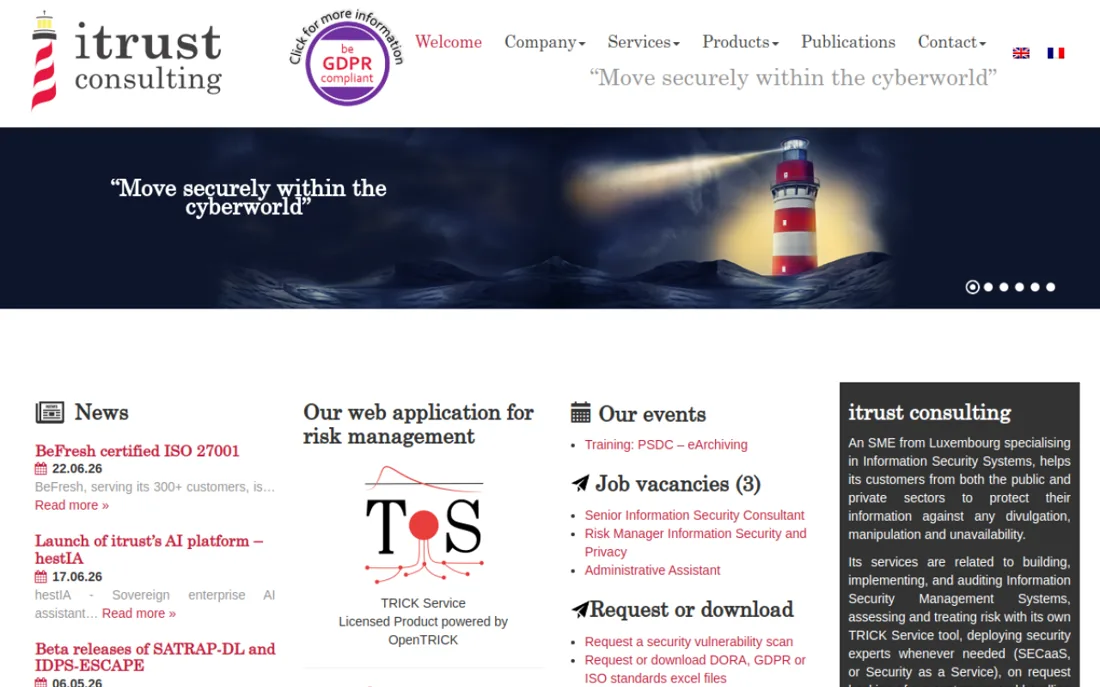
itrust consulting is one of the few genuinely independent security consultancies headquartered in Luxembourg, working across information security management, risk and research. Independence matters more in a small market than a large one, because when most providers are arms of telecoms groups or integrators, an advisor with nothing to resell is structurally scarce. For a Luxembourg organisation that wants advice rather than a platform, this is the local answer.
itrust consulting - Information security in Luxembourg
How itrust consulting describes itself on itrust.lu, September 2026
Strengths
- Genuinely independent and Luxembourg headquartered
- Established track record in security management and risk work
Watch out for
- Small team, so large multi-workstream programmes will stretch capacity
- No published pricing
Team size: 10-49 · Rate: Not published · Minimum engagement: Not published
4. Atlant Security
Remote, serving 14 countries · Website: atlantsecurity.com
Best for: Companies that need someone to decide what to do and then implement it
Atlant Security is a consultancy rather than a managed services provider or a product vendor, and the distinction is the reason it is on this list at all. There is no help desk, no monitoring platform and nothing to resell. What it does is the part most local providers leave to you: an audit that produces a prioritised remediation plan with named owners and effort estimates, and the same engineers then implementing the fixes. The firm has run 200+ security assessments across 14 countries since 2013, works to fixed prices rather than hourly billing, and is vendor-independent, so the recommendation carries no resale commission. For a company that does not yet know whether it needs an MSP, a penetration test or a compliance programme, that ordering is the useful thing to buy first.
Strengths
- Fixed price, so scope and invoice are agreed before work starts
- Implements the fixes rather than stopping at a findings report
- Vendor-independent, with no product resale margin behind the advice
Watch out for
- No help desk, so day-to-day IT support still needs a local provider
- No 24/7 monitoring platform of its own; continuous detection goes to a partner
- Remote-first, so regular on-site presence is not the model
Team size: Small senior team · Rate: Fixed price, not hourly · Minimum engagement: $8,000+
How to Choose a Cybersecurity Company in Luxembourg
The providers below fall into several quite different categories, which makes the selection process matter more than the shortlist. Work through these five steps in order.
- Work out which of the things below you are buying
A managed provider keeps your estate running day to day. A testing firm tries to break in and reports how it went. A consultancy decides what you should do and in what order. A product vendor sells you a platform somebody then has to operate. The table above says which is which.
- Ask who fixes the problem after it is found
A scan, an audit and a penetration test all end with a document. Somebody then has to change firewall rules, rebuild permissions, roll out multi-factor authentication and argue with a vendor about a legacy application. Ask in writing whether remediation is included, excluded, or billed separately.
- Get the scope and the price in writing before anyone starts
A proposal that prices security services without listing what is monitored, tested or documented is not a proposal you can hold anyone to. Ask for a fixed or capped price and an explicit list of exclusions. The price transparency panel further down shows how many of these firms publish anything at all.
- Establish your DORA position before you buy anything else
DORA has applied since 17 January 2025, and it changes what you are buying. Article 6(4) requires financial entities other than microenterprises to assign ICT risk management to a control function with the independence to challenge the business. If your provider also runs your IT, they cannot credibly be that function. That single constraint reshapes the shortlist.
- Ask what you keep if you leave after twelve months
Documentation, configurations, log history, tenancy ownership. If the answer is that you keep nothing, you are not buying a security programme, you are renting one, and the renewal conversation will reflect that.
Good signs
- They name the engineer who will do the work, and you can check that person exists
- They tell you what is out of scope before you ask
- They are willing to quote a fixed price for a bounded piece of work
- They ask about your customers and your parent company, not just your firewall
- They can say plainly which parts of the job they would subcontract
Walk away if
- Security is one of a dozen services listed and nobody on the team does it full time
- The proposal prices security services as a single line with no itemised scope
- The recommendation happens to be the product they resell
- They will not put the remediation position in writing
- They offer to run your IT and hold your DORA control function at the same time
Five questions worth putting in the RFP
| Ask this | Why it matters | What a good answer sounds like |
|---|---|---|
| What proportion of your revenue is security work? | A directory search returns many firms listing cybersecurity among a dozen services. | A number, followed by the names of the people who do it full time. |
| Who specifically will be assigned, and what is their background? | Small teams sell with a senior and deliver with a junior. It is the most common complaint. | A name, a history you can verify, and a willingness to put it in the contract. |
| What does your managed security tier actually monitor, and during which hours? | MSSP is a marketing term as often as it is an operating model. | Named data sources, named hours, and who reads an alert at 03:00. |
| Is remediation included, excluded, or billed separately? | This is where the budget you did not plan for appears. | One of the three words, in writing, before you sign. |
| What happens contractually if we are breached during the engagement? | It reveals how much of the risk the provider is genuinely taking on. | A clear, unembarrassed answer. Whether they have thought about it matters most. |
Atlant Security editorial, September 2026. These are the questions we would ask, based on what goes wrong in engagements we are called in to rescue.
What Cybersecurity Costs in Luxembourg
Luxembourg providers do not generally publish rates, and the market is not price-transparent. Expect Western European professional services pricing, with the large national operators running formal enterprise procurement and the independent consultancies quoting per engagement.
Where supervision drives the work, the documentation and evidence burden typically exceeds the technical remediation, sometimes by a wide margin. Demonstrating an outsourcing arrangement is properly governed involves considerably more paperwork than configuring the control it governs, and budgets that ignore this run short.
A fixed-price independent audit generally runs $8,000 to $35,000 depending on scope. For a Luxembourg entity that is not supervised, that assessment is usually the right first purchase. For one that is, the first purchase is a gap analysis against the specific supervisory expectations that apply to your licence category.
The practical problem with buying here
Price transparency among these providers
What each firm publishes about what it charges, before you have spoken to anyone.
| Provider | Hourly rate published | Minimum engagement published | Fixed price offered |
|---|---|---|---|
| POST Luxembourg | |||
| Proximus NXT (formerly Telindus) | |||
| itrust consulting | |||
| Atlant Security |
0 of the 4 publish an hourly rate. 1 publish a minimum engagement. Expect to ask, and expect to get the answer in writing before anyone starts.
Rates and minimums as published by each firm on the Clutch directory, checked 14 September 2026. A cross means the figure is not published. It is not a finding that the firm refuses to quote.
| What you are buying | Price | Where this number comes from |
|---|---|---|
| Minimum engagement, published | $8,000+ to $8,000+ | Published by 1 of the 4 firms above. |
| Fixed-price independent security audit | US$8,000 to US$35,000 | Atlant Security estimate, based on our own engagements. Not a published figure. |
| Penetration test, bounded scope | US$8,000 to US$20,000 | Atlant Security estimate. Varies more with scope than with provider. |
| Managed detection and response, per year | From US$30,000 | Atlant Security estimate. The variable is who reads the alerts, not the platform licence. |
| Gap assessment against DORA readiness | Quoted per organisation | Scope depends on which framework applies. See our DORA readiness page. |
Rows marked as published are the firms’ own figures, checked 14 September 2026. Rows marked as an estimate are Atlant Security’s, are labelled as such, and should be treated as a planning range rather than a quotation.
Frequently Asked Questions: Cybersecurity Companies in Luxembourg
Is Excellium Services still a Luxembourg cybersecurity company?
excellium-services.com now redirects to the Thales group cybersecurity services pages, which indicates the brand has been absorbed. Excellium was a leading independent Luxembourg security firm and appears on most older shortlists, so this is worth knowing if you are working from dated research.
What happened to Telindus Luxembourg?
Telindus Luxembourg now operates as Proximus NXT, and telindus.lu redirects to proximusnxt.lu. The business continues; only the brand has changed. Older articles and shortlists still refer to Telindus.
Which cybersecurity companies are actually based in Luxembourg?
POST Luxembourg, the national postal and telecommunications operator, has a substantial cybersecurity arm. Proximus NXT, formerly Telindus, is a large local ICT integrator with a security practice. itrust consulting is an independent Luxembourg security consultancy. Atlant Security works remotely with clients across 14 countries.
Does CSSF supervision change what security work we need?
Substantially. Supervised entities face detailed expectations covering IT risk, outsourcing and cloud use, and must be able to demonstrate compliance rather than simply assert it. If you are supervised, scope your programme against those expectations rather than against a generic standard, and confirm the detail with counsel.
Why are only four companies listed?
Because Luxembourg is a genuinely small market and we would rather list four firms we have verified than pad the number with general IT companies or with names that have been absorbed into foreign groups. Two well-known names from older shortlists have changed hands or rebranded, which we flag above.
What is the DORA register of information?
A structured record of all contractual arrangements with ICT third-party providers, including the services provided, whether they support critical or important functions, subcontracting chains, contract terms and exit provisions. It has to be kept current and produced to the supervisor on request, and it is the basis for the concentration risk and exit-plan work DORA also requires. Our DORA page covers how we build and reconcile one.
Can our IT provider also be our DORA ICT risk management function?
It is hard to see how. Article 6(4) requires the control function to have the independence to challenge the business, and a provider who operates your IT would be challenging its own delivery. That is precisely why the function is usually held by someone with no operational IT responsibility, with the appointment, scope, independence and escalation path written down.
Not sure which of these you actually need?
That is the question a fixed-price security audit answers. We assess what you have, tell you what to fix and in what order, and give you a plan you can hand to any provider on this page, including one of our competitors. 200+ assessments across 14 countries since 2013, fixed price agreed before we start.
See what a fixed-price audit coversRelated reading: the 15 largest computer security companies compared, our fixed-price IT security audit, and virtual CISO services.
Need options beyond Luxembourg? The directory of cybersecurity companies covers providers worldwide, filterable by speciality and location.
