
Trust is not what you say - it's what you can prove." - Inspired by Joseph Sugarman
Dubai is a magnet for innovation.
But innovation attracts attention - and not all of it is welcome.
Whether you're a fintech startup in DIFC, a government contractor in Abu Dhabi, or a cloud platform scaling across the GCC, you are a target.
And when the breach happens - not if, but when - only one question will matter:
"Can you prove you did everything you could to prevent this?"
A cybersecurity audit is more than a checklist.
It's a shield, a sales asset, and a signal to the market that you are ready, responsible, and secure.
This is your ultimate guide to cybersecurity audits in Dubai - how they work, why they matter, what they cost, and how to turn them into a competitive weapon instead of a bureaucratic burden.
Need hands-on NESA / UAE IA compliance help?
Atlant Security provides NESA / UAE IA compliance consulting: fixed price, led by a former Microsoft security consultant, and you review the readiness report before you pay. See the service and book a strategy call
What Is a Cybersecurity Audit - Really?
Forget the fluff.
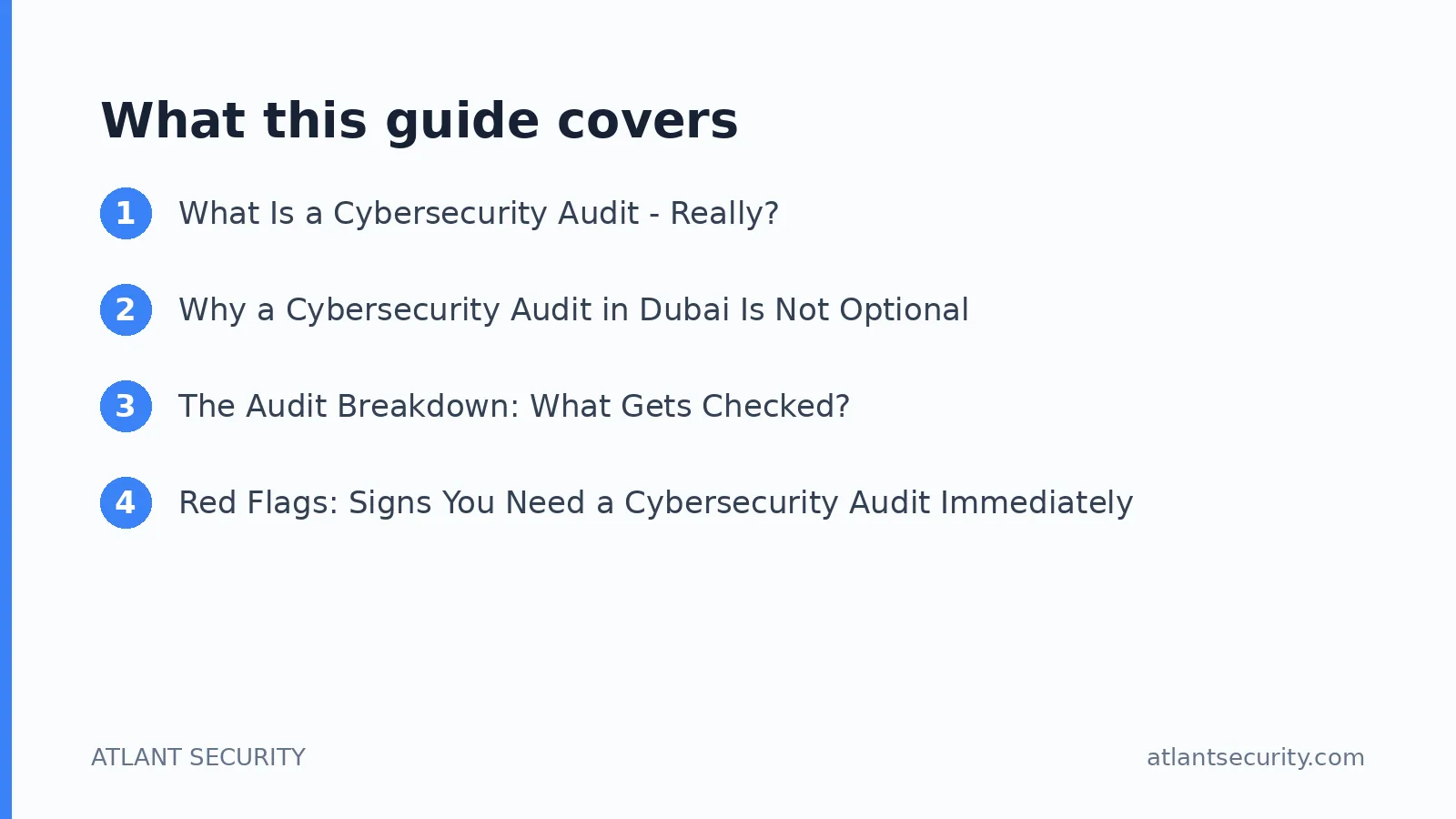
A cybersecurity audit is a deep forensic and strategic review of your company's ability to prevent, detect, and respond to cyber threats - using recognized frameworks like:
-
ISO/IEC 27001
-
NIST 800-53 / 800-171
-
CIS Controls
-
NESA IA (for UAE)
-
PDPL / DIFC / ADGM / GDPR
-
SOC 2 (for SaaS companies)
Why a Cybersecurity Audit in Dubai Is Not Optional
This is where fear of loss meets value stacking - the core of Sugarman's and Hormozi's persuasion psychology.
Dubai's cybersecurity landscape is changing rapidly:
-
UAE PDPL is now enforced
-
DFSA mandates regular risk assessments for DIFC firms
-
NESA applies to national infrastructure
-
Major clients and investors demand security proof before contracts
| Reason to Audit | Business Impact |
|---|---|
| Comply with regulations (PDPL, NESA, DFSA) | Avoid fines, disqualification, or shutdown |
| Win client trust | Close deals faster with security proof |
| Prepare for investment or acquisition | Avoid red flags during due diligence |
| Reduce breach probability | Identify and fix vulnerabilities before attackers do |
| Lower insurance premiums | Prove risk posture and resilience to insurers |
The Audit Breakdown: What Gets Checked?
A real audit looks at three layers of your organization:
1. People
-
Are employees trained on phishing, data handling, and incident response?
-
Do privileged users follow least privilege principles?
-
Is there a culture of cyber awareness?
2. Processes
-
Are security policies documented, enforced, and reviewed?
-
Are vendors evaluated and monitored for risk?
-
Is there a tested disaster recovery plan?
3. Technology
-
Are firewalls, VPNs, and cloud configurations hardened?
-
Is data encrypted in transit and at rest?
-
Are logs stored, reviewed, and alert-enabled?
Here's a table of what a Dubai-based cybersecurity audit typically includes:
| Audit Area | Key Focus | Relevance in Dubai |
|---|---|---|
| Identity & Access | MFA, RBAC, password policy | PDPL, ISO 27001 |
| Cloud Security | Config hardening, data segregation | DIFC, AWS/UAE Cloud laws |
| Network Security | Firewall rules, segmentation | NESA |
| Data Protection | DLP, encryption, data flow mapping | UAE PDPL |
| Backup & Recovery | RTO/RPO testing, backup isolation | SOC 2, business continuity |
| Incident Response | IR plan, simulation logs, roles | DFSA, ISO 27035 |
| Vendor Risk | Contract clauses, third-party scoring | Common audit fail point |
| Policy & Training | Acceptable Use, BYOD, awareness sessions | Evidence of security culture |
Red Flags: Signs You Need a Cybersecurity Audit Immediately
If you recognize even one of these, it's time to act:
You haven't reviewed your security policies in over a year
No employee security awareness program is in place
Your cloud environment was set up by developers, not security experts
Backups exist, but haven't been tested or reviewed
Your last pen test was more than 12 months ago
You've never done a risk assessment or gap analysis
You're unsure what UAE law actually applies to your business
Now compare that to the green flags we see in audit-ready companies:
All policies are updated, reviewed, and acknowledged by staff
Risk assessments are conducted annually and reported to leadership
A Virtual CISO or internal cybersecurity lead owns the roadmap
Cloud, endpoints, and identities are continuously monitored
There's a tested, documented incident response and recovery plan
Staff are trained and phishing-tested quarterly
What Happens If You Don't Audit?
Let's paint the picture - using Sugarman's "emotional trigger of anticipation".
You're onboarding a major bank as a client.
Legal sends over their vendor due diligence checklist.
They ask for your access policy, breach history, and risk register.
You stall. Fumble. Delay.
The bank goes silent. The deal dies quietly.
Nobody ever tells you why.
That's what not auditing costs you.
It's silent. Invisible.
Until the revenue never arrives.
Real-World Stories: What an Audit Actually Saves You From
The situations that push Dubai companies toward an audit tend to repeat: a DIFC fintech hit with a bank's vendor due diligence questionnaire it cannot answer, a SaaS platform asked for a risk assessment during M&A that it never built, or a government contractor facing a NESA inspection assuming its setup is "good enough." In each case, a structured cybersecurity audit is what turns missing evidence into an audit-ready package of policies, controls mapping, and hardened cloud and access.
Pricing: What a Cybersecurity Audit in Dubai Actually Costs
A confused mind never buys. Clarity sells." - Alex Hormozi
Here's a realistic pricing table based on company size, scope, and compliance needs in the UAE:
| Company Type | Scope of Audit | Timeframe | Estimated Cost (AED) |
|---|---|---|---|
| Small Business (<25 people) | Basic PDPL / ISO 27001 light | 2-3 weeks | 12,000 - 25,000 |
| Mid-Market Firm (25-100 people) | Full audit + 10-15 policies | 4-6 weeks | 35,000 - 65,000 |
| Enterprise / Regulated | DFSA, NESA, PDPL + tech validation | 6-8 weeks | 85,000 - 180,000 |
| Virtual CISO & Ongoing Audit Support | Monthly reviews, policy updates | Ongoing | From 5,500/month |
These costs are nothing compared to:
-
Fines (up to AED 5M for PDPL violations)
-
M&A value reductions
-
Lost client deals
-
Breach-related recovery costs
ROI: Auditing vs. Breaching
Let's use Hormozi's value math:
Value = (Dream Outcome × Likelihood of Achievement) ÷ (Time × Effort × Risk)
When you audit:
-
Dream outcome: Secure deals, compliance, trust
-
Likelihood: High (controlled, proven process)
-
Time: 3-6 weeks
-
Risk: Dramatically reduced
Now let's compare it to not auditing:
| Factor | Audited | Not Audited |
|---|---|---|
| Win rate on enterprise deals | Higher | Lower |
| Probability of breach | Lower | Higher |
| Cost of breach recovery | Minimal | AED 300,000-5M |
| Stress level | Low (proactive) | High (reactive) |
| Insurance premiums | Lowered | Increased or denied |
What to Expect During a Cybersecurity Audit
| Phase | What Happens | Outcome |
|---|---|---|
| Kickoff | Define scope, stakeholders, frameworks (ISO, NIST, etc.) | Roadmap clarity |
| Data Collection | Interview staff, collect configs, policies, logs | Baseline posture |
| Gap Analysis | Identify risks, classify severity, recommend remediations | Risk register |
| Remediation Guidance | Help fix issues: MFA, logging, backup, policy edits | Improved security |
| Final Report | PDF report + presentation, executive summary | Ready for clients, auditors, regulators |
Total Duration: 2-8 weeks, depending on company size and complexity
Who's Involved: IT/Cloud lead, compliance/legal, leadership, vCISO or external auditor
Future Snapshot: Audit or Avoidance?
Let's make the invisible visible.
Step into the boardroom 6 months from now. Two futures await.
Scenario A - You Completed a Cybersecurity Audit
-
Clients onboard in record time
-
You answer every security questionnaire with confidence
-
Regulators nod during reviews
-
Insurance premiums drop
-
Staff feels aligned and aware
-
You sleep soundly knowing: "We're ready."
Scenario B - You Delayed
-
A breach hits over a long weekend
-
Regulators request logs, policies, response plans - and you have none
-
Legal fees and forensics drain your Q2 budget
-
PR disaster unfolds silently on X and LinkedIn
-
Clients start pulling out - because trust can't be retrofitted
The cost of preparing is always less than the cost of repairing." - Joseph Sugarman
What You Actually Get When You Book a Cybersecurity Audit With Us
Here's your Offer Stack, designed to increase perceived value while eliminating fear and friction.
Book a Cybersecurity Audit Consultation Now
When you do, you'll receive:
A 15-minute discovery call with a senior audit consultant
A compliance scoping brief aligned to your specific industry and jurisdiction (PDPL, NESA, DFSA, SOC 2)
A custom checklist based on your frameworks (ISO 27001, NIST, CIS)
Clarity on timeline, cost, and team involvement - before you commit
Access to audit templates and policy samples for your use
Then, if you move forward:
-
A full audit is launched within 72 hours
-
You'll receive clear action steps, mapped to business risk
-
Every deliverable will be client-ready, auditor-friendly, and investor-impressive
No surprises. No jargon. Just security leadership - delivered.
Summary Table for Decision-Makers
| Factor | Without Audit | With Audit |
|---|---|---|
| Breach Probability | High | Significantly reduced |
| Deal Conversion | Stalls due to lack of trust | Accelerated via audit proof |
| Regulatory Risk | Elevated | Controlled and compliant |
| Internal Clarity | Uncertainty, finger-pointing | Confidence and roles defined |
| Insurance Outcome | Higher premiums, denied claims | Lower premiums, faster payouts |
| Board/Investor Confidence | Hesitant | High-trust environment |
Final Trigger: The Psychology of Action
People don't buy audits. They buy clarity, protection, and peace of mind." - Adapted from Hormozi
If you've made it this far, it means one thing:
You care. You're serious. You know cyber risk isn't a someday problem - it's a today priority.
But intention without action is still vulnerability.
So here's your next move - and it's simple:
Book Your Cybersecurity Audit Strategy Call
Let's protect your business.
Let's win more clients.
Let's build trust you can prove.
Final Word: The Audit Isn't About Checking a Box. It's About Earning Trust.
When your customers, investors, or partners ask if you're secure -
You can say yes, not because you hope so…
But because you know.
In business, the most powerful currency isn't money. It's trust." - Joseph Sugarman
And a cybersecurity audit?
It's how you mint it.
Click here to book your audit now
See also: SOC 2 compliance consultant
Ready to get started? Atlant Security helps companies close security gaps and pass compliance fast, led personally by a former Microsoft security consultant with 200+ assessments across 14 countries. Book a free strategy call and get a fixed-price proposal within 24 hours.
