

Every week brings fresh headlines about data breaches, ransomware extortion, and DDoS attacks that knock companies offline. If you are growing a business, you already know you cannot afford to be the next headline. Hiring full-time security staff usually is not realistic, and generic "cyber hygiene" advice will not cut it.
Enter the Computer Security Consultant: a seasoned expert who plugs into your organisation, tailors proven tactics to your unique environment, and fortifies your defences - without the overhead of a full security department.

| Focus Area | DIY Approach | Consultant-Led Tactics |
|---|---|---|
| Cost | Scattered, one-off tool purchases | Predictable, project-based fees |
| Expertise | Limited to in-house skills | Deep, cross-industry insights |
| Speed | Slow learning curve | Rapid deployment in weeks |
| Coverage | Gaps in policy, training, tech | End-to-end roadmap with seven tactics |
| Ongoing Improvement | Ad hoc, reactive | Continuous tuning and reviews |
Below are 7 Proven Tactics your consultant will deploy to shield your business from today's cyber threats.
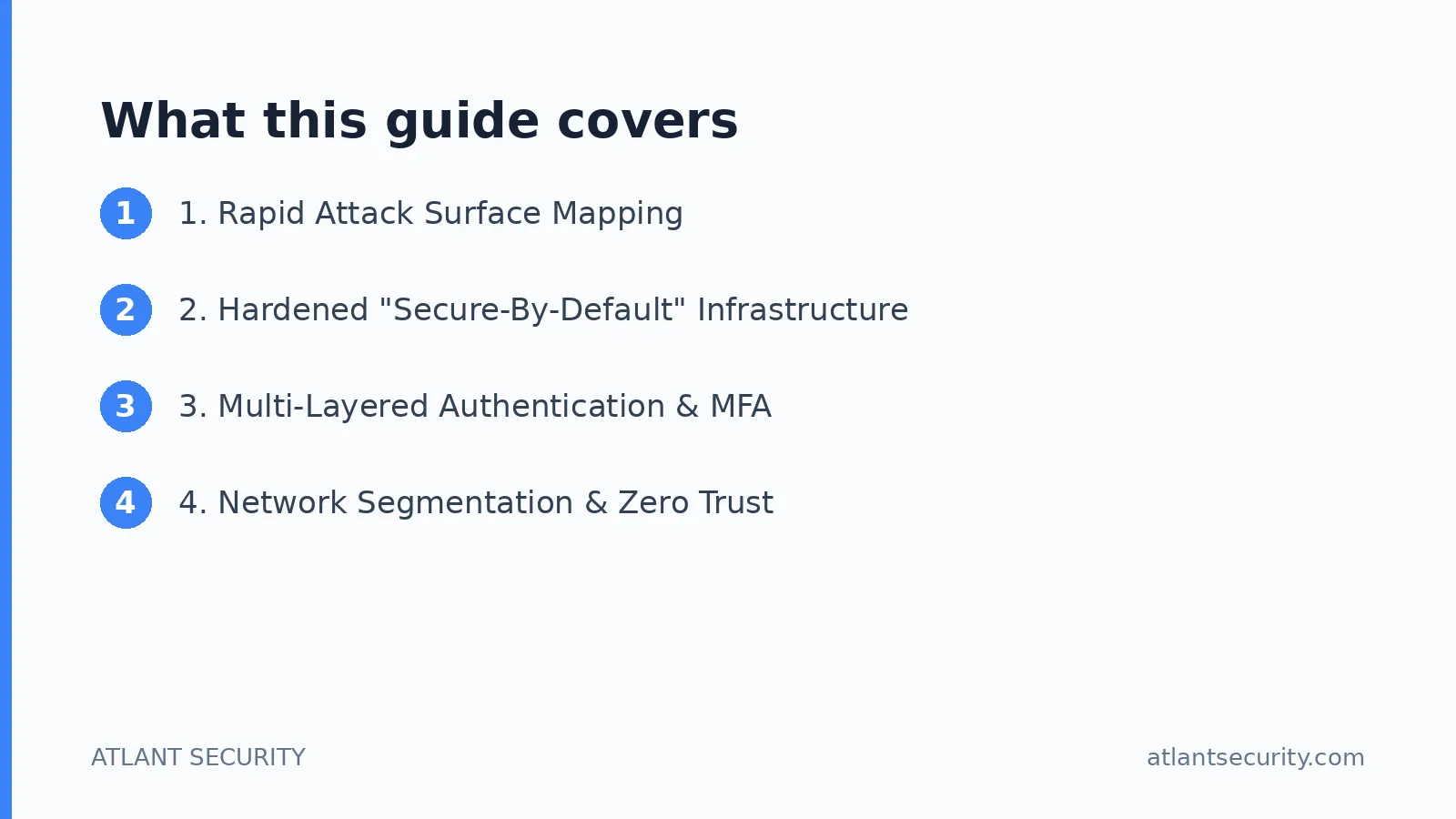
1. Rapid Attack Surface Mapping
Before you can defend, you must know what to defend. A consultant's first move is to map every entry point - cloud services, VPNs, web apps, IoT devices, and even printer networks.
| Step | Action |
|---|---|
| 1. Automated Discovery | Run a cloud-friendly scanner (e.g., Shodan, Nmap) to inventory assets. |
| 2. Manual Validation | Interview IT, dev, and operations stakeholders to catch shadow IT and legacy gear. |
| 3. Asset Prioritisation | Classify assets by criticality (High/Medium/Low). |
| 4. Visualisation | Build a network diagram highlighting public-facing systems. |
2. Hardened "Secure-By-Default" Infrastructure
Out-of-the-box configurations are dangerous. Your consultant codifies secure baselines so every new server, container, or cloud service comes locked down from day one.
| Tactic | Implementation |
|---|---|
| Least Privilege | Enforce role-based access controls; deny everything by default. |
| Golden Images | Create hardened VM/container templates with pre-installed logging and patching. |
| Policy-as-Code | Use tools like Terraform + Aquasec for IaC guardrails. |
| Automated Drift Checks | Schedule daily scans to detect config drift and auto-remediate. |
Learn more: NIST's National Checklist Program
3. Multi-Layered Authentication & MFA
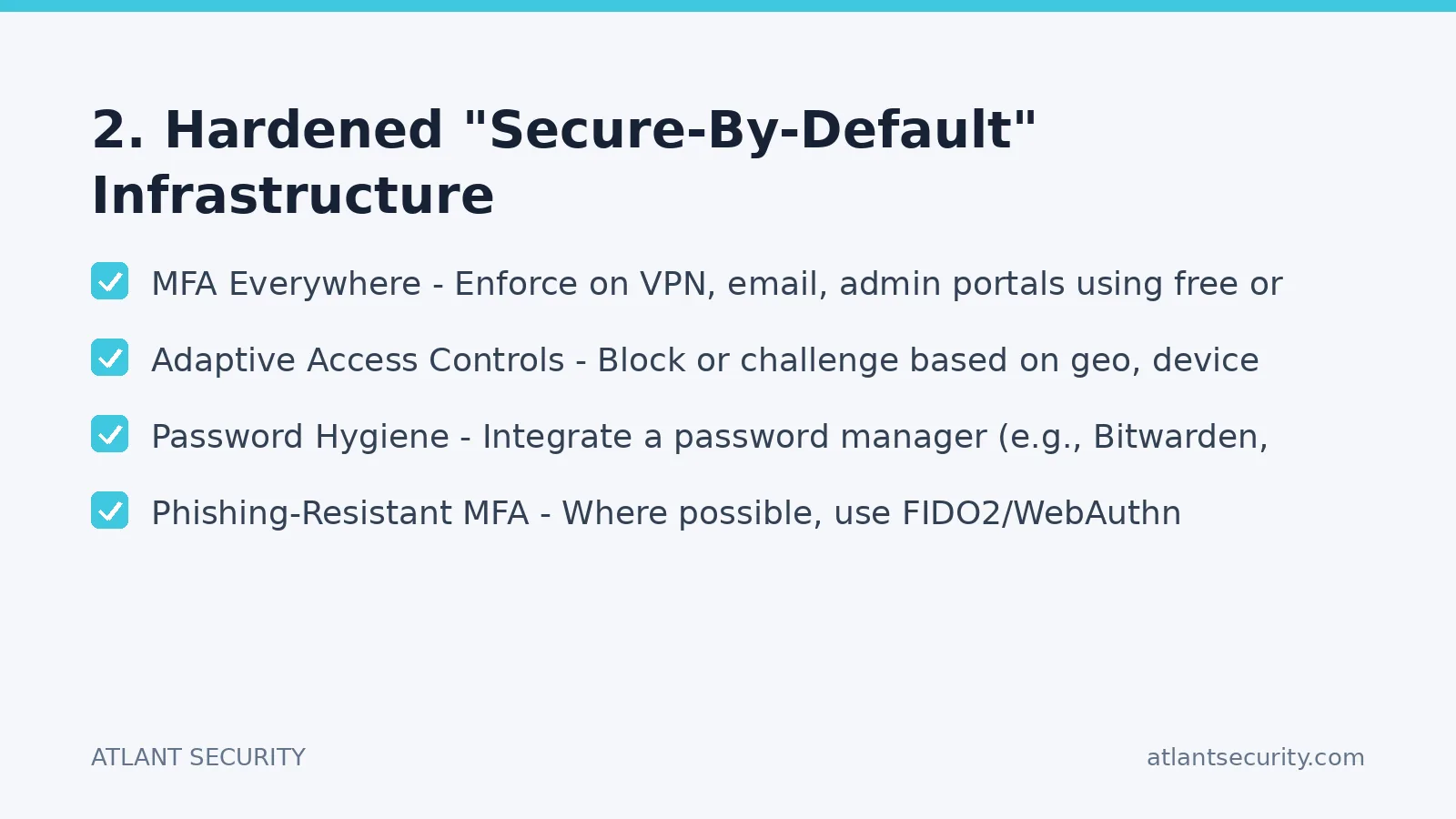
Weak passwords and single-factor logins are your biggest blind spots. A consultant implements a layered approach:
-
MFA Everywhere - Enforce on VPN, email, admin portals using free or low-cost tools (e.g., Authy, Duo).
-
Adaptive Access Controls - Block or challenge based on geo, device health, or IP reputation.
-
Password Hygiene - Integrate a password manager (e.g., Bitwarden, 1Password) and enforce rotation policies.
-
Phishing-Resistant MFA - Where possible, use FIDO2/WebAuthn hardware tokens.
4. Network Segmentation & Zero Trust
Flat networks are easy prey. Your consultant designs micro-segments so an intruder in one zone can't roam freely:
| Segment | Controls |
|---|---|
| User Workstations | VLAN separation, host-based firewalls, daily patching |
| Server Farms | Isolated subnets, strict ACLs, jump-box administration |
| Dev/Test Environments | Restricted egress, no production access, ephemeral credentials |
| Guest Networks | Air-gapped from core IT, captive portal, heavy logging |
Resource: CIS's Zero Trust Maturity Model
5. Continuous Monitoring & Alerting
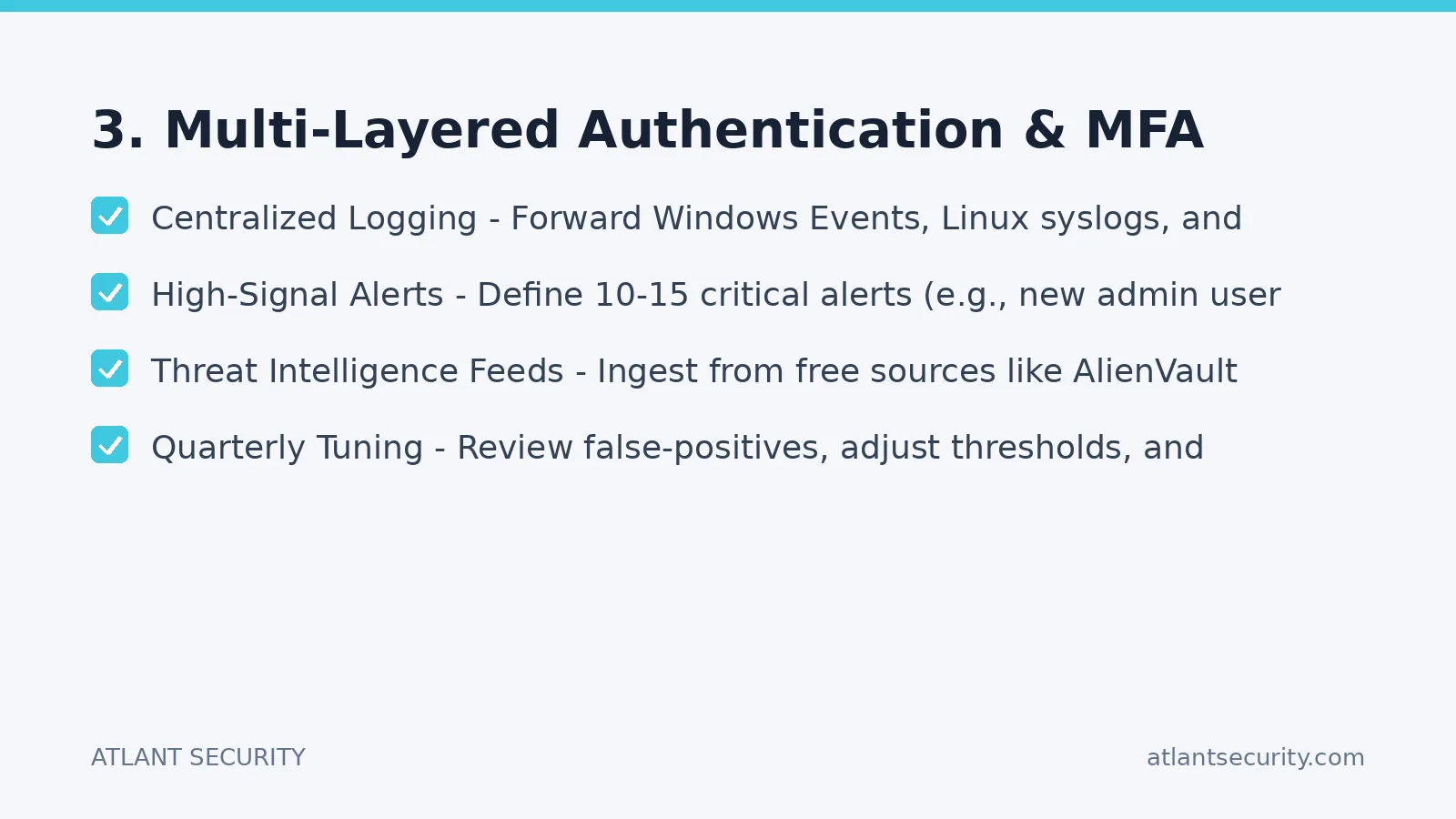
Detection is your last line of defence. Consultants stand up a lean Security Information and Event Management (SIEM) or log-aggregation stack:
-
Centralized Logging - Forward Windows Events, Linux syslogs, and application logs to Elastic Stack or Graylog.
-
High-Signal Alerts - Define 10-15 critical alerts (e.g., new admin user creation, outbound data spikes, privilege escalations).
-
Threat Intelligence Feeds - Ingest from free sources like AlienVault OTX or MISP.
-
Quarterly Tuning - Review false-positives, adjust thresholds, and update playbooks.
6. Security Awareness & Culture
The best tech defenses fail if employees click unsafe links. A consultant embeds a security-first mindset:
-
Micro-Learning - Weekly 5-minute modules on real-world scams.
-
Phishing Drills - Quarterly simulations via GoPhish.
-
Security Champions - Appoint peer advocates in each team.
-
Recognition Programs - Reward staff for reporting suspicious activity.
Tip: SANS's "Securing The Human" offers free awareness materials.
7. Incident Response & Recovery Planning
Preparation turns panics into rehearsals. Your consultant delivers a tailored IR plan and runs live tabletop drills:
| Phase | Activity |
|---|---|
| Preparation | Define roles, communication channels, tooling |
| Detection & Analysis | Triage alerts, gather evidence, notify stakeholders |
| Containment | Isolate affected segments, revoke credentials |
| Eradication & Recovery | Remove malware, restore from backups, validate |
| Lessons Learned | Update playbooks, hold an after-action review |
Next Steps
By engaging a Computer Security Consultant, you gain a rapid-deployment team of experts who implement these 7 Proven Tactics:
-
Attack Surface Mapping
-
Secure-By-Default Hardened Infrastructure
-
Multi-Layered Authentication
-
Network Segmentation & Zero Trust
-
Continuous Monitoring & Alerting
-
Security Culture & Awareness
-
Incident Response Planning
This approach transforms security from a reactive expense into a strategic enabler. Ready to shield your business?
Next Step:
Book a Free 30-Minute Security Assessment and discover how these tactics fit your environment - no strings attached!
See also: Top Computer Security Companies: A Detailed Comparison Guide
Ready to get started? Atlant Security helps companies close security gaps and pass compliance fast, led personally by a former Microsoft security consultant with 200+ assessments across 14 countries. Book a free strategy call and get a fixed-price proposal within 24 hours.
