
Getting MAS TRM compliant is tough. But ... ticking every TRM box doesn't mean banks will choose you. In Singapore's financial ecosystem, TRM is the starting line, not the win. Teams that treat it like the finish line end up "compliant but unchosen" - stuck in security reviews or in silence.
Compliance is table stakes. Confidence is what closes.
Below, I'll spell out the unwritten demands Singapore banks, regulators, and investors look for - things that don't show up in a checklist, but absolutely determine whether your FinTech SaaS scales. Digital banking, payment workflows, internal networks and privileged access each fail differently, which is why penetration testing for banks is scoped around them rather than around a generic web test.
Need hands-on MAS TRM compliance help?
Atlant Security provides MAS TRM compliance consulting: fixed price, led by a former Microsoft security consultant, and you review the readiness report before you pay. See the service and book a strategy call →
MAS TRM in a nutshell (and why it isn't enough)
TRM = Technology Risk Management Guidelines. It lays down governance, access control, incident response, third-party risk, and resilience practices for financial institutions (FIs) - and, by extension, for vendors serving them. It's the baseline language you must speak to even enter the room. (If you need a compact explainer: PwC's summary of the 2021 update is solid, and Google Cloud's page shows how hyperscalers align.) (source: PwC)
But there's a gap: TRM proves you're compliant; it doesn't prove you're scalable - and scalable is what procurement, risk, and the business side need to feel. That confidence comes from signals TRM only hints at.
The big idea: Compliance vs. Confidence
Think of TRM as your driver's license. It gets you on the road. But when it's Friday 6 PM and it's raining on the PIE, the license isn't what keeps you from crashing - skill, habits, and visibility do. Same with banks: they don't just want controls; they want assurance you'll hold up under load, failures, and scrutiny. When a bank asks a Singapore vendor for evidence of testing, the counterpart on the bank side is a bank pentest with the same authorisation-focused API scope.
To get there, you'll need to meet three unwritten expectations.
The 3 unwritten demands (and how to show them)
1) Real-time transparency (not after-the-fact logs)
TRM says "have logging and monitoring." Banks hear that and ask: "Can we see what you see - live?" They want operational transparency they can plug into their own dashboards and alerting - not a quarterly PDF.
What this looks like in practice
-
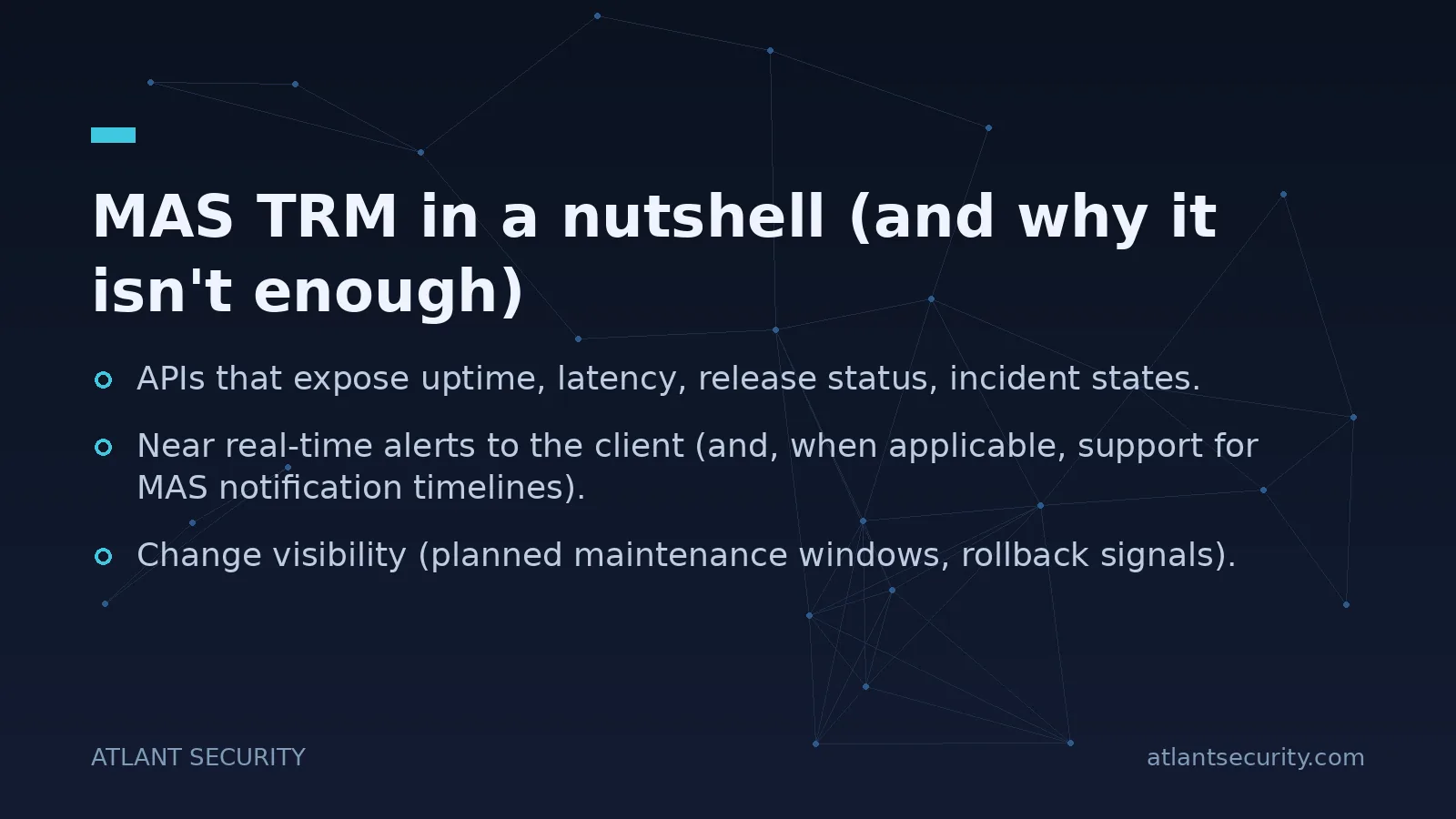
APIs that expose uptime, latency, release status, incident states.
-
Near real-time alerts to the client (and, when applicable, support for MAS notification timelines).
-
Change visibility (planned maintenance windows, rollback signals).
If your customer only finds out you're down from Twitter, you've already lost the review.
Why it matters in Singapore: severe incidents for regulated institutions can trigger 1-hour notification obligations to MAS, followed by a root cause report within 14 days. Even if you're a vendor (not the FI), the bank's ability to meet its clock often depends on your telemetry. Linklaters and Pinsent Masons summarize the 1-hour expectation across MAS notices (banks, insurers, etc.). (source: MAS Notice FSM-N05)
Bonus alignment: IMDA explicitly encourages continuous monitoring and real-time compliance postures in its MTCS scheme guidance - mirroring what banks expect to see, not just read. (source: Infocomm Media Development Authority)
2) Cloud-native resilience (architecture, not just DR binders)
TRM requires BCP/DR. But the unwritten expectation is resilience by design: multi-AZ or multi-region architectures, graceful degradation, and automated failover that's tested continuously, not annually.
What this looks like in practice
-
Active-active across availability zones; active-passive across regions at minimum.
-
Documented RTO/RPO and regular chaos/failover drills with client-visible evidence.
-
Portability planning to mitigate concentration risk (what happens if your sole region or provider has issues?).
Table: "Compliant" vs. "Chosen" on resilience
| Area | "Compliant" (meets TRM) | "Chosen" (wins banks) |
|---|---|---|
| BCP/DR | Policy + annual test | Active-active / multi-region + automated failover tests weekly |
| RTO/RPO | Declared in docs | Proved in drills + client-visible reports |
| Cloud concentration | Single-region OK on paper | Strategy to mitigate region/provider failure |
TRM emphasizes sound risk governance; top firms convert that into provable robustness that reassures both risk and revenue owners. For additional context on Singapore's cloud posture (including outage response guidance), IMDA's references on MTCS and TR 62 (cloud outage incident response) are useful touchpoints for expectations here. (source: Infocomm Media Development Authority)
3) Culture of security ownership (beyond one CISO and a binder)
TRM wants governance and roles. Banks want to feel security in your muscle memory - not just in your documents.
What this looks like in practice
-
Developers trained in secure coding (can they talk about authz, secrets, and least privilege without phoning a friend?).
-
Product managers who understand data-classification and residency implications of features.
-
Company-wide drills (phishing, incident, table-tops) with participation and improvement metrics.
If the only person who can answer security questions is your CISO, you don't have a culture - you have a bottleneck.
This is exactly the difference decision-makers probe in diligence meetings. It's not that TRM ignores culture; it's that banks need to see it breathing.
Why this matters commercially (not just to pass audits)
Faster cycles, bigger deals. Teams that offer live transparency, real resilience, and a security-literate culture shorten security reviews, unlock higher data-sensitivity tiers, and move from pilot to production faster. Hyperscalers showcase their TRM posture for a reason - procurement wants confidence that your stack can handle scale and scrutiny. (source: Google Cloud)
Regulatory reality: Where MAS obligations apply (to the FI), timelines can be tight. Expectation setting around 1-hour notifications and 14-day root-cause filings is normal in the bank/vendor relationship - even if the formal reporting is the FI's job, they need your telemetry and RCA muscle to meet it. (source: MAS Notice FSM-N05)
Mini-case: "Compliant but unchosen"
A lending SaaS had TRM-aligned policies and passed a bank's paper review. When the CTO asked, "What happens if the aws-ap-southeast-1 region has a cascading issue?" the team pointed to their DR binder - single region, manual failover. Deal cooled. A competitor brought active-active + API telemetry. They didn't just meet TRM - they made the bank's job easier. They won. Fintech attack surface is API-first, and so is fintechpentest.com: payment logic, BOLA and mass-assignment in the API, and multi-tenant boundaries.
Bridging plan: from "compliant" to "chosen"
Step 1 - Map TRM to your build
Translate the guideline into operational proofs: for each control, list the live signal the bank can see (API, dashboard, notification). Use a TRM summary to accelerate the mapping, then localize to your stack. (source: PwC)
Step 2 - Instrument transparency
Expose uptime/latency/incident states via read-only APIs, add webhook alerts, and publish a client-facing status page with history. This directly supports FI obligations around urgent incident visibility (the "1-hour" world). (source: MAS Notice FSM-N05)
Step 3 - Engineer resilience
Move beyond "we have backups." Implement multi-AZ by default, multi-region for material services, and automate failover tests. Log and share drill outputs with clients (and, where relevant, align to IMDA's posture on resilient cloud). (source: Infocomm Media Development Authority)
Step 4 - Operationalize culture
Run quarterly secure-coding refreshers, company-wide phishing drills, and table-tops with product + support in the room. Make security part of delivery, not a department.
Quick reference: where the public guidance points
-
MAS TRM (2021 revision) - core governance and risk principles for tech and cyber in FIs (good context for vendors too). (source: PwC)
-
MAS incident handling expectations - FIs may have 1-hour notify and 14-day RCA duties under various notices (banks/insurers/DPT providers). You, as vendor, must support those clocks with telemetry and RCA inputs. (source: MAS Notice FSM-N05)
-
IMDA MTCS & continuous monitoring - Singapore's cloud stance emphasizes multi-tier security, transparency, and even near real-time compliance displays - all useful signals for bank buyers. (source: Infocomm Media Development Authority)
FAQ
Is MAS TRM compliance enough for FinTech SaaS in Singapore?
It's necessary, not sufficient. You'll still be evaluated on live transparency, resilience by design, and security culture - the confidence factors that actually close deals. (TRM update summaries: PwC, Google Cloud.) (source: PwC)
Do we need to help banks meet MAS incident timelines?
Yes - practically speaking. The FI reports, but your telemetry and RCAs are how they hit 1-hour notify and 14-day RCA expectations under MAS notices. Build to support that workflow. (source: MAS Notice FSM-N05)
Does MTCS matter to FinTech SaaS?
If you touch public sector or want to mirror Singapore-style cloud assurance, MTCS (SS 584:2020) is a recognizable signal - plus it encourages continuous monitoring displays that banks love. (source: Infocomm Media Development Authority)
What's the fastest way to show "confidence" without a full rebuild?
Ship status APIs, client alerts, and multi-AZ first. Then schedule failover drills and share results. Parallel-track the culture work (dev training, table-tops).
Turn MAS TRM into trust that closes
Get a free 30 minute Singapore Scale Audit for your FinTech SaaS. Walk away with:
-
A 1 page TRM to confidence signal map
-
A 90 day resilience upgrade plan
-
An incident telemetry checklist that supports the 1 hour MAS clock
-
A status API outline banks will love
Limited to 8 teams this month.
Book your Singapore Scale Audit
See also: Steps to Implement SOC 2 Type 2 for US SaaS Companies: Never Lose a $2M Deal Again
Ready to get started? Atlant Security helps companies close security gaps and pass compliance fast, led personally by a former Microsoft security consultant with 200+ assessments across 14 countries. Book a free strategy call and get a fixed-price proposal within 24 hours.
