How to Choose a Vulnerability Assessment Company That Actually Finds What Matters
Alexander Sverdlov
Security Analyst

💫 Key Takeaways
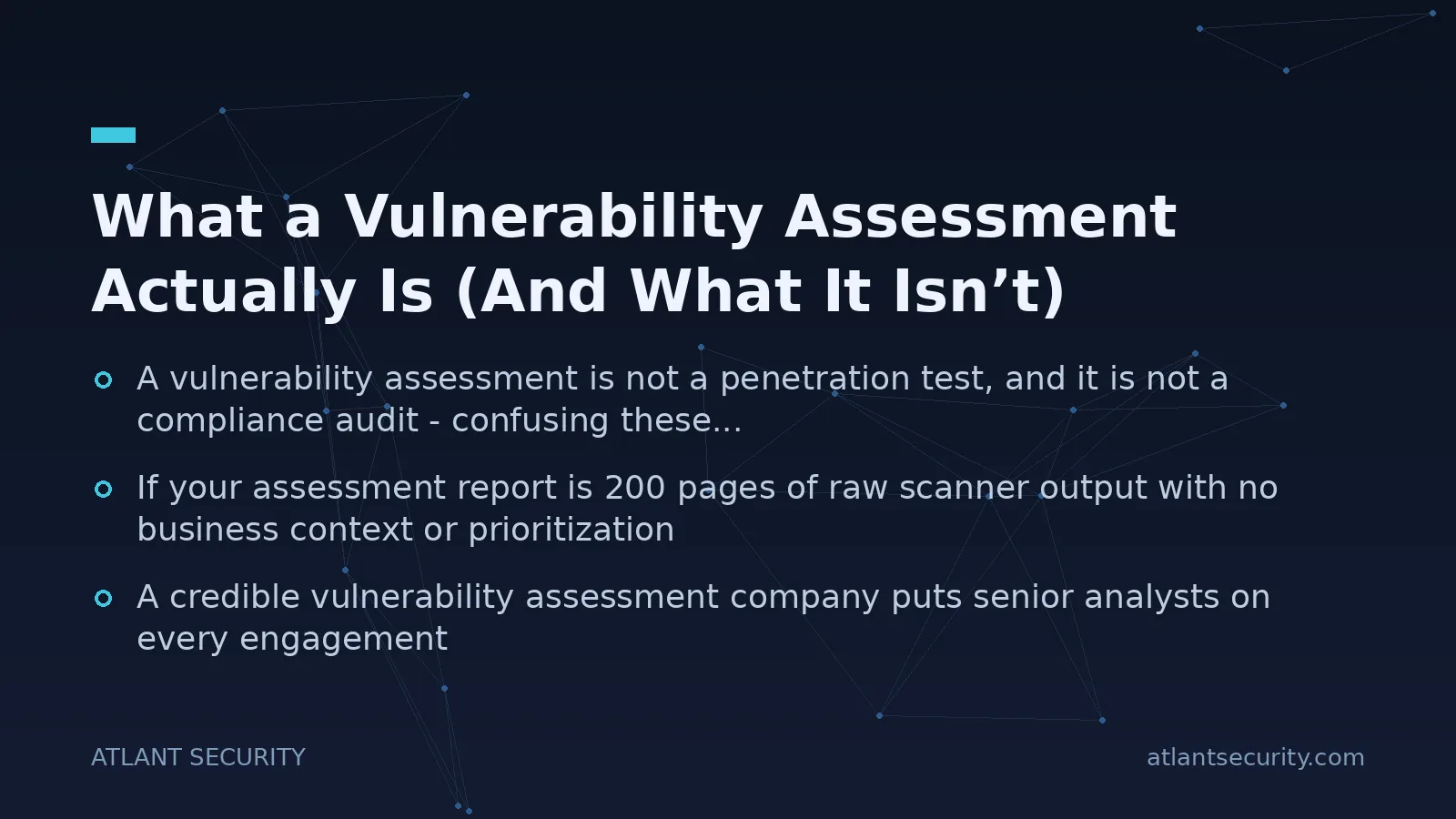
- A vulnerability assessment is not a penetration test, and it is not a compliance audit - confusing these services is the most expensive mistake companies make
- If your assessment report is 200 pages of raw scanner output with no business context or prioritization, you hired the wrong company
- A credible vulnerability assessment company puts senior analysts on every engagement, not junior staff supervised from a distance
- Pricing ranges from $3,000-$5,000 for small businesses to $30,000-$80,000+ for enterprise environments - anything under $2,000 is an automated scan, not an assessment
- A real assessment covers at least 14 domains: network, cloud, endpoints, identity, applications, data, physical, wireless, social engineering, supply chain, policies, incident response, compliance, and business continuity
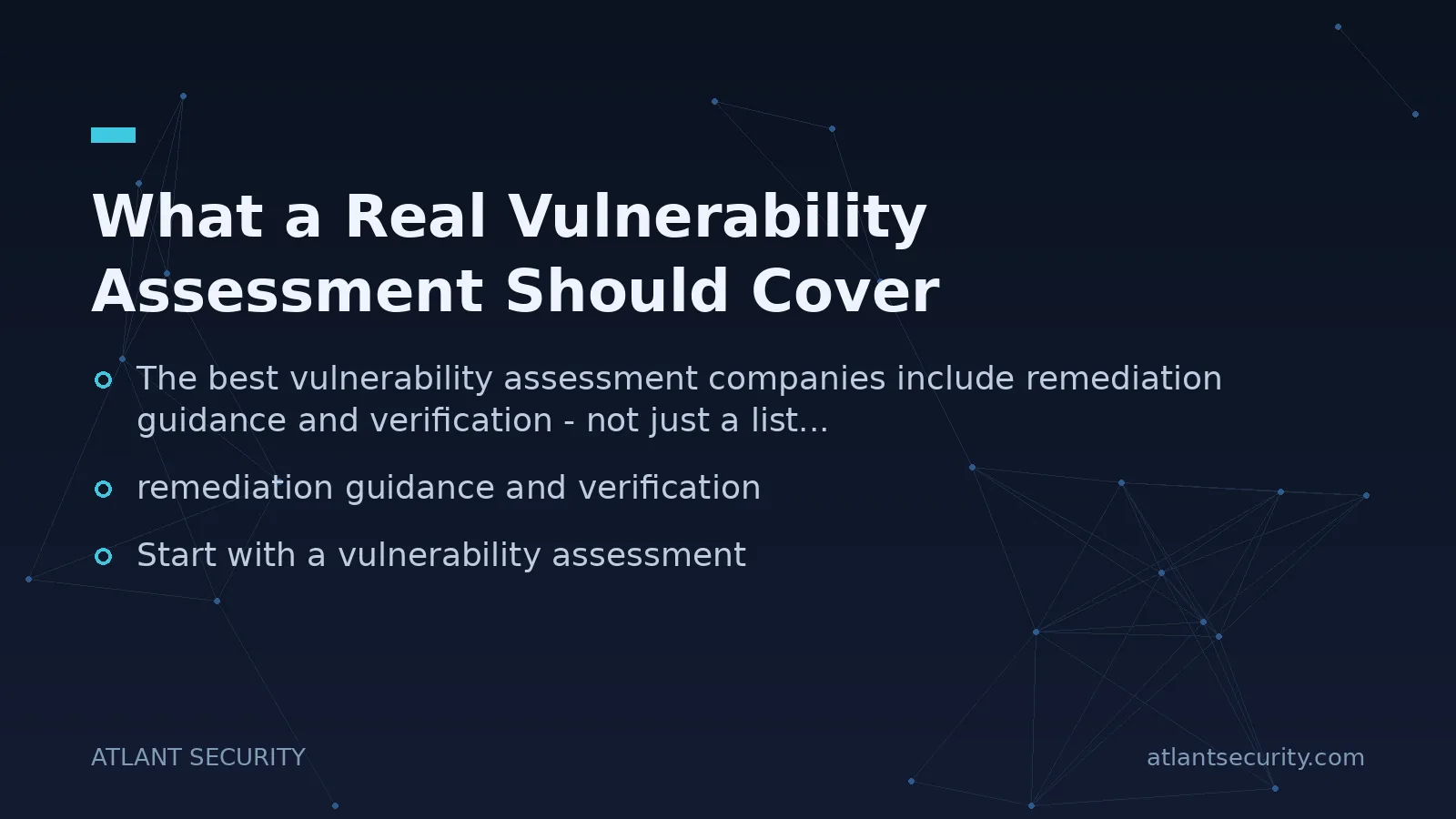
- The best vulnerability assessment companies include remediation guidance and verification - not just a list of problems
Six months ago, a logistics company with 1,200 employees called us in a panic. They had been breached. Ransomware. Fourteen servers encrypted, operations frozen for three days, $1.8 million in direct costs before they even started calculating lost revenue and reputational damage.
The kicker? They had a “clean” vulnerability assessment from eight months earlier. A well-known firm had scanned their environment, produced a 213-page PDF, and declared them in good shape. The executive summary said “no critical findings.”
When our team conducted the post-breach forensic investigation, we found the vulnerability that the attackers exploited. It was a misconfigured Remote Desktop Protocol gateway that allowed brute-force authentication from the public internet. And here is the part that should make you angry: that exact vulnerability was on page 147 of the 213-page report. It was listed as “Medium” severity. No business context. No explanation that this single misconfiguration, combined with weak password policies they also flagged on page 89, created a direct path to domain admin.
The scan found it. The report listed it. But nobody at the company read page 147. And the assessment company never told them it mattered.
That is the difference between a vulnerability assessment company that runs a scanner and one that actually makes you secure. This article will teach you how to tell them apart - before you learn the difference the expensive way.
Definitions Matter
What a Vulnerability Assessment Actually Is (And What It Isn’t)
A vulnerability assessment is a systematic process of identifying, quantifying, and prioritizing security weaknesses across your technology environment. It combines automated scanning tools with human analysis to produce a risk-ranked inventory of vulnerabilities, along with specific recommendations for remediation.
That definition sounds straightforward, but the market has muddied it beyond recognition. Companies use “vulnerability assessment” interchangeably with penetration testing, security audits, and compliance audits. These are four fundamentally different services, and confusing them is the single most common - and most expensive - mistake companies make when buying security services.
| Service | Goal | Approach | Output | Typical Cost |
|---|---|---|---|---|
| Vulnerability Assessment | Find and prioritize all known weaknesses | Automated scanning + manual validation + business-context analysis | Risk-ranked findings with remediation roadmap | $5K-$80K |
| Penetration Testing | Prove specific vulnerabilities are exploitable | Manual exploitation, chaining vulnerabilities, simulating real attacks | Proof-of-concept exploits with demonstrated impact | $10K-$150K |
| Security Audit | Evaluate the maturity of your entire security program | Policy review, process evaluation, control testing, interviews | Maturity assessment with gap analysis and strategic recommendations | $15K-$100K |
| Compliance Audit | Verify adherence to a specific regulatory framework | Control mapping, evidence collection, certification body reporting | Pass/fail certification or attestation report | $20K-$200K |
Here is a useful analogy: a vulnerability assessment is like a thorough building inspection that identifies every crack, leak, and code violation. A penetration test is hiring someone to actually break in and prove they can steal what matters. A security audit evaluates whether you have proper building management processes. A compliance audit checks whether you meet the fire code.
You need different services at different times. But if you are reading this article, you are likely looking for a vulnerability assessment - the foundational service that tells you where you are exposed before you invest in anything else. It is the starting point for any serious security program.
💡 When to Choose Which Service
Start with a vulnerability assessment if you have never had one, if it has been more than 12 months, or if your environment has changed significantly (cloud migration, major acquisition, new application deployments).
Add penetration testing after your vulnerability assessment, once you have remediated the critical and high findings. A pen test against an environment full of known vulnerabilities is a waste of money.
Get a security audit when you need to evaluate your overall security program maturity - policies, processes, governance, and technology controls together.
Buyer Beware
The 7 Red Flags of a Bad Vulnerability Assessment Company
After conducting and reviewing hundreds of vulnerability assessments over the past decade, we have seen a clear pattern. The companies that deliver poor assessments almost always exhibit the same warning signs. Here is what to watch for.
1. They quote by the hour, not by scope
Hourly billing for vulnerability assessments is a red flag for two reasons. First, it creates a perverse incentive: the longer the engagement takes, the more the company earns. A firm that bills hourly has no financial motivation to work efficiently. Second, it transfers all cost risk to you. If their scanner breaks, if they need extra time because their analyst is learning on the job, if scope creep happens - you pay for all of it.
A credible vulnerability assessment company scopes the work upfront, quotes a fixed price based on the size and complexity of your environment, and delivers within a defined timeline. If the assessment takes them longer than expected, that is their problem, not yours.
2. The “assessment” is just an automated Nessus/Qualys scan with no human analysis
This is the most common scam in the vulnerability assessment industry, and “scam” is not too strong a word. Here is what happens: the company points an automated scanner (Nessus, Qualys, Rapid7, or similar) at your environment, waits for it to finish, exports the results to PDF, slaps their logo on the cover page, and sends you an invoice.
The problem is not the tools. Nessus and Qualys are excellent scanners. The problem is that a scanner does not understand your business. It cannot tell you that the “Medium” severity finding on your internet-facing RDP gateway is actually a critical risk when combined with your weak password policy. It cannot tell you that the “Low” severity missing patch on your domain controller is the first step in a privilege escalation chain. It generates findings in isolation, without context, without chaining, without understanding what matters to your business.
⚠️ How to Spot a Scanner-Only Report
Ask for a sample report before you sign. If you see: generic descriptions copied from CVE databases, no “business impact” column, no attack chain analysis, no prioritization beyond CVSS scores, and no remediation steps specific to your technology stack - you are looking at a scanner dump, not an assessment.
3. Junior analysts do the work while senior partners do the selling
This is the consulting industry's oldest trick, and it is rampant in cybersecurity. The pitch meeting features a seasoned security expert with decades of experience. The person who actually runs your assessment is a recently certified analyst with 18 months of experience.
There is nothing wrong with junior analysts contributing to an engagement. But the person leading the assessment - the one making judgment calls about what matters and what does not - must have deep experience. Ask directly: “Who will personally lead my assessment, and what is their background?” If the answer is vague, walk away.
4. They can’t explain their methodology beyond “we run a scan”
A real vulnerability assessment methodology includes: asset discovery and inventory, automated scanning across multiple tool sets, manual validation of findings to eliminate false positives, attack chain analysis that maps how individual vulnerabilities combine into exploitable paths, business context mapping that translates technical risk into operational impact, and risk-ranked prioritization that tells you what to fix first and why.
If you ask a company about their methodology and they cannot articulate these steps clearly, they do not have a methodology. They have a scanner license.
5. The report has no business context or prioritization
A report that lists 847 findings sorted by CVSS score is not useful. It is overwhelming. What you need is a report that tells you: “Here are the 12 things that will get you breached. Here is the order to fix them. Here is why each one matters to your specific business. And here is what you can safely deprioritize.”
Business context means understanding that a SQL injection vulnerability in your public-facing customer portal is not the same severity as the same vulnerability in an internal reporting tool used by three people. Technical severity is only half the equation. Business exposure is the other half.
6. They don’t offer remediation support
Finding vulnerabilities without helping fix them is like a doctor diagnosing a disease and then leaving the room. The assessment is the diagnosis. Remediation is the treatment. Any vulnerability assessment company worth hiring should offer at least: detailed remediation guidance specific to your technology stack, a prioritized remediation roadmap with timelines, access to the assessment team for questions during remediation, and a verification scan after remediation to confirm the fixes worked.
Companies that refuse to help with remediation are usually the same companies that ran a scanner and cannot actually explain the findings.
7. They’ve never worked in your industry
A vulnerability assessment for a healthcare organization looks different from one for a financial services firm or a manufacturing company. The threat landscape differs. The regulatory requirements differ. The business-critical systems differ. The attack surface differs.
Industry experience does not mean the company has to specialize exclusively in your sector. But they should be able to demonstrate that they understand your regulatory environment, your typical technology stack, and the threats specific to your industry. If they cannot, the “business context” in their report will be generic filler.
Comprehensive Coverage
What a Real Vulnerability Assessment Should Cover
A comprehensive vulnerability assessment is not limited to running a network scan. It covers every layer of your environment where vulnerabilities can exist - and where attackers actually look. Here are the 14 domains a thorough assessment should address:
| # | Assessment Domain | What Gets Tested | Why It Matters |
|---|---|---|---|
| 1 | Network Infrastructure | Firewalls, routers, switches, VPNs, network segmentation, DNS, open ports | Network misconfigurations are the #1 initial access vector for attackers |
| 2 | Cloud Infrastructure | IAM policies, storage permissions, security groups, logging, encryption at rest and in transit | Cloud misconfigurations caused 82% of data breaches in 2025 |
| 3 | Endpoints & Devices | Workstations, laptops, servers, mobile devices, patch levels, endpoint protection | Unpatched endpoints are the #1 ransomware entry point |
| 4 | Identity & Access | Active Directory, SSO, MFA coverage, password policies, privileged accounts, stale accounts | Compromised credentials are involved in 86% of breaches |
| 5 | Web Applications | OWASP Top 10, input validation, authentication flows, session management, API security | Web applications are the most common external attack surface |
| 6 | Data Protection | Encryption, data classification, DLP controls, backup security, data retention policies | Data is what attackers are ultimately after - everything else is a means to this end |
| 7 | Physical Security | Server room access, visitor policies, device disposal, badge systems, clean desk policies | Physical access bypasses every digital control |
| 8 | Wireless Networks | WiFi encryption, rogue access points, guest network segmentation, WPA3 adoption | Wireless networks are often the weakest perimeter control |
| 9 | Social Engineering | Phishing susceptibility, pretexting scenarios, security awareness effectiveness | 74% of breaches involve a human element |
| 10 | Supply Chain & Third Party | Vendor risk assessment, third-party access controls, SaaS security posture, API integrations | Supply chain attacks increased 78% in 2025 - your security is only as strong as your weakest vendor |
| 11 | Security Policies & Governance | Policy completeness, enforcement mechanisms, security awareness training, acceptable use policies | Technology controls without governance are inconsistently applied and eventually fail |
| 12 | Incident Response Readiness | IR plan existence and quality, communication chains, log retention, forensic readiness | Companies without a tested IR plan take 80% longer to contain a breach |
| 13 | Compliance Posture | GDPR, HIPAA, PCI DSS, SOC 2, ISO 27001, NIS2 - mapping current state against applicable requirements | Non-compliance means fines, and fines come on top of breach costs |
| 14 | Business Continuity & DR | Backup integrity, recovery time objectives, failover testing, ransomware resilience | A breach you can recover from in 4 hours costs a fraction of one that takes 4 weeks |
✅ Pro Tip
Not every assessment needs to cover all 14 domains in equal depth. A good vulnerability assessment company will scope the engagement based on your environment, industry, and risk profile. But they should be able to cover all of them. If a company can only assess networks and endpoints, they are missing the majority of your modern attack surface.
Investment Guide
How Much Does a Vulnerability Assessment Cost?
Let me be transparent about pricing because this is the question everyone asks and few companies answer honestly. Costs vary significantly based on the size of your environment, the depth of assessment required, and the expertise of the firm you hire. Here is what realistic pricing looks like in 2026:
| Company Profile | Typical Scope | Price Range | Delivery Timeline |
|---|---|---|---|
| Small Business (25-100 employees) | Single office, 1-2 servers, cloud SaaS stack, 50-150 endpoints | $3,000-$8,000 | 5-10 business days |
| Mid-Market (100-500 employees) | Multiple offices, hybrid cloud, 200-800 endpoints, custom applications | $8,000-$25,000 | 10-15 business days |
| Enterprise (500-5,000 employees) | Multi-cloud, global offices, complex Active Directory, multiple application portfolios | $25,000-$80,000 | 15-25 business days |
| Multi-Location / Regulated Industry | Distributed environments, OT/SCADA systems, strict compliance requirements, multiple subsidiaries | $50,000-$150,000+ | 20-40 business days |
What drives cost differences: The primary cost drivers are the number of IP addresses and hosts being assessed, the number of applications in scope, geographic distribution (on-site work costs more than remote assessment), industry-specific compliance requirements (healthcare and financial services assessments require deeper analysis), and the complexity of your cloud architecture. A company running entirely on Microsoft 365 and a handful of SaaS tools is fundamentally different from one with a multi-cloud Kubernetes environment and custom-built microservices.
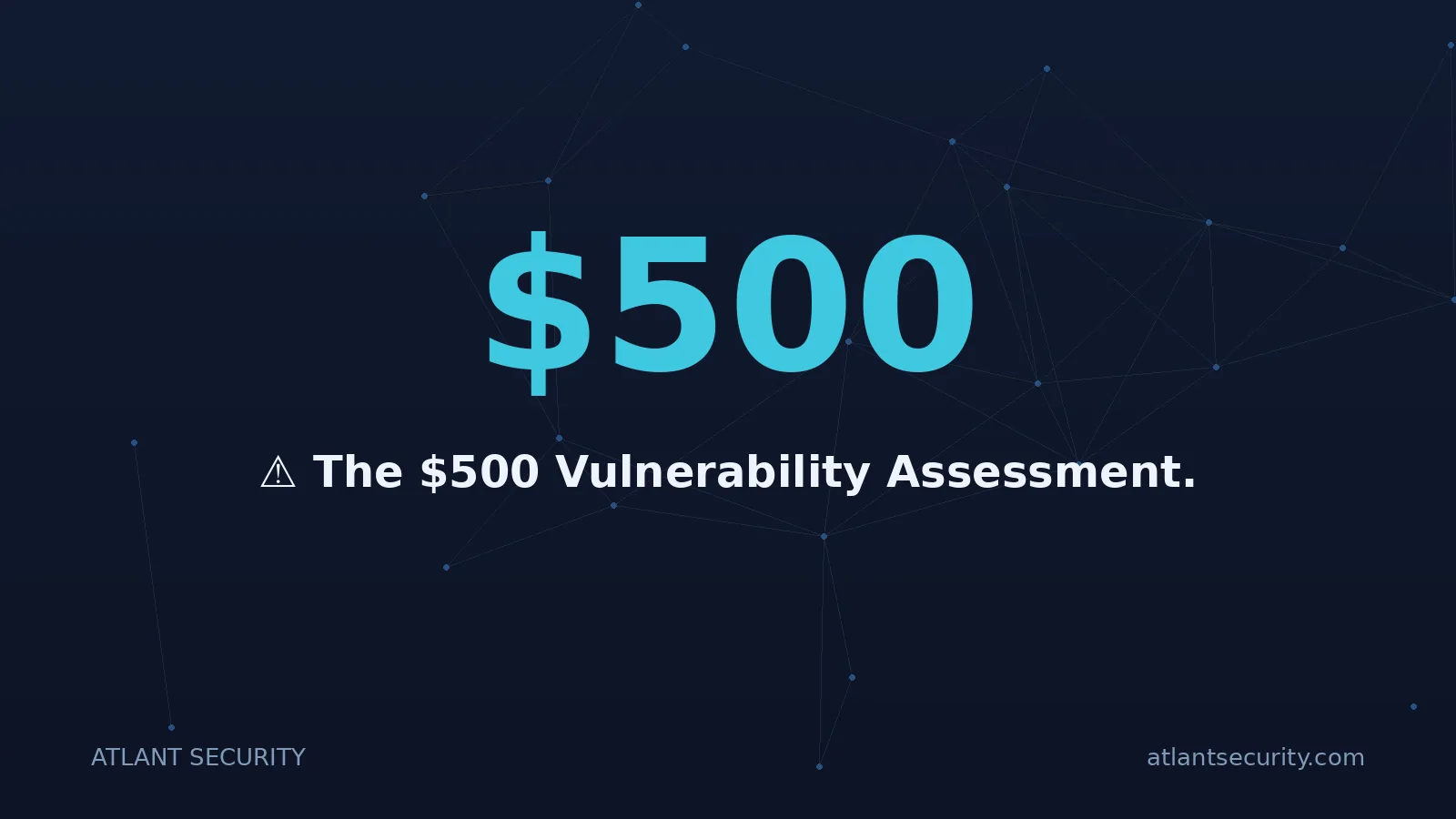
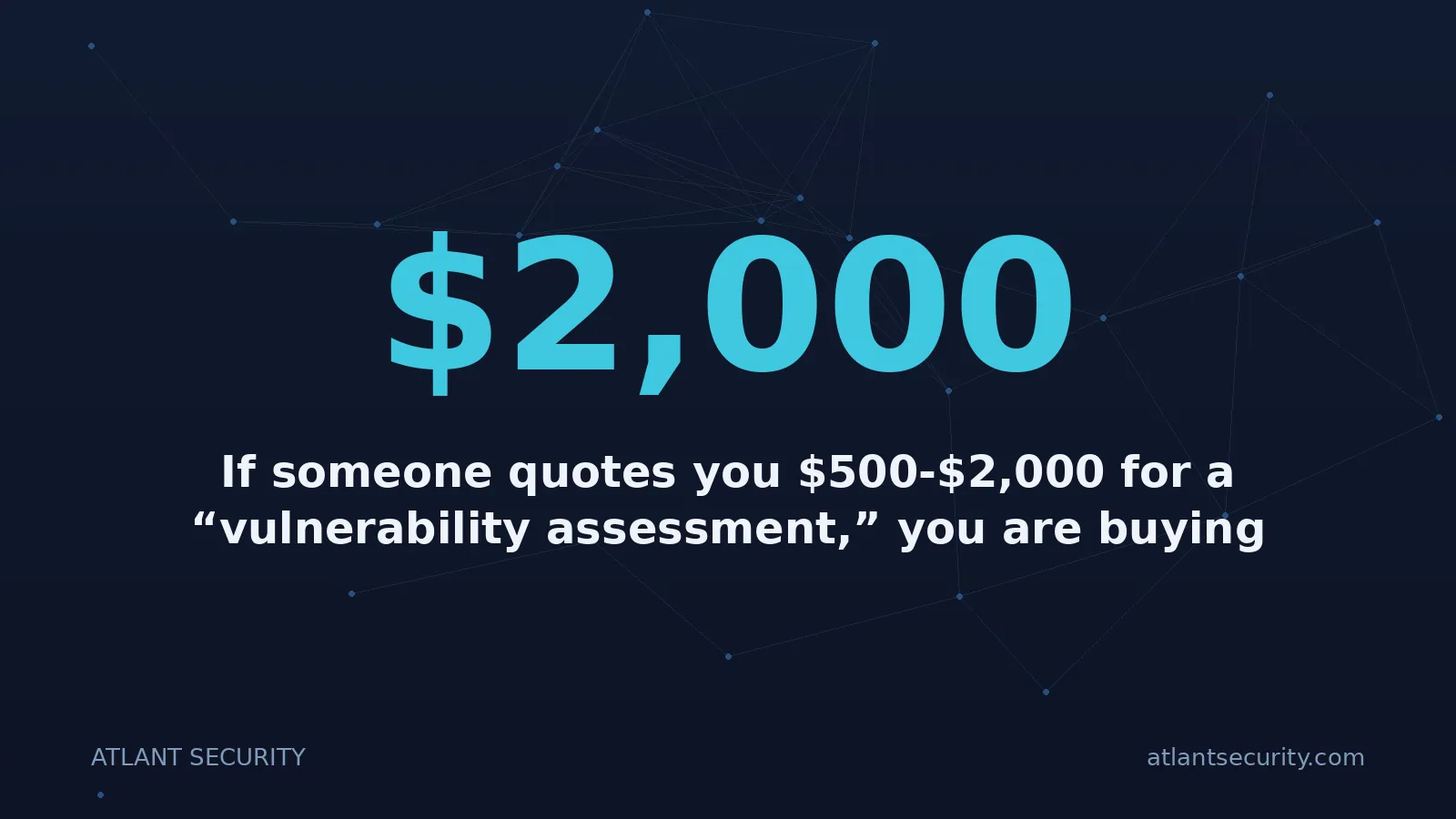
⚠️ The $500 Vulnerability Assessment
If someone quotes you $500-$2,000 for a “vulnerability assessment,” you are buying a scanner report with a cover page. That is a legitimate service - automated vulnerability scanning has its place - but it is not an assessment. Do not confuse the two. The difference is the same as the difference between a blood test and a medical examination. One gives you raw data. The other gives you a diagnosis, a prognosis, and a treatment plan.
Here is how to think about ROI: the average cost of a data breach in 2025 was $4.88 million (IBM Cost of a Data Breach Report). Even the most expensive vulnerability assessment on our table above is less than 3% of that figure. The question is not whether you can afford a vulnerability assessment. The question is whether you can afford not to have one.
Our Approach
What Makes a Vulnerability Assessment Company Worth Hiring
After outlining what to avoid, let me describe what to look for - using our own approach at Atlant Security as a concrete example. These are not proprietary secrets. Any serious vulnerability assessment company should be able to match these commitments.
What We Commit to on Every Vulnerability Assessment Engagement
- Senior expert on every engagement. The person leading your assessment has a minimum of 10 years of hands-on experience. We do not use junior analysts for lead roles and then supervise them from a distance. You get the expert in the pitch meeting and in the assessment.
- Fixed pricing, no surprises. We scope the engagement thoroughly during the proposal phase and quote a fixed price. If the assessment takes us longer than anticipated, that cost falls on us, not you. You know exactly what you are paying before the work begins.
- 14-day delivery guarantee. For standard engagements, you receive the final report within 14 business days of kickoff. We have never missed a deadline, and we disclose this commitment in our proposal so you can hold us to it.
- Remediation included. Every engagement includes detailed, technology-specific remediation guidance, a prioritized roadmap, and a follow-up verification scan to confirm your fixes worked. We do not hand you a list of problems and disappear.
- Vendor-agnostic recommendations. We do not resell security products. We do not have partnerships that create conflicts of interest. When we recommend a solution, it is because it is the right fit for your environment - not because we earn a commission on the sale.
- Executive-ready reporting. You receive two deliverables: a detailed technical report for your IT team, and a concise executive summary for your leadership and board. Both are written in plain language, not scanner output.
We have assessed more than 200 companies across healthcare, financial services, technology, logistics, manufacturing, and government. That breadth of experience means we bring pattern recognition to every engagement - we have seen what goes wrong in environments like yours, and we know where the bodies are buried.
“The real value of a vulnerability assessment is not the list of vulnerabilities. It is the expert judgment that tells you which ones matter, in what order, and what happens if you ignore them.”
Your Evaluation Checklist
10 Questions to Ask Before Hiring a Vulnerability Assessment Company
Print this list. Use it in every sales conversation. The quality of the answers will tell you everything you need to know about the company you are considering.
1. “Who will personally lead my assessment?”
Good answer: A named individual with specific credentials, years of experience, and relevant industry background. Bad answer: “One of our senior team members.” If they cannot name the person, they have not assigned one yet.
2. “Can I see a sample report?”
Good answer: Yes - here is a redacted sample showing our methodology, finding format, risk scoring, and remediation guidance. Bad answer: “Our reports are confidential.” Every reputable firm has sanitized sample reports ready to share.
3. “What tools do you use, and what do your analysts do beyond the scan?”
Good answer: We use [specific tools] for automated discovery, then our analysts manually validate findings, eliminate false positives, map attack chains, and contextualize risk to your business. Bad answer: “We use Nessus” (full stop).
4. “How do you price your assessments?”
Good answer: Fixed-price based on the scope of your environment - number of hosts, applications, cloud accounts, and locations. Bad answer: “We bill hourly at $250/hour.” Or even worse: “Depends on how many findings we discover.”
5. “What is your false positive rate?”
Good answer: Every finding in our report is manually validated. Our false positive rate is below 5%. Bad answer: Confusion, or “We include everything the scanner finds so you don't miss anything.” That means they do not validate.
6. “How do you prioritize findings?”
Good answer: We use CVSS as a baseline but layer on exploitability, business exposure, asset criticality, and attack chain potential. A “Medium” CVSS finding on an internet-facing asset may rank higher than a “Critical” finding on an isolated internal system. Bad answer: “We sort by CVSS score, highest to lowest.”
7. “Do you include remediation support?”
Good answer: Yes - remediation guidance, a prioritized roadmap, team access for questions, and a verification rescan are included. Bad answer: “Remediation is a separate engagement.” While deep remediation implementation may require separate scoping, basic guidance and verification should be part of the assessment.
8. “What industries have you worked in?”
Good answer: Specific examples with context about regulatory requirements and common challenges in those industries. Bad answer: “We work with everyone.” A company that specializes in nothing delivers nothing special.
9. “What happens after the report is delivered?”
Good answer: A findings walkthrough with your technical team, an executive briefing for leadership, and 30-90 days of follow-up support for remediation questions. Bad answer: “We email you the report.”
10. “Can you provide references from companies similar to ours?”
Good answer: Yes - here are contacts at companies in your industry and of similar size who can speak to our work. Bad answer: “We can share case studies.” Case studies are marketing. References are accountability. There is a difference.
Common Questions
Frequently Asked Questions
How often should we conduct a vulnerability assessment?
At minimum, annually. Quarterly is the gold standard for most mid-sized companies. You should also trigger an assessment after any major infrastructure change: cloud migration, acquisition, new application deployment, or significant network redesign. The threat landscape changes constantly - a clean assessment from 12 months ago says nothing about your risk today.
What is the difference between a vulnerability assessment and a vulnerability scan?
A vulnerability scan is automated - a tool runs against your environment and produces a list of potential issues. A vulnerability assessment includes the scan but adds human analysis: manual validation, false positive elimination, attack chain mapping, business context prioritization, and actionable remediation guidance. The scan is one input. The assessment is the complete service.
Will a vulnerability assessment disrupt our operations?
A properly conducted assessment should cause zero disruption. Professional firms use non-intrusive scanning techniques and schedule any intensive testing during off-peak hours. We always agree on a scanning window with our clients beforehand and have kill-switch procedures to immediately stop any test that begins affecting production systems. In over 200 assessments, we have never caused a client outage.
Do we need a vulnerability assessment if we already have EDR/XDR and a firewall?
Absolutely. Security tools protect against threats they are configured to detect. A vulnerability assessment identifies the gaps those tools do not cover: misconfigurations, policy weaknesses, missing patches, excessive permissions, insecure application code, and architectural flaws. Think of it this way: a burglar alarm does not help if you left the back door unlocked. The assessment finds the unlocked doors.
Can we do a vulnerability assessment with our internal IT team?
You can run vulnerability scans internally, and many companies do. But a comprehensive assessment benefits enormously from external expertise for three reasons: (1) Fresh eyes catch what familiarity misses - your team has blind spots about the environment they built and maintain daily. (2) External assessors bring cross-industry pattern recognition from hundreds of engagements. (3) Third-party findings carry more weight with executives, boards, auditors, and compliance bodies.
How long does a vulnerability assessment take?
For a mid-sized company (100-500 employees), expect 10-15 business days from kickoff to final report delivery. This includes: 1-2 days for scoping and preparation, 3-5 days for scanning and testing, 3-5 days for analysis and report writing, and 1-2 days for review and finalization. Larger or more complex environments may require 3-5 weeks. Any company that promises a comprehensive assessment in 2-3 days is either running a scanner-only engagement or cutting corners on analysis.
What compliance frameworks require vulnerability assessments?
PCI DSS explicitly requires quarterly vulnerability scans and annual assessments. HIPAA requires periodic technical evaluations (which vulnerability assessments fulfill). SOC 2 requires evidence of ongoing vulnerability management. ISO 27001 requires assessment of technical vulnerabilities. NIS2 requires appropriate and proportionate technical measures, which includes vulnerability identification. GDPR requires regular testing and evaluating of security measures. In practice, nearly every major compliance framework either mandates or strongly implies regular vulnerability assessments.
What should we do to prepare for a vulnerability assessment?
Good preparation accelerates the engagement and improves results. Before your assessment begins: (1) Provide an accurate inventory of your IT assets - servers, endpoints, cloud accounts, applications, network diagrams. (2) Designate a technical point of contact with access to systems and the authority to answer questions. (3) Identify your critical business systems and data repositories so the assessor can prioritize accordingly. (4) Inform your IT team and any managed service providers about the upcoming assessment to avoid false alarms. (5) Share any previous assessment reports so the firm can measure progress and focus on new risks.
Published: April 2026 · Author: Alexander Sverdlov
This article is for informational purposes only and does not constitute legal or professional advice. Pricing ranges reflect market averages as of Q1 2026 and may vary based on organizational complexity, scope, and geographic location. For an accurate quote tailored to your environment, contact us for a free scoping conversation.

Alexander Sverdlov
Founder of Atlant Security. Author of 2 information security books, cybersecurity speaker at the largest cybersecurity conferences in Asia and a United Nations conference panelist. Former Microsoft security consulting team member, external cybersecurity consultant at the Emirates Nuclear Energy Corporation.