Removing perimeter security is safe for a cyber fortress
Alexander Sverdlov
Security Analyst
💫 Key Takeaways
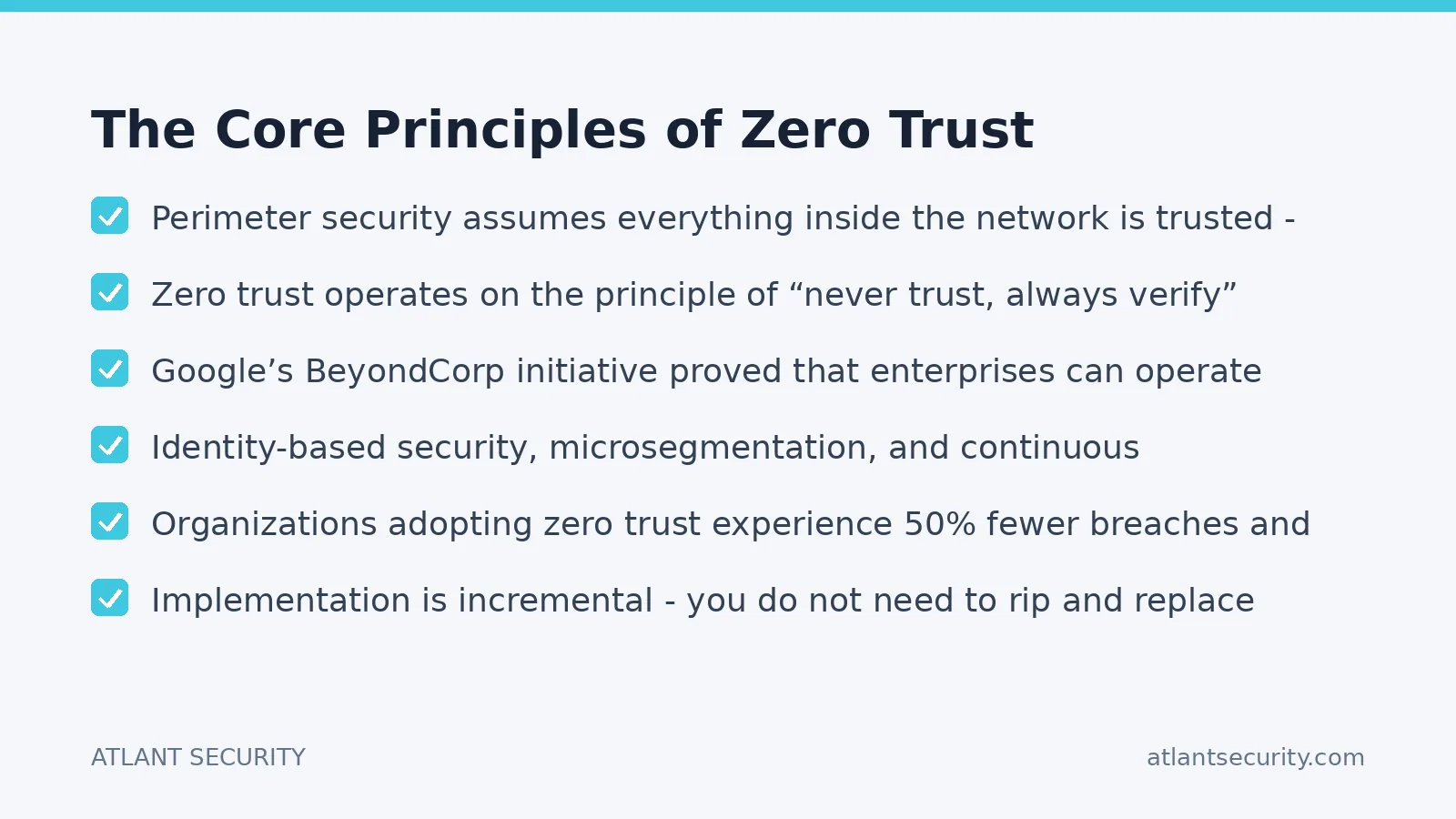
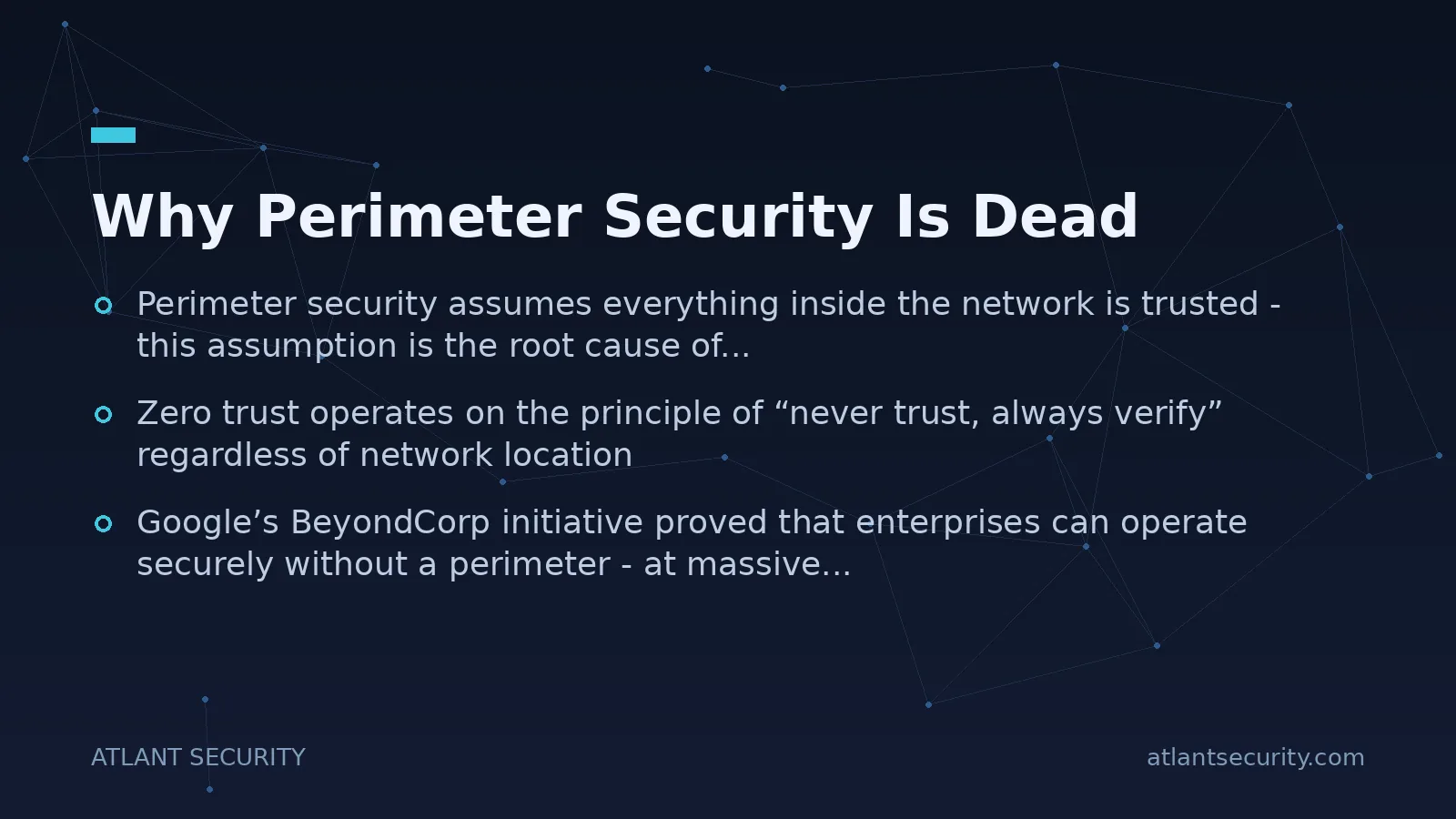
- Perimeter security assumes everything inside the network is trusted - this assumption is the root cause of most breaches
- Zero trust operates on the principle of “never trust, always verify” regardless of network location
- Google’s BeyondCorp initiative proved that enterprises can operate securely without a perimeter - at massive scale
- Identity-based security, microsegmentation, and continuous verification replace VPNs, firewalls, and network zones
- Organizations adopting zero trust experience 50% fewer breaches and significantly lower lateral movement risk
- Implementation is incremental - you do not need to rip and replace everything on day one
In December 2014, Google published a paper titled “BeyondCorp: A New Approach to Enterprise Security.” That paper articulated what the security community had been whispering for years: perimeter security is fundamentally broken, and the industry needs to stop pretending otherwise.
What made BeyondCorp remarkable was not just the theory. Google actually did it. They moved their enterprise applications to the public internet, removed their VPN requirement, and made access decisions based on user identity and device trust rather than network location. The result was not a security disaster - it was a measurably more secure environment than the perimeter-based model it replaced.
Over a decade later, the evidence is overwhelming. Organizations clinging to perimeter-based security are not being cautious - they are being reckless. This article explains why, what should replace it, and how to make the transition without burning everything down.
The Problem
Why Perimeter Security Is Dead
The perimeter security model - sometimes called the castle-and-moat model - is built on a single, fatal assumption: everything inside the network boundary can be trusted, and everything outside cannot. For decades, organizations invested heavily in firewalls, VPN concentrators, DMZs, and intrusion detection systems to maintain this boundary. The logic seemed sound: build a strong wall, and you are safe inside it.
That logic has been systematically dismantled by five forces:
1. The perimeter dissolved
When employees work from home, coffee shops, and co-working spaces - connecting to SaaS applications hosted in AWS, Azure, and Google Cloud - where exactly is the perimeter? Corporate data now lives in dozens of cloud services, on personal mobile devices, and in third-party platforms. The neat boundary between “inside” and “outside” simply does not exist anymore.
2. Attackers bypass the wall, not breach it
Modern attackers do not need to penetrate your firewall. They use phishing to steal credentials, compromise a vendor in your supply chain, or exploit a misconfigured cloud service. Once they have valid credentials, they walk through the front door. Your firewall sees an authenticated user connecting from a recognized VPN - it waves them through. Inside the perimeter, the attacker moves laterally with minimal resistance because internal traffic is implicitly trusted.
3. VPNs create a false sense of security
VPNs were the bridge solution - extend the perimeter to remote workers by tunneling them “inside.” But a VPN grants broad network access to anyone who authenticates. If an attacker compromises a single VPN credential, they are inside the network with the same access as the legitimate user. The SolarWinds attack, the Colonial Pipeline incident, and countless ransomware campaigns exploited exactly this pattern.
4. Lateral movement is trivially easy inside flat networks
Once past the perimeter, most corporate networks are relatively flat. An attacker who compromises a marketing workstation can often reach the database server, the domain controller, and the backup infrastructure. The perimeter protects the boundary - it does nothing to limit movement inside it.
5. The data supports this conclusion
The Numbers Are Clear
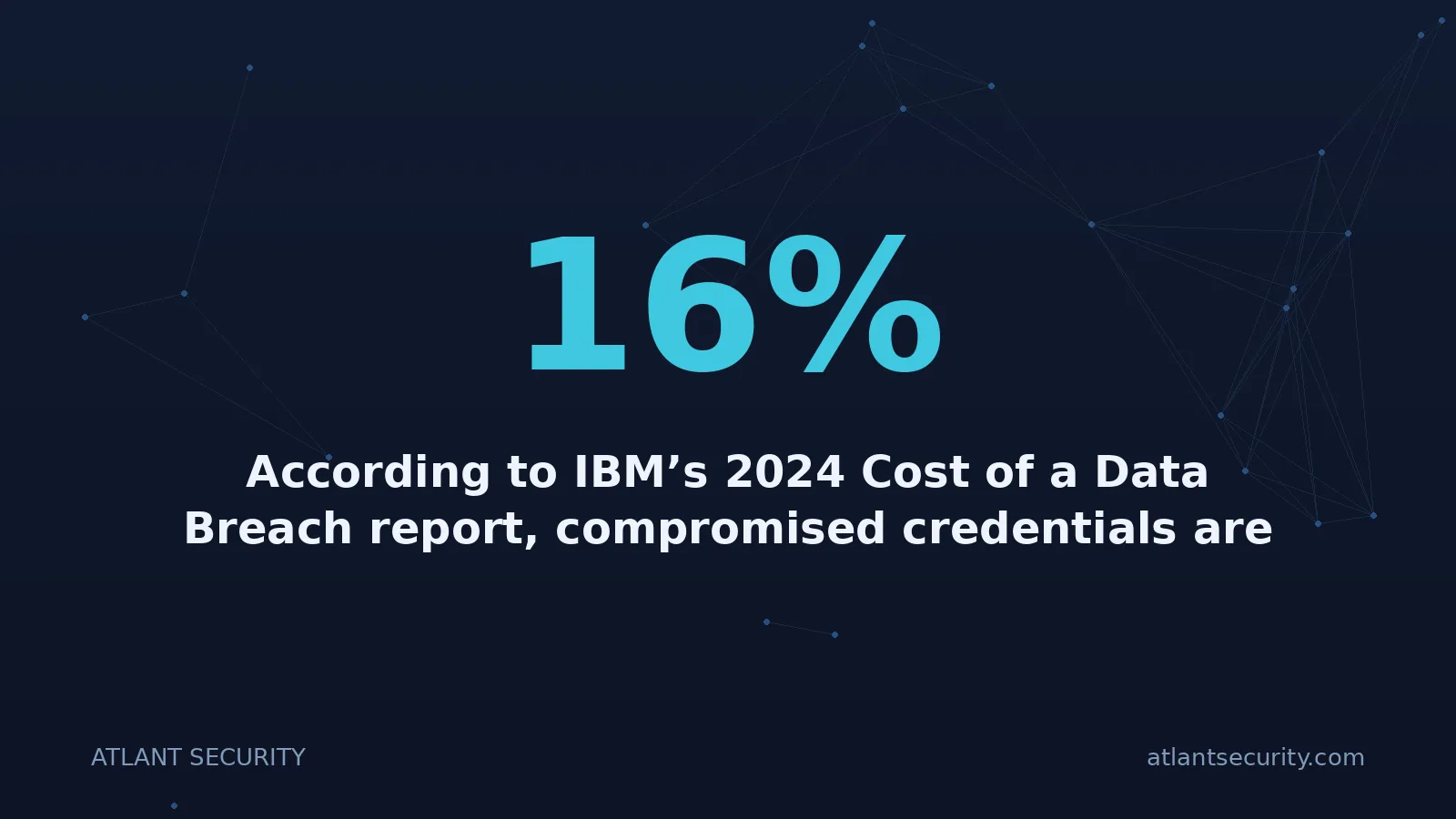
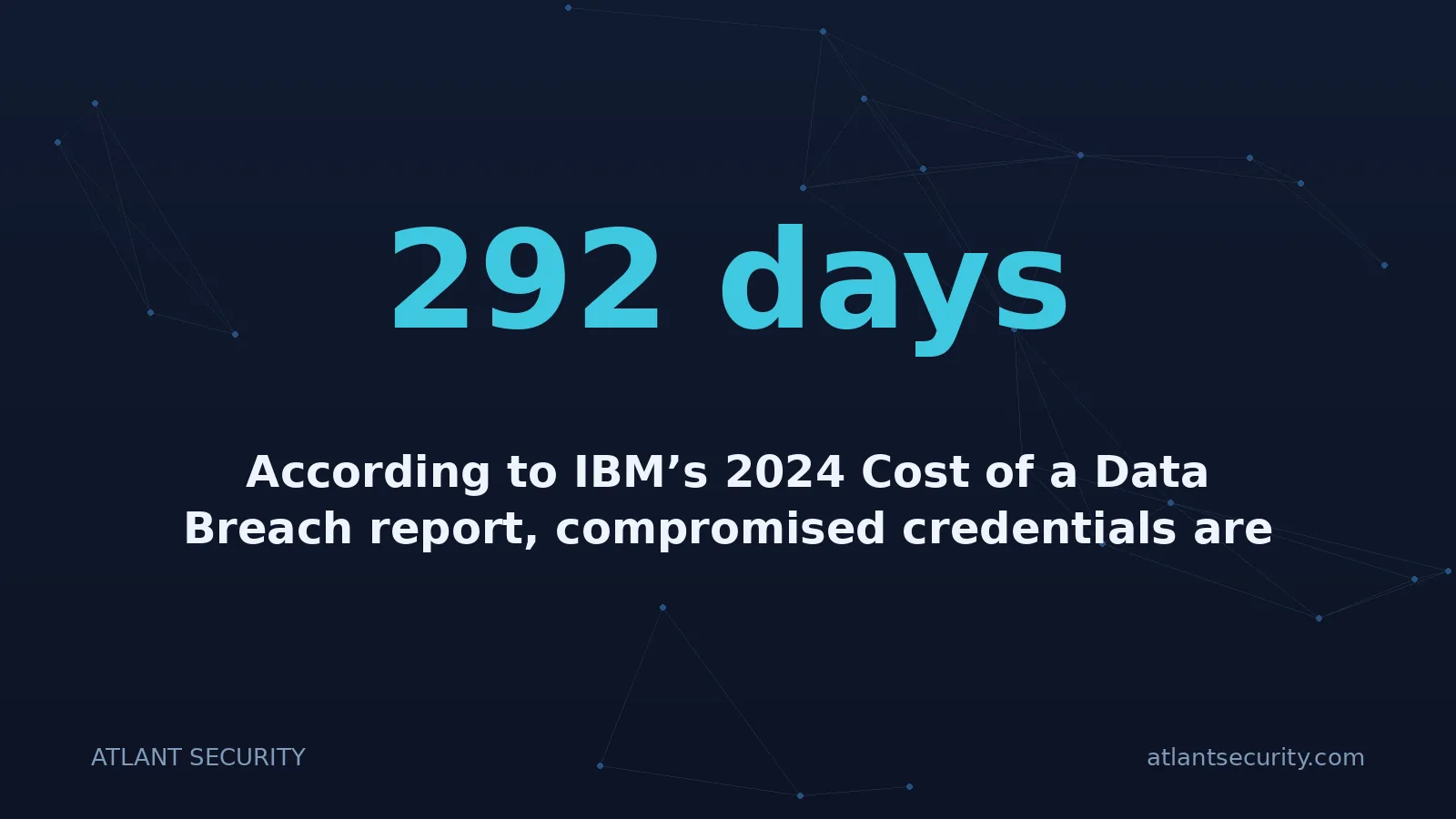
According to IBM’s 2024 Cost of a Data Breach report, compromised credentials are the #1 initial attack vector, responsible for 16% of breaches. The average breach takes 292 days to identify and contain when credentials are involved. Organizations with mature zero-trust deployments saved an average of $1.76 million per breach compared to those without.
The Foundation
The Core Principles of Zero Trust
Zero trust is not a product you buy. It is an architecture and a set of principles that fundamentally change how access decisions are made. The concept was formalized by John Kindervag at Forrester Research in 2010, but the underlying ideas predate the term. At its core, zero trust rests on these principles:
| Principle | What It Means | Replaces |
|---|---|---|
| Never trust, always verify | Every access request is authenticated and authorized, regardless of source | Implicit trust based on network location |
| Least privilege access | Users and services get the minimum access needed, for the minimum time needed | Broad network access once inside the VPN |
| Assume breach | Design systems as if an attacker is already inside the network | Trust everything inside the perimeter |
| Continuous verification | Authentication is not a one-time event - trust is re-evaluated continuously | Authenticate once at the VPN, then roam freely |
| Microsegmentation | Divide the network into small, isolated zones with independent access controls | Flat internal networks with minimal segmentation |
The practical implication is profound: the network location of a user or device provides zero information about whether they should be trusted. A request from the corporate office is treated with the same scrutiny as a request from a coffee shop in another country. Access decisions are based on identity, device health, context, and behavior - not on which side of the firewall you happen to be sitting on.
The New Perimeter
Identity Is the New Perimeter
In a zero-trust architecture, identity replaces the network boundary as the primary security control. Every access decision is gated by: who is asking (identity), what are they using (device posture), what are they accessing (resource sensitivity), and does this request make sense (behavioral context).
This requires a mature identity infrastructure built on several components:
- Strong authentication - Multi-factor authentication (MFA) is non-negotiable. Phishing-resistant MFA (FIDO2/WebAuthn hardware keys) is the gold standard. Passwords alone are insufficient in a zero-trust model.
- Single sign-on (SSO) - Centralize authentication through an identity provider (IdP) like Okta, Azure AD (Entra ID), or Google Workspace. This gives you a single point of policy enforcement, audit logging, and access revocation.
- Device trust - Verify that the device making the request meets security requirements: up-to-date OS, disk encryption enabled, endpoint detection agent running, not jailbroken. Solutions like Microsoft Intune, Jamf, or Google BeyondCorp Enterprise evaluate device posture before granting access.
- Conditional access policies - Combine user identity, device health, location, and risk signals to make dynamic access decisions. A request from a managed device in a known location might get full access; the same user on an unknown device gets read-only access or is blocked entirely.
- Just-in-time (JIT) access - Privileged access is granted temporarily and expires automatically. Administrators do not have standing access to production systems - they request elevated privileges when needed, with approval workflows and audit trails.
Google’s BeyondCorp in Practice
When Google implemented BeyondCorp, they made every internal application accessible from the public internet. No VPN required. Every request was authenticated against user identity and device trust. The result: employees could work from anywhere without a VPN, and Google’s security posture improved because every access was explicitly verified rather than implicitly trusted. If it works at Google’s scale - with over 100,000 employees - it can work for your organization.
Limiting Blast Radius
Microsegmentation: Containing the Breach You Cannot Prevent
If zero trust assumes breach, then microsegmentation is the mechanism that limits how far an attacker can go once inside. Instead of a flat network where any compromised system can reach any other system, microsegmentation divides the environment into small, isolated segments - each with its own access policies.
In a perimeter-based model, an attacker who compromises a workstation in the marketing department can typically reach the database servers, file shares, domain controllers, and backup systems. In a microsegmented environment, that workstation can only communicate with the specific services it needs - the marketing application server and the printing service. The database, domain controller, and backup infrastructure are invisible to it.
Microsegmentation can be implemented at multiple layers:
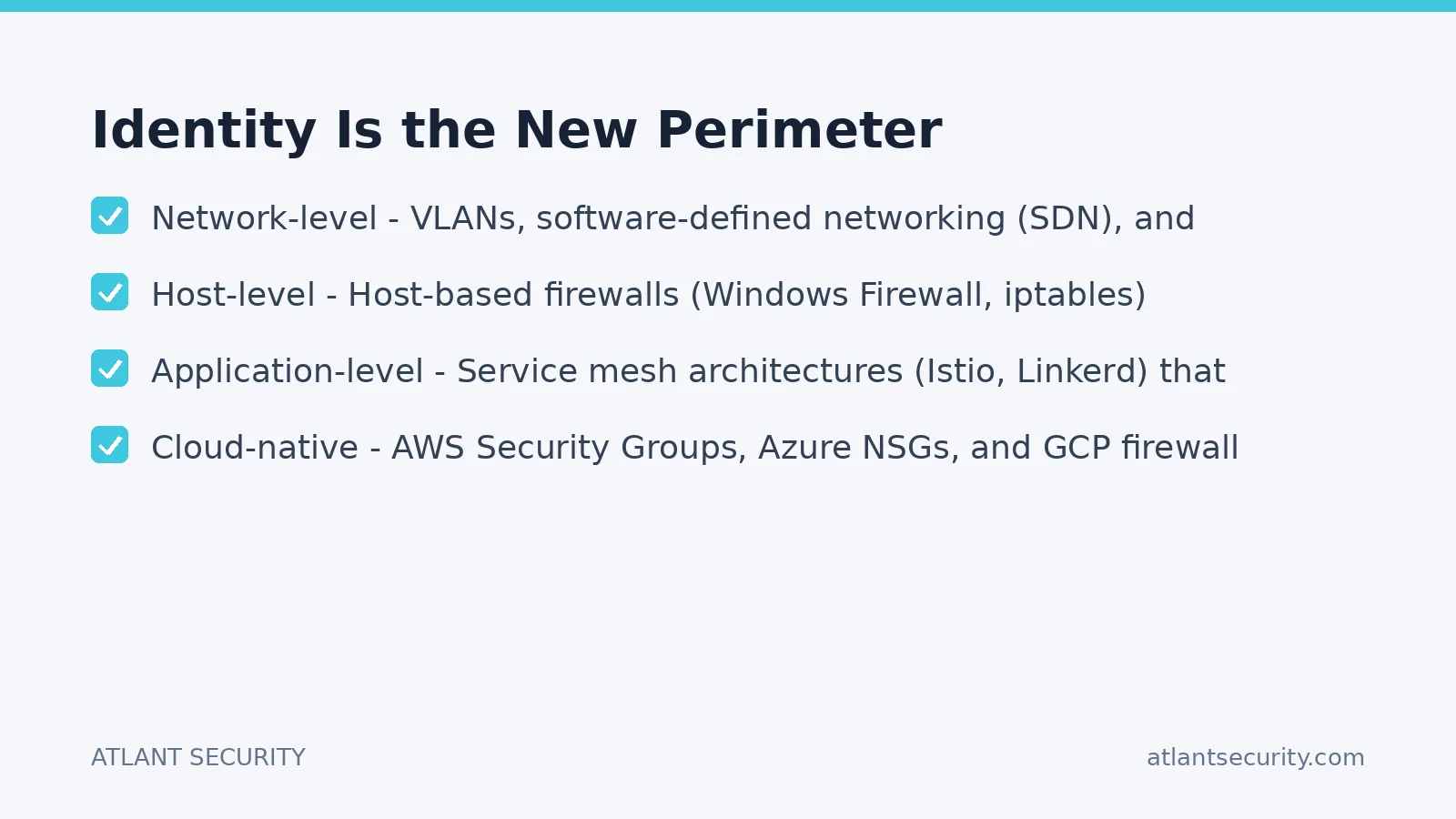
- Network-level - VLANs, software-defined networking (SDN), and next-generation firewalls with application-aware policies.
- Host-level - Host-based firewalls (Windows Firewall, iptables) configured to allow only necessary connections.
- Application-level - Service mesh architectures (Istio, Linkerd) that enforce mutual TLS and access policies between microservices.
- Cloud-native - AWS Security Groups, Azure NSGs, and GCP firewall rules that restrict traffic between cloud workloads.
The key insight is that microsegmentation shifts the security model from protecting the perimeter of the network to protecting the perimeter of each workload. Every server, every container, every application becomes its own fortress with its own access controls.
The Roadmap
Zero Trust Implementation Roadmap
Zero trust is not a weekend project. It is a multi-phase transformation that typically spans 12-24 months for a mid-sized organization. Here is a practical, phased approach:
Phase 1: Foundation (Months 1-3)
- Asset inventory - You cannot protect what you do not know about. Catalog all users, devices, applications, and data stores.
- Identity provider consolidation - Centralize authentication through a single IdP with SSO and MFA for all applications.
- Network visibility - Deploy monitoring to understand current traffic flows. You need to know what talks to what before you can segment it.
- Quick wins - Enable MFA everywhere, disable legacy authentication protocols, and implement conditional access policies.
Phase 2: Segmentation (Months 3-9)
- Classify assets by sensitivity - Identify crown jewels (databases, domain controllers, backup systems) and high-value targets.
- Implement microsegmentation - Start with the most sensitive assets and progressively segment the rest. Use software-defined policies that do not require hardware changes.
- Replace VPN with ZTNA - Deploy Zero Trust Network Access (ZTNA) solutions that provide application-specific access instead of broad network access.
- Endpoint security - Ensure all devices meet security baselines before accessing corporate resources.
Phase 3: Continuous Verification (Months 9-18)
- Behavioral analytics - Deploy UEBA (User and Entity Behavior Analytics) to detect anomalous access patterns.
- Just-in-time access - Implement privileged access management (PAM) with time-limited elevated permissions.
- Automated response - Configure automated policy enforcement: if a device falls out of compliance, access is revoked immediately.
- Data-centric security - Apply classification labels and DLP policies to protect sensitive data regardless of where it resides.
Addressing Resistance
Common Objections to Zero Trust - And Why They Are Wrong
“It is too expensive to implement.”
Zero trust reduces costs in the long run. VPN infrastructure is expensive to maintain and scale. ZTNA solutions are typically cloud-delivered and priced per user. More importantly, the cost of a breach in a perimeter-only environment dwarfs the cost of implementing zero trust. The average breach costs $4.88M. A phased zero-trust deployment for a mid-sized company costs a fraction of that.
“Our users will revolt if we make access more difficult.”
Done correctly, zero trust improves the user experience. No more VPN connections that drop during video calls. No more waiting for VPN authentication before accessing cloud applications. SSO reduces password fatigue. Conditional access policies can be designed to be invisible when users are on managed devices in normal conditions - additional verification only triggers when something is unusual.
“We have compliance requirements that mandate a firewall.”
Zero trust does not mean removing all firewalls. It means that firewalls are no longer your primary security control. Firewalls still play a role at the network edge for north-south traffic filtering. But they are supplemented by identity-based access controls, microsegmentation, and continuous monitoring. Every major compliance framework - PCI DSS, SOC 2, HIPAA, ISO 27001, NIST - supports zero-trust architectures.
“We are too small for zero trust.”
Small organizations are actually the easiest to migrate to zero trust because they have fewer legacy systems and smaller network footprints. Cloud-native businesses can implement zero trust from day one with managed identity providers, ZTNA solutions, and cloud-native segmentation at costs comparable to traditional VPN setups.
“We already have a next-gen firewall. That is enough.”
A next-generation firewall is still a perimeter device. It is excellent at filtering known threats in north-south traffic. It does nothing to prevent lateral movement after an attacker compromises a valid credential and moves east-west inside your network. NGFWs are a component of defense-in-depth, not a substitute for zero-trust architecture.
Common Questions
Frequently Asked Questions
Does zero trust mean we eliminate firewalls entirely?
No. Firewalls still serve a purpose for perimeter traffic filtering and compliance requirements. Zero trust means that firewalls are no longer your sole or primary defense. They become one layer among many, supplemented by identity verification, microsegmentation, and continuous monitoring.
How long does a zero-trust implementation take?
For most mid-sized organizations, 12 to 24 months for a comprehensive implementation. However, you can achieve significant security improvements within the first 90 days by deploying MFA, SSO, conditional access, and replacing VPN with ZTNA for the most critical applications.
What is the difference between ZTNA and a traditional VPN?
A VPN provides broad network access once authenticated - the user is “inside” the network. ZTNA provides access only to specific applications, verified on every request, with no direct network connectivity. Think of VPN as a key to the building; ZTNA is a keycard that opens only the specific rooms you need, and only during your authorized hours.
Can zero trust work with legacy applications?
Yes, though it requires additional effort. Legacy applications that do not support modern authentication can be fronted by an application proxy (Azure AD Application Proxy, Cloudflare Access, Zscaler Private Access) that enforces zero-trust policies. The legacy application sees a trusted connection; the proxy handles identity verification and conditional access upstream.
What is the first step we should take toward zero trust?
Start with identity. Deploy MFA on everything - especially email, VPN, and cloud administration consoles. Consolidate to a single identity provider with SSO. These two steps alone close the majority of credential-based attack vectors and lay the foundation for every subsequent zero-trust initiative. If you need help mapping out the full journey, a virtual CISO engagement can provide the strategic roadmap.
Updated: March 2026 · Author: Alexander Sverdlov
This article is for informational purposes only and does not constitute professional advice. Zero-trust implementation should be tailored to your organization’s specific environment, compliance requirements, and risk profile. If you need help planning your zero-trust journey, contact a qualified security consultant.
Related services from Atlant Security: IT Security Audit, Virtual CISO, All Services. Book a discovery call to discuss your specific situation.

Alexander Sverdlov
Founder of Atlant Security. Author of 2 information security books, cybersecurity speaker at the largest cybersecurity conferences in Asia and a United Nations conference panelist. Former Microsoft security consulting team member, external cybersecurity consultant at the Emirates Nuclear Energy Corporation.