

Endpoint Security · EDR/XDR · March 2026
The July 2024 CrowdStrike outage grounded airlines, shut down hospitals, and paralyzed enterprises worldwide. If your organization is evaluating CrowdStrike alternatives - or simply wants to understand the endpoint security landscape - this guide compares the leading EDR/XDR platforms and explains what actually matters when choosing one.
Key Takeaways
- The CrowdStrike outage on July 19, 2024 affected 8.5 million Windows devices worldwide - caused by a faulty kernel-level driver update
- CrowdStrike remains a technically strong product - the question is whether the vendor risk is acceptable for your organization
- Leading alternatives include SentinelOne, Microsoft Defender for Endpoint, Sophos Intercept X, Palo Alto Cortex XDR, and Trend Micro Vision One
- The real lesson is not “replace CrowdStrike” - it is “never depend on a single security product for your entire defense”
- Evaluation criteria should include kernel-level architecture, update deployment practices, OS compatibility, and vendor transparency about past incidents
- Proper security hardening of endpoints reduces dependence on any single EDR product
On July 19, 2024, a defective content update to CrowdStrike’s Falcon sensor caused a kernel-level crash on Windows systems worldwide. The infamous Blue Screen of Death appeared on an estimated 8.5 million devices. Airlines grounded flights. Hospitals diverted patients. Banks could not process transactions. Emergency services lost dispatch capabilities. The global economic impact was estimated at over $5 billion.
The root cause was simple and devastating: CrowdStrike pushed a channel file update to its kernel-mode driver that contained a logic error. Because the Falcon sensor operates at Ring 0 - the deepest level of the operating system - the crash was unrecoverable without manual intervention. Every affected machine needed to be physically or remotely booted into Safe Mode and have the faulty file deleted by a technician.
If you are reading this, your organization is likely evaluating whether to stay with CrowdStrike, switch to an alternative, or fundamentally rethink your endpoint security strategy. All three are valid responses. This article will help you make that decision with clarity rather than panic.
The Catalyst
Why Organizations Are Evaluating CrowdStrike Alternatives

The July 2024 outage is the primary catalyst, but it is not the only reason organizations are looking at alternatives. The motivations typically fall into several categories:
1. Vendor concentration risk

The outage demonstrated what happens when a single vendor has kernel-level access to millions of devices and pushes updates without adequate staging. This is a concentration-of-risk problem. Many organizations - especially those in critical infrastructure - are now implementing policies that limit single-vendor dependency for security-critical functions.
2. Cost

CrowdStrike is among the most expensive endpoint security platforms on the market. Its per-endpoint pricing, combined with add-on modules for identity protection, cloud workload protection, and threat intelligence, can make the total cost substantial - particularly for mid-sized organizations. Alternatives often provide comparable detection capabilities at lower per-endpoint costs.
3. Kernel-level architecture concerns
The fundamental issue exposed by the July 2024 outage is that CrowdStrike’s Falcon sensor runs a kernel-mode driver on Windows. In 2009, Microsoft agreed to give all antivirus vendors the same unrestricted kernel access as its own Defender product, under pressure from the European Commission. This means any EDR vendor running kernel-mode drivers poses the same theoretical risk.
The Precedent Nobody Talks About
CrowdStrike was not the first to do this. In April 2010, McAfee pushed a faulty DAT file update that caused Windows XP machines worldwide to enter an infinite reboot loop by quarantining the critical system file svchost.exe. The following year, McAfee’s CTO George Kurtz left to co-found CrowdStrike. Until the operating system vendors fundamentally change how security products interact with the kernel, this class of failure will remain possible with any EDR product.
4. Complexity and operational overhead

CrowdStrike’s platform has grown significantly in scope. What started as an EDR product now includes identity protection, cloud security, IT hygiene, and threat hunting modules. For organizations without a dedicated security operations team, the platform can be overwhelming. Simpler alternatives that provide strong detection with less operational complexity are attractive.
Head-to-Head
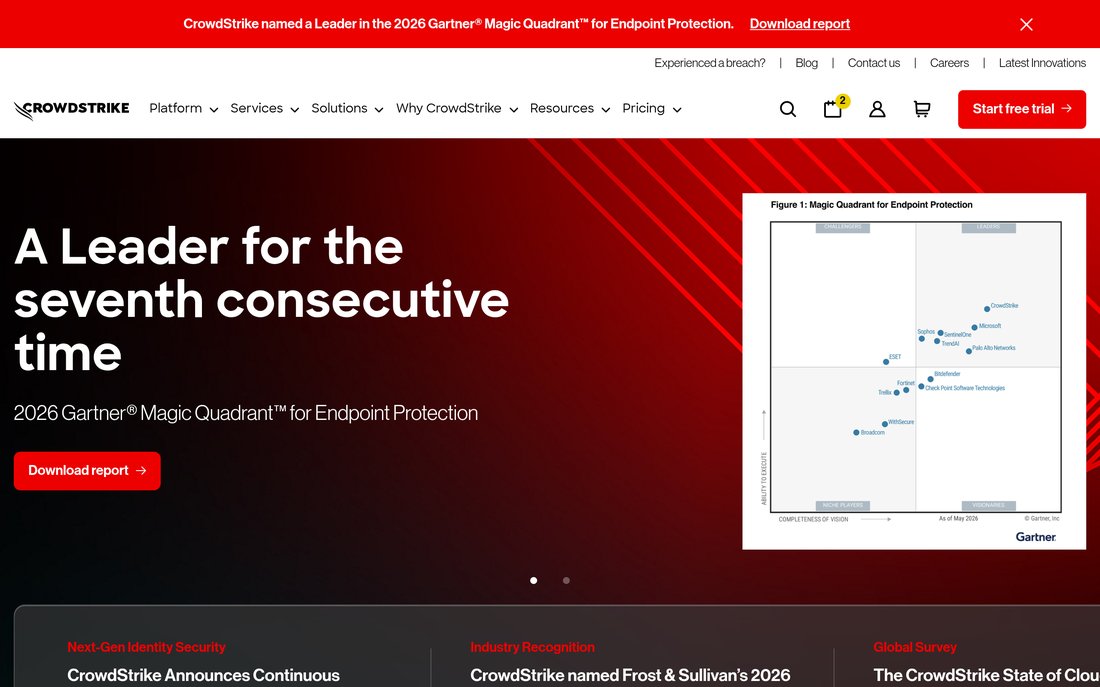
CrowdStrike Alternatives Compared
| Platform | Type | Key Strength | Consideration | Pricing |
|---|---|---|---|---|
| SentinelOne Singularity | EDR/XDR | Autonomous AI-driven response; can roll back ransomware | Also uses kernel-level driver; smaller threat intel team than CrowdStrike | $$$ |
| Microsoft Defender for Endpoint | EDR/XDR | Deep OS integration; included in M365 E5; massive threat intel | Best on Windows; cross-platform coverage improving but weaker on macOS/Linux | $$ (or included in E5) |
| Sophos Intercept X | EDR + MDR | Excellent managed detection; strong anti-ransomware; simpler management | Less advanced threat hunting than CrowdStrike; smaller enterprise presence | $$ |
| Palo Alto Cortex XDR | XDR | Integrates with Palo Alto network/cloud stack; strong analytics | Best value when using Palo Alto ecosystem; standalone pricing is high | $$$ |
| Trend Micro Vision One | XDR | Broad coverage (email, endpoint, network, cloud); competitive pricing | UI can feel dated; less brand recognition in North America | $$ |
| Cybereason | EDR/XDR | MalOp-centric approach; strong attack visualization | Smaller company; had financial challenges; evaluate stability carefully | $$ |
| Carbon Black (VMware/Broadcom) | EDR | Strong in virtualized environments; good Linux support | Product direction uncertain after Broadcom acquisition; monitor roadmap closely | $$ |
Selection Guide
What to Evaluate When Choosing an EDR/XDR Platform
Independent test results from MITRE ATT&CK evaluations are useful but not sufficient. Here are the criteria that actually matter for an enterprise deployment:
Kernel architecture and update practices
After July 2024, this is the most important question to ask any EDR vendor: How does your agent interact with the OS kernel, and what is your update deployment process? Specifically: Do you use a kernel-mode driver? How are content updates tested before global deployment? Do you support staged rollouts? Can customers delay updates? What is your rollback mechanism if an update causes issues?
Detection efficacy
Review MITRE ATT&CK evaluation results, but understand their limitations. MITRE tests detect known attack techniques in a controlled lab. Real-world efficacy depends on how the product handles novel threats, fileless attacks, and living-off-the-land techniques. Ask for a proof-of-concept with realistic test scenarios in your own environment.
Response capabilities
Detection without response is just expensive logging. Evaluate: Can the agent automatically isolate a compromised endpoint? Does it support automated remediation (kill process, quarantine file, rollback changes)? Can your SOC team remotely investigate and respond through the platform? Does it integrate with your SOAR platform?
Cross-platform support
Most organizations run a mix of Windows, macOS, and Linux. Mobile devices increasingly matter too. Evaluate the quality of the agent on each platform - many vendors have strong Windows agents but weaker macOS or Linux coverage. If you run cloud workloads on Linux, this gap matters enormously.
Managed detection and response (MDR) option
If your team cannot monitor and respond to alerts 24/7, an MDR option is essential. Many vendors offer managed services where their SOC monitors your environment, triages alerts, and responds to threats on your behalf. This is often more cost-effective than building an in-house SOC. Whichever vendor runs it, write down who owns detection, triage, escalation and response before you sign; our managed security services site has that requirement list.
For the MDR providers themselves, including Falcon Complete and its alternatives, see managed security service providers compared.
Total cost of ownership
Per-endpoint licensing is only part of the cost. Factor in: add-on module costs, implementation and tuning effort, ongoing operational overhead (alert volume, investigation time), integration costs with your SIEM/SOAR, and training for your security team.
The Bigger Picture
The Real Lesson: Stop Relying on Any Single Product
The most important takeaway from the CrowdStrike incident is not “replace CrowdStrike with Product X.” It is this: no single security product should be the foundation of your entire defense. Any product can fail. Any vendor can push a bad update. Any software running at the kernel level can crash your systems.
The organizations that weathered the July 2024 outage best were those with defense-in-depth strategies:
- Security hardening - Properly hardened endpoints are resilient even when the EDR agent fails. CIS benchmarks, DISA STIGs, application whitelisting, and least-privilege access reduce the attack surface independent of any security product.
- Network segmentation - Even if endpoints are compromised, network segmentation limits the blast radius. An attacker (or a faulty update) that takes down one segment does not take down the entire organization.
- Staged update policies - Organizations that configured delayed deployment of EDR updates to a test group before rolling out to production were not affected by the outage. This should be standard practice for any software with kernel-level access.
- Incident response planning - Having a tested plan for mass endpoint recovery - including the ability to remotely boot into Safe Mode via UEFI/PXE - dramatically reduced downtime for prepared organizations.
The Uncomfortable Truth
Until Microsoft changes how security products interact with the Windows kernel - as Apple did with macOS years ago by moving security extensions to user space - any EDR product with a kernel-mode driver poses the same theoretical risk as CrowdStrike. Switching vendors does not eliminate this risk. Switching to a vendor with better update testing practices and staged rollouts reduces it, but does not eliminate it. The only real mitigation is defense-in-depth.
Planning the Transition
Migration Considerations
If you decide to migrate away from CrowdStrike, plan carefully. EDR migrations are operationally complex and, if done poorly, can leave you with gaps in coverage:
- Run parallel deployment - Deploy the new agent alongside CrowdStrike in monitor-only mode before removing CrowdStrike. This validates detection coverage without creating a gap. Most EDR agents can coexist temporarily.
- Migrate in phases - Start with non-critical systems, then move to production servers and executive endpoints last. Build confidence in the new platform before full deployment.
- Preserve investigation data - Export historical detection and investigation data from CrowdStrike before removing it. You may need this data for compliance or incident investigations.
- Update integrations - CrowdStrike likely integrates with your SIEM, SOAR, identity provider, and ticketing system. Each integration needs to be rebuilt with the new platform.
- Retrain your team - Every EDR platform has different investigation workflows, query languages, and response actions. Budget time for your security team to become proficient.
- Negotiate contract timing - CrowdStrike contracts are typically annual or multi-year. Check termination clauses and negotiate transition periods with both the outgoing and incoming vendors.
Common Questions
Frequently Asked Questions
Should we leave CrowdStrike after the July 2024 outage?
Not necessarily. CrowdStrike remains one of the strongest EDR platforms in terms of detection and threat intelligence. The question is whether you trust their updated deployment practices and whether the concentration risk is acceptable for your organization. If you stay, implement staged update policies and ensure you have defense-in-depth controls that work independently of the EDR agent.
Is Microsoft Defender for Endpoint good enough to replace CrowdStrike?
For organizations already invested in the Microsoft 365 E5 ecosystem, Defender for Endpoint is a strong choice. Its integration with Azure AD, Intune, and Microsoft Sentinel provides a unified security stack. Detection quality has improved dramatically and it performs well in MITRE evaluations. The main considerations are weaker macOS/Linux support compared to CrowdStrike and the fact that Microsoft itself is both the OS vendor and the security vendor - which some see as a benefit (deep integration) and others as a risk (single point of failure).
Can the same type of outage happen with other EDR products?
Yes. Any EDR product that uses a kernel-mode driver on Windows can theoretically cause the same type of crash if a faulty update is pushed. The difference is in how vendors test updates, whether they support staged rollouts, and how quickly they can respond. Ask every vendor: what is your update testing process, and can we delay updates by a configurable window?
What is more important: the EDR product or the security team operating it?
The team. A mediocre EDR product operated by a skilled security team will outperform a world-class EDR product that nobody monitors. If you do not have the resources for 24/7 monitoring, invest in an MDR service rather than the most expensive standalone product. The best detection is meaningless if alerts go uninvestigated.
What should we do first to reduce risk regardless of which EDR we choose?
Implement security hardening across all endpoints. Proper configuration of OS security settings, application whitelisting, least-privilege access, and disabling unnecessary services reduces the attack surface dramatically - independent of which EDR product you deploy. If you need guidance, our security hardening services can establish the baseline that makes any EDR product more effective.
Need Help Evaluating Endpoint Security Platforms?
Choosing the right EDR/XDR is critical. The wrong choice wastes budget; the right choice stops breaches.
Our team helps organizations evaluate, select, and deploy endpoint security platforms. We provide: vendor-neutral EDR/XDR evaluation, proof-of-concept testing, migration planning from CrowdStrike or other platforms, security hardening to complement any EDR, and ongoing advisory through our virtual CISO service.
Updated: March 2026 · Author: Alexander Sverdlov
This article is for informational purposes only and does not constitute an endorsement of any specific product or vendor. Product capabilities and pricing change frequently. Evaluate all platforms in your own environment before making a purchasing decision. If you need help with endpoint security strategy, contact a qualified security consultant.
Related services from Atlant Security: IT Security Audit, Virtual CISO, All Services. Book a discovery call to discuss your specific situation.
