Law Firms · Legal Ethics · Confidentiality Duty
Most attorneys treat cybersecurity as an IT problem. Model Rule 1.6 has quietly turned it into an ethics problem. Since the 2012 amendment, the duty of confidentiality has carried an explicit clause requiring lawyers to make reasonable efforts to prevent the unauthorized disclosure of client information. Four ABA ethics opinions now define what that means. This is the practical reading: what Rule 1.6(c) requires, the five-factor test that decides how far you must go, the control set that satisfies it, and what the rule demands the day after a breach.
Key Takeaways
- Cybersecurity is an ethics obligation, not an IT preference. ABA Model Rule 1.6(c), added in the 2012 Ethics 20/20 amendments, states that a lawyer "shall make reasonable efforts to prevent the inadvertent or unauthorized disclosure of, or unauthorized access to, information relating to the representation of a client." Most state bars have adopted the same language or its substance.
- The standard is reasonable efforts, not a guarantee. A breach is not automatically an ethics violation. The violation is failing to take the precautions a competent lawyer would have taken given the facts. Comment [18] to Rule 1.6 lists five factors that decide how much is enough.
- Four ABA Formal Opinions now operationalize the duty: 477R on securing client communications, 483 on obligations after a breach, 498 on virtual practice, and the technology-competence language in Comment [8] to Rule 1.1. Together they convert a one-sentence rule into a concrete program.
- Opinion 483 is the one most firms have not read. It imposes affirmative duties to monitor for, stop, and remediate a breach, and to notify current clients when their confidential information is compromised. Rule 1.4 supplies the notice obligation; Rule 1.6 supplies the prevention obligation.
- The duty extends to everyone who touches the data. Rules 5.1 and 5.3 make partners responsible for associates, paralegals, contract attorneys, and outside vendors, including the cloud platform that stores your matters.
- A defensible position for a small-to-midsize firm is not expensive, but it is specific. The 90-day path at the end of this article costs a fraction of a single malpractice deductible and produces the written record that turns a future bar inquiry from an investigation into a closed file.
A name partner at a fourteen-attorney real estate and estates firm called us during a malpractice insurance renewal. Her carrier had attached a two-page security questionnaire to the renewal binder, and her office administrator could not answer half of it. Her question to us was blunt: "Is encrypted email actually an ethics requirement, or is our IT vendor just upselling us? I have practiced for twenty-six years. Nobody mentioned cybersecurity in a single CLE until about five years ago."
It is a fair question, and the honest answer is more interesting than yes or no. Encrypted email is not categorically required. It is also not categorically optional. Whether your firm must use it depends on a five-factor test written into the comments of Model Rule 1.6, applied to the specific matter in front of you. The same is true of almost every security control a vendor will try to sell a law firm. The rule does not hand you a checklist. It hands you a standard of care and expects you to apply professional judgment, which is exactly what lawyers are trained to do in every other part of practice.
This article is the long version of the answer we gave her. It is written for practicing attorneys and the people who run their firms, not for security engineers. It covers what Model Rule 1.6 actually says after the 2012 amendment, the five factors that decide how far the duty reaches, the four ABA ethics opinions that turn the rule into a program, the control set that satisfies a reasonable-efforts review, the moments when the duty escalates, and what the rule requires the day a breach is discovered.
One framing point before we start. Every reference here is to the ABA Model Rules, which no jurisdiction adopts verbatim. Your governing authority is your state's rules of professional conduct and your state bar's ethics opinions. The Model Rules are the template the states work from, and on the confidentiality-and-technology question the states have been unusually consistent. Treat this as the map, and confirm the territory with your own jurisdiction.
Section One
What Rule 1.6(c) Actually Requires
For most of the modern history of the profession, Rule 1.6 was a rule about what a lawyer must not say. It prohibited the voluntary disclosure of information relating to a representation. The duty was about the lawyer's own conduct: do not gossip about the matter, do not reveal a client confidence to gain advantage, do not discuss the case in an elevator. The rule assumed that the threat to confidentiality was the lawyer's own mouth.
![What this guide covers: What Rule 1.6(c) Actually Requires, The Reasonable-Efforts Test: Comment [18]'s Five Factors, The Four Ethics](/images/blog/cards/aba-model-rule-1-6-cybersecurity-attorneys-2026/card-1.webp)
In August 2012, the ABA House of Delegates adopted a set of amendments developed by the Commission on Ethics 20/20. The Commission had spent three years studying how technology and a globalized practice had changed the profession. One of its conclusions was that the confidentiality rule no longer matched the threat model. The biggest risk to a client confidence in a modern practice is not the lawyer talking. It is an intruder reading the firm's file server, a paralegal forwarding a document to the wrong address, a stolen laptop, or a vendor with a misconfigured cloud bucket. The 2012 amendments added a new subsection to address exactly that:
Model Rule 1.6(c)
"A lawyer shall make reasonable efforts to prevent the inadvertent or unauthorized disclosure of, or unauthorized access to, information relating to the representation of a client."
Three words in that sentence carry the entire weight of the obligation, and each one deserves a moment.
"Reasonable efforts." The rule does not require a perfect defense, and it does not make the lawyer a guarantor of the data. It requires the level of care a competent practitioner would apply. This is the same standard that governs every other professional judgment a lawyer makes. A breach, on its own, is not proof of a violation. A breach that follows a failure to take precautions a reasonable lawyer would have taken is a different matter. The question a bar disciplinary body asks is not "were you breached," it is "what had you done before the breach, and was it reasonable."
"Unauthorized access." The amendment deliberately reaches access, not just disclosure. An intruder who copies a folder of client files has not been told anything by the lawyer, and under the pre-2012 rule it was possible to argue the lawyer had not "disclosed" anything. The amendment closes that gap. If a third party obtains client information because the firm did not guard it, the lawyer's duty is implicated regardless of whether the lawyer ever spoke.
"Inadvertent." The duty covers accidents, not just attacks. The misdirected email, the document left in a shared printer tray, the cloud link set to "anyone with the link," the laptop on the back seat of a car. The most common confidentiality failure in a law firm is not a sophisticated intrusion. It is a tired associate at 9 p.m. autocompleting the wrong name in the To field. Rule 1.6(c) reaches that, and the comments make clear it expects firms to design against it.
The same 2012 package amended Comment [8] to Rule 1.1, the competence rule. The amended comment states that to maintain competence a lawyer "should keep abreast of changes in the law and its practice, including the benefits and risks associated with relevant technology." This is the much-quoted duty of technology competence. It has been adopted in substance by the large majority of states. Read together, the two amendments say something simple and demanding: understanding the technology your practice runs on is now part of being a competent lawyer, and protecting the client information that technology holds is now part of the duty of confidentiality.
None of this is exotic. It is the profession applying a familiar idea, the standard of reasonable care, to a part of practice that did not exist when the rules were first written. The discomfort many attorneys feel is not about the legal concept. It is about the subject matter. The next section removes most of that discomfort by showing that the rule already tells you how to think about it.
Section Two
The Reasonable-Efforts Test: Comment [18]'s Five Factors
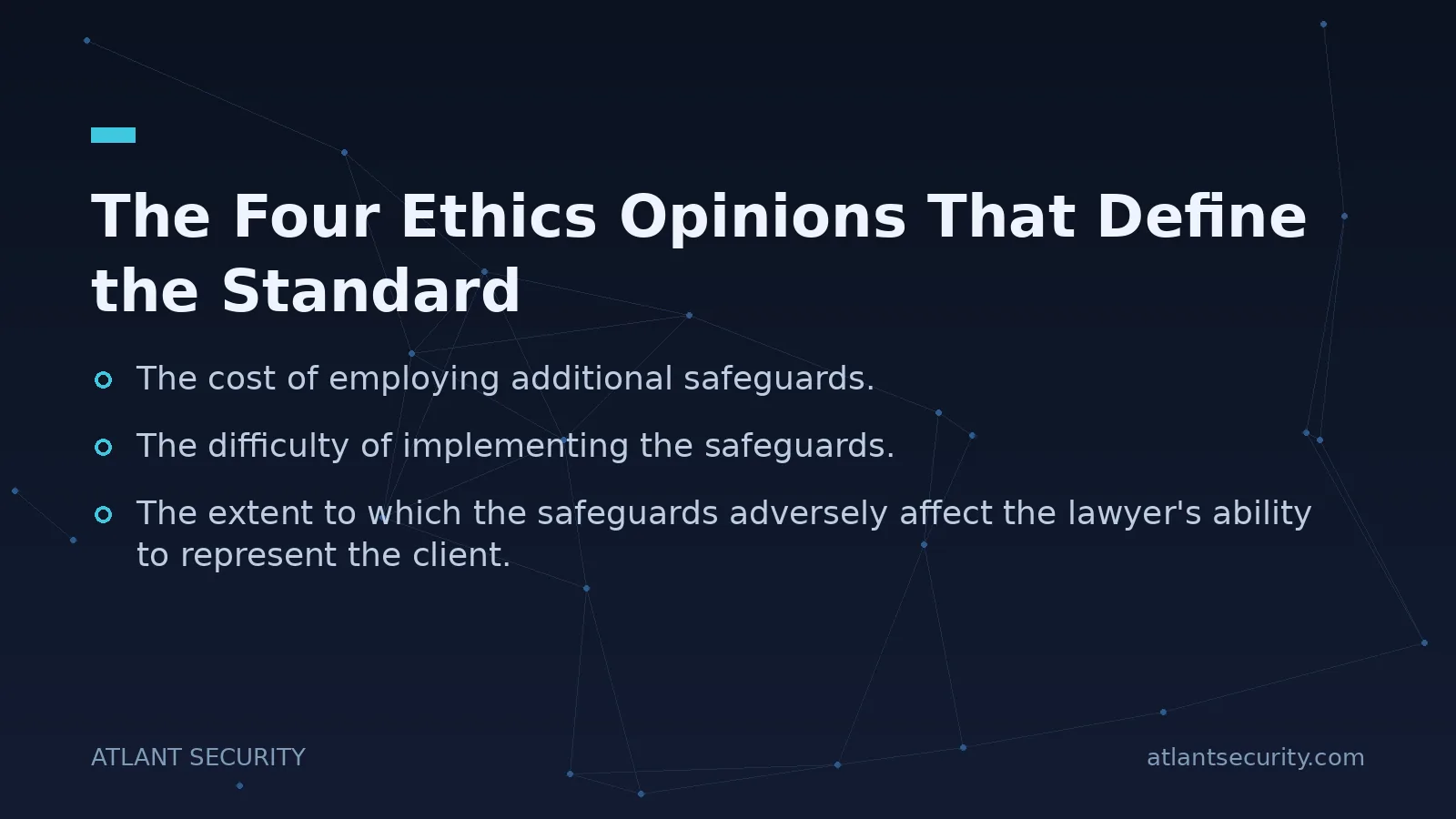
If "reasonable efforts" were left undefined, the rule would be unworkable. It is not left undefined. Comment [18] to Rule 1.6 supplies a five-factor test. It is the single most useful paragraph in the entire confidentiality rule for a practicing lawyer trying to decide how much security a given matter requires, and most attorneys have never read it. The comment tells you that whether a lawyer's efforts are reasonable is determined by weighing these factors:
- The sensitivity of the information. A routine scheduling email and a sealed settlement term sheet are not the same data. The duty scales with what is at stake if the information escapes. Trade secrets, merger terms, criminal exposure, custody allegations, immigration status, and health information all sit at the high-sensitivity end.
- The likelihood of disclosure if additional safeguards are not employed. How exposed is the information without the extra control? A document sitting only on an encrypted internal server is in a different posture from the same document attached to plain email crossing several mail servers.
- The cost of employing additional safeguards. The rule openly acknowledges that security costs money and that cost is a legitimate factor. It does not say cost is an excuse. It says cost is one weight on the scale. An inexpensive, high-impact control is hard to justify skipping.
- The difficulty of implementing the safeguards. A control that a small firm genuinely cannot operate is weighed differently from one that is a single setting in software the firm already owns. As tools get easier, this factor protects firms less and less.
- The extent to which the safeguards adversely affect the lawyer's ability to represent the client. Security that makes a device or system so cumbersome that the representation suffers is itself a problem. A control that blocks the lawyer from doing the work is not a reasonable control.
Read those five together and a structure appears. The first two factors push the duty up: more sensitive information and more exposure mean more is required. The last three pull it down: real cost, real difficulty, and real interference with the representation can justify a lighter touch. Reasonable efforts is the point where those forces balance for the matter in front of you.
Two practical consequences follow from reading the test honestly. First, the duty is matter-specific, not firm-specific. The same firm can correctly conclude that a routine letter goes by plain email and that a sealed settlement term sheet does not. Opinion 477R, discussed next, says this directly. Second, the cost and difficulty factors protect firms less every year. When a control was expensive and hard to run, the third and fourth factors carried real weight. When the same control is a free setting inside software the firm already pays for, those factors collapse, and skipping the control becomes very hard to defend. Multi-factor authentication is the clearest example. A decade ago a firm could argue it was burdensome. Today it is a checkbox, and a bar reviewer knows it.
Section Three
The Four Ethics Opinions That Define the Standard
Rule 1.6(c) is one sentence. The ABA Standing Committee on Ethics and Professional Responsibility has spent the years since the amendment turning that sentence into a usable standard through a series of Formal Opinions. Four of them, read together, are the working manual. A firm that has read all four and acted on them is in a fundamentally different position from a firm that has read none, regardless of how much each firm spends on software.
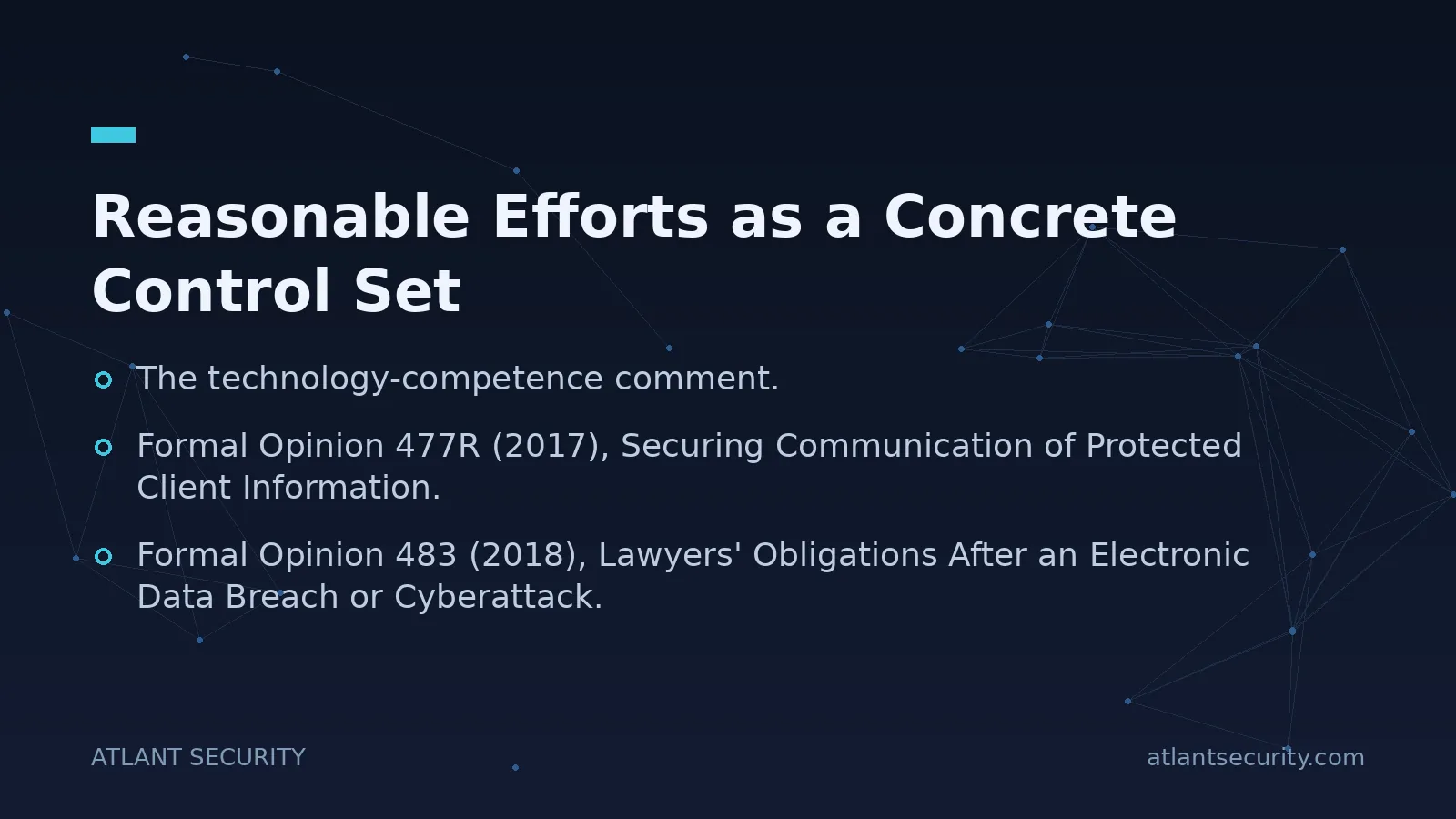
The technology-competence comment. Comment [8] to Rule 1.1 is where the obligation begins. It does not require a lawyer to become a technologist. It requires the lawyer to understand enough about the benefits and risks of the technology the practice depends on to make informed decisions, or to get help from someone who does. A partner who cannot say where the firm's client files are stored, who can reach them, or what happens if a laptop is lost has a competence gap, not just a security gap.
Formal Opinion 477R (2017), Securing Communication of Protected Client Information. This is the opinion that answers the encrypted-email question. Its conclusion is nuanced and worth stating precisely. A lawyer may, as a general matter, use unencrypted email for routine communications with a client. But the lawyer must assess, matter by matter, whether the sensitivity of the information and the circumstances of the transmission call for heightened security such as encryption. The opinion is the application of the Comment [18] factors to the specific act of sending a message. It also makes the obvious point that the analysis can change inside a single representation: an early scheduling email and a later transmission of sensitive discovery are not the same decision.
Formal Opinion 483 (2018), Lawyers' Obligations After an Electronic Data Breach or Cyberattack. This is the opinion most firms have never read, and it is the one most likely to surface in a disciplinary context, because it governs the moment when something has already gone wrong. Opinion 483 reads Rule 1.6 together with Rules 1.1, 1.4, 5.1, 5.3 and 1.15 and draws out a set of affirmative duties. A lawyer must act competently to monitor for a breach. When a breach is detected, the lawyer must act reasonably and promptly to stop it and to restore the affected systems. And the lawyer must notify current clients whose confidential information was or may have been compromised, with enough detail for the client to make informed decisions. Section Six walks through this in operational order.
Formal Opinion 498 (2021), Virtual Practice. Issued after the profession moved a large share of its work out of the office, this opinion applies the same duty to the home office, the personal laptop, the residential wireless network, the videoconference, and the always-listening smart speaker on the kitchen counter. Its message is that the duty travels with the work. A firm cannot meet Rule 1.6 inside the office and ignore it on the dining table where an associate now drafts pleadings three days a week.
Notice the supporting cast in Opinion 483: Rules 5.1 and 5.3. Rule 5.1 makes partners and supervising lawyers responsible for the conduct of other lawyers in the firm. Rule 5.3 extends that responsibility to nonlawyer assistants, and the ABA has made clear that "nonlawyer assistance" includes outside vendors such as cloud storage and practice-management providers. The duty cannot be delegated away by signing a contract with an IT company. A firm may, and usually should, hire that help. The firm remains responsible for choosing a competent vendor, understanding what the vendor does, and confirming that the arrangement protects client information. That is the through-line of all four authorities, and the next section turns it into a concrete control set.
Section Four
Reasonable Efforts as a Concrete Control Set
The rule does not name controls, and that is deliberate. Controls change; the standard of care does not. But "apply professional judgment" is cold comfort to a managing partner who wants to know what to actually do on Monday. The table below is the control set we would expect a competent firm to have in place, mapped to the rule it satisfies and the Comment [18] factor that makes skipping it hard to justify. None of these is exotic. Most are settings inside software the firm already pays for.
![The Reasonable-Efforts Test: Comment [18]'s Five Factors - key points](/images/blog/cards/aba-model-rule-1-6-cybersecurity-attorneys-2026/card-3.webp)
| Control | What it does for confidentiality | Why it is hard to skip |
|---|---|---|
| Multi-factor authentication on email and the document system | Stops a stolen or phished password from becoming full access to every client matter | Free in software you own. Cost and difficulty factors no longer protect you. |
| Full-disk encryption on every laptop, phone and tablet | A lost or stolen device becomes a hardware loss, not a confidentiality breach | Built into current operating systems. High likelihood of loss; low cost. |
| Encrypted or secure-portal delivery for sensitive transmissions | Implements Opinion 477R for high-sensitivity matters and large document sets | Directly named in an ABA opinion as the matter-specific safeguard. |
| Tested, off-network backups of all matter data | Lets the firm restore after ransomware without paying or losing client files | Opinion 483 expects the ability to restore systems after a breach. |
| Endpoint detection and response on every machine | Detects and contains an intrusion early, supporting the duty to monitor | Opinion 483's monitoring duty is hard to meet with legacy antivirus alone. |
| Email security with impersonation and link protection | Reduces the phishing and wire-fraud attacks that target law firms and trust accounts | Phishing is the modal entry point; Rule 1.15 covers client funds. |
| Access limits so staff see only the matters they work on | Contains the damage of any single compromised account or insider error | Supports the 5.1 and 5.3 supervision duties and conflict walls. |
| Vendor diligence and a data protection clause in vendor contracts | Confirms the cloud and practice-management providers meet the firm's duty | Rule 5.3 makes the firm responsible for vendor conduct. |
| A written information security policy and incident response plan | Turns ad hoc habits into a repeatable program and a reviewable record | A written program is the evidence a bar reviewer asks to see. |
| Annual staff training and phishing practice | Addresses the inadvertent-disclosure half of Rule 1.6(c) directly | Comment [8]'s competence duty reaches everyone the firm supervises. |
The point of the table is not the list. It is the third column.
Every control above was once expensive, hard, or both, which meant the cost and difficulty factors of Comment [18] genuinely protected a firm that went without it. That protection has eroded. Most of these controls are now included in the email and document subscriptions a firm already buys, or cost a few dollars per person per month. When a control is cheap and easy, factors three and four stop carrying weight, and the reasonable-efforts balance tips firmly toward "you should have done this." That shift, more than any single rule change, is why a firm that was defensible five years ago may not be defensible today without having done anything wrong. The standard of care moved.
A firm does not need to deploy all ten controls in a week, and it does not need the most expensive product in any category. It needs to be able to show, in writing, that it considered each one, decided what to do, and did it. A reasonable-efforts review is satisfied by a thoughtful, documented, implemented program. It is not satisfied by the most costly tools bought in a panic and left unconfigured.
Section Five
When the Duty Escalates: A Decision Tree
The baseline control set in Section Four is the floor. For some matters and some clients, the reasonable-efforts test points higher. Two questions decide whether a given matter calls for more than the baseline: how sensitive is the information, and has anything outside the rules raised the bar. The second question matters because client contracts and outside regulation frequently impose security obligations that are stricter than the ethics rules, and once a firm has agreed to them, they become part of the standard the firm is held to.
The external-obligation branch is the one firms underestimate. A growing share of corporate clients now send their outside counsel a set of outside counsel guidelines or a security addendum that specifies encryption, breach-notice timelines, access controls, and sometimes the right to audit the firm. When a firm signs that document, it has agreed to a standard, and a failure to meet it is both a contract breach and, very often, evidence in any later ethics analysis that the firm knew the matter called for more. Regulated client data behaves the same way. A firm holding protected health information for a healthcare client may be a business associate under HIPAA. A firm handling the personal data of European residents may sit within the reach of the GDPR. A firm advising on government contracts may inherit federal information-handling requirements. None of these replaces Rule 1.6. They stack on top of it, and the firm owes the strictest applicable standard.
The discipline that ties this section together is documentation. When a matter calls for heightened handling, a short note in the matter file recording the decision and its reason is worth far more than its two minutes of effort. It converts a judgment call into a defensible, contemporaneous record. If a question ever arises, the difference between "we thought about this and here is what we decided" and "we never considered it" is the difference between a closed inquiry and an open one.
Section Six
After a Breach: What Rule 1.6, Rule 1.4 and Opinion 483 Require
Rule 1.6(c) is about prevention. The moment prevention fails, a second body of duty takes over, and it is the part of the standard a firm is most likely to handle badly under pressure. Formal Opinion 483 is the operating manual for that moment. Its duties run in a sequence, and the sequence matters, because a firm that improvises will usually skip the step that later turns out to be the one the bar cared about. The timeline below is that sequence.
Monitor. Opinion 483 treats the ability to detect a breach as part of the ongoing duty, not as something a firm thinks about afterward. A firm that has no way to know whether it has been breached cannot meet the later steps, because it never starts the clock. This is the ethics-rule basis for endpoint detection and for keeping and reviewing logs.
Stop and contain. Once a breach is detected, the firm must act reasonably and promptly to halt it. In practice this means isolating affected machines, disabling compromised accounts, and resisting the strong temptation to wipe and rebuild before anyone has recorded what happened. Containment and evidence preservation are not in tension if the firm has decided in advance how to do both.
Investigate and restore. The firm must make a reasonable effort to determine what information was affected and which clients are implicated, and then restore operations from trusted backups. This is where the backup control from Section Four stops being a line item and becomes the thing that decides whether the firm recovers in days or negotiates with criminals. A firm that cannot restore has a confidentiality problem and an availability problem at the same time.
Notify affected current clients. This is the step that firms most want to skip and least can. Opinion 483 concludes that when a breach involves, or substantially likely involves, the confidential information of a current client, the lawyer has a duty under Rule 1.4 to inform that client. The notice must carry enough information for the client to make an informed decision about the representation and about protecting its own interests. The opinion is more cautious about a firm's duty to former clients, leaving more of that to other law, but it is clear about current clients in active matters.
The ethics duty is not the only clock running
All fifty states have data-breach notification statutes with their own definitions and deadlines. A client contract may set a shorter notice window than any statute. A regulatory regime such as HIPAA or the GDPR adds another. Opinion 483 addresses the professional-responsibility layer only. A firm responding to a real breach is managing several legal obligations at once, on different timelines, and the worst moment to discover that is mid-incident. This is the single strongest argument for writing the incident response plan now, while nobody is panicking, and rehearsing it once a year.
There is one more reason to plan the breach response before it is needed. A firm that handles a breach competently, contains it quickly, restores from backups, and notifies clients candidly will usually keep those clients and close any bar inquiry without a finding. A firm that hides the breach, delays notice, or cannot say what happened converts a security incident into an ethics case. The breach is rarely the thing that ends a firm. The cover-up, the silence, or the visible absence of any plan is.
Section Seven
Five Mistakes, and the 90-Day Path to a Defensible Position
Across the law firm engagements we have run, the same five misconceptions show up again and again. Each one feels reasonable from inside the firm and looks indefensible from the outside.
1. "Cybersecurity is the IT vendor's job."
Rules 5.1 and 5.3 say otherwise. A firm may hire help, and usually should, but the duty stays with the lawyers. Hiring a vendor without understanding what the vendor does, or what it does not do, leaves the obligation unmet and the firm unaware of it.
2. "We are too small to be a target."
Attackers do not select law firms by prestige. They select by access and by weak controls. A small firm holds settlement funds, merger terms, and personal data, and frequently runs lighter defenses than the corporations it advises. Size is not cover. It is often the reason a firm is chosen.
3. "We bought the tools, so we are covered."
A reasonable-efforts review looks at what is configured, operated, and documented, not at what is licensed. An unconfigured security product is a receipt, not a control. The firm with three well-run basics outscores the firm with ten tools nobody turned on.
4. "There is nothing in writing, but we know what we do."
An undocumented program cannot be reviewed, supervised, or proven. When a client, an insurer, or a bar reviewer asks what the firm does, an honest "we have habits but no policy" reads as no program at all. The written record is the asset.
5. "We will deal with a breach if one happens."
Opinion 483 makes monitoring and a response capability part of the standing duty, not an afterthought. A plan written calmly in advance and rehearsed once a year is the difference between a contained incident and an ethics case. Improvisation during an active breach is the most expensive way to learn the sequence.
The correction for all five is the same: a deliberate, written, implemented program built in a sensible order. For a small-to-midsize firm starting from a low baseline, ninety days is enough.
The total cost of this path for a firm of ten to forty attorneys is modest, often a small fraction of a single malpractice deductible, and a large part of it is configuration of software the firm already owns rather than new spending. What the ninety days produces is two things at once: a genuine reduction in the risk of the incident that would actually hurt the firm, and the contemporaneous written record that converts a future bar inquiry, malpractice question, or client security review from an open-ended investigation into a short, closed file. That second asset is the one firms forget to value until the day they need it.
Section Eight
What Rule 5.3 Diligence Should Ask a Legal Technology Vendor
Section Four listed vendor diligence as one control among ten. It earns its own treatment, because the practice management platform, the document system, the e-discovery tool and the client portal between them now hold more privileged material than the firm's own servers do, and Rule 5.3 leaves the responsibility where it started.
The economics are worth stating plainly. One legal technology platform may hold matters for dozens or hundreds of firms. Compromising it once reaches all of them, which makes the vendor a more attractive target than any single firm on it. A firm that assesses its own perimeter carefully and never assesses its vendors has measured the smaller half of its exposure.
Four questions separate a serious vendor from a confident one:
- Can you show that one tenant cannot reach another's data? The incidents that damage legal platforms are rarely exotic. They are insecure direct object references and missing server-side authorization checks, where changing a document identifier in a request returns someone else's file. Ask how tenant context is enforced, and how that enforcement is tested.
- What exactly is encrypted? The database usually is. Search indexes, temporary files, log files and backup snapshots frequently are not, and each of those is a working copy of the material the firm is obliged to protect. Ask whether client-managed keys are available for the most sensitive matters.
- Can the platform show who opened which matter and when, in a log nobody can quietly edit? A firm cannot evidence its own access controls if the vendor's audit trail is coarse or mutable.
- Where does privileged content go when an AI feature touches it? Ask which model processes it, whether the content leaves the vendor's environment, what the retention and training terms say, and how one firm's material is isolated from another's inside that pipeline. Get the answer in the contract rather than the sales call.
Then ask for the artifacts: the current SOC 2 report, a penetration test summary, the data processing agreement with its breach-notification timetable, the sub-processor list, and confirmation that matter-level access controls and legal-hold retention are supported. A vendor that produces these without friction is one the firm can defend having chosen. A vendor that cannot is a Rule 5.3 problem the firm will end up owning alone.
Frequently Asked
FAQ
Is a data breach automatically a violation of Rule 1.6?
No. Rule 1.6(c) requires reasonable efforts, not a guaranteed result. A firm that took the precautions a competent lawyer would have taken and was still breached has not violated the rule by being breached. The violation arises from failing to make reasonable efforts beforehand, or from mishandling the response afterward under Formal Opinion 483. A bar reviewer asks what the firm had done before the incident and how it responded, not simply whether an incident occurred.
Does Rule 1.6 require me to encrypt all client email?
Not categorically. ABA Formal Opinion 477R concluded that a lawyer may generally use unencrypted email for routine client communication, but must assess each matter and use heightened security such as encryption when the sensitivity of the information and the circumstances of transmission call for it. The decision is matter-specific. A routine scheduling note and a sealed settlement term sheet are not the same call, and the same firm can correctly answer the question differently for each.
If I outsource IT to a managed provider, have I met the duty?
Hiring competent help is sensible and often necessary, but it does not transfer the obligation. Rule 5.3 makes the firm responsible for the conduct of nonlawyer assistance, which the ABA has confirmed includes outside vendors such as cloud and practice-management providers. The firm must still exercise diligence in choosing the vendor, understand what the vendor does and does not cover, and confirm that client information is protected. The duty is delegated in execution, never in responsibility.
Does Rule 1.6 require me to tell a client about a breach?
Formal Opinion 483 concludes that when a breach involves, or is substantially likely to involve, the confidential information of a current client, the lawyer has a duty under Rule 1.4 to notify that client with enough detail to make informed decisions. The opinion is more cautious about former clients, leaving more of that question to other law. Separately, all fifty states have data-breach notification statutes, and client contracts and regulations such as HIPAA or the GDPR can impose their own notice obligations with their own deadlines. The ethics duty is one of several clocks, not the only one.
We are a four-lawyer firm. Does the duty really apply to us?
Yes. Rule 1.6 makes no exception for firm size, and Comment [18]'s factors turn on the sensitivity of the information and the cost and difficulty of safeguards, not on headcount. The cost and difficulty factors do give a very small firm room on the most demanding controls, but they give no cover at all on the inexpensive, high-impact basics: multi-factor authentication, device encryption, tested backups, and a written plan. Those are well within reach of a four-lawyer firm, and skipping them is hard to defend precisely because they are cheap and easy.
Are these obligations the same in every state?
The ABA Model Rules are a template; each jurisdiction adopts its own rules of professional conduct and issues its own ethics opinions. On the confidentiality-and-technology question the states have been notably consistent: the substance of Rule 1.6(c) is widely adopted, and the duty of technology competence from Comment [8] to Rule 1.1 has been adopted by a large majority of states. Some state bars have issued their own opinions that go further than the ABA on specific points. Treat the Model Rules as the map and confirm the details against your own jurisdiction's rules and opinions.
A reasonable-efforts review for your firm
Turn Rule 1.6 from an open question into a closed file.
We run fixed-fee security reviews for law firms against the exact standard in this article: the Comment [18] factors, the four ABA opinions, and the control set a bar reviewer or a malpractice carrier expects to see. You get a written assessment, a prioritized 90-day plan, and the documented record that proves reasonable efforts. If your firm is already in good shape, we will tell you that on the call.